Science / Grade 7
Watts and joules
Learning goal: Convert milliamps to amps, calculate steady resistor power, and distinguish energy over an interval from an energy-transfer rate.
Before you start: Multiply decimals, divide by 1000, and distinguish voltage across a resistor from current through it. Reading or calculator support is welcome.
Read or print this lesson What to practiceThe video could not load. The transcript is still available below.
Next: your worksheet
Watts: Energy Each Second
Checking sign-in...
Read the transcript
Saved reading place
Video transcript and practice. Reading or printing does not count as playback time or an assessed grade.
1. Rate or total?
Video: 0:00
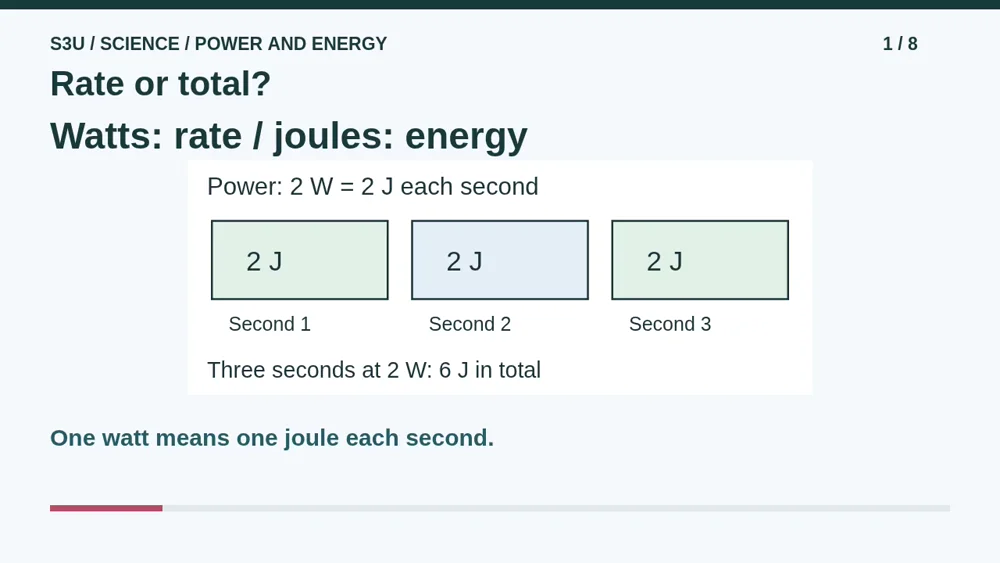
Watts and joules are not rival science teams. They answer different questions. Power tells us how quickly energy is transferred. Energy tells us how much is transferred over an interval. One watt means one joule each second. We will use steady ideal resistor models, not build anything. A model number does not tell us a real component temperature or whether a physical circuit is safe.
2. First, check the current unit
Video: 0:30
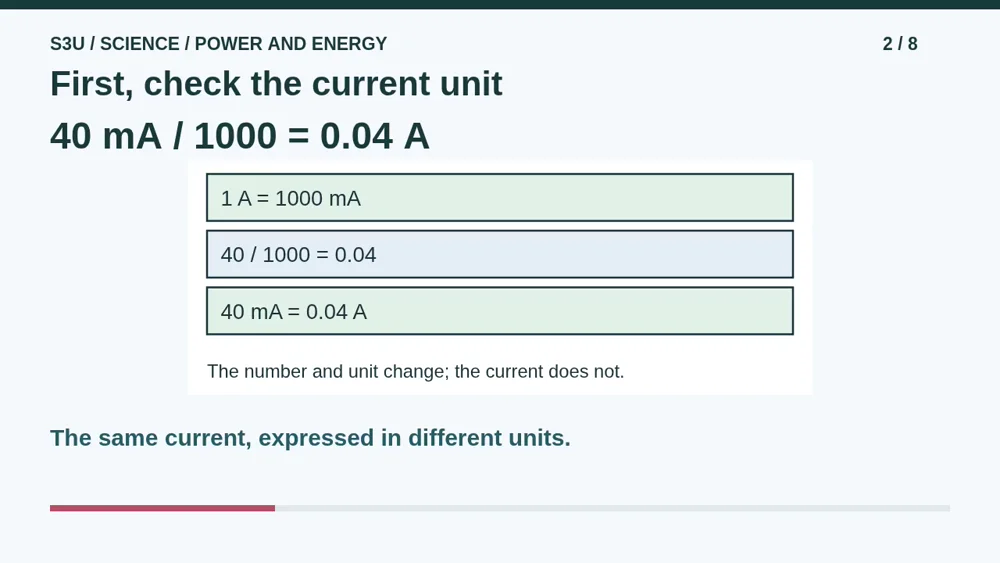
Our first model carries forty milliamps. There are one thousand milliamps in one ampere, so divide forty by one thousand. That gives zero point zero four amperes, often called amps. The current did not shrink. Only the number and its unit changed. Keep the unit beside the number. A calculator will happily multiply the wrong numbers for us. It does not check our science homework!
3. Multiply volts by amps
Video: 1:01
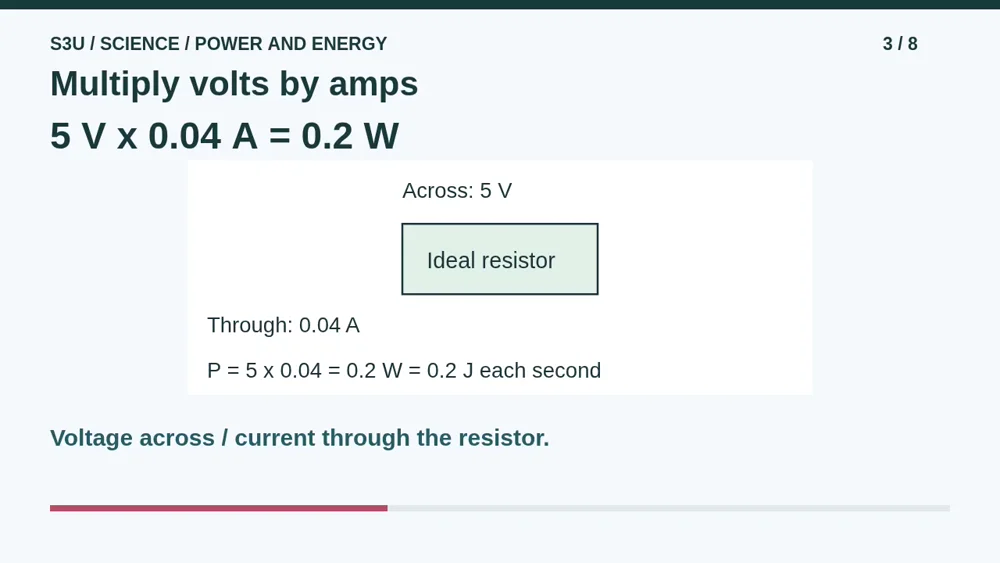
The model resistor has five volts across it and zero point zero four amps through it. Power equals voltage times current. Five times zero point zero four is zero point two watts. That means zero point two joules transferred each second. Multiplying five by forty would not give watts because forty was measured in milliamps. Convert first, then multiply. Voltage is across the resistor; current is through it.
4. Give the rate an interval
Video: 1:34
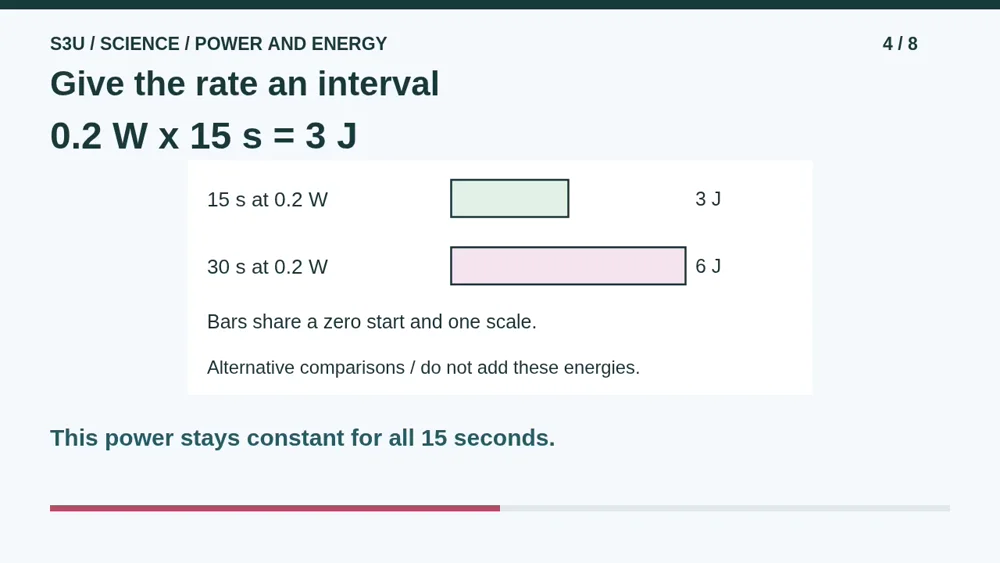
Let that same model state last fifteen seconds. Energy equals constant power times duration. Zero point two watts times fifteen seconds gives three joules. Notice which quantity needed the time: energy, not power. For thirty seconds at the same power, energy would be six joules. These are alternative comparisons, not two successive parts of one run. We do not add them unless a problem says both intervals happened one after the other.
5. Pause: a new model
Video: 2:08
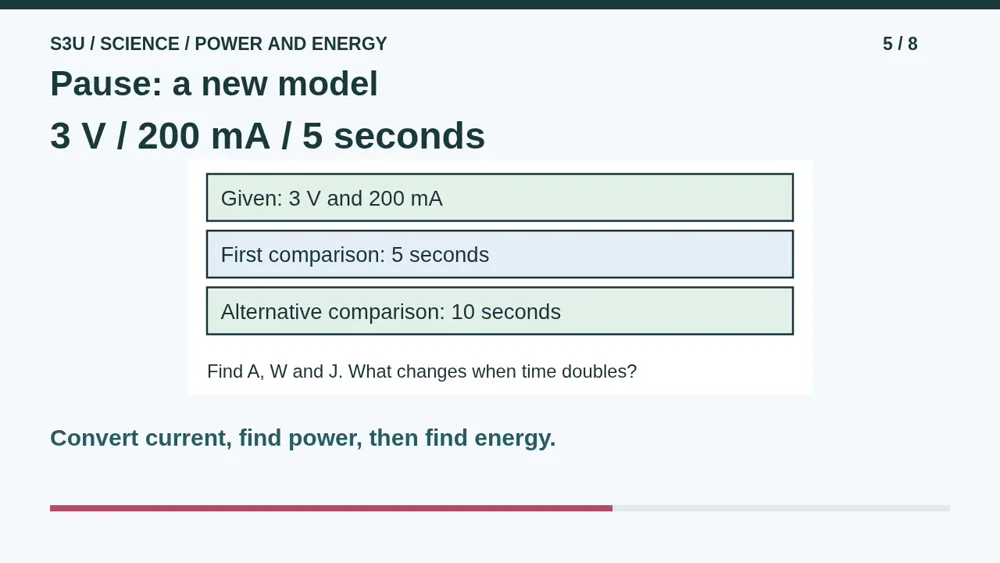
Pause and try a fresh model. A resistor has three volts across it and two hundred milliamps through it. Those values stay constant for five seconds. What is the current in amps? What is the power in watts, and how much energy is transferred? Then imagine ten seconds instead, without changing voltage or current. Which quantities change? Explain your reasoning aloud or on paper before continuing. No real equipment or waiting is needed.
6. Check the units and interval
Video: 2:43
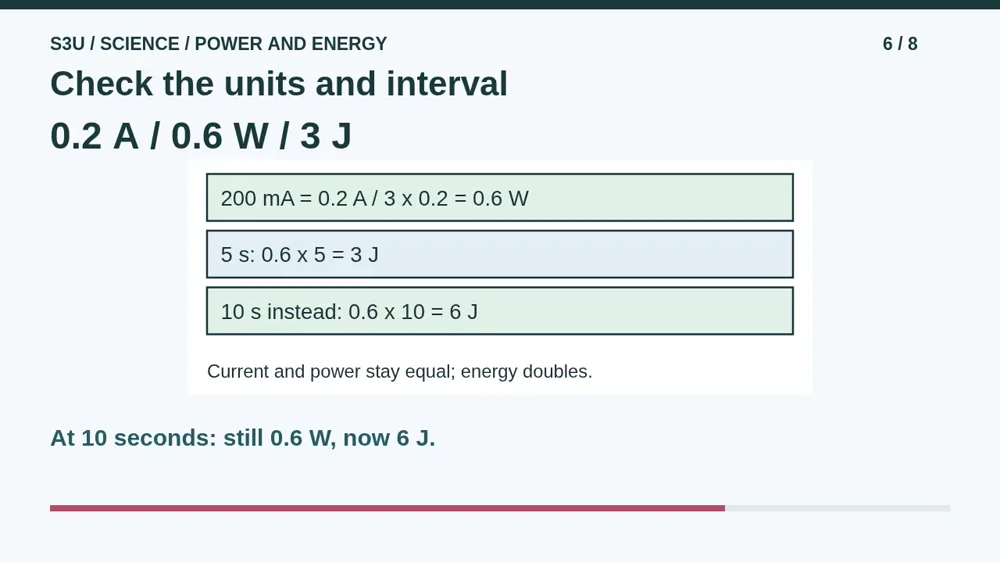
Two hundred divided by one thousand is zero point two amps. Three volts times zero point two amps is zero point six watts. Over five seconds, zero point six times five is three joules. Over ten seconds instead, the energy is six joules. Current and power stay the same. More time gave more transferred energy, not more power. If you wrote six watts for the longer comparison, revisit which unit describes a rate.
7. Different rates, equal energy
Video: 3:16
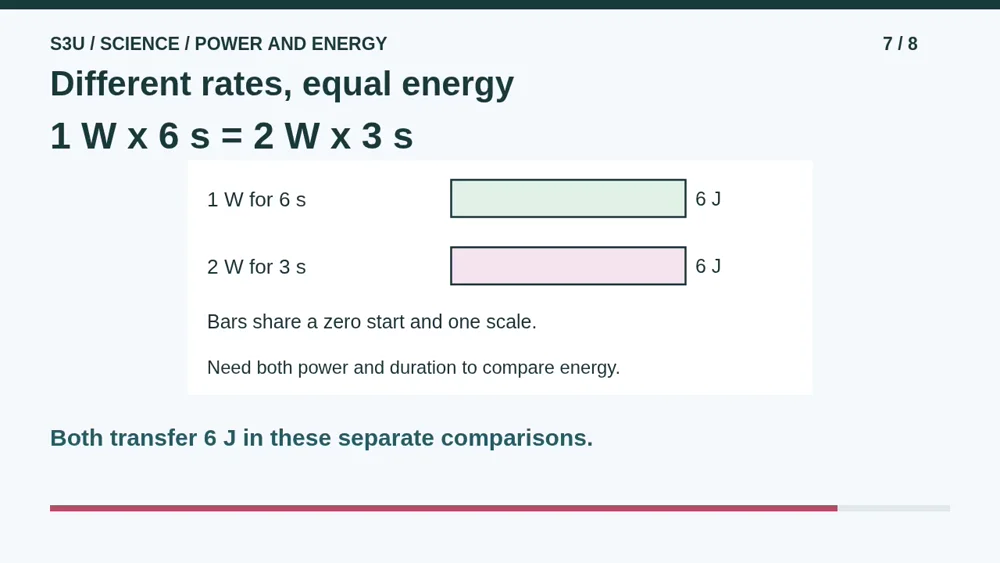
Fun fact: different powers can transfer the same energy over different times. One watt for six seconds transfers six joules. Two watts for three seconds also transfers six joules. The faster rate had less time. You cannot decide total energy from the watt reading alone. Nor can six joules alone tell us a temperature: materials, mass and heat transfer also matter. These comparisons do not certify a real circuit.
8. Continue to the worksheet
Video: 3:49
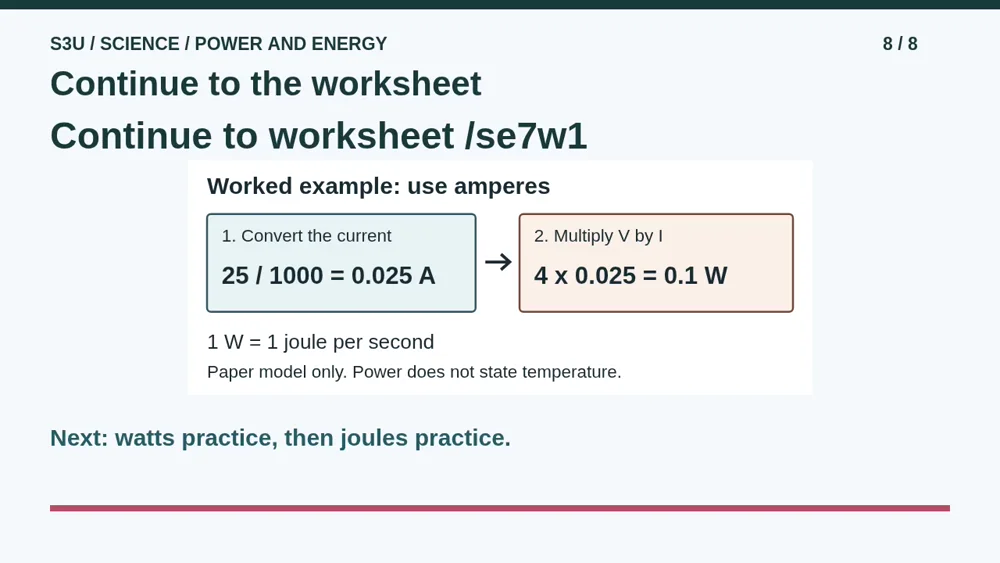
Continue to the watts worksheet below. Read its different worked example, convert milliamps to amps, and explain each answer. Then follow its next link for joules practice. You can print either worksheet or answer on screen. Circuit Bench also lets you compare power and pretend intervals. Its model seconds are not your learning time. Keep the central question with you: am I describing an energy transfer rate, or energy over a stated interval?
Show your understanding
You can point, explain aloud, draw or write.
- Convert mA to A before using P = VI, and describe a watt as a joule per second.
- Use constant-power E = Pt to compare alternative intervals without changing power or adding intervals that did not happen successively.
Try it yourself
Pause at the 3 V, 200 mA model. Find current, power and energy for five seconds, then compare ten seconds instead.
Continue to watts practice, then follow the link to joules practice. Explain which quantities change; no real circuit or waiting is required.
Next: your worksheet
Watts: Energy Each Secondhttps://s3u.com/se7w1
Compare power and energy in Circuit Bench
Next worksheet: joules over an interval · Continue to Compare resistor power
Lesson: https://s3u.com/lessons/watts-and-joules