Science / Grade 8
Compare resistor power
Learning goal: Compare equal-current series resistors and equal-voltage parallel branches, then combine successive interval energies and calculate average power.
Before you start: Use volts, amperes, watts and joules; multiply decimals and divide whole numbers. Review Watts and joules before comparing ideal series and parallel resistors.
Read or print this lesson What to practiceThe video could not load. The transcript is still available below.
Next: your worksheet
Resistor Power: What Stays Equal?
Checking sign-in...
Read the transcript
Saved reading place
Video transcript and practice. Reading or printing does not count as playback time or an assessed grade.
1. Same parts, different comparison
Video: 0:00
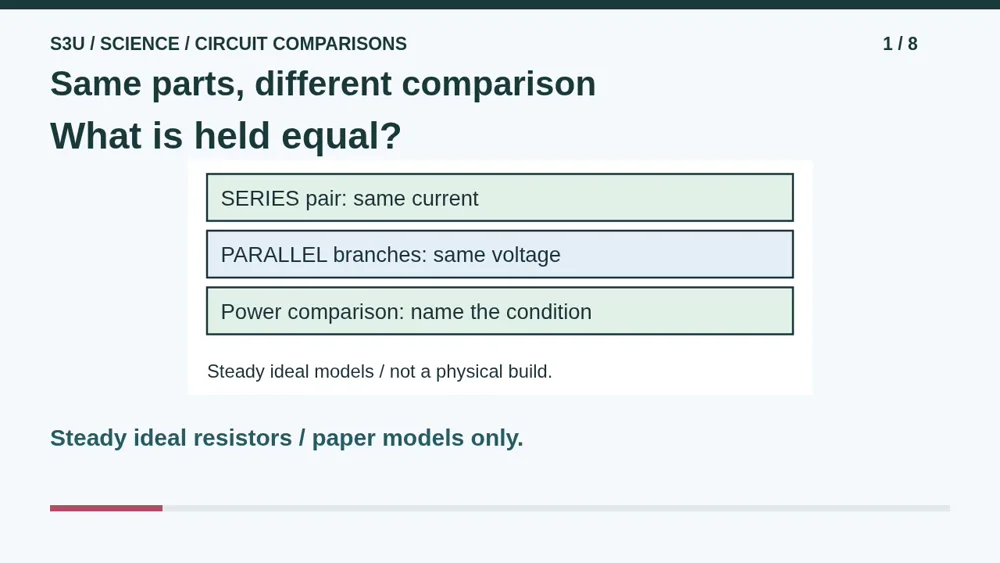
Which resistor has more power? Before choosing, ask what stays equal. A larger resistance can mean more power in one comparison and less in another. The resistors have not changed their minds. The comparison changed! We will distinguish series current from parallel voltage, then add energy over separate intervals. Use paper models only. Review volts, amps, watts and joules first; these numbers are not permission to build a physical circuit.
2. Series: shared current
Video: 0:36
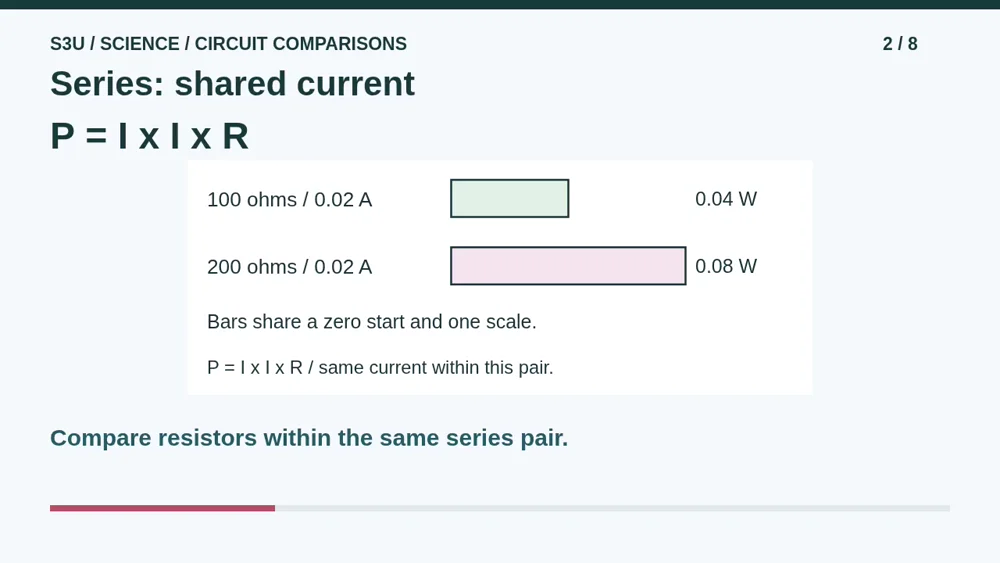
In a closed series path, the same steady current passes through both resistors. Suppose it is zero point zero two amps. For one hundred ohms, power is zero point zero two times zero point zero two times one hundred: zero point zero four watts. For two hundred ohms, it is zero point zero eight watts. At this equal current, the larger resistance has more power. This compares the two resistors within one pair, not every possible change to a source.
3. Parallel: shared voltage
Video: 1:11
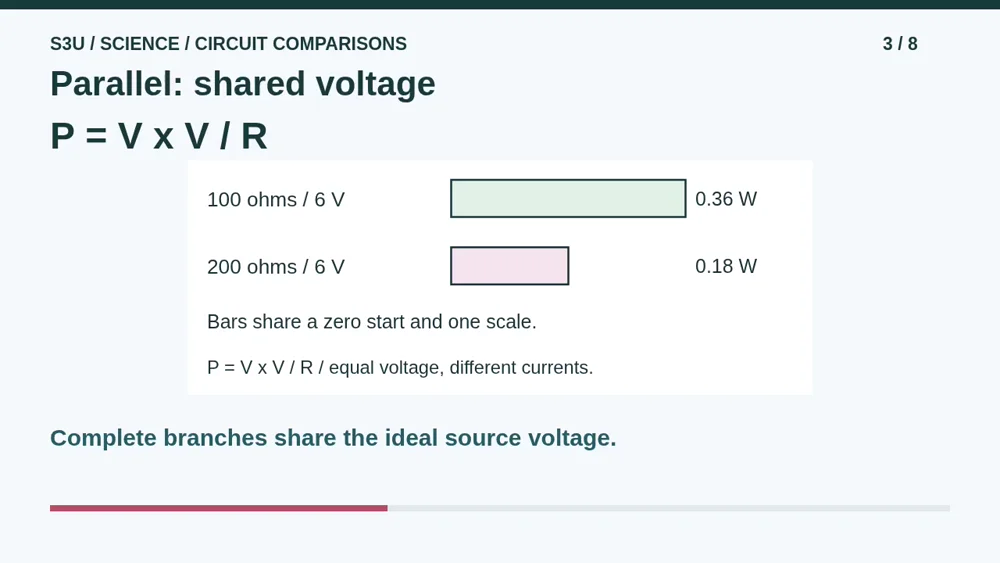
Now compare complete parallel branches across an ideal six volt source. Each resistor has six volts across it. For one hundred ohms, six times six divided by one hundred gives zero point three six watts. For two hundred ohms, it gives zero point one eight watts. At equal voltage, the smaller resistance has more power. Our earlier equal current rule does not apply here. The current is different in the two branches.
4. One run, two intervals
Video: 1:44
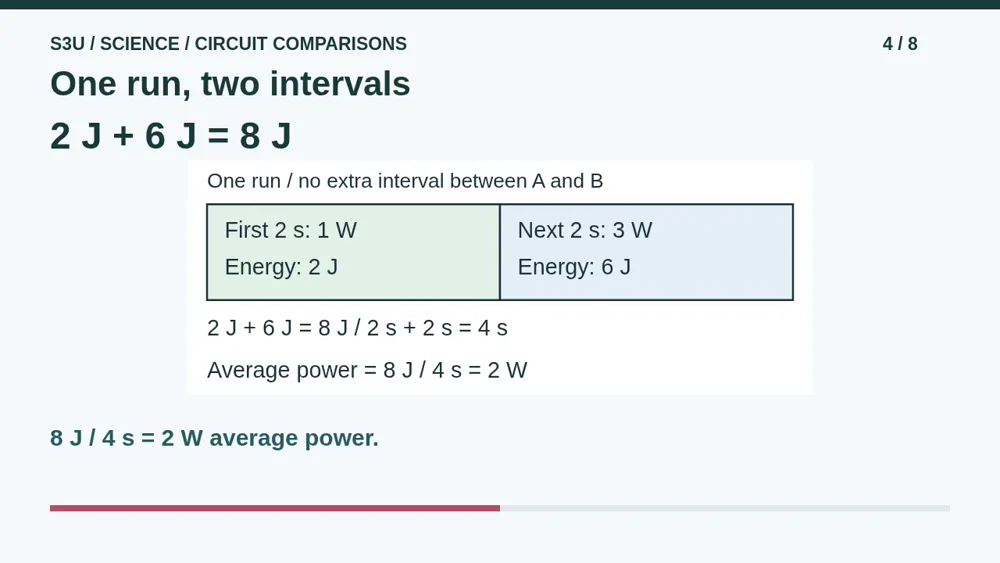
A different model runs at one watt for two seconds, then three watts for two seconds. The first interval transfers two joules. The next transfers six joules. Because they happen one after the other, add their energies: eight joules over four seconds. Average power for the whole run is eight divided by four, or two watts. Adding the interval powers to get four watts is not a time average. Boundaries and durations matter.
5. Pause: compare and combine
Video: 2:16
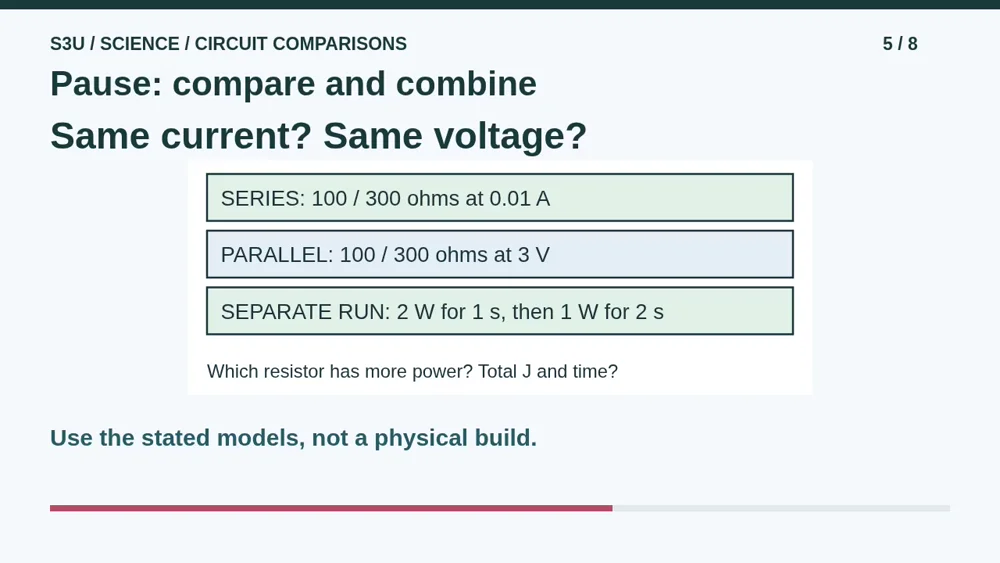
Pause for three checks. First, a series pair has one hundred and three hundred ohms, both carrying zero point zero one amps. Which resistor has more power? Next, compare those resistances in parallel across three volts. Which has more power now? Finally, a separate model runs at two watts for one second, then one watt for two seconds. Find total energy and total time. Work through the conditions before continuing.
6. Check each condition
Video: 2:50
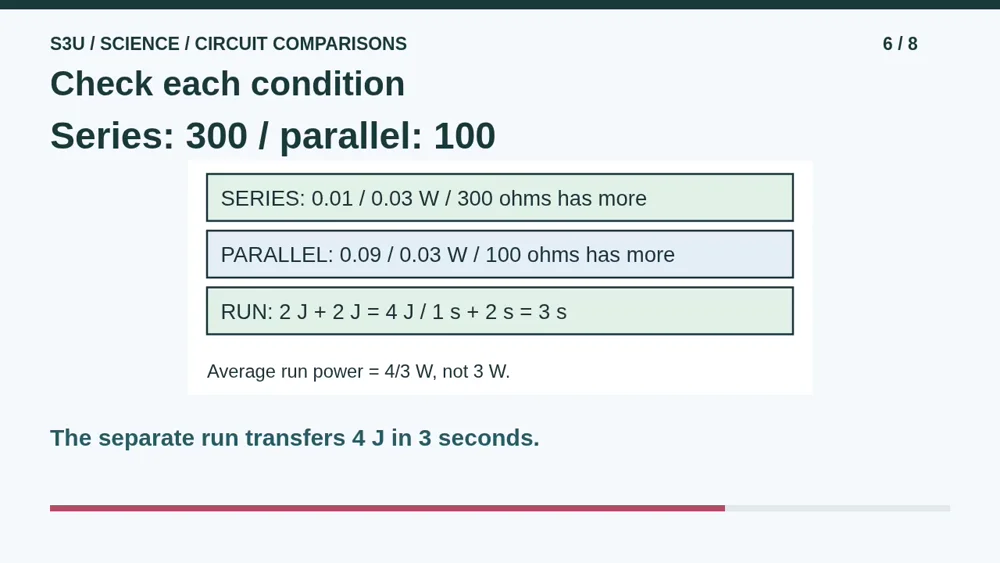
In the series pair, the powers are zero point zero one and zero point zero three watts, so three hundred ohms has more. In parallel, nine divided by one hundred gives zero point zero nine watts; nine divided by three hundred gives zero point zero three watts. One hundred ohms now has more. The separate run transfers two joules plus two joules, or four joules over three seconds. Its average power is four thirds of a watt, not three watts.
7. There is no universal winner
Video: 3:24
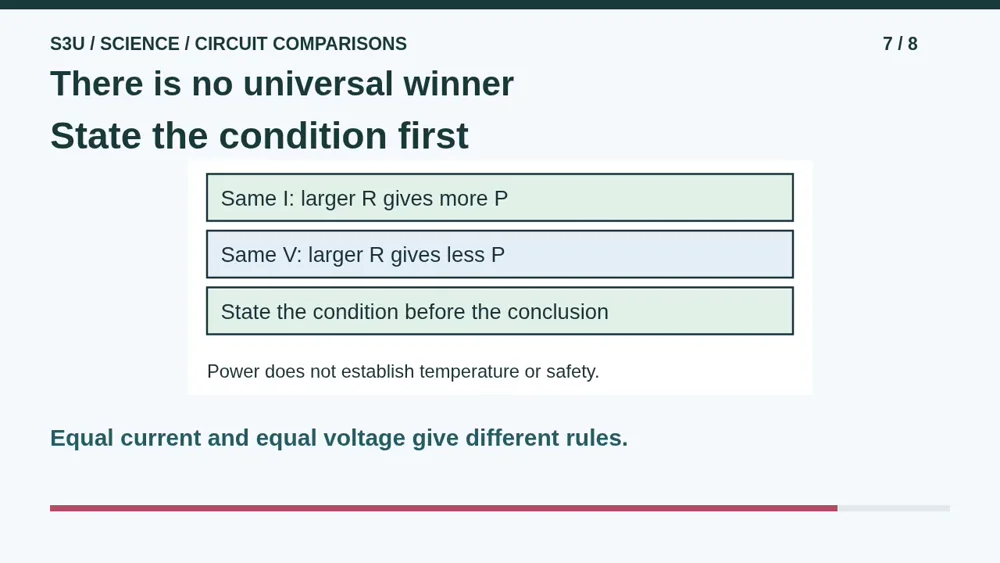
Fun fact: a larger ideal resistor can dissipate more power at equal current, but less at equal voltage. A statement such as bigger resistance always means less power leaves out the condition. Use the equation that matches the comparison and keep the units. Also keep average power distinct from the power during each interval. None of these values alone predicts a real temperature, component rating or safe physical build.
8. Continue to the worksheet
Video: 3:56
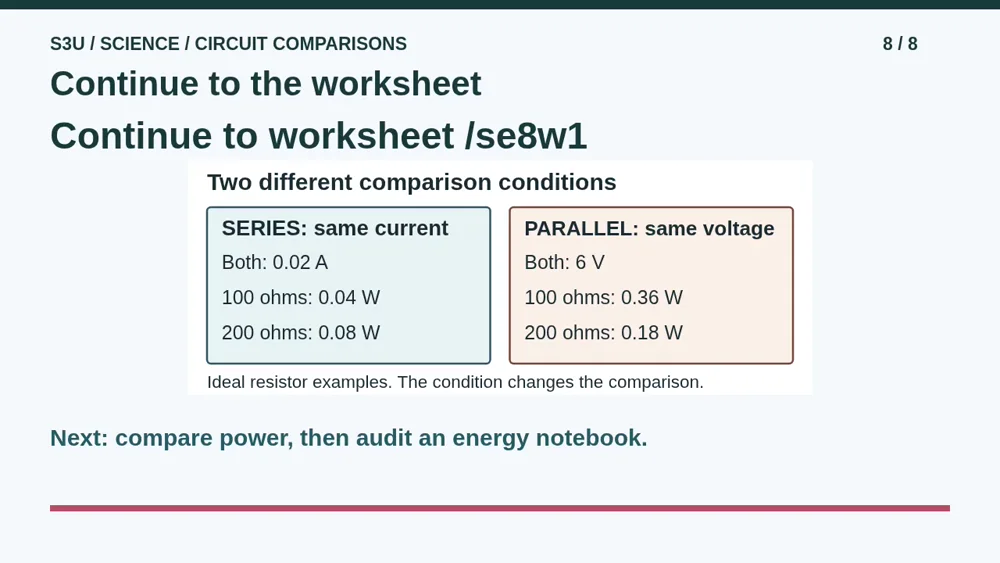
Continue to the resistor power worksheet below. It uses new current and voltage values, so calculate rather than copy the lesson answers. Then follow the link to Check the Energy Notebook for a two interval record and average power. You may point, speak, dictate or write your reasoning. Circuit Bench offers further guided comparisons. A useful explanation names what stays equal, uses the correct units, and separates a model result from a claim about real equipment.
Show your understanding
You can point, explain aloud, draw or write.
- Explain why larger resistance gives more power at equal current but less power at equal voltage, using the stated model values.
- Add energies and durations for successive intervals, then calculate average power without adding interval powers or inferring real temperatures.
Try it yourself
Pause at the 100/300-ohm comparisons. Identify what stays equal, then calculate total energy and duration for the separate two-interval run.
Continue to resistor power practice and the energy notebook. Keep model results separate from physical temperature or safety claims.
Next: your worksheet
Resistor Power: What Stays Equal?https://s3u.com/se8w1
Compare power and energy in Circuit Bench
Next worksheet: check an energy notebook · Review Watts and joules
Lesson: https://s3u.com/lessons/compare-resistor-power