Math / Grade 9
Close the period, keep the records
Learning goal: Work through four closing steps, transfer a profit or loss correctly and check what carries forward without moving cash twice.
Before you start: Read debit and credit balances and add signed amounts. Every account, amount, side and fresh-case question is spoken. Pause to write entries or replay the balances; no diagram or real financial record is needed.
Read or print this lesson What to practice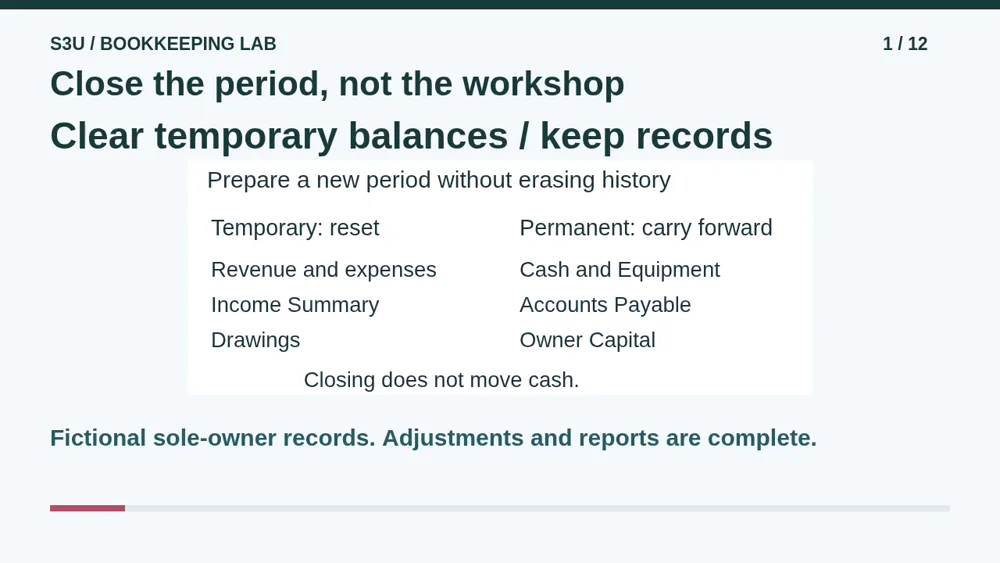
Audio and video share one lesson record. Keep this page open while listening.
Download audio Downloads do not save lesson progress.
The audio could not load. The transcript is still available below.
Next: your worksheet
Close a Profitable Period
Checking sign-in...
Read the transcript
Saved reading place
Audio transcript and practice. Reading or printing does not count as playback time or an assessed grade.
1. Close the period, not the workshop
Audio: 0:00
Closing the books does not mean locking the door and sending the cash box on vacation. It means preparing selected accounts for a new period. We will close revenue, expenses, Income Summary and Drawings. Cash, equipment and money owed continue into the next period. Our workshop has one owner, so we use Owner Capital, not a corporation's retained earnings. All adjustments and financial statements are already complete. The dollars and records are invented, and this simplified practice is not financial advice.
2. Read the adjusted balances first
Audio: 0:39
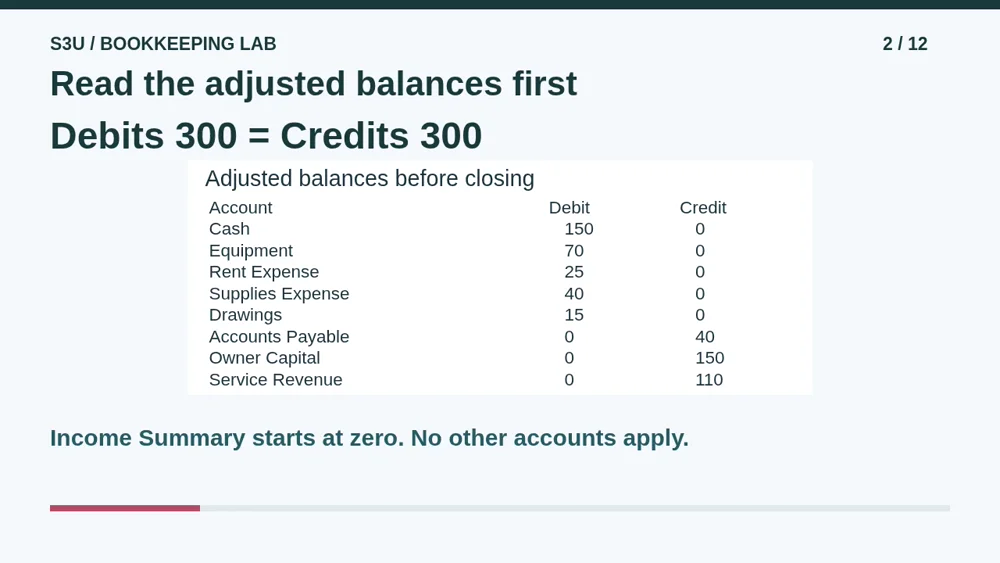
Start with these adjusted balances. Debits are Cash one hundred fifty, Equipment seventy, Rent Expense twenty-five, Supplies Expense forty, and Drawings fifteen. Credits are Accounts Payable forty, Owner Capital one hundred fifty, and Service Revenue one hundred ten. Each column totals three hundred. Income Summary starts at zero. These are the only accounts. Drawings records money the owner already took out, so we must not pay it again. Debit means the left side and credit means the right side; neither word simply means good or bad.
3. Step one: close revenue
Audio: 1:21
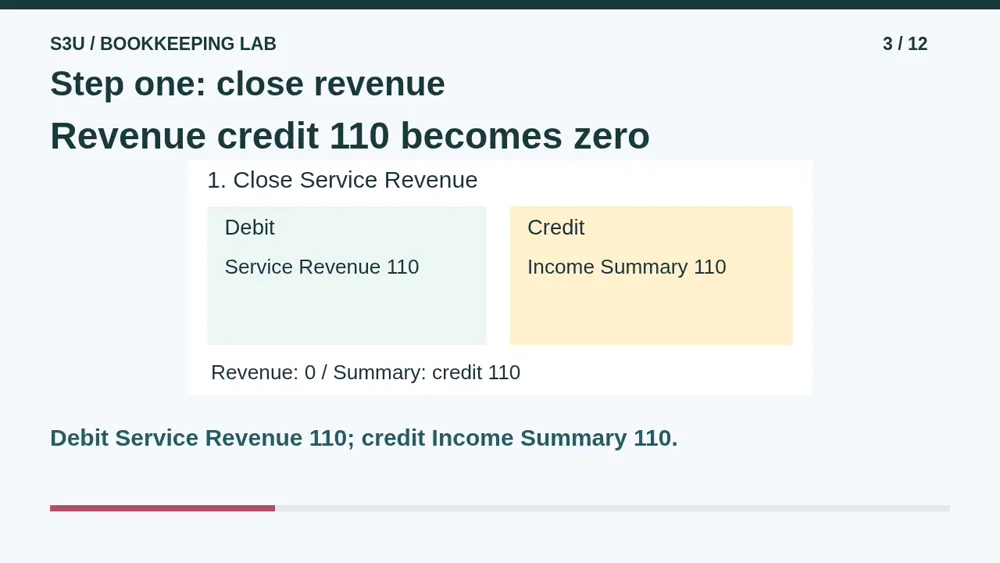
First, close Service Revenue. It has a credit balance of one hundred ten. Put an equal debit of one hundred ten in Service Revenue, and a credit of one hundred ten in Income Summary. The entry balances. The opposite debit cancels the revenue balance, leaving zero ready for the next period. Income Summary now has a credit balance of one hundred ten. No cash moves. We added a closing entry; we did not delete the original services or their history.
4. Step two: close expenses
Audio: 1:58
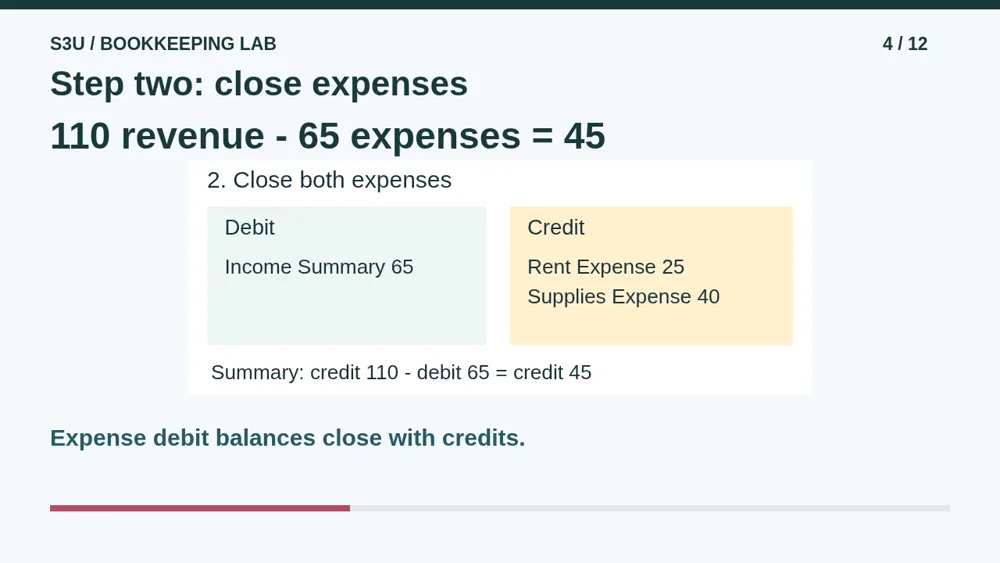
Next, close the expense accounts. Rent has a debit balance of twenty-five and Supplies Expense has a debit balance of forty. Credit Rent Expense twenty-five and Supplies Expense forty. Debit Income Summary by their combined sixty-five. Both expenses are now zero. Income Summary has credits of one hundred ten and debits of sixty-five, leaving a credit balance of forty-five. That is the period profit. Closing does not pay rent or buy supplies again. It transfers the already recorded balances.
5. Step three: transfer the profit
Audio: 2:39
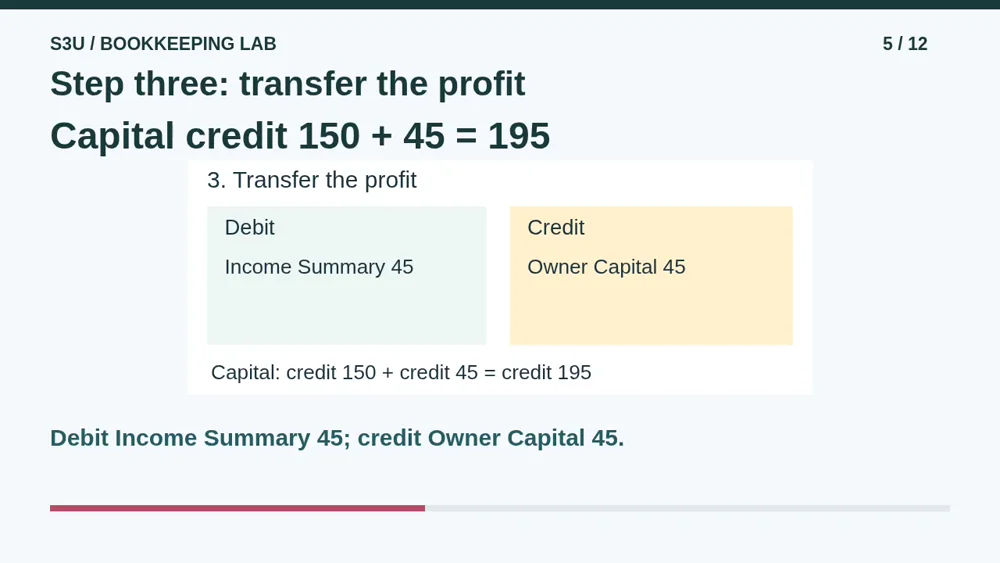
Income Summary now holds a credit balance of forty-five. To close it, debit Income Summary forty-five and credit Owner Capital forty-five. Income Summary returns to zero, and the capital credit balance rises from one hundred fifty to one hundred ninety-five. This is how this model transfers the period profit to the owner's capital. The profit was earned earlier; this is not another sale and not another cash receipt. Do not add the same profit a second time.
6. Step four: close drawings separately
Audio: 3:15
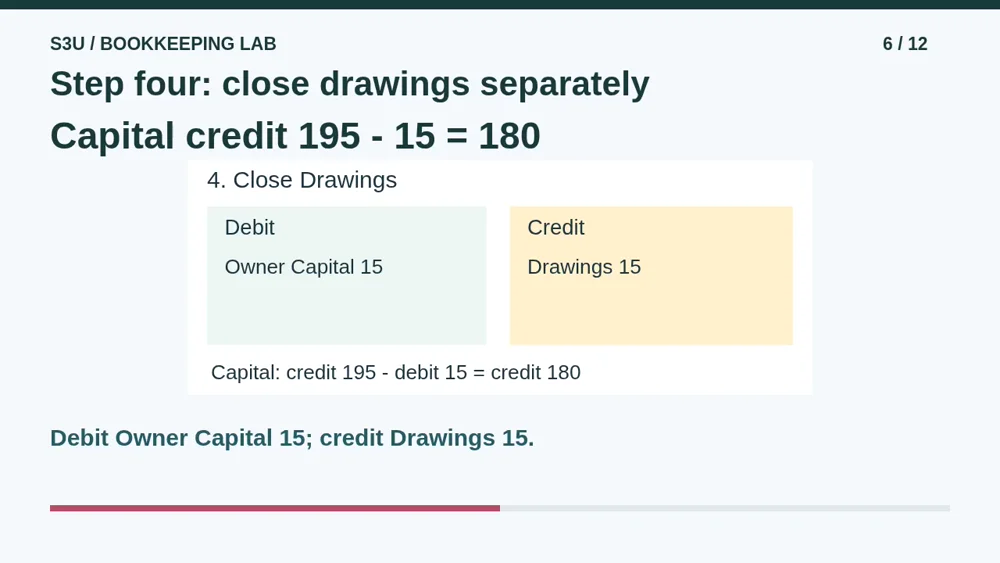
Finally, close Drawings. Its debit balance is fifteen. Credit Drawings fifteen to clear it, and debit Owner Capital fifteen. Capital falls from a credit of one hundred ninety-five to a credit of one hundred eighty. Drawings is not an operating expense, so it does not pass through Income Summary or change our forty-five-dollar profit. The withdrawal was already recorded. If we handed over another fifteen dollars now, the owner would get two withdrawals for the price of one. Closing changes the records, not the cash box.
7. Check what carries forward
Audio: 3:55
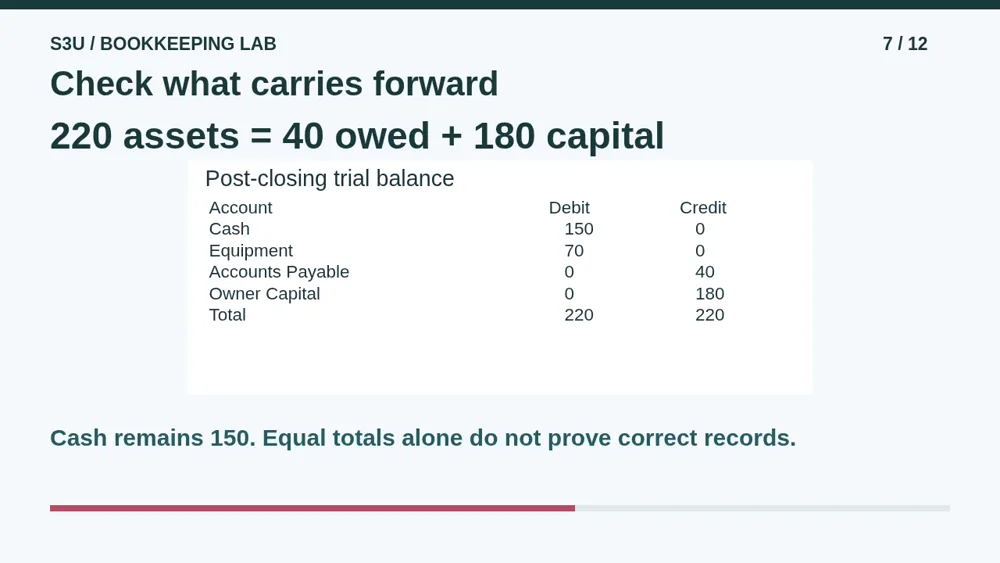
The post-closing trial balance contains the remaining balances. Cash is still one hundred fifty and Equipment is still seventy, so debits total two hundred twenty. Accounts Payable is still forty and Owner Capital is now one hundred eighty, so credits also total two hundred twenty. Revenue, both expenses, Income Summary and Drawings are zero and do not appear as balances on this trial balance. Cash and the amount owed did not vanish at midnight. Matching totals are useful, but still do not prove that every original record was correct.
8. A loss transfers the other way
Audio: 4:36
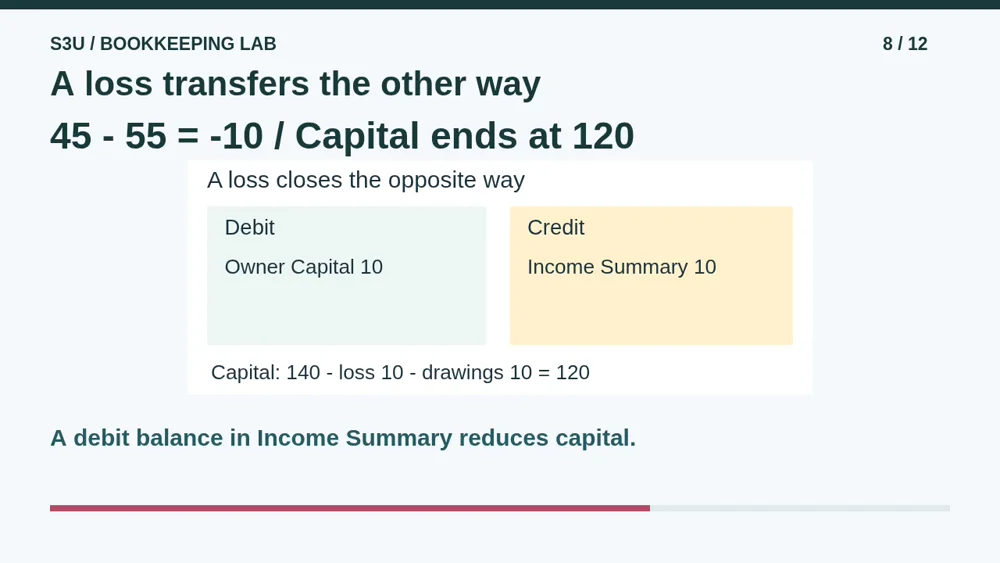
Now use a separate workshop. Revenue is forty-five, Rent Expense thirty-five and Supplies Expense twenty. Close revenue with a debit to Revenue and credit to Income Summary, both forty-five. Close expenses with a debit to Income Summary fifty-five and credits to Rent thirty-five and Supplies twenty. Income Summary has a debit balance of ten: a loss. Close it with a credit to Income Summary ten and a debit to Capital ten. Starting capital of one hundred forty falls to one hundred thirty. Then close ten of Drawings directly to Capital, leaving a credit of one hundred twenty. Cash one hundred and Equipment fifty still equal Payable thirty plus Capital one hundred twenty.
9. Pause: close a fresh workshop
Audio: 5:28
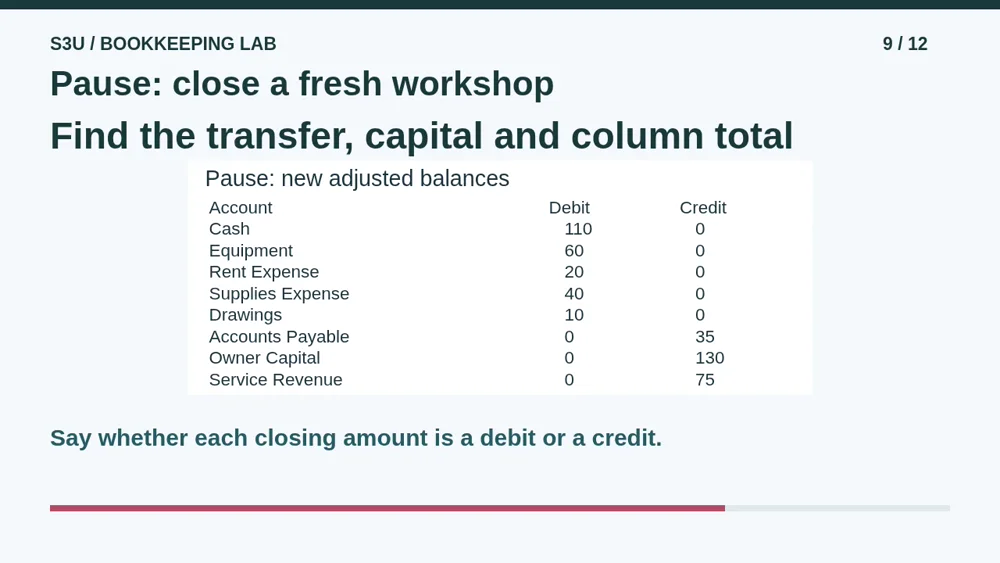
Pause for new records. All adjustments and reports are complete, and Income Summary starts at zero. Debits are Cash one hundred ten, Equipment sixty, Rent Expense twenty, Supplies Expense forty and Drawings ten. Credits are Accounts Payable thirty-five, Owner Capital one hundred thirty and Service Revenue seventy-five. No other accounts apply. Close revenue, expenses, Income Summary and Drawings. Which direction does the summary transfer go? What is ending capital, and the total of each post-closing column? Does Cash change? Write or say your entries before continuing.
10. Check the fresh closing entries
Audio: 6:15
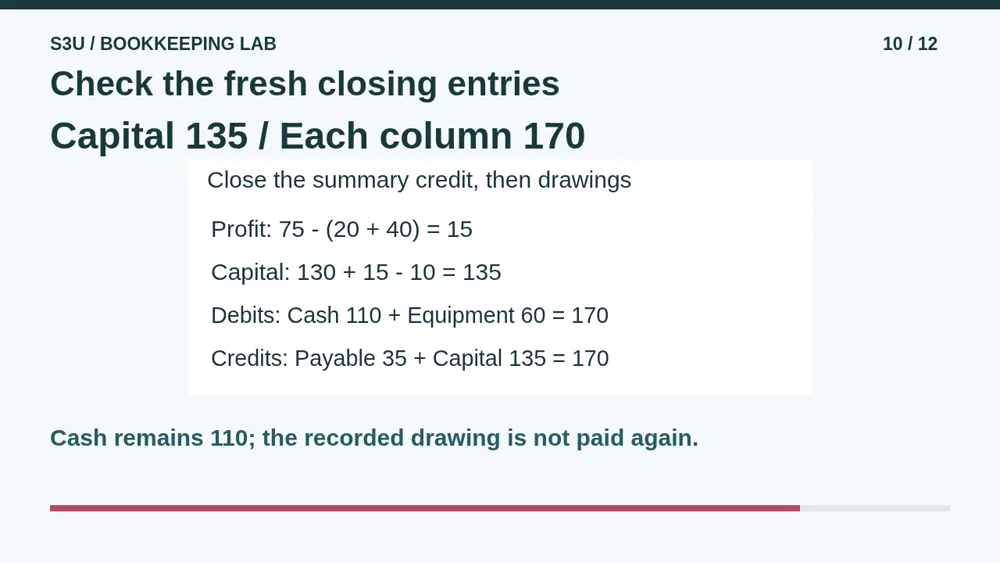
Debit Revenue seventy-five and credit Income Summary seventy-five. Debit Income Summary sixty and credit Rent twenty and Supplies Expense forty. That leaves a summary credit of fifteen, a profit. Debit Income Summary fifteen and credit Capital fifteen. Finally, debit Capital ten and credit Drawings ten. Capital is one hundred thirty plus fifteen minus ten, or one hundred thirty-five. Cash one hundred ten plus Equipment sixty gives debits of one hundred seventy. Payable thirty-five plus Capital one hundred thirty-five gives the same credits. Cash remains one hundred ten. If your result differs, find the first entry whose account sides or amounts do not match.
11. Zero does not mean erased
Audio: 7:08
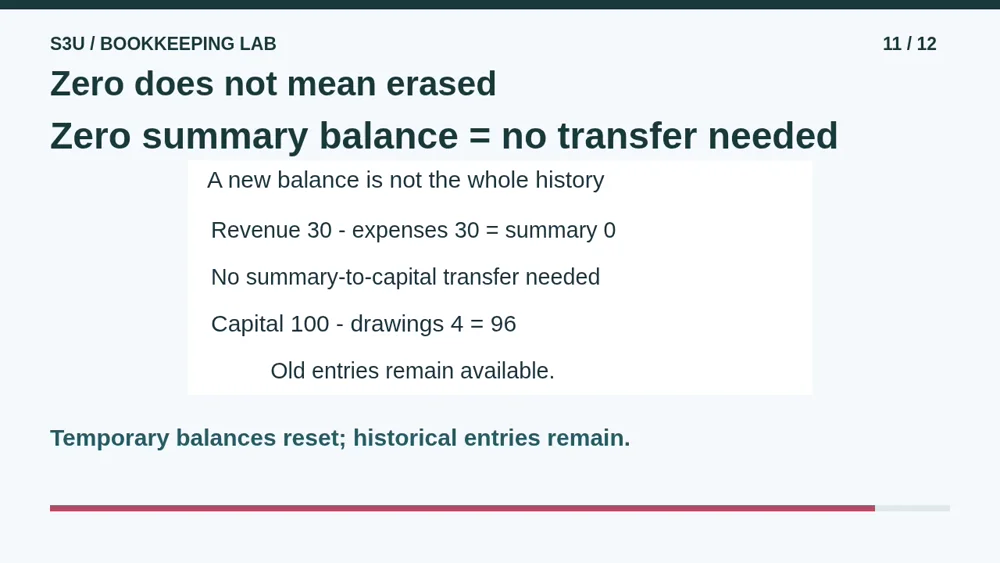
Fun fact: an account can finish at zero and still have a busy history. Closing revenue to zero does not mean the workshop earned nothing; the original revenue entries and reports remain. In another separate case, revenue of thirty and expenses of thirty leave Income Summary at zero. No summary-to-capital transfer is needed. If capital is one hundred and recorded Drawings is four, closing Drawings still reduces capital to ninety-six. A zero balance needs no zero-dollar entry. Look at the steps and the history, not only the final zero.
12. Continue with your own records
Audio: 7:50
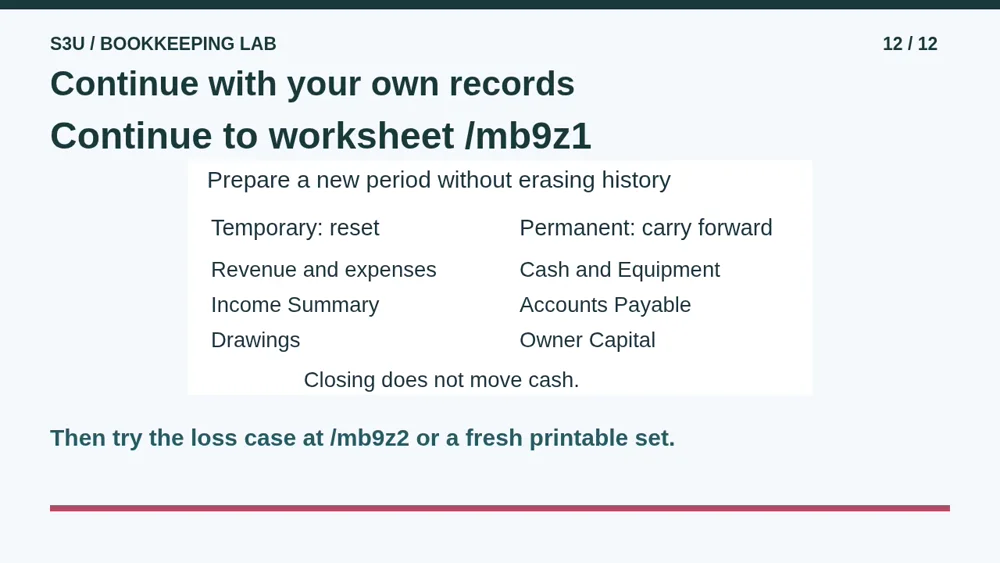
Continue to the worksheet below for a different profit case, then use the linked loss worksheet. Their numbers are different from this lesson. For each case, close revenue, close expenses, transfer the remaining summary balance in the correct direction, and close drawings separately. Check permanent balances and the post-closing columns. Explain why cash stays unchanged and why history is preserved. A fresh printable set is also available through the skill path. You do not need a real account, purchase or personal financial record. Watching teaches the method; the worksheet is your chance to apply it.
Show your understanding
You can point, explain aloud, draw or write.
- Prepare the four closing steps, including opposite transfer directions for a profit and a loss, with Drawings separate from expenses.
- Calculate ending capital and post-closing column totals while explaining unchanged Cash, retained history and a zero Income Summary balance.
Try it yourself
Pause at the fresh workshop. Write the four closing entries, find ending capital and each post-closing column total, and explain why Cash does not change.
Continue to the profit worksheet, then the linked loss case. Use each new set of records, not the lesson totals.
Next: your worksheet
Close a Profitable Periodhttps://s3u.com/mb9z1
Practice Two: close a period with a loss · Practice the four closing steps
Fresh printable closing records · Review debit and credit balances
Lesson: https://s3u.com/listen/close-the-period