Creativity / Grade 3
Follow an edge
Learning goal: Look closely, trace an outer contour and compare one specific turn before revising a drawing.
Before you start: Recognize straight and curved lines and distinguish inside from outside. An adult may read the labels. Paper and pencil are optional.
Read or print this lesson What to practiceThe video could not load. The transcript is still available below.
Next: your worksheet
Follow an Outer Contour - Bottle Practice
Checking sign-in...
Read the transcript
Saved reading place
Video transcript and practice. Reading or printing does not count as playback time or an assessed grade.
1. Look before you draw
Video: 0:00
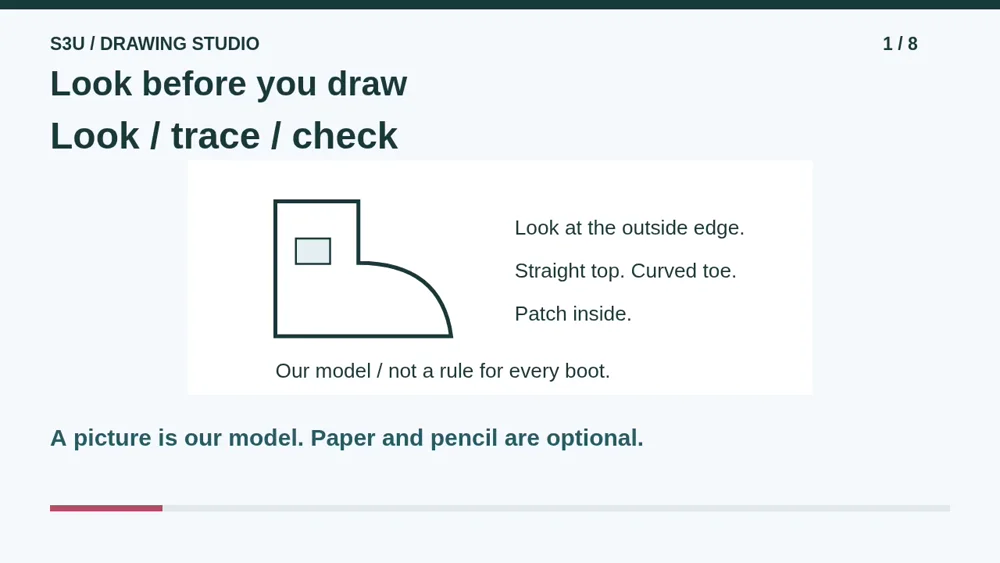
Look at this invented boot. Before drawing, let your eyes travel around its outside edge. Where is it straight? Where does it turn or curve? Today we will follow that edge slowly, then look back to check. You may draw, point in the air, or describe the path. Your boot does not need to win a fashion contest.
2. Choose the outside edge
Video: 0:25
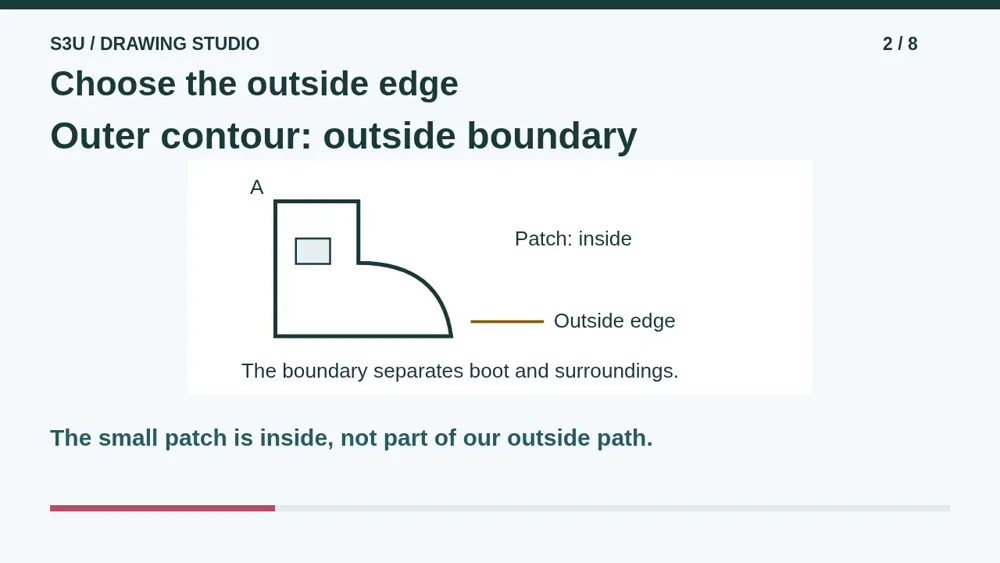
A contour follows an edge of a shape. Today we are studying the outer contour, the boundary between the boot and its surroundings. Start at A, at the top left. Travel across the top, down the right side, around the toe, along the bottom, then up the left side. The little patch stays inside this path.
3. Notice one part at a time
Video: 0:48
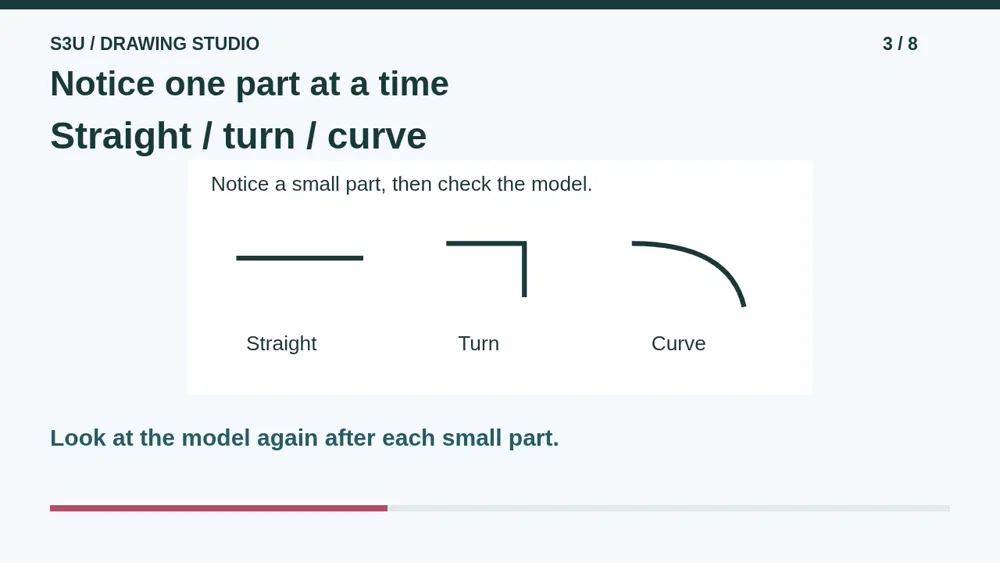
The top is straight. At the top right, the edge turns downward. Near the toe, it curves instead of making a sharp corner. Look at a small part, mark that part, then look back at the model. You can lift your pencil. This exercise is about noticing edges, not making one perfect unbroken line.
4. Check a specific difference
Video: 1:12
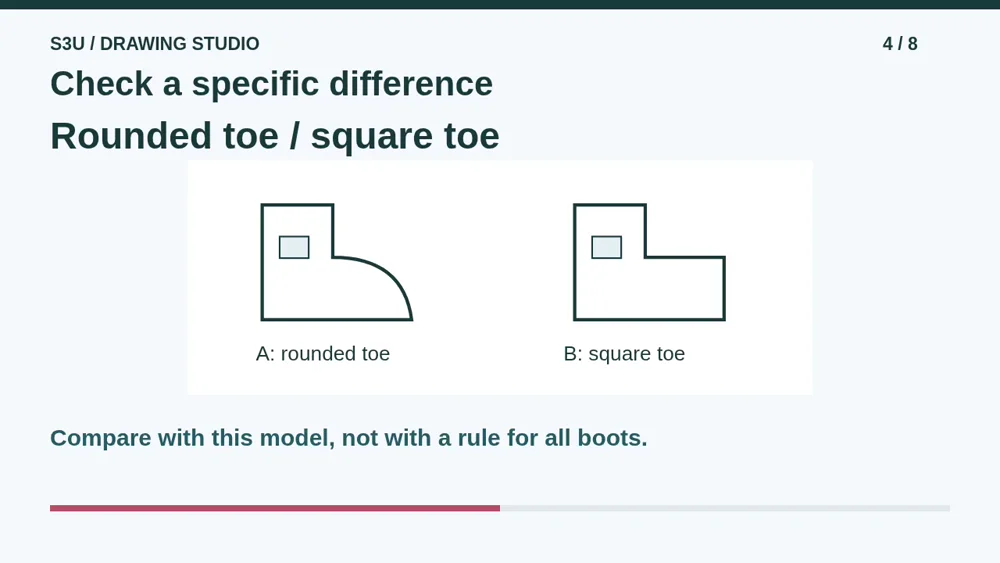
Compare these two small sketches with our model. Sketch A has a rounded toe like the model. Sketch B has a square toe. If our aim is to follow this model, we could revise B by rounding the toe. A square toe is not bad art. It is simply different from the edge we chose to observe.
5. Pause: a different outline
Video: 1:35
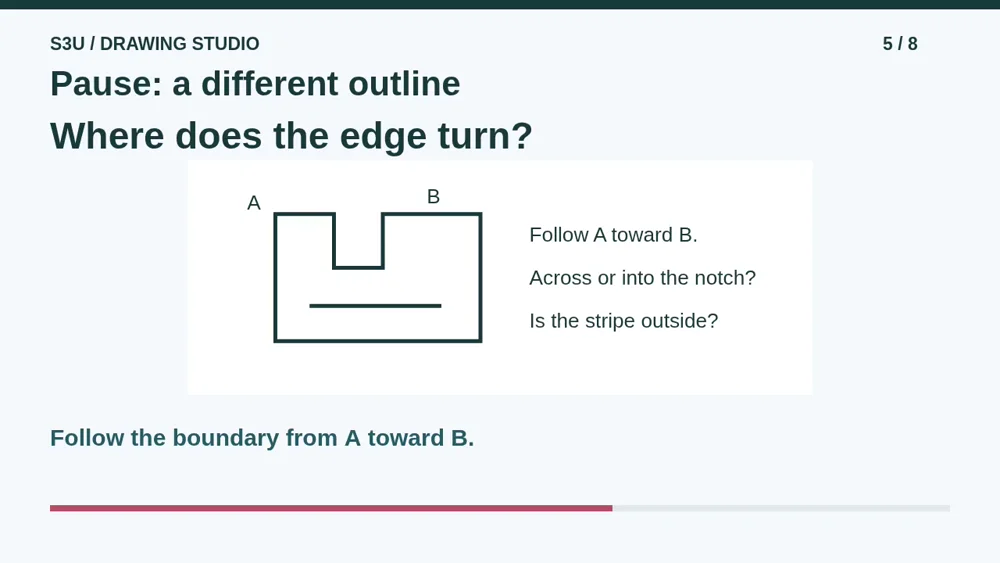
Pause for a new shape: a pretend tile with a notch cut into its top. Start at A in the top left. Follow the outside edge toward B. Does it jump straight across the notch, or travel down into it and back up? Is the small stripe in the middle part of that outside path? Point or explain before continuing.
6. Follow the notch, too
Video: 1:59
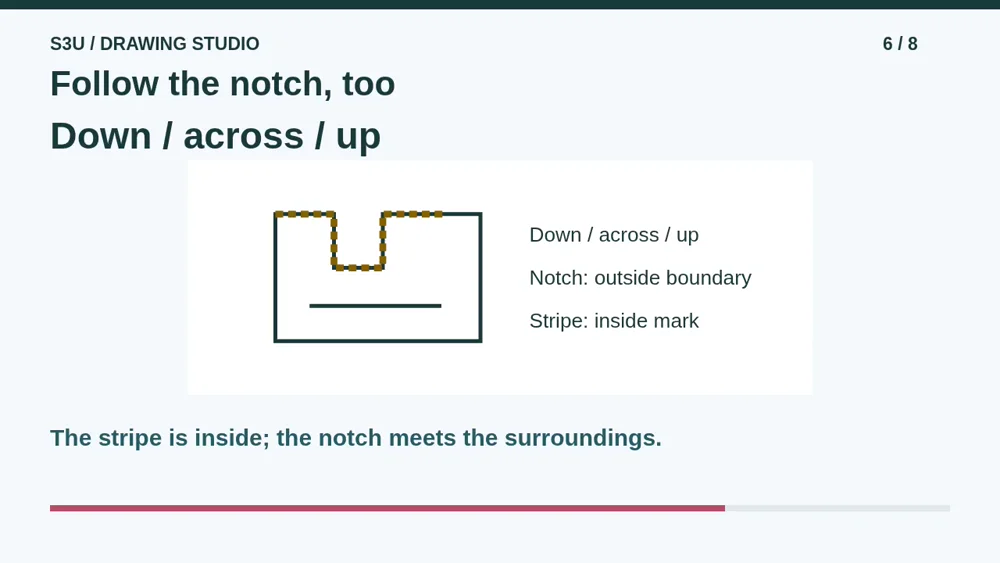
The outside path travels down into the notch, across its bottom, then up again. Jumping straight across would hide a change in the observed shape. The small stripe stays inside and is not part of this outside path. A boundary can bend inward as well as outward. Look for those turns before adding tiny details.
7. A line can tell a story
Video: 2:23
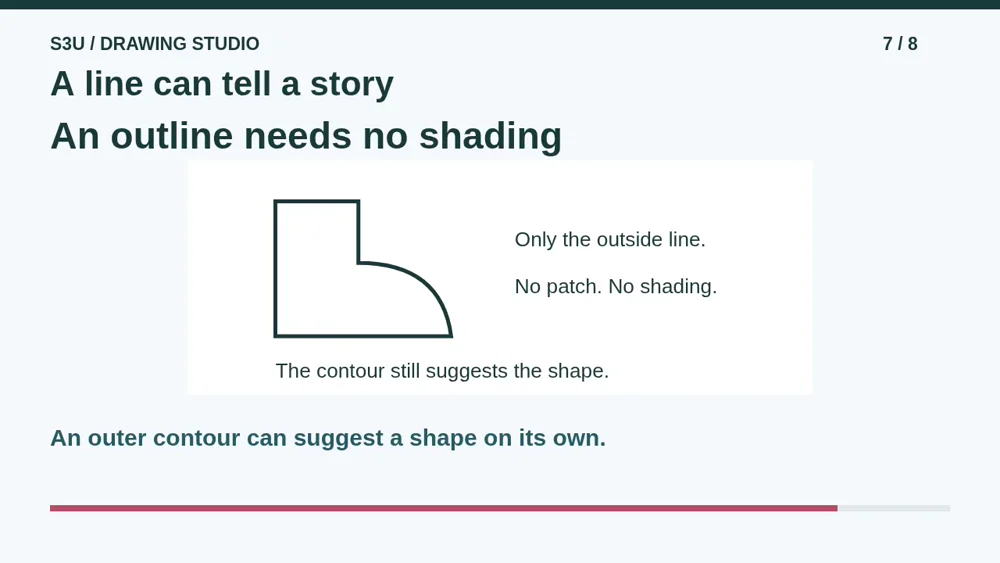
Fun fact: a line drawing can suggest an object without colored filling or shaded areas. Our boot is still a boot-shaped picture when we keep only its outside line. You can add details later, but first let the boundary do its job. One line has quite a busy day without carrying a paint bucket.
8. Try, compare, revise
Video: 2:46
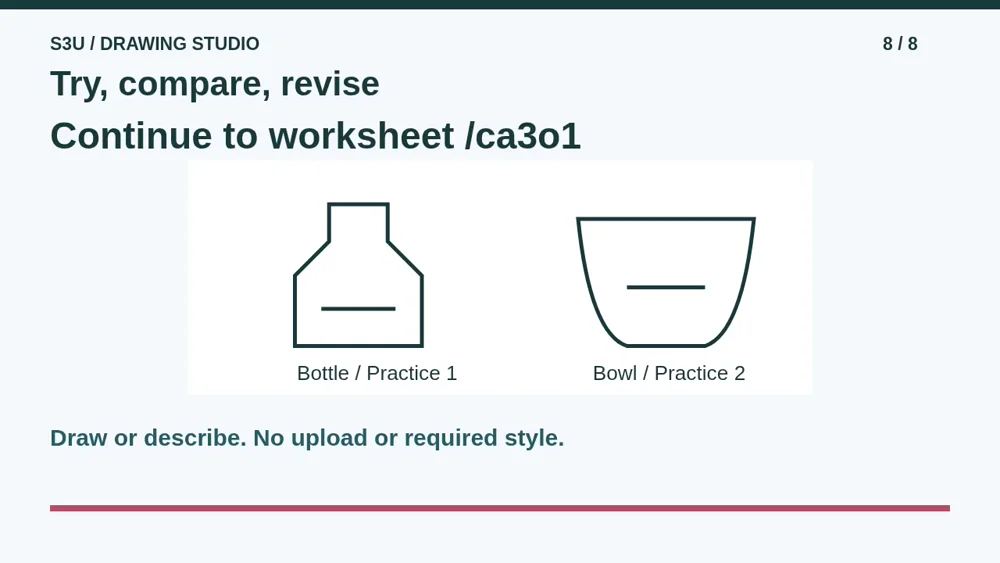
Continue to the worksheet for a bottle picture, then try the bowl picture in Practice Two. Name an outside edge and an inside mark before answering. For your own practice, invent a simple shape, draw its outline, and compare one turn with your model. Revise one detail or explain what you would change. Your creative drawing is not scored.
Show your understanding
You can point, explain aloud, draw or write.
- Follow an outer boundary, including an inward notch, while distinguishing separate interior marks.
- Look back at a model to compare one specific turn or curve and explain a revision without judging artistic style.
Try it yourself
Pause at the notched tile. Follow the outside path and distinguish the stripe inside from the boundary.
Continue to the bottle and bowl worksheets. Draw, point or describe one observed edge, then compare a specific revision. Creative style is not scored.
Next: your worksheet
Follow an Outer Contour - Bottle Practicehttps://s3u.com/ca3o1
Practice Two: observe a bowl outline · Next: look at the surrounding spaces
Lesson: https://s3u.com/lessons/follow-an-edge