Science / Grade 9
Add bits and keep the carry
Learning goal: Use half and full adders, trace Sum and Carry separately, and explain their binary place values.
Before you start: Use AND, inclusive OR and two-input XOR with bits 0 and 1. Add small whole numbers and recognize that a digit's place affects its value. Review the basic-gates lesson when needed.
Read or print this lesson What to practiceThe video could not load. The transcript is still available below.
Next: your worksheet
Add Two Bits with Sum and Carry
Checking sign-in...
Read the transcript
Saved reading place
Video transcript and practice. Reading or printing does not count as playback time or an assessed grade.
1. Two places for a tiny total
Video: 0:00
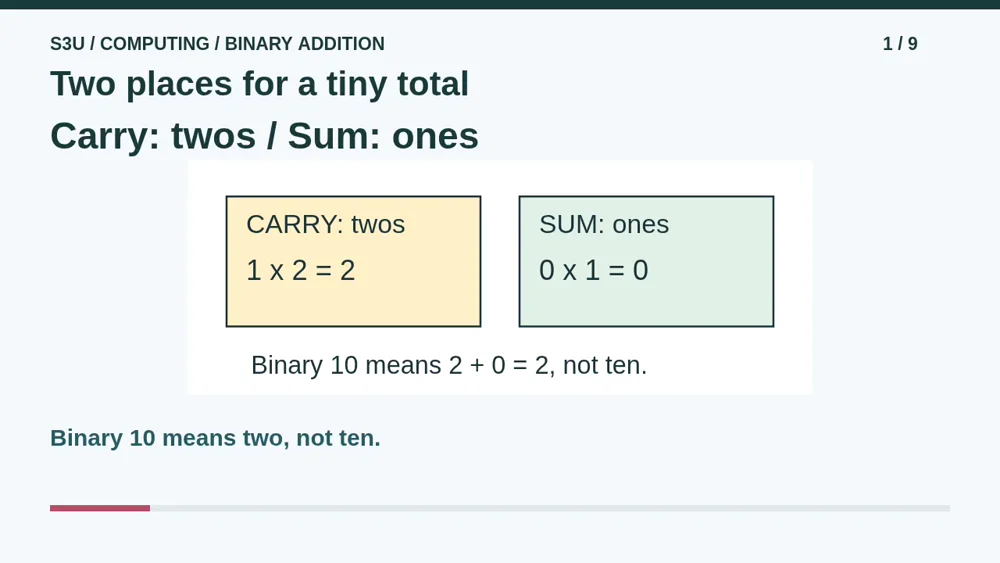
A bit holds zero or one. But one plus one makes two. Where can the two go? Give the result two places. The right-hand Sum bit is worth one, and the left-hand Carry bit is worth two. Carry one and Sum zero write the binary number one-zero, meaning two, not ten. The two is not lost. It simply needs a bigger chair. We will use ideal logical bits, not real voltages or wiring.
2. A half adder uses two rules
Video: 0:33
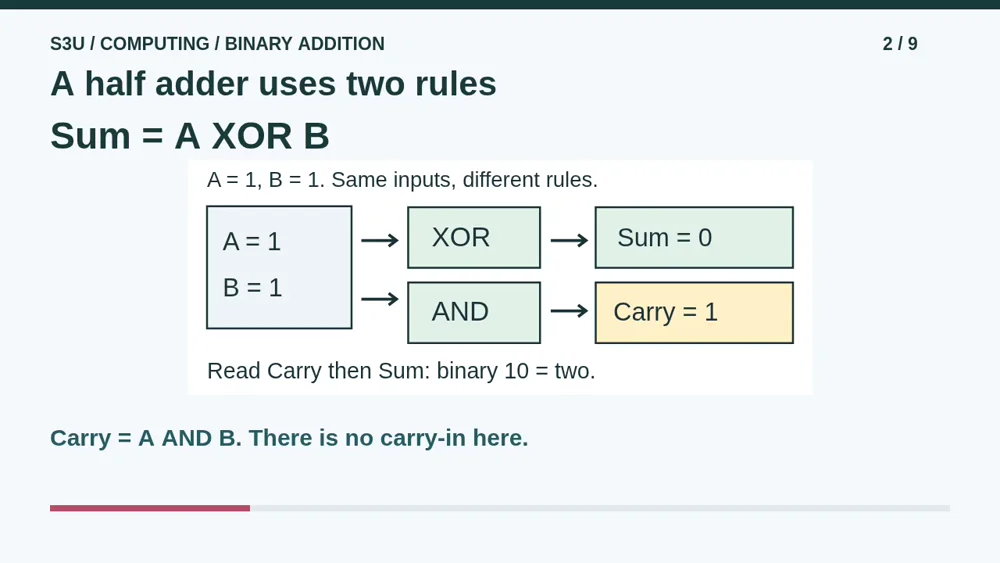
A half adder adds two input bits, A and B. It has two outputs. XOR makes the Sum bit: one when the inputs differ, zero when they match. AND makes Carry: one only when both inputs are one. With A one and B one, XOR gives Sum zero, while AND gives Carry one. Read Carry first, then Sum: binary one-zero, or two. Half adder does not mean half an answer. It means this adder has no input for a carry from another column.
3. Check every input pair
Video: 1:08
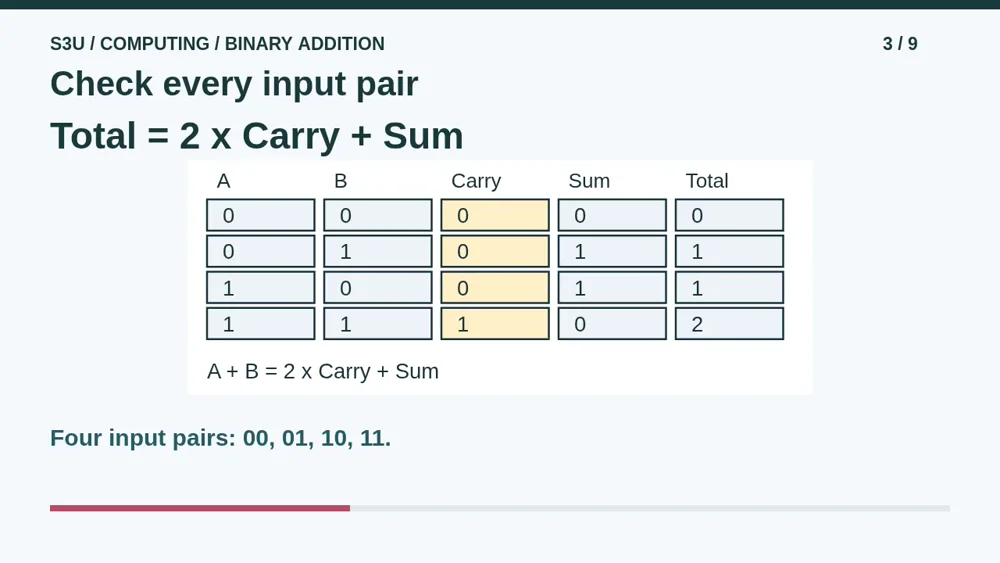
A truth table checks every allowed input pair. Zero plus zero gives Carry zero and Sum zero. Zero plus one, and one plus zero, each give Carry zero and Sum one. One plus one gives Carry one and Sum zero. In every row, twice Carry plus Sum equals A plus B. Notice that Sum alone is zero for both zero-zero and one-one. Without Carry, those very different totals would look the same. Keep both outputs.
4. Include the incoming carry
Video: 1:42
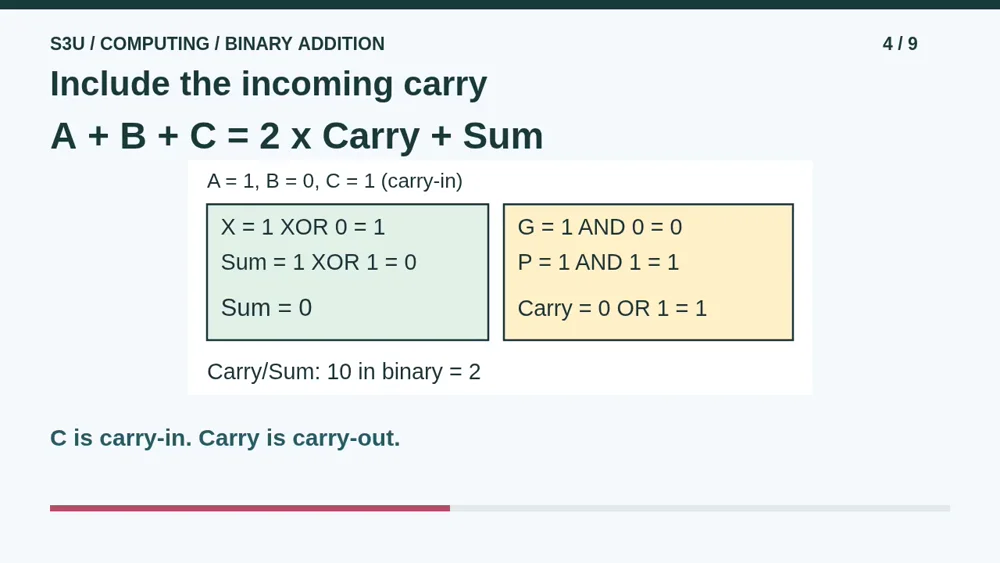
A full adder adds A, B and a carry coming in, called C. First find X using A XOR B. Then Sum is X XOR C. Carry comes from A AND B, or from X AND C. Trace A one, B zero, C one. X is one. Sum is one XOR one, giving zero. A AND B is zero, but X AND C is one, so Carry is one. The inputs total two, and the outputs show binary one-zero. C and Carry have different jobs.
5. Three ones still fit
Video: 2:18
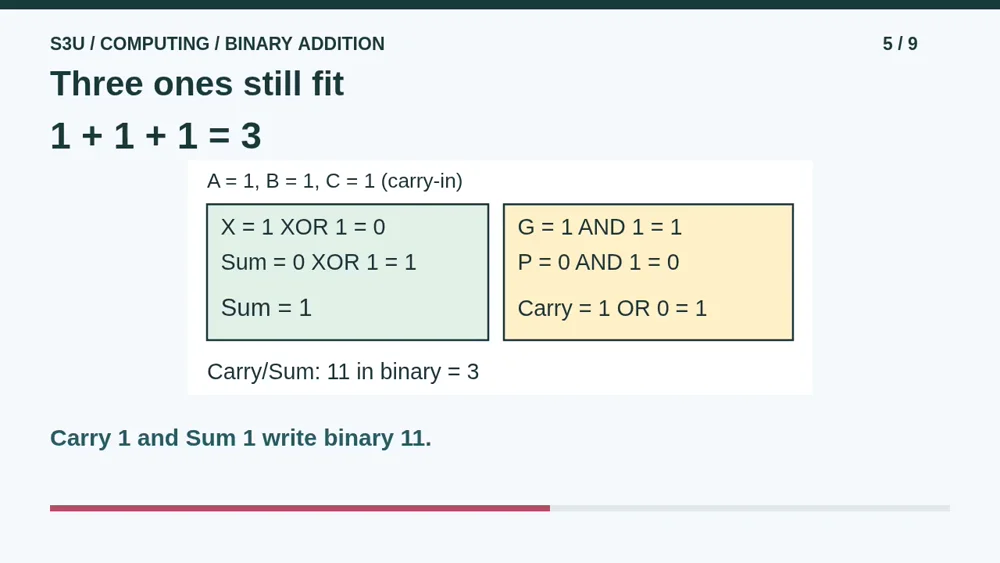
Try all three inputs at one. A XOR B gives X zero. X XOR C is zero XOR one, so Sum is one. A AND B gives one. X AND C gives zero. OR combines those two carry paths and gives Carry one. The result is binary one-one: two plus one, or three. It is not eleven. A single Sum bit could not distinguish this total from one. Carry keeps the extra two from going missing.
6. Pause: keep the outputs separate
Video: 2:53
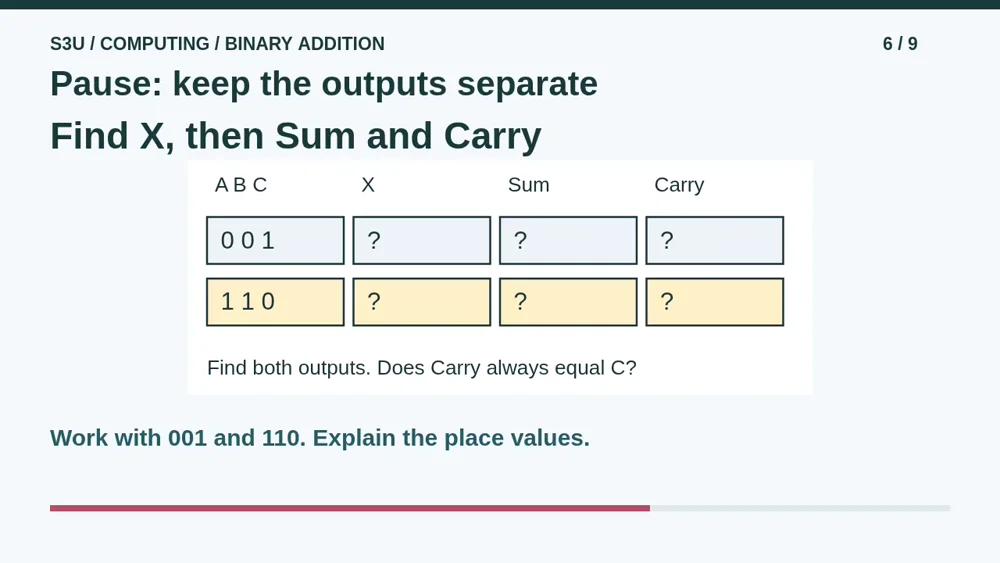
Pause and solve these two fresh triples: zero-zero-one and one-one-zero. The order is A, B, C. Find X first. Then find Sum and the two paths into Carry. For each triple, write the result with Carry on the left and Sum on the right, and check its ordinary number value. Does the outgoing Carry always match the incoming C? Use these rows to support your explanation. Do not replace either output with the total number.
7. Check the carry direction
Video: 3:27
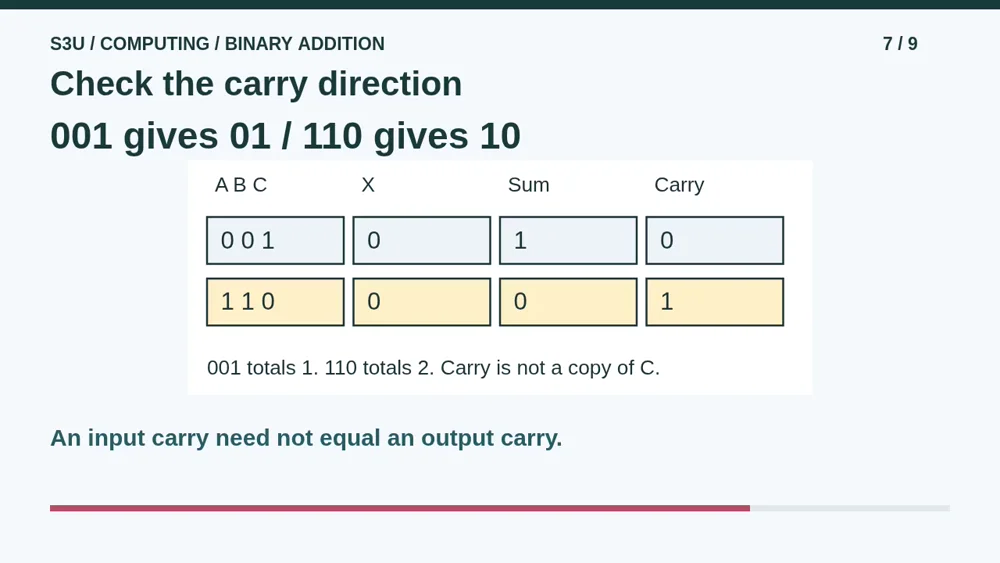
For zero-zero-one, X is zero. Sum is one and both carry paths are zero, so Carry is zero. The total is one: binary zero-one. Here C is one, but Carry is zero. For one-one-zero, X is zero. Sum is zero and A AND B makes Carry one. The total is two: binary one-zero. Here C is zero, but Carry is one. These two rows show why carry-in and carry-out cannot be treated as the same signal.
8. One column can help the next
Video: 4:02
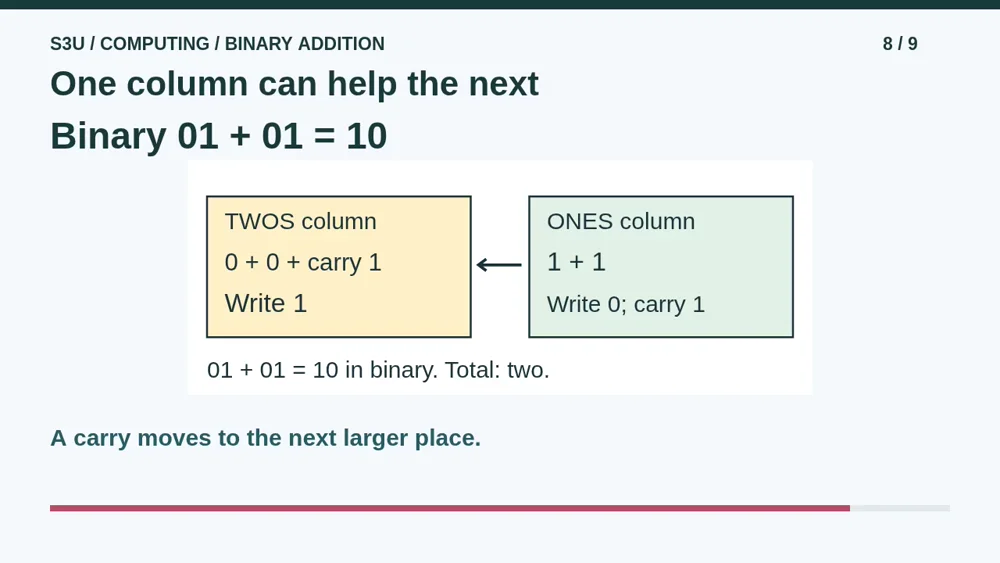
Fun fact: a larger binary adder can connect one column's carry-out to the next column's carry-in. For binary zero-one plus zero-one, the ones column adds one and one, writes Sum zero and passes a carry. The twos column adds zero, zero and that incoming one, so it writes one. The result is binary one-zero, meaning two. This is a paper model of place values. It does not model electrical timing or tell us how fast a real computer adds.
9. Continue with the worksheets
Video: 4:36
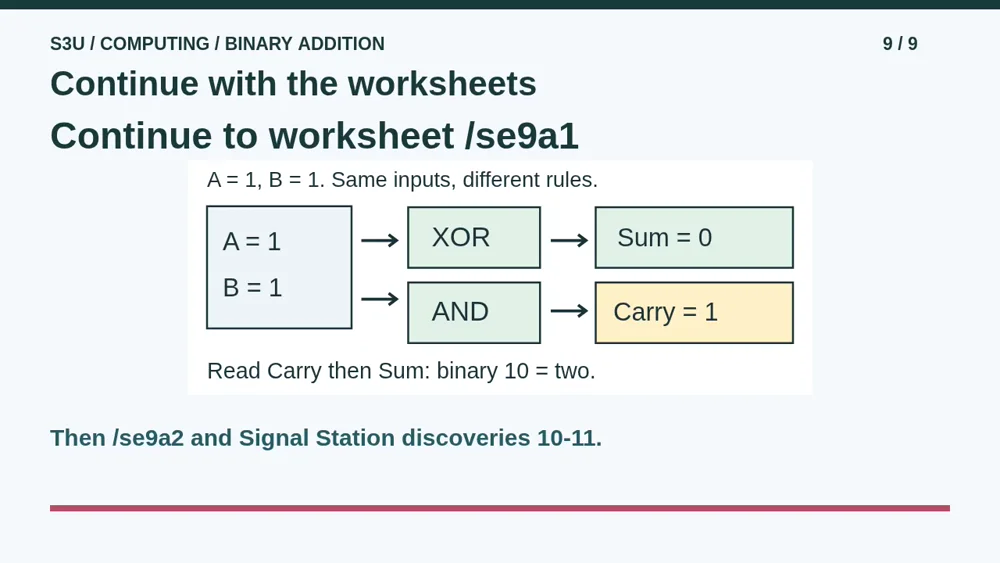
Open the first worksheet below to practice half adders and binary place values. Its next-practice link opens the full-adder worksheet. Keep the Sum and Carry labels on your working, and check twice Carry plus Sum against the input total. Then try discoveries ten and eleven in Signal Station. Its earlier discoveries review the gates. The aim is to explain both outputs, not to guess a lucky bit. No physical build or opening a device is needed.
Show your understanding
You can point, explain aloud, draw or write.
- Trace the Sum and Carry outputs of half/full adders and check the weighted result against the input total.
- Distinguish binary 10 and 11 from decimal ten and eleven, and explain why carry-in need not match carry-out.
Try it yourself
Pause at 001 and 110. Find X, Sum and Carry separately, then check each result using twice Carry plus Sum.
Continue to both worksheets and Signal Station discoveries 10-11. Distinguish carry-in from carry-out and logical values from physical wiring.
Next: your worksheet
Add Two Bits with Sum and Carryhttps://s3u.com/se9a1
Build and test the rules in Signal Station
Next worksheet: include a carry-in · Review the basic gates and truth tables
Lesson: https://s3u.com/lessons/add-bits-and-carry