Science / Grades 9-11
Check every logic case
Learning goal: Build Boolean truth tables, follow explicit grouping, distinguish inclusive and exclusive OR, and check an equivalence across all input pairs.
Before you start: Distinguish true from false and follow a row-and-column table. Inputs are already Booleans; no hardware or automatic type conversion is needed.
Read or print this lesson What to practiceThe video could not load. The transcript is still available below.
Next: your worksheet
Programming Basics: Combine Boolean Conditions
Checking sign-in...
Read the transcript
Saved reading place
Video transcript and practice. Reading or printing does not count as playback time or an assessed grade.
1. Two inputs, four possible pairs
Video: 0:00
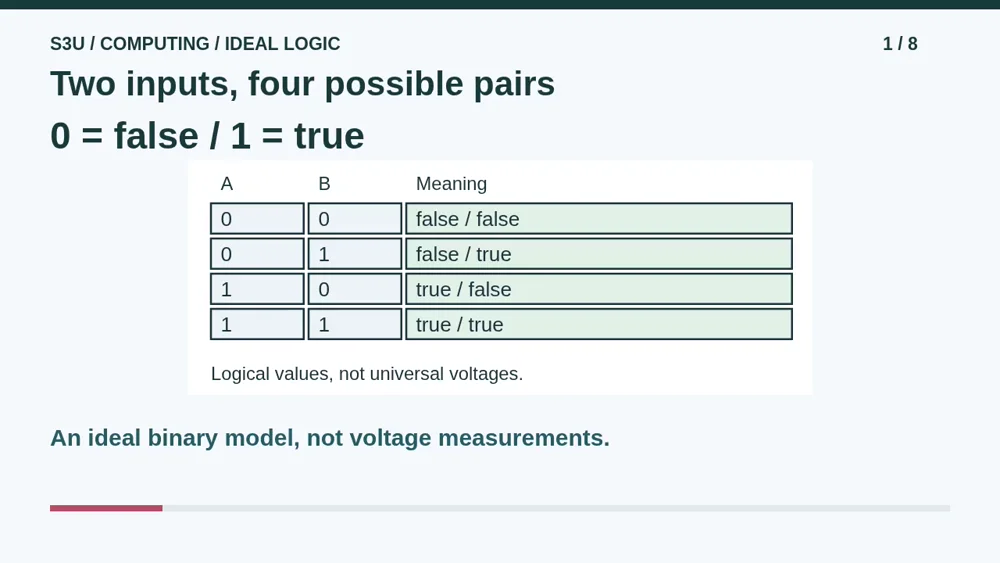
Our pretend signal desk takes two inputs, A and B. Each is already a Boolean value: false or true. We write zero for false and one for true. There are four possible pairs: zero zero, zero one, one zero, and one one. A truth table lists them all. This is an ideal model, not a wiring activity. A one is not a universal five-volt instruction, and the table does not measure circuit speed.
2. AND and OR ask different questions
Video: 0:32
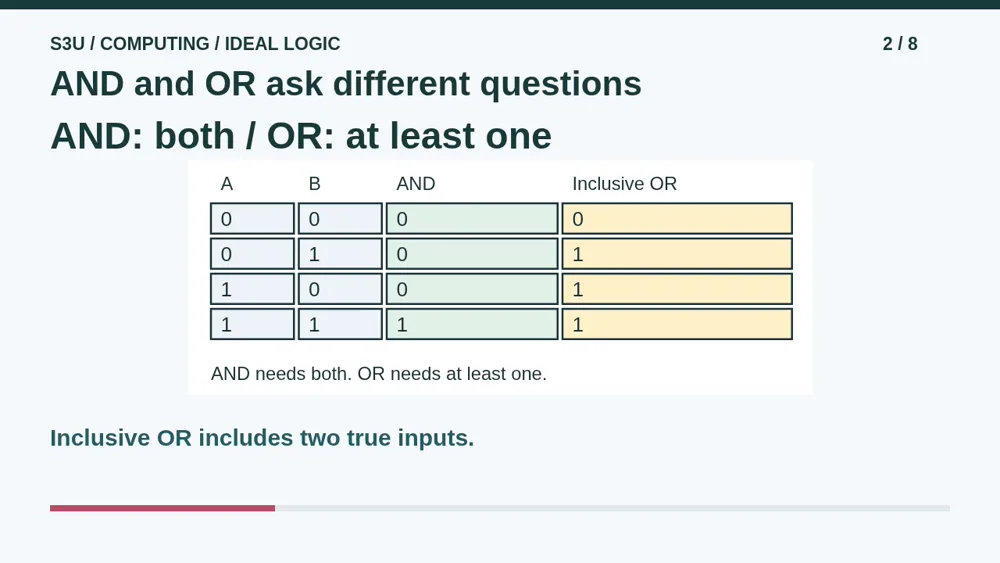
AND asks whether both inputs are true. Only the one-one row gives output one. OR asks whether at least one input is true. Its outputs are zero, one, one, one in our row order. This OR is inclusive: two true inputs still give one. It is not addition, so one OR one is not two. The signal desk does not hand out extra points for being doubly convinced.
3. NOT changes the value it covers
Video: 1:02
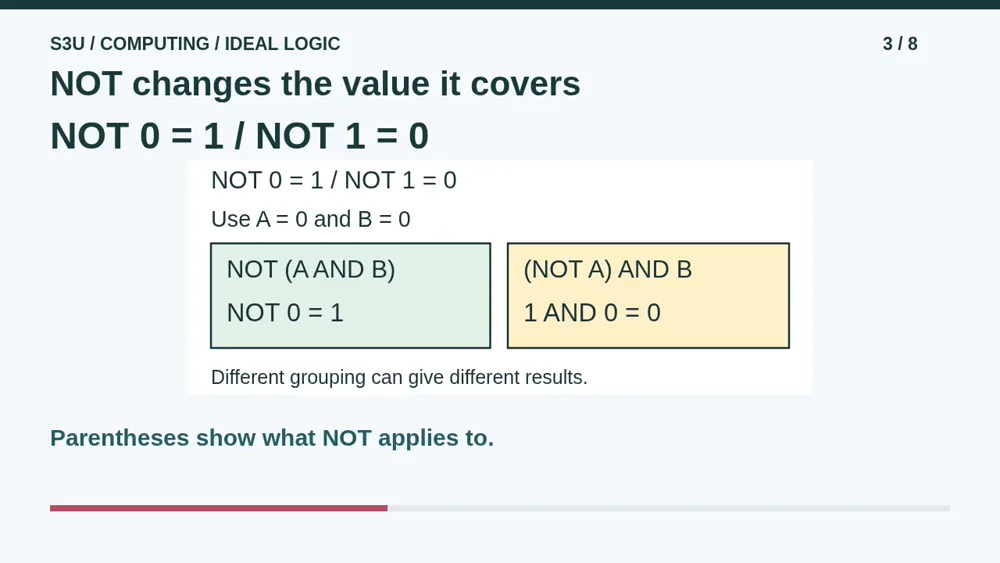
NOT reverses one Boolean value. Not zero gives one, and not one gives zero. Parentheses matter when an expression contains several operations. With A zero and B zero, not of A AND B first computes zero AND zero, then reverses that zero to one. But not A, then AND B, becomes one AND zero, which is zero. Moving the parentheses changes which result is reversed. Do not guess a language rule when the grouping can be written explicitly.
4. Trace the named intermediate results
Video: 1:38
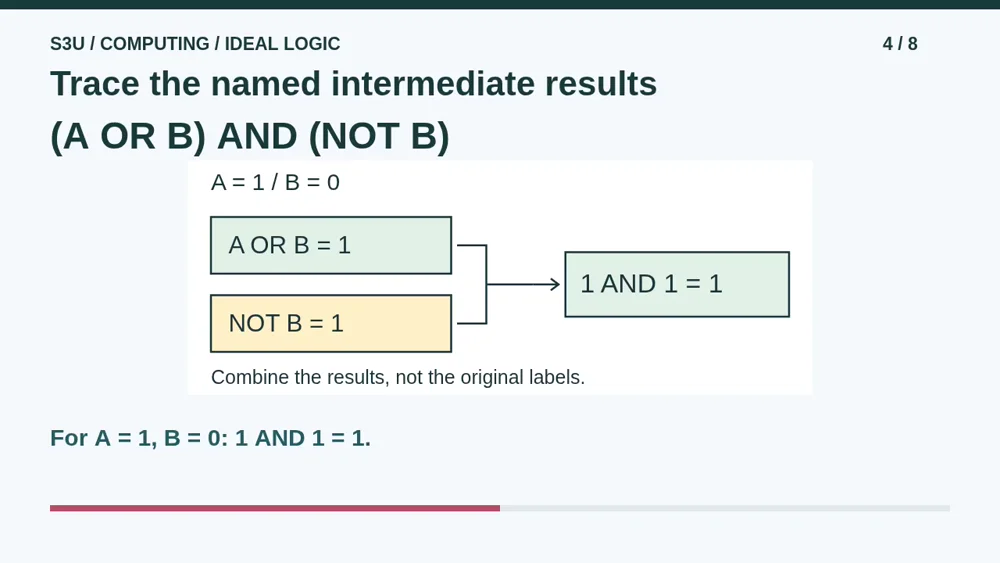
For A one and B zero, trace the expression A OR B, AND not B. First calculate the parenthesized OR: one OR zero is one. Then calculate not B: not zero is one. Combine those results with AND: one AND one gives one. The arrows show dependence on earlier results, not the timing of a real device. These examples use only Boolean inputs; they do not silently convert text, missing values or other numbers into Booleans.
5. Pause: build a fresh truth table
Video: 2:13
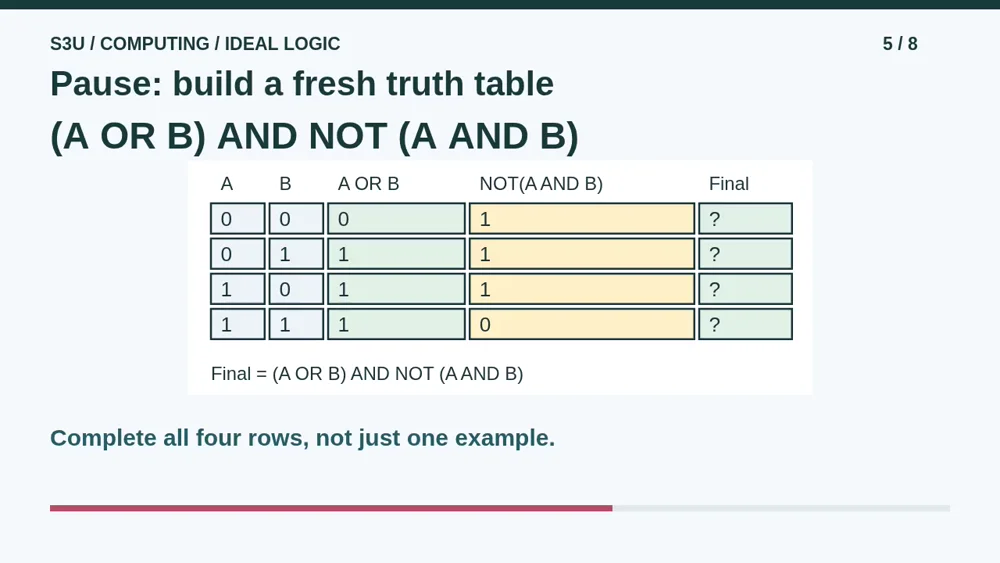
Here is a different rule. Calculate A OR B. Separately calculate A AND B, then reverse that result with NOT. Finally AND those two results together. Pause and fill the final output for all four input pairs. Keep the OR and AND columns visible so you can explain each step. In particular, check what happens when both inputs are one. Try predicting in words when the finished rule will give one.
6. Check: exactly one input is true
Video: 2:46
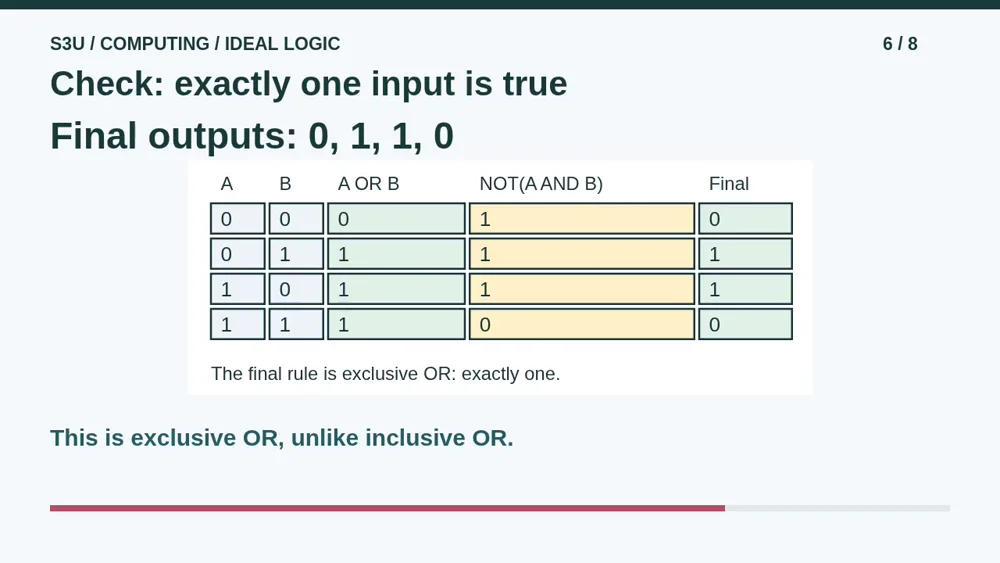
The completed outputs are zero, one, one, zero. With two zeros, the first OR is zero, so the final AND is zero. With just one input true, OR is one and the inner AND is zero; reversing that zero gives one, so the final result is one. With two ones, the inner AND is one, its NOT is zero, and the final result is zero. This rule is exclusive OR: exactly one input must be true.
7. Different expressions can agree
Video: 3:17
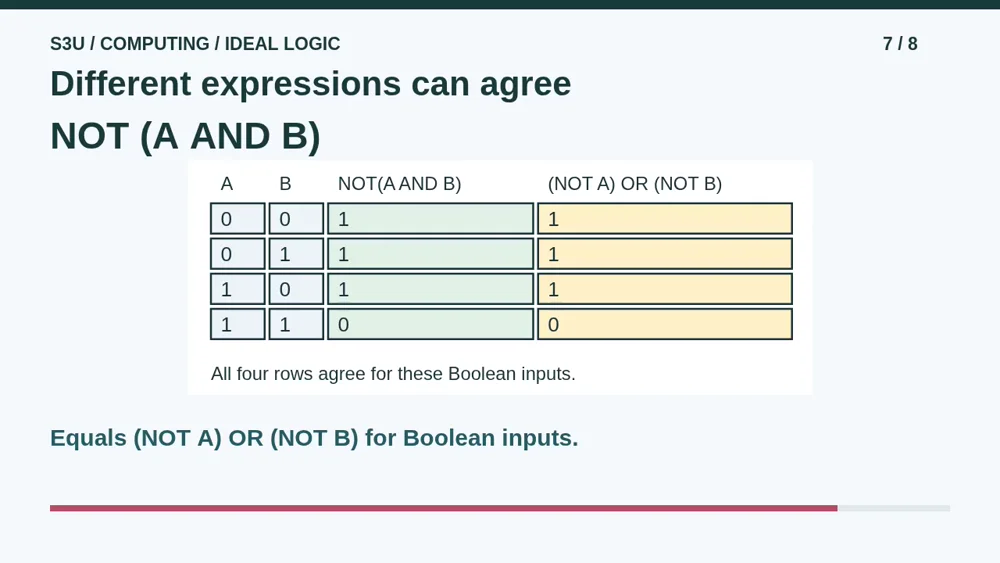
Fun fact: expressions that look different can agree on every input. Not of A AND B has outputs one, one, one, zero. Not A OR not B gives those same four outputs. Checking every row establishes their equivalence for these Boolean inputs; one matching example would not. This is one of De Morgan's laws. It is not the same as not A AND not B, which fails when exactly one input is true.
8. Continue to the worksheet
Video: 3:48
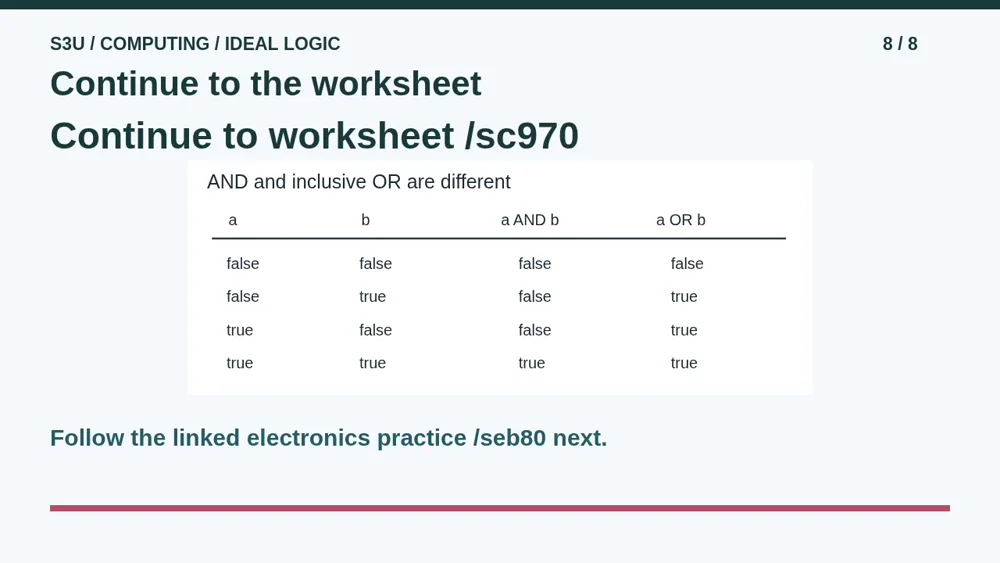
Continue to the Boolean conditions worksheet below, then use its linked electronics practice to read the same ideal zero-one rules. Name the operation, follow the parentheses and check every input pair when comparing rules. Real electronic voltage thresholds depend on the device and supply, and actual devices have timing and other limits. Keep this activity on paper or screen. Do not open powered equipment, short batteries or use wall outlets to test these tables.
Show your understanding
You can point, explain aloud, draw or write.
- Calculate AND, inclusive OR and NOT using explicit grouping, and explain why the composite practice rule is exclusive OR.
- Check equivalent expressions across all four input pairs and separate ideal logical outputs from real voltage and timing specifications.
Try it yourself
Pause at the new composite rule and complete all four final outputs using the two intermediate columns. Explain why both true differs from inclusive OR.
Continue to Boolean conditions, then its linked electronics worksheet. Use paper or screen only: these ideal models do not specify real device voltages, timing or wiring.
Next: your worksheet
Programming Basics: Combine Boolean Conditionshttps://s3u.com/sc970
Lesson: https://s3u.com/lessons/check-every-logic-case