Science / Grades 3-5
Rock detectives
Learning goal: Follow the clues that show how rocks form and change.
Before you start: Distinguish cooling, loose pieces joining and changes caused by heat and pressure. Follow the spoken formation clues; no rock collection is needed.
Read or print this lesson What to practice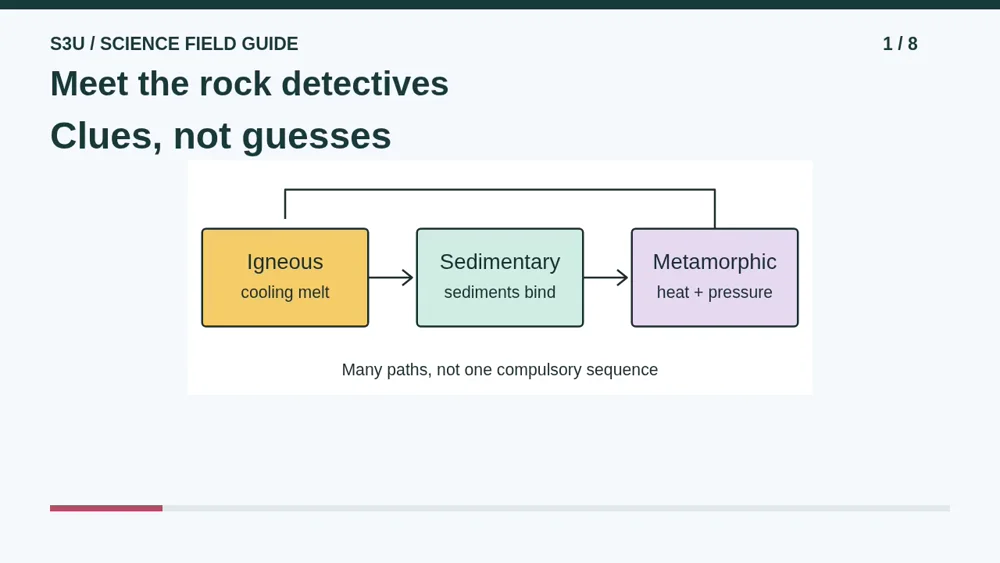
Audio and video share one lesson record. Keep this page open while listening.
Download audio Downloads do not save lesson progress.
The audio could not load. The transcript is still available below.
Next: your worksheet
Three rock families
Checking sign-in...
Read the transcript
Saved reading place
Audio transcript and practice. Reading or printing does not count as playback time or an assessed grade.
1. Meet the rock detectives
Audio: 0:00
A rock cannot fill out a form explaining where it came from. Very unhelpful. We can still investigate. Grains, layers, and textures give us clues. Today we will compare three rock families and follow a few paths between them.
2. Cooling makes a solid
Audio: 0:19
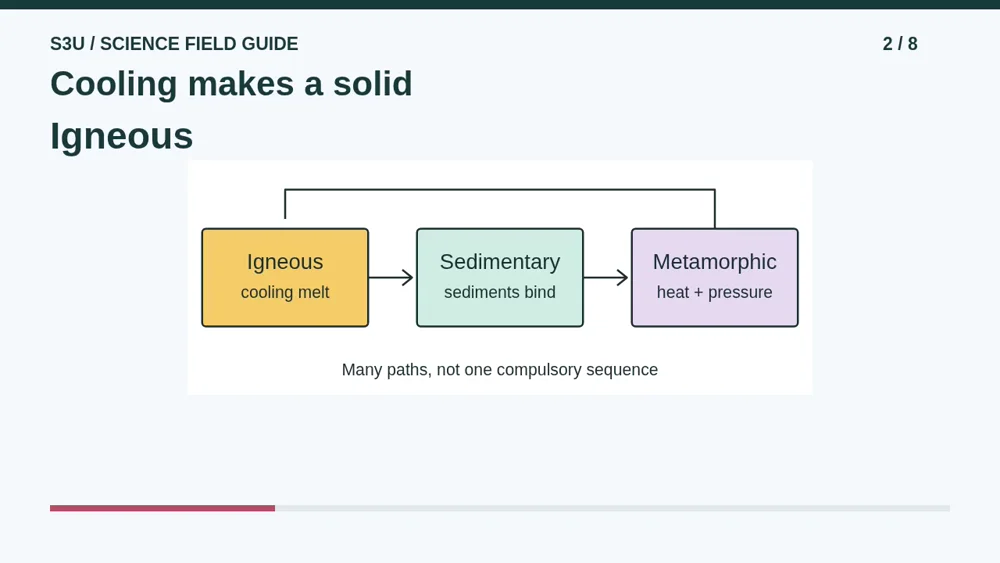
When molten rock cools and becomes solid, igneous rock forms. Molten material below the surface is called magma. At the surface it is called lava. Remember the process: melted material, then cooling. Do not go near hot lava to test this.
3. Small pieces join up
Audio: 0:39
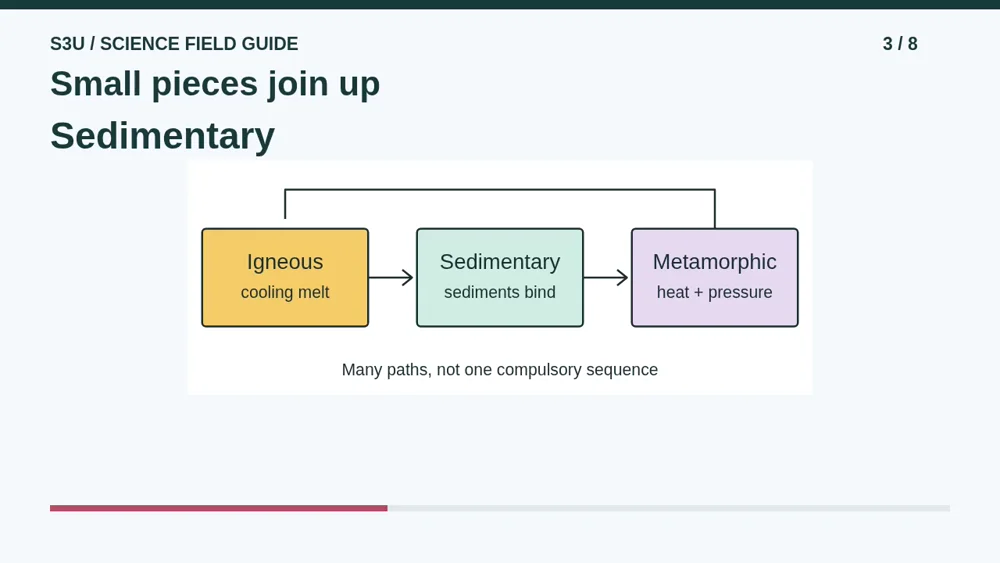
Water and wind can move small particles. Particles may settle in layers. Over time, compaction and cementation can turn sediment into rock. Sandstone is an example. Not every sedimentary rock forms exactly this way, but this is an important path.
4. Change without melting
Audio: 1:01
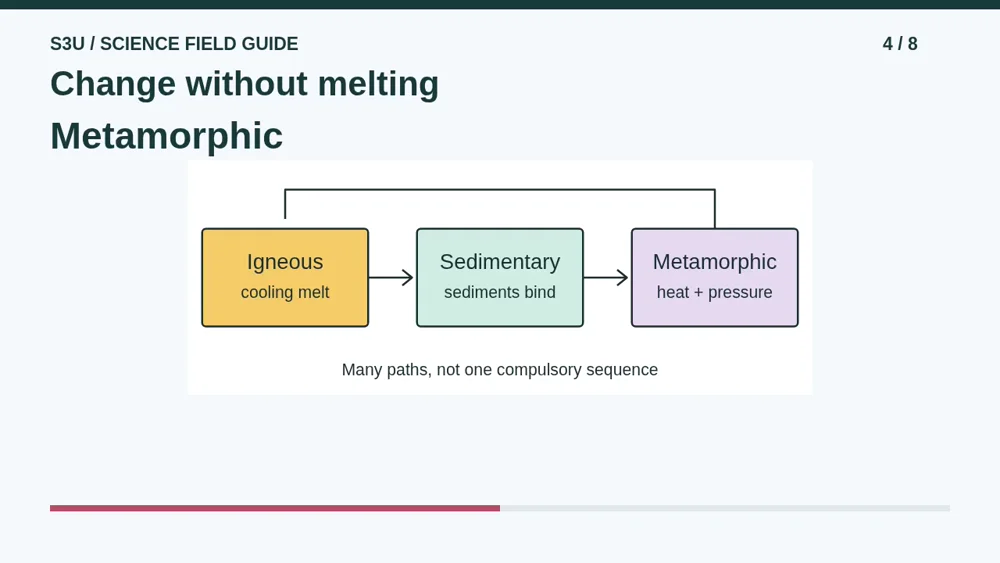
Heat and pressure can change an existing rock while it stays solid. The result is metamorphic rock. If the rock melts, that is a different step. Our rock detective must not confuse a change in solid rock with a puddle of molten material.
5. Pause and solve
Audio: 1:20
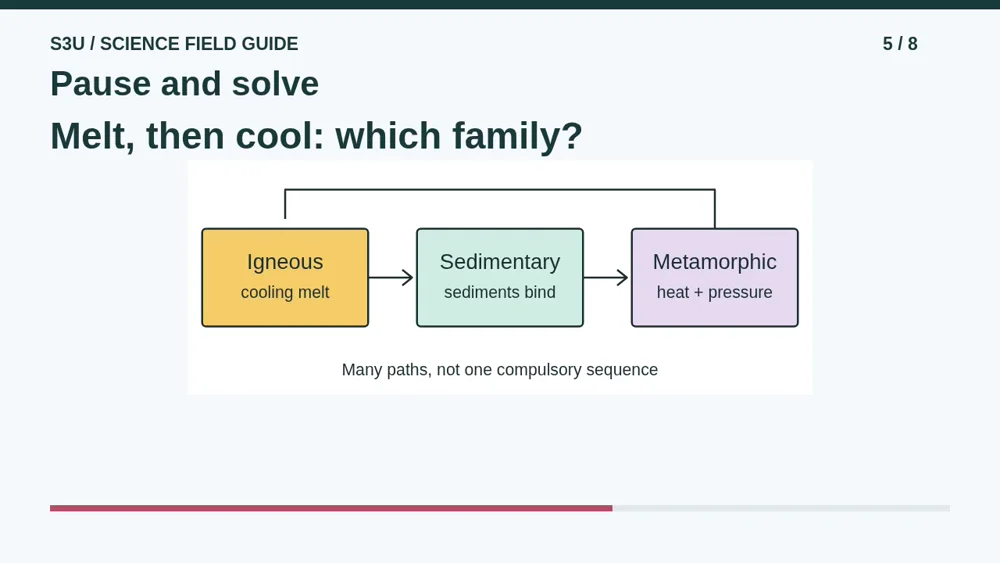
A rock melts and later cools into a solid. Pause the video and choose its new family. Is it igneous, sedimentary, or metamorphic? The important clue is the process, not whether the rock looks pretty on a shelf.
6. Follow the process
Audio: 1:37
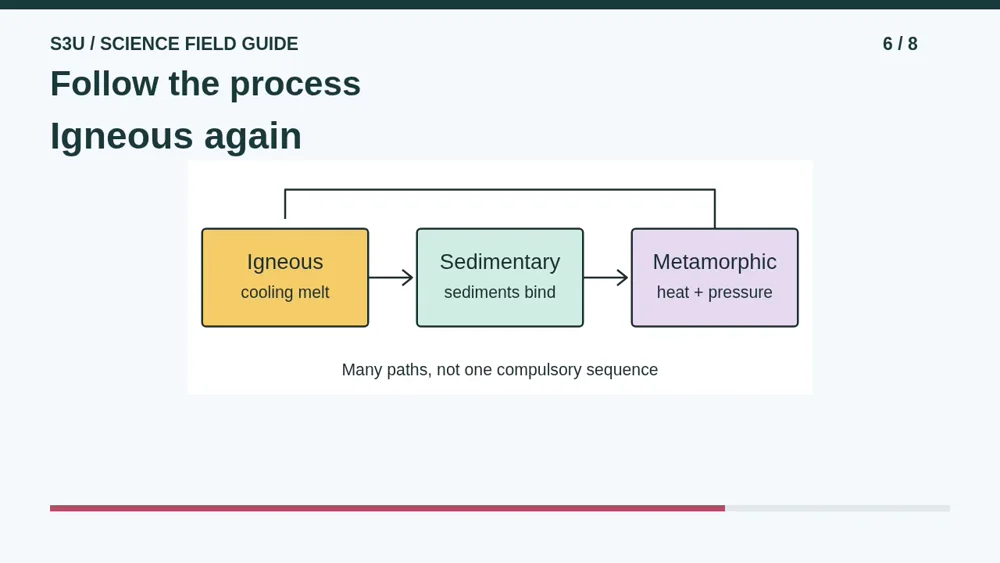
It is igneous because it formed from cooling molten material. The rock cycle is not a board game with one starting square. Rocks can take different paths. Some skip steps, and some remain in one form for a very long time.
7. The floating rock
Audio: 1:55
Here is a surprising fact. Some pumice can float on water. Gas bubbles leave spaces in this volcanic rock, lowering its overall density. It is not wearing a life jacket. Water can enter some spaces over time, so floating need not last forever.
8. Investigate safely
Audio: 2:16
Observe a cool, safe rock with an adult. Look for grains, layers, and holes. Never taste rocks or smash them near your eyes. Write what you observe separately from what you think it means. Then continue to the worksheet for more detective work.
Show your understanding
You can point, explain aloud, draw or write.
- Use formation clues to distinguish the three rock families in the lesson.
- Trace a possible rock-cycle path without claiming that every rock follows one fixed sequence.
Try it yourself
Pause at the question and explain your answer before continuing.
Complete the matching worksheet, then explain one new idea in your own words.
Next: your worksheet
Three rock familieshttps://s3u.com/sg310
Lesson: https://s3u.com/listen/rock-detectives