Science / Grade 3
Read a magnet test
Learning goal: Separate guesses from observations, compare tested objects fairly and explain why a shiny surface does not predict every magnet result.
Before you start: Know toward and away. Listen for each object letter and what its record says; every needed result is spoken. No magnets or equipment are needed.
Read or print this lesson What to practice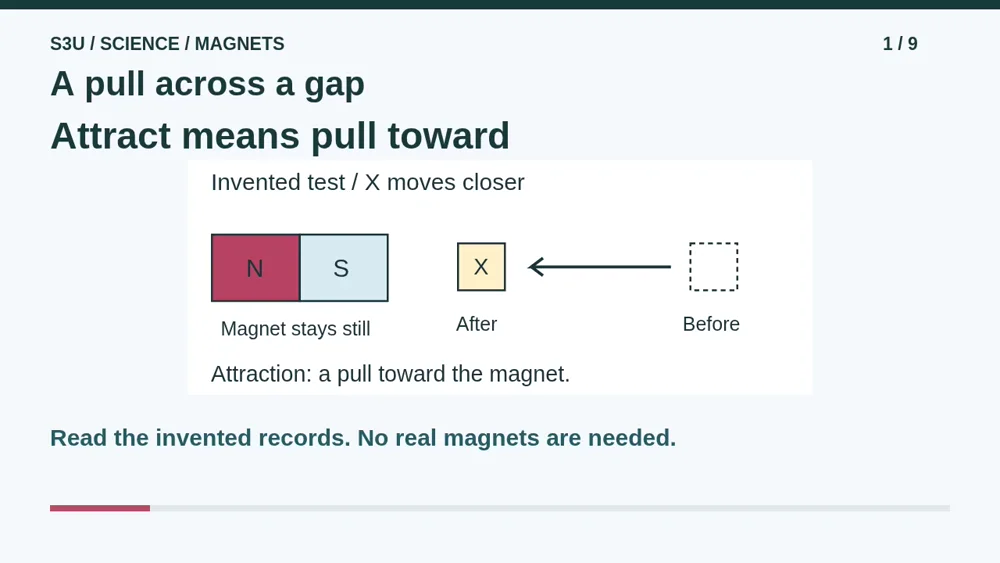
Audio and video share one lesson record. Keep this page open while listening.
Download audio Downloads do not save lesson progress.
The audio could not load. The transcript is still available below.
Next: your worksheet
Use a Magnet Test without Overgeneralizing - Practice 1
Checking sign-in...
Read the transcript
Saved reading place
Audio transcript and practice. Reading or printing does not count as playback time or an assessed grade.
1. A pull across a gap
Audio: 0:00
A magnet can pull some objects toward it without touching them. We call that attraction. In our invented test, object X moved toward a magnet across a small gap. The magnet did not grow a tiny grabbing hand! We will use drawings and records only. You do not need to find or handle magnets for this lesson.
2. A guess is not a result
Audio: 0:25
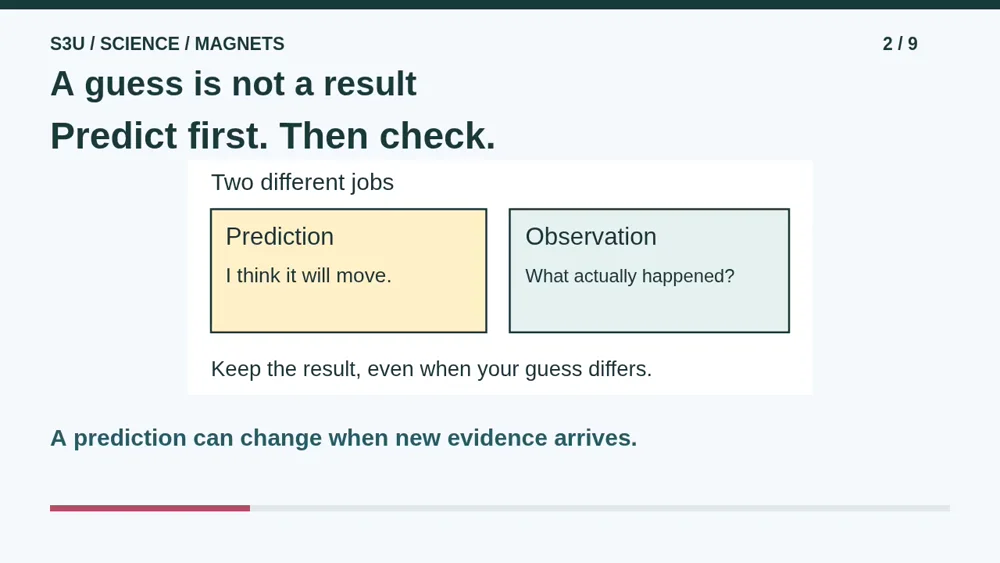
Before a test, we might predict that a shiny object will move toward a magnet. A prediction is what we think will happen. An observation is what the test actually shows. If the result differs from our prediction, we keep the result. We do not erase it to make our guess look right. Shiny is a description, not a test result.
3. Two objects, two records
Audio: 0:51
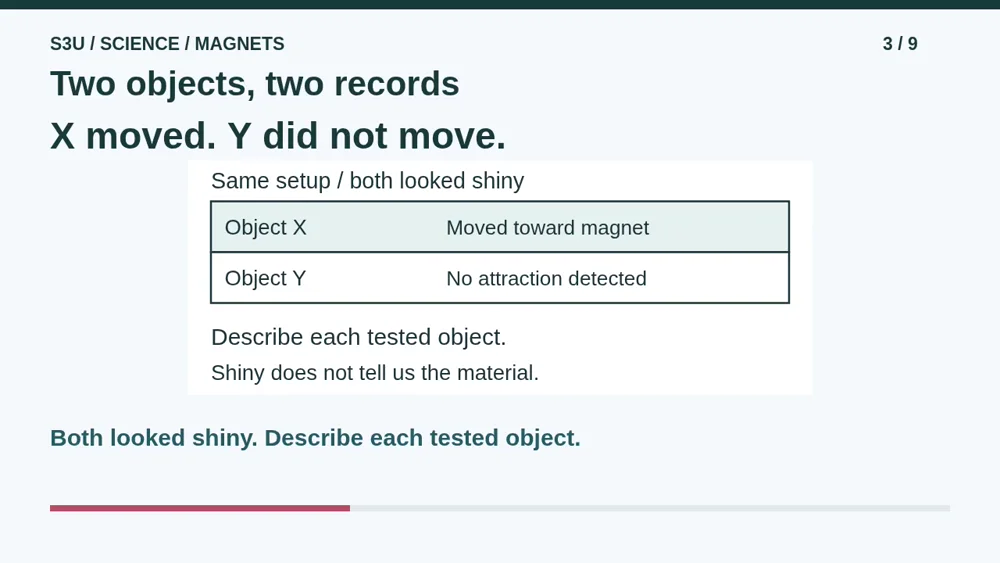
Here are the invented records. X and Y both looked shiny. X moved toward the magnet. For Y, the observers detected no attraction in this test. Which object was attracted here? X. The record does not say Y was attracted too. It also does not tell us exactly what X or Y is made of. Read each observation before making a claim.
4. Make the comparison fair
Audio: 1:21
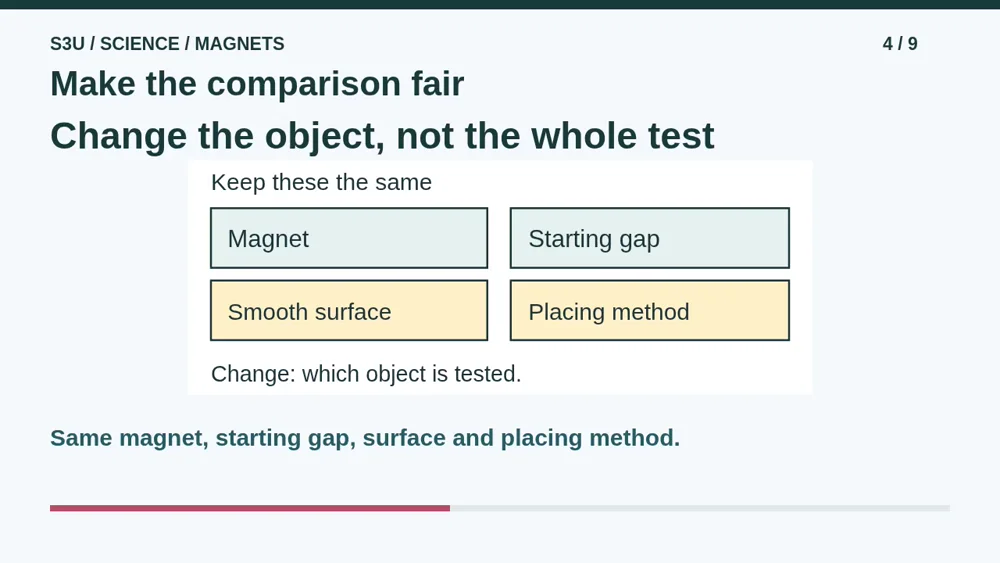
To compare these objects, the observers used the same magnet, the same starting gap, the same smooth surface, and the same way of placing each object. They changed the object being tested. If one object started nearby and another started far away, distance could help explain a difference. This compares the tested objects. It does not prove that every object made from a certain material will behave exactly the same.
5. Keep the limit in the sentence
Audio: 1:52

For Y, say no attraction was detected in this test. That is more careful than saying Y can never respond under any conditions. We can check the setup and repeat the observation. Object Z has not been tested at all. Its empty record means we do not know the result. Empty is not another way to write no. Keep unknown results separate from observed results.
6. Pause: write a careful report
Audio: 2:21
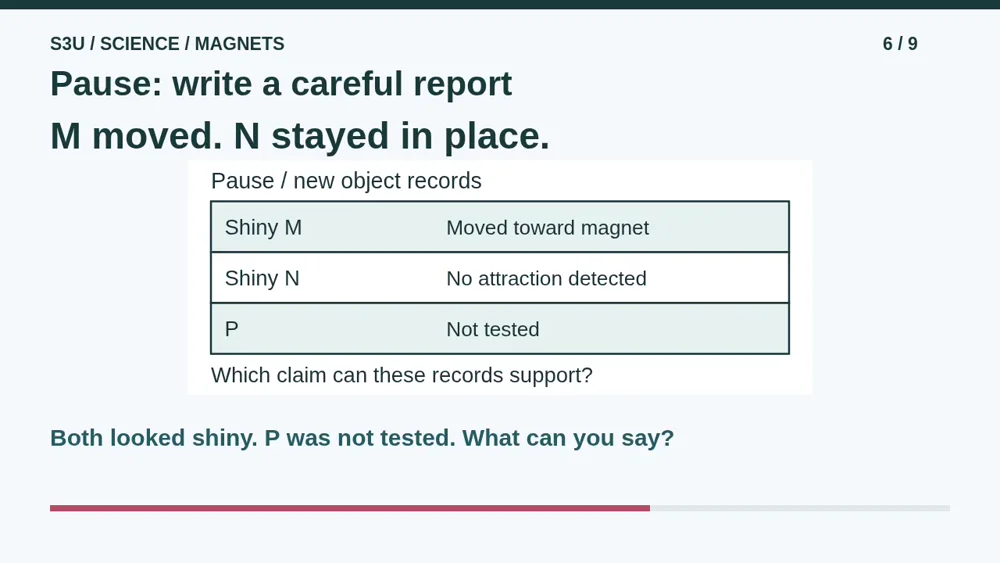
Pause for three new objects. In the same kind of test, shiny M moved toward the magnet. Shiny N stayed in place, with no attraction detected. P was not tested. Which object was attracted in this test? Does this show that all shiny objects are attracted? What can you say about P? Say or write your report before continuing. Use these new records, not the earlier letters.
7. Check the size of your claim
Audio: 2:53
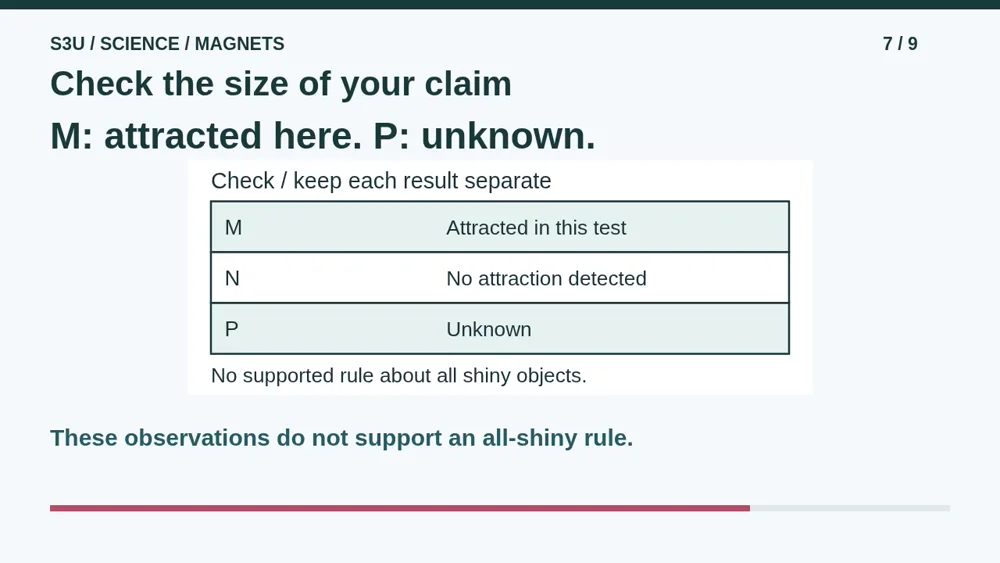
M was attracted in this test. N showed no detected attraction. Since both looked shiny but the results differed, these records do not support the rule that all shiny objects are attracted. P is still unknown because there is no test result for it. We can propose testing P using the same method, but we cannot write the result before the test happens.
8. Metal is not a single answer
Audio: 3:20
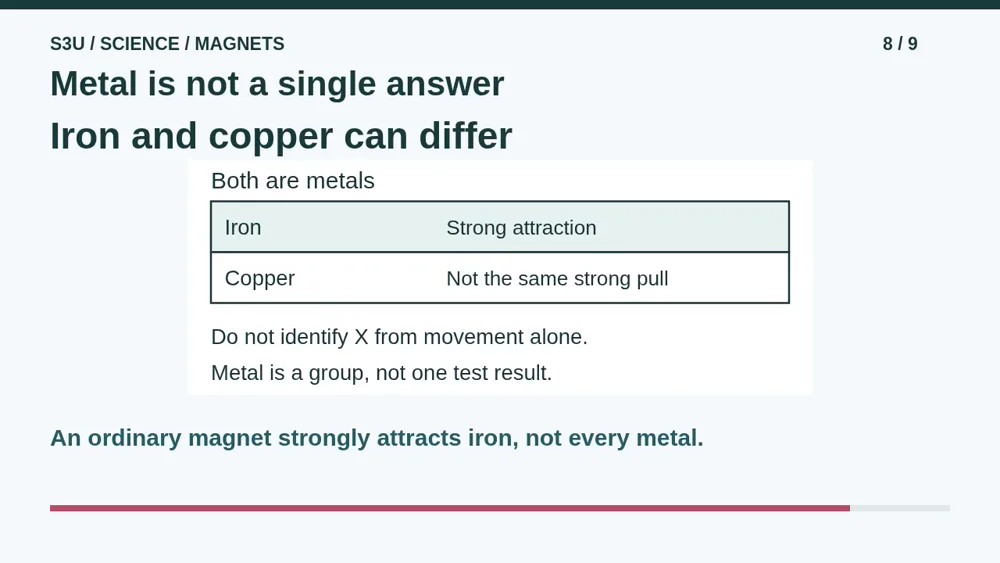
Fun fact: iron is strongly attracted to an ordinary magnet, while copper does not show that same strong attraction. Both are metals. Calling something metal, or noticing that it is shiny, is not enough to decide its result. A magnet is not a shiny-object collector! Our fictional letters did not identify materials, so do not rename X as iron just because X moved.
9. Continue to the worksheet
Audio: 3:49
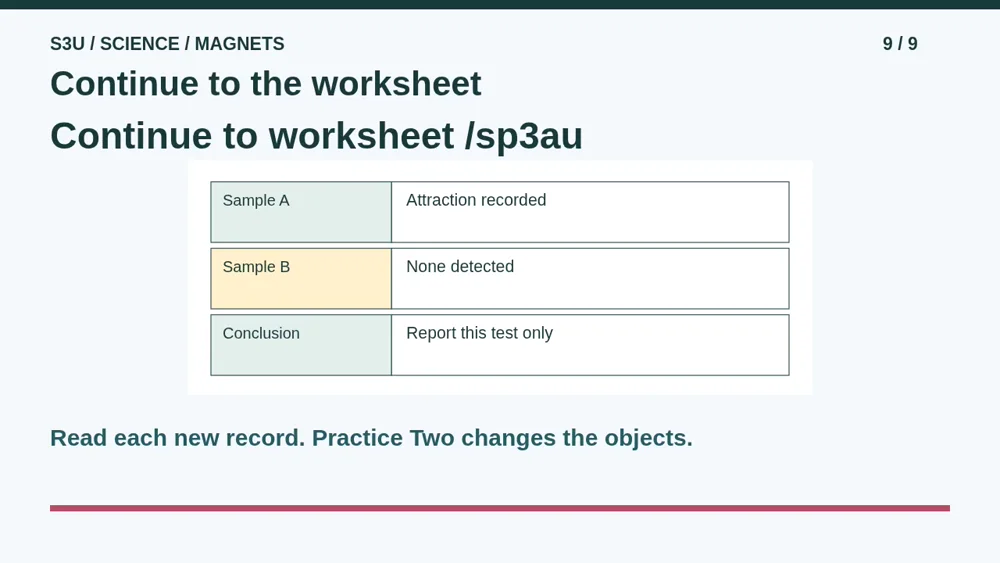
Continue to the magnet-test worksheet below. It has new pairs of objects. Read which sample moved and which showed no detected attraction, then choose the report supported by that record. Practice Two gives more pairs. You can answer on screen or print a copy. Explain why a result for one object is not a rule about all shiny things. No equipment, upload or real experiment is needed.
Show your understanding
You can point, explain aloud, draw or write.
- Use a recorded magnet test to distinguish attraction, no detected attraction and an untested object.
- Explain why a prediction, a shiny surface or one result cannot establish a rule about every object; name conditions kept the same for comparison.
Try it yourself
Pause at objects M, N and untested P. Say what was observed, what remains unknown and whether the records support a rule about all shiny objects.
Continue to the worksheet and Practice Two. Use each new pair of records, keep the limits of the test in your explanation and do not guess an object's material from one result.
Next: your worksheet
Use a Magnet Test without Overgeneralizing - Practice 1https://s3u.com/sp3au
Practice Two: more magnet-test records · Practice reading magnet-test evidence
Lesson: https://s3u.com/listen/read-a-magnet-test