Science / Grade 5
Packet puzzles: order the pieces
Learning goal: Reconstruct a labeled paper message, distinguish duplicates from missing pieces and state the model limits.
Before you start: Put whole numbers in order and match two labels. Use the paper-message model, not real network settings.
Read or print this lesson What to practice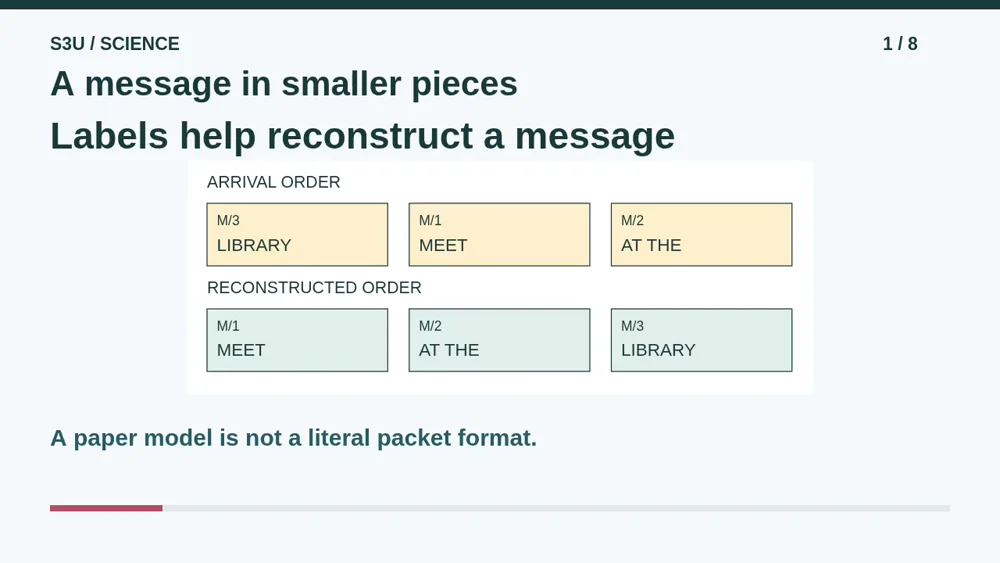
Audio and video share one lesson record. Keep this page open while listening.
Download audio Downloads do not save lesson progress.
The audio could not load. The transcript is still available below.
Next: your worksheet
Put a Packet Message Back in Order
Checking sign-in...
Read the transcript
Saved reading place
Audio transcript and practice. Reading or printing does not count as playback time or an assessed grade.
1. A message in smaller pieces
Audio: 0:00
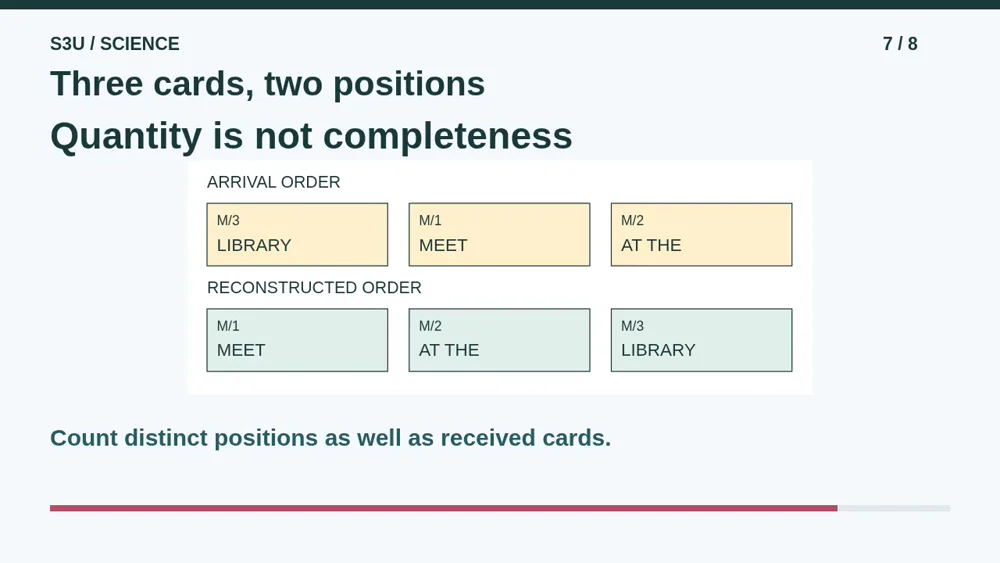
A message can travel in smaller pieces instead of one giant block. Our paper model labels each piece with a message name and a position. Real network protocols are more detailed and do not all make the same promises. Today we are studying a simple ordering problem.
2. Read both parts of the label
Audio: 0:21
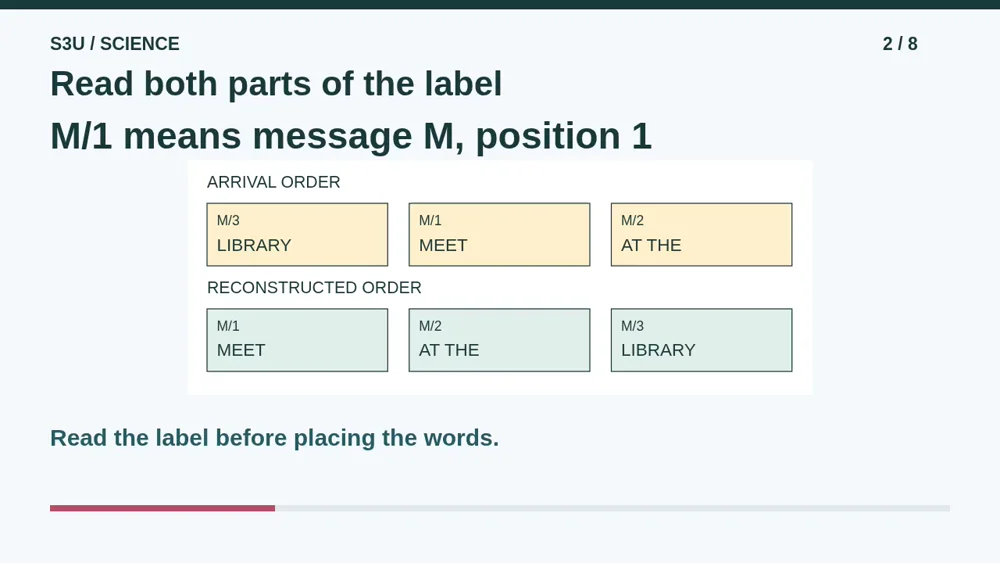
Message M needs three pieces. M one carries the word meet, M two carries at the, and M three carries library. The label and the words have different jobs. One helps organize the pieces; the other carries the message we want to reconstruct.
3. Arrival is not the answer
Audio: 0:41
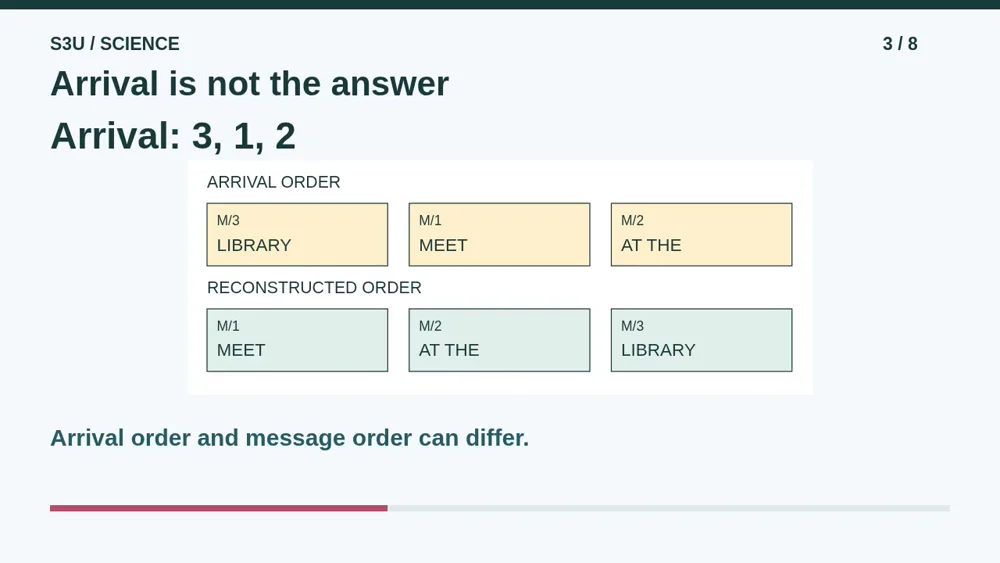
Our pieces arrive in the order three, one, two. Reading immediately in arrival order would scramble the message. Instead, use each position label. The last piece to arrive need not be the last piece in the sentence. Our desk is an organizer, not a race announcer.
4. Reconstruct the whole message
Audio: 1:03
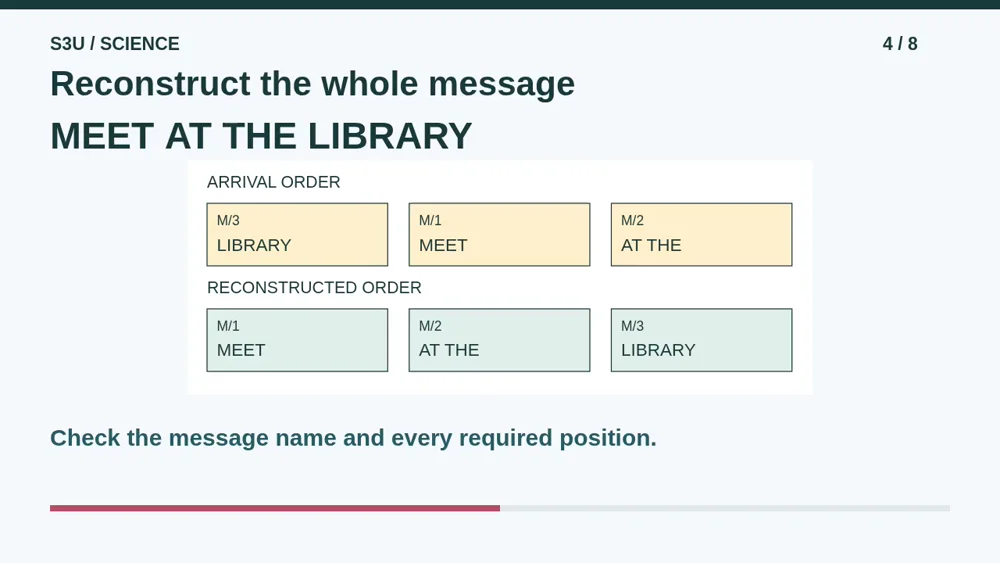
Place M one first, M two second and M three third. The reconstructed message is meet at the library. We know it is complete in this model because all three required positions are present for message M. Counting cards alone would not give us the same assurance.
5. Pause: inspect a new delivery
Audio: 1:24
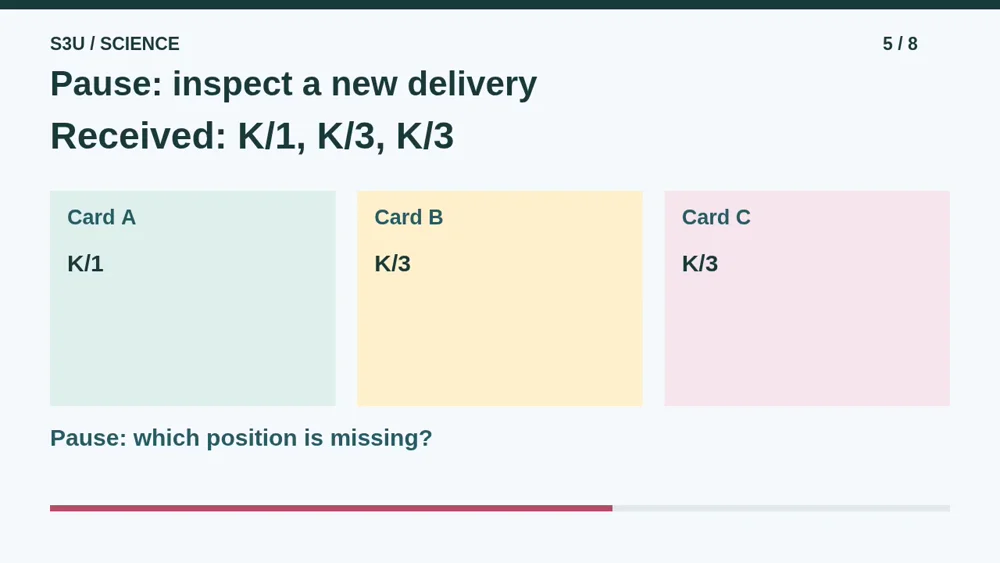
Here is a new message K that needs positions one, two and three. The received cards are K one, K three and another K three. Pause and identify the missing position. Then explain why having three cards does not prove that all three parts of the message arrived.
6. Check the missing piece
Audio: 1:45
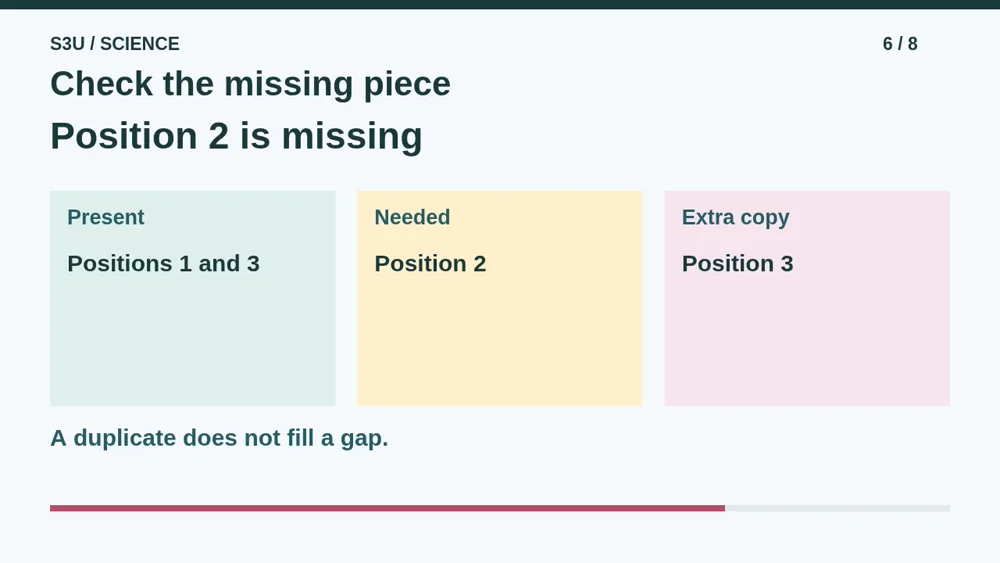
Position two is missing. Two copies of position three do not supply position two. In a system designed to request missing information, that gap can be a reason to request the missing part. We should not invent its contents or borrow a piece from a different message.
7. Three cards, two positions
Audio: 2:06
Fun fact: three received cards can cover only two different positions. Our example has one, three and three. It is another reason to name what you count. Cards received and distinct message positions are different quantities, even when their numbers sometimes happen to match.
8. Keep the model honest
Audio: 2:28
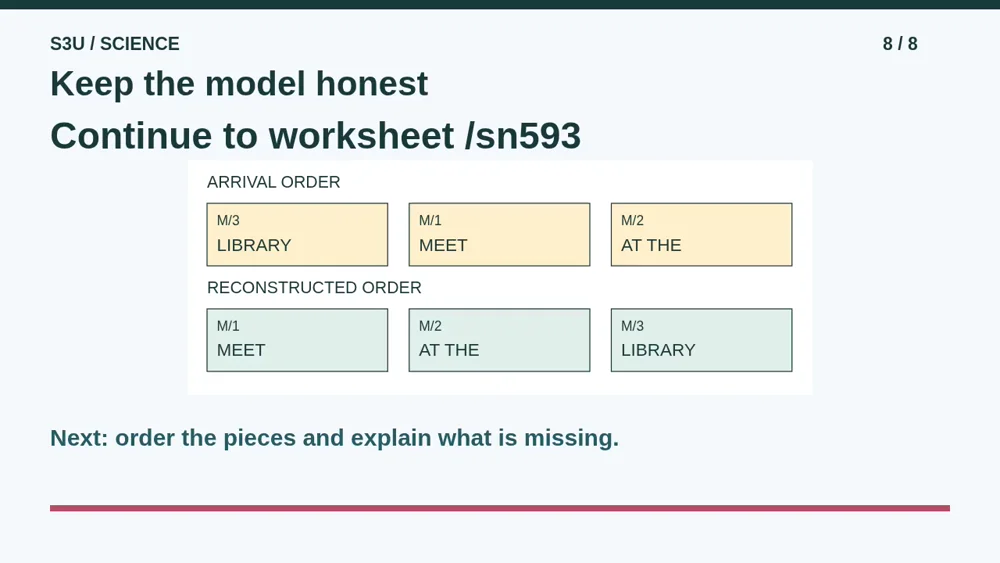
Continue to the worksheet below. Reconstruct the original message, inspect a duplicate and reject a piece labeled for another message. Keep the exercise on paper. It does not require sending traffic, collecting real addresses or scanning networks. The goal is careful reasoning about labeled information.
Show your understanding
You can point, explain aloud, draw or write.
- Rebuild a labeled message while identifying a duplicate or missing piece.
- Explain one thing the simplified paper model does not establish about a real network.
Try it yourself
Here is a new message K that needs positions one, two and three. The received cards are K one, K three and another K three. Pause and identify the missing position. Then explain why having three cards does not prove that all three parts of the message arrived.
Continue to the matching worksheet.
Next: your worksheet
Put a Packet Message Back in Orderhttps://s3u.com/sn593
Lesson: https://s3u.com/listen/packet-order