Science / Grades 6-8
Mass and weight on different worlds
Learning goal: Calculate gravitational force and find out why an unchanged backpack weighs less on the Moon.
Before you start: Multiply decimals and distinguish kilograms from newtons.
Read or print this lesson What to practice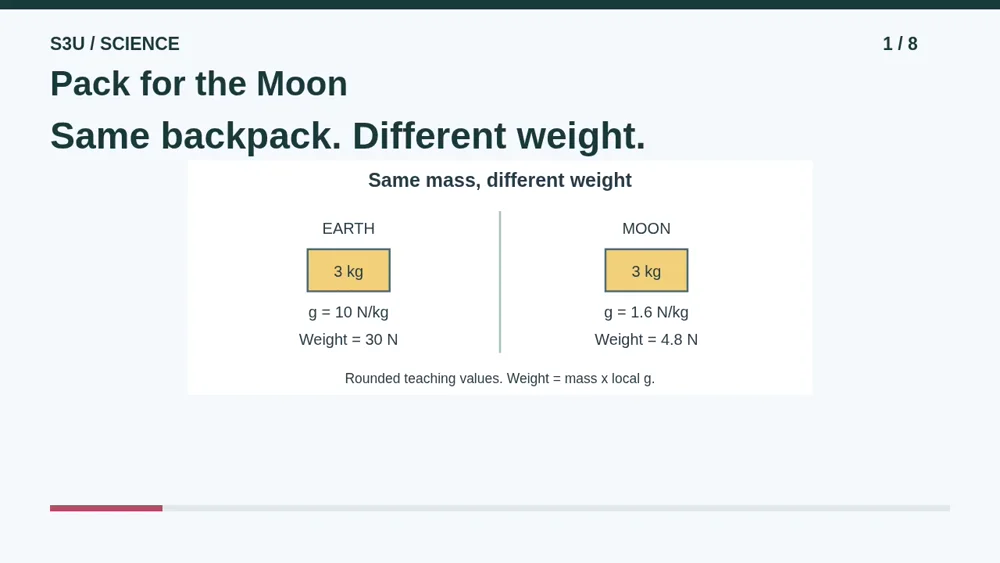
Audio and video share one lesson record. Keep this page open while listening.
Download audio Downloads do not save lesson progress.
The audio could not load. The transcript is still available below.
Next: your worksheet
Gravity: Calculate Mass and Weight
Checking sign-in...
Read the transcript
Saved reading place
Audio transcript and practice. Reading or printing does not count as playback time or an assessed grade.
1. Pack for the Moon
Audio: 0:00
Imagine packing a three kilogram backpack for a trip to the Moon. Its mass does not disappear on arrival. But its weight changes. Your backpack did not quietly eat less lunch. It is in a place with a different gravitational field.
2. Mass and weight are different
Audio: 0:19
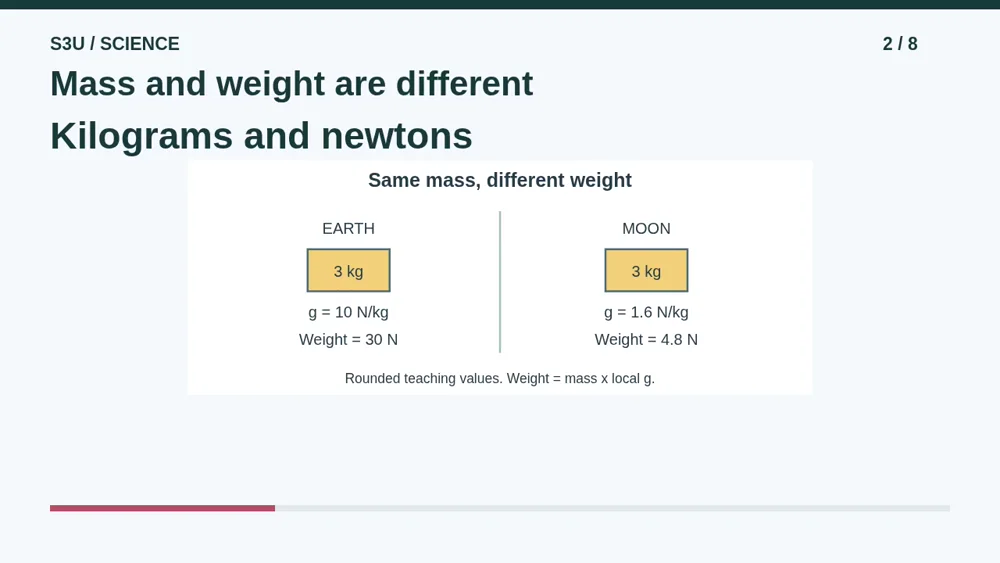
Mass describes how much an object resists a change in motion. We measure mass in kilograms. Weight is the gravitational force acting on that mass. We measure force in newtons. In everyday speech people mix these words, but our science notebook keeps them separate.
3. A useful relationship
Audio: 0:41
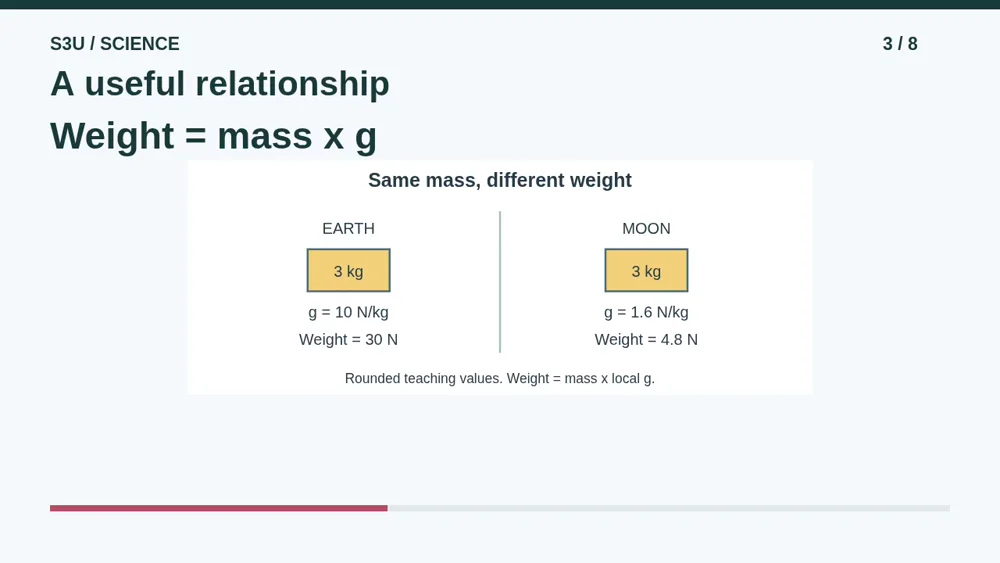
To find weight, multiply mass by local gravitational field strength, called g. When mass is in kilograms and g is in newtons per kilogram, the answer is in newtons. The local value matters. There is no one weight for a backpack everywhere in the universe.
4. Work an Earth example
Audio: 1:02
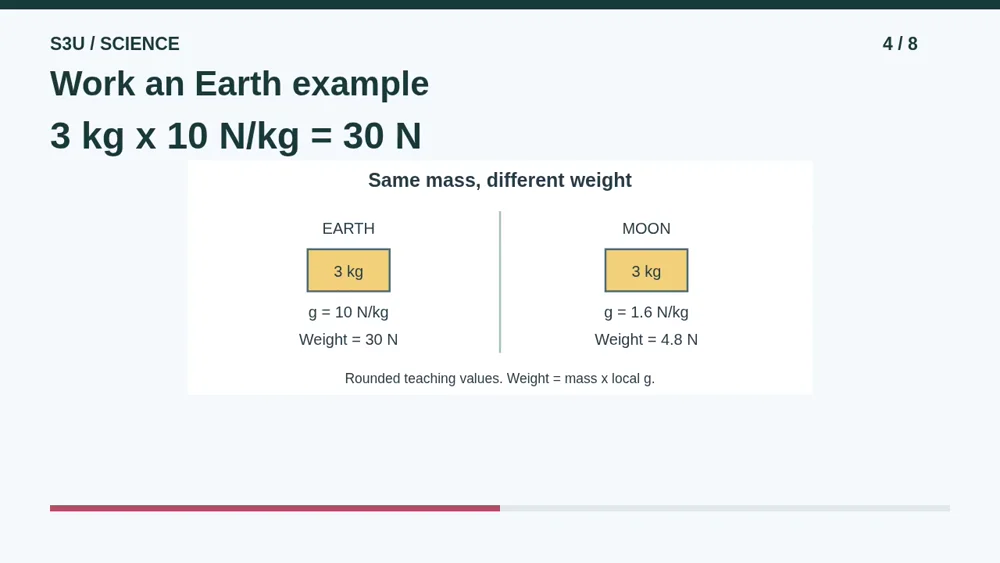
For a simple Earth estimate, use g equal to ten newtons per kilogram. A three kilogram backpack then weighs thirty newtons. Ten is a convenient approximation, not an exact value everywhere. Near Earth surface, a more usual rounded value is nine point eight.
5. Now try the Moon
Audio: 1:24
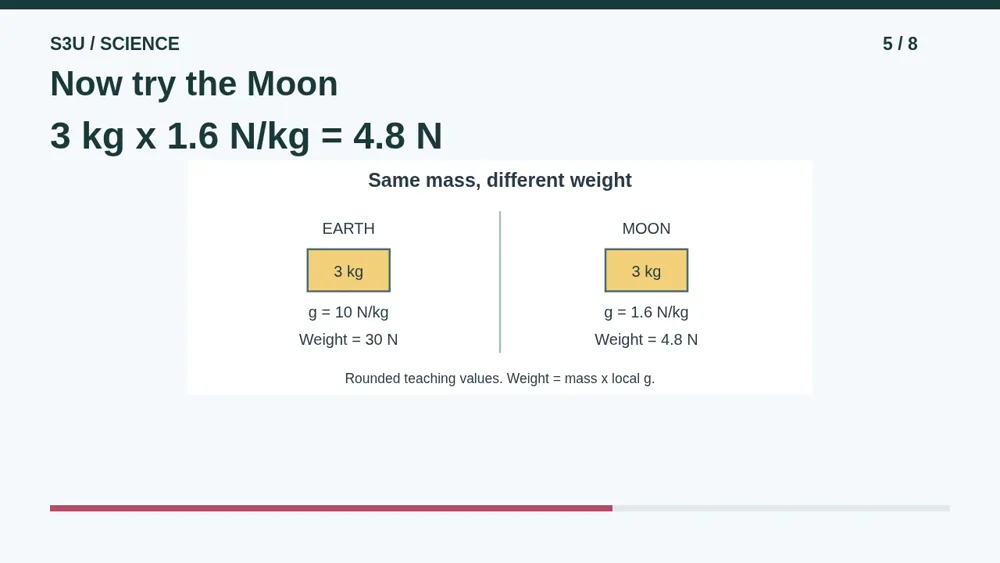
Near the Moon surface, use about one point six newtons per kilogram. Multiply three by one point six. The same backpack weighs about four point eight newtons. Its mass is still three kilograms. Smaller gravitational pull changed the force, not the contents.
6. Pause and calculate
Audio: 1:46
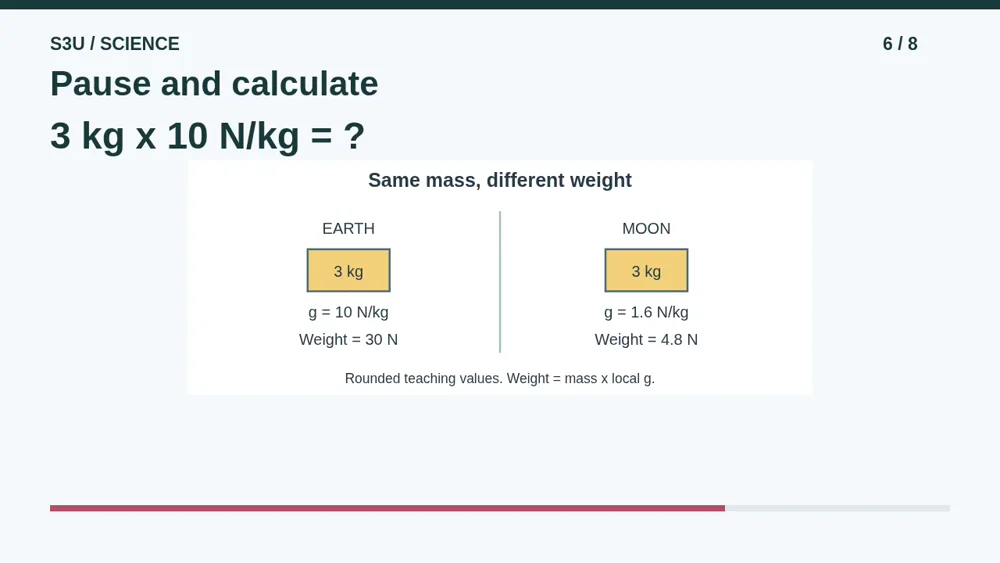
Pause and calculate the weight of a three kilogram package in our simplified Earth model. Then ask a second question. If we take it to the Moon without adding or removing anything, will its mass change? Explain each answer before continuing.
7. Check the units
Audio: 2:05
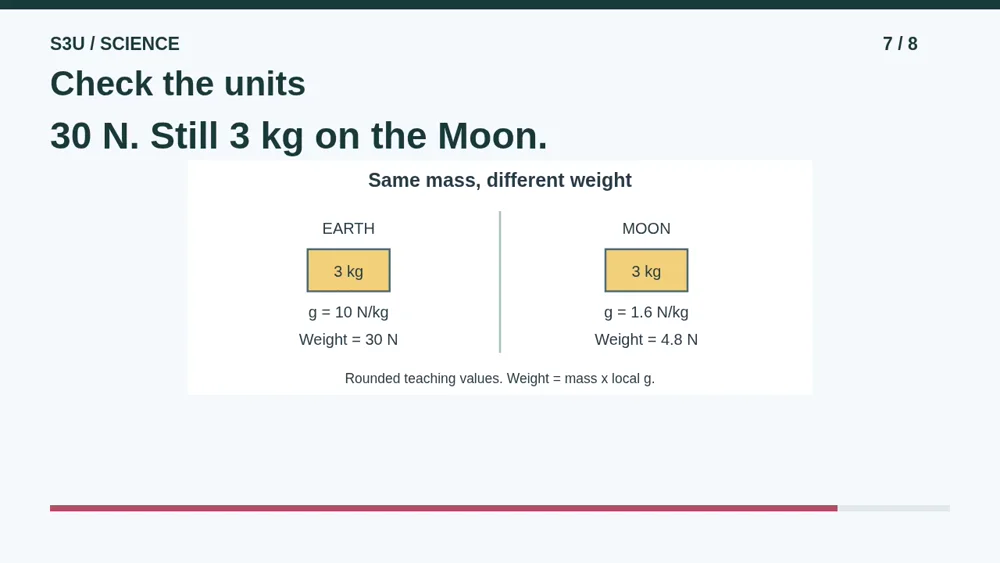
The Earth estimate is thirty newtons, because three times ten is thirty. The mass stays three kilograms on the Moon. Here is a fun fact: a floating object on a space station still has mass and resists changes in motion. Floating is not mass disappearing.
8. A scale needs context
Audio: 2:26
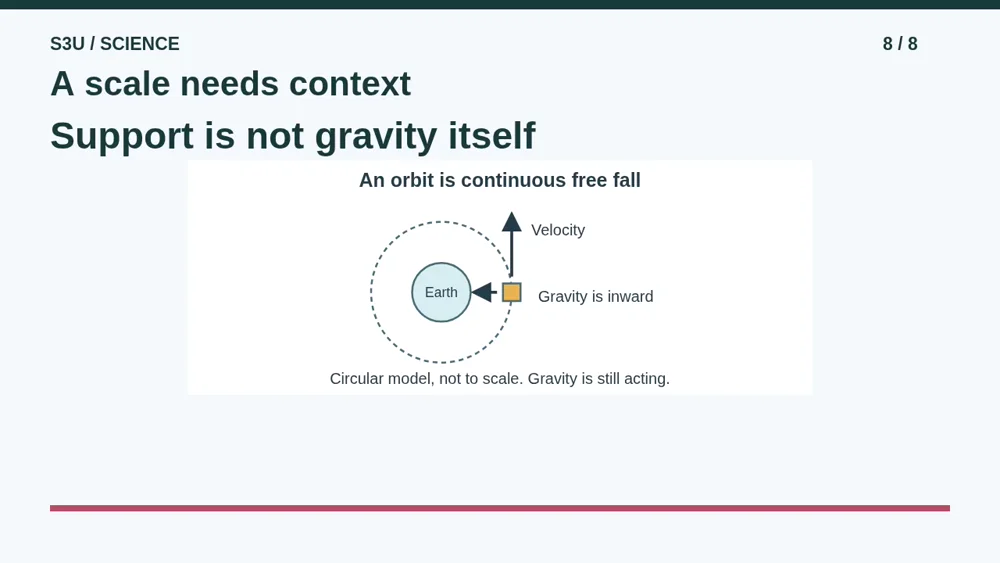
An ordinary scale responds to a support force. In orbit, a scale and its load can fall together, even while gravity still acts. Do not use a floating object as proof of zero gravity. Continue to the worksheet to compare masses, weights, and units.
Show your understanding
You can point, explain aloud, draw or write.
- Use the given gravitational field strength and mass to calculate weight with units.
- Compare the same object in two places while keeping its mass separate from its weight.
Try it yourself
Use W = mg and write the units at every step.
Explain why a floating object still has mass.
Next: your worksheet
Gravity: Calculate Mass and Weighthttps://s3u.com/sf620
Lesson: https://s3u.com/listen/mass-and-weight