Math / Grade 3 / time of day
Morning, evening and 24-hour time
Learning goal: Match a.m. and p.m. times to 24-hour readings, handle the twelve o'clock hours and count a short wait across midnight.
Before you start: Read analog and digital times, add or subtract twelve and count minutes across an hour. Use one time zone with no clock changes.
Read or print this lesson What to practiceThe video could not load. The transcript is still available below.
Next: your worksheet
Morning, Evening and 24-Hour Time: Set One
Checking sign-in...
Read the transcript
Saved reading place
Video transcript and practice. Reading or printing does not count as playback time or an assessed grade.
1. Same hands, different time of day
Video: 0:00
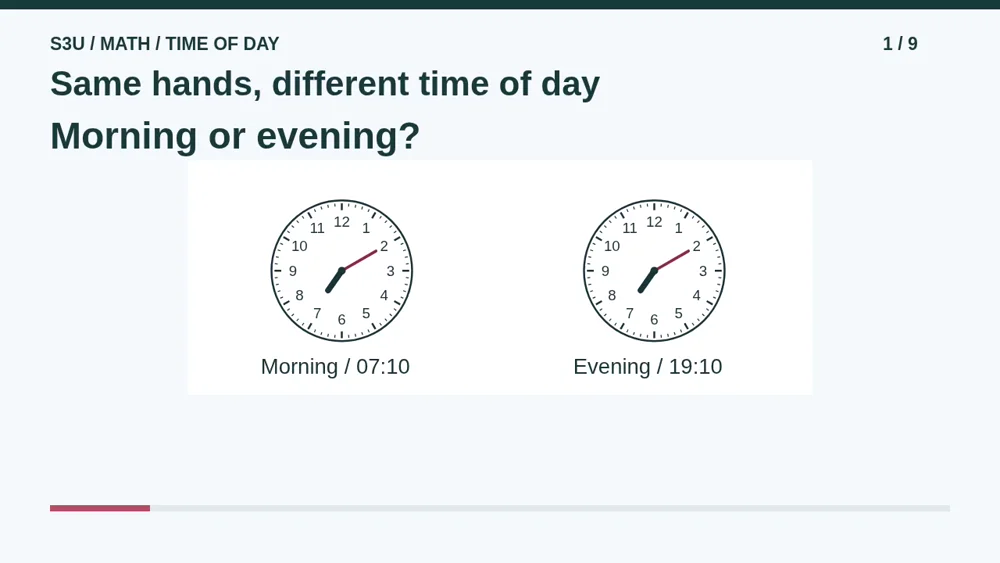
These two clocks have matching hands. Each shows seven ten. But the first label says morning. The second says evening. The hands are not broken. They just cannot tell the whole story! We need another clue to know which part of the day is meant. Today we will name the same time in two different ways.
2. The letters add a clue
Video: 0:25
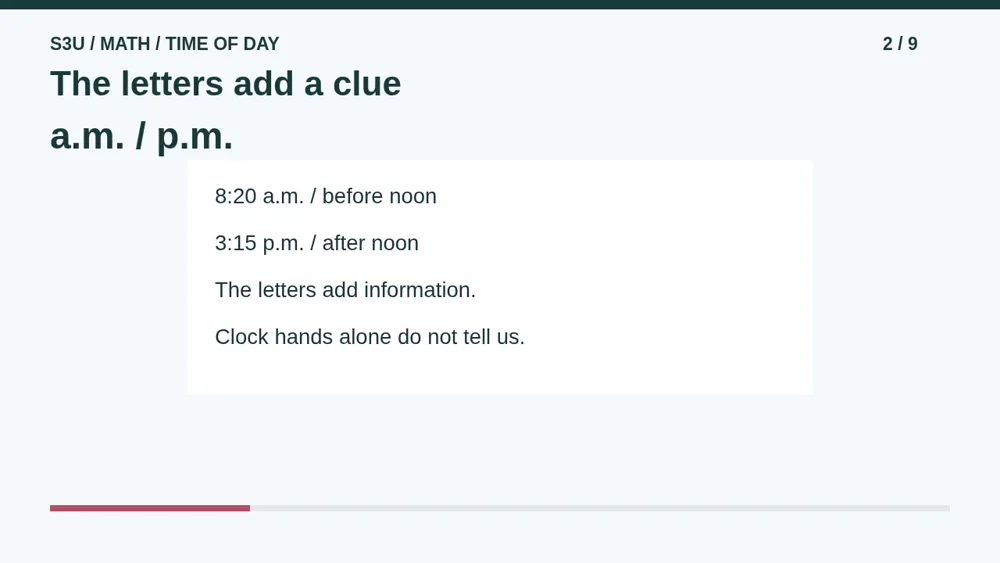
Eight twenty A M is before noon. Three fifteen P M is after noon. The letters add information that the clock hands do not give us. Do not guess from a sunny or dark picture. Daylight depends on where you are and the time of year. Read the time label instead.
3. Count the hours from zero
Video: 0:47
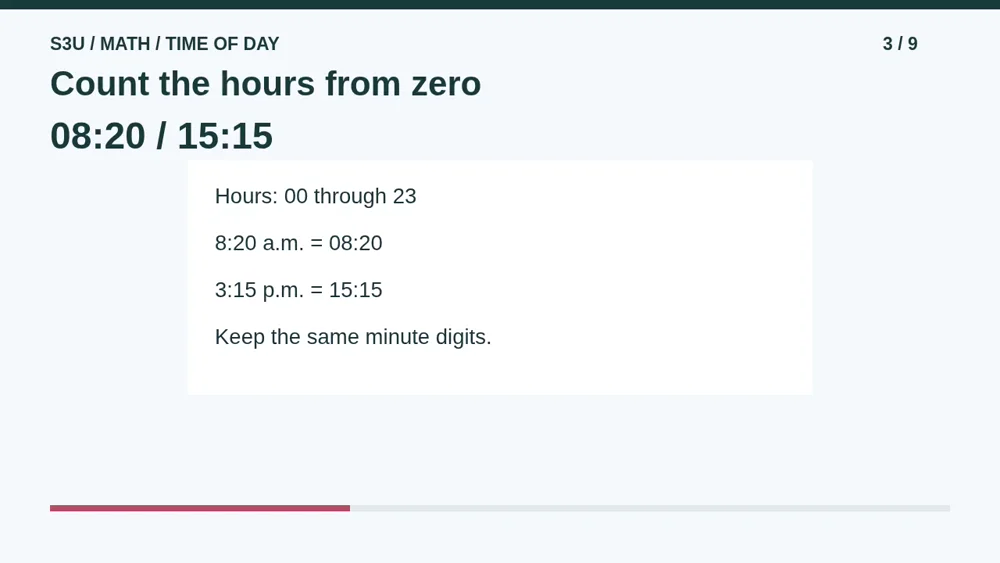
A twenty-four-hour clock uses hour numbers from zero through twenty-three. Eight twenty A M becomes zero eight, colon, twenty. Three fifteen P M becomes fifteen, colon, fifteen. The minutes stay the same. In these written readings, we keep two digits on each side of the colon. No A M or P M letters are needed.
4. Take special care with twelve
Video: 1:13
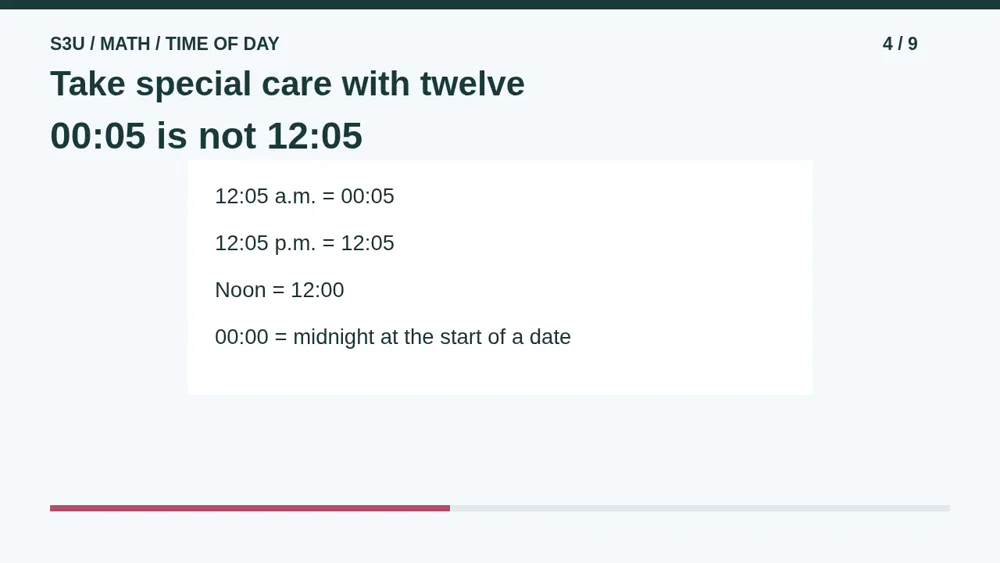
Twelve needs a little extra care. Twelve oh five A M is five minutes after midnight. Write zero zero, colon, zero five. Twelve oh five P M is five minutes after noon. Write twelve, colon, zero five. For exact boundaries, say noon, or midnight at the start of a named date. Here, noon is twelve, colon, zero zero. Midnight at the start of a date is zero zero, colon, zero zero.
5. Change the hour, not the minutes
Video: 1:46
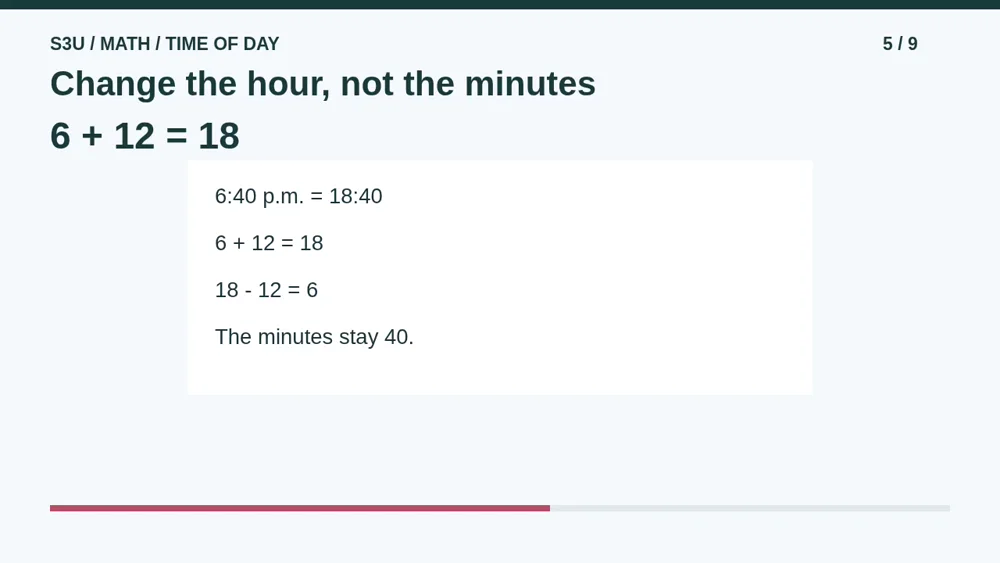
For a P M hour from one through eleven, add twelve. Six forty P M becomes eighteen forty. To go back, subtract twelve from eighteen. That gives six forty P M. The minutes stay forty both ways. Do not add twelve to the minutes. They were not invited to that calculation! Remember, the P M hour twelve stays twelve.
6. Pause: name these another way
Video: 2:14
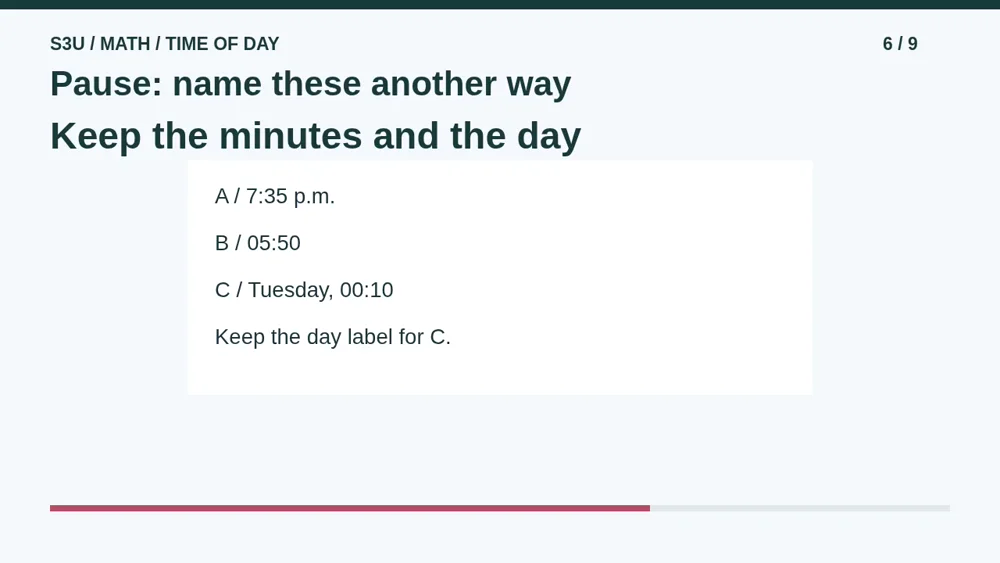
Pause and try three new readings. A is seven thirty-five P M. Write it in twenty-four-hour time. B is zero five, colon, fifty. Say it with A M or P M. C is Tuesday, zero zero, colon, ten. Say it with A M or P M, and keep the correct day. Explain what happens to the hour. Continue when you are ready to check.
7. Check the hour and the day
Video: 2:43
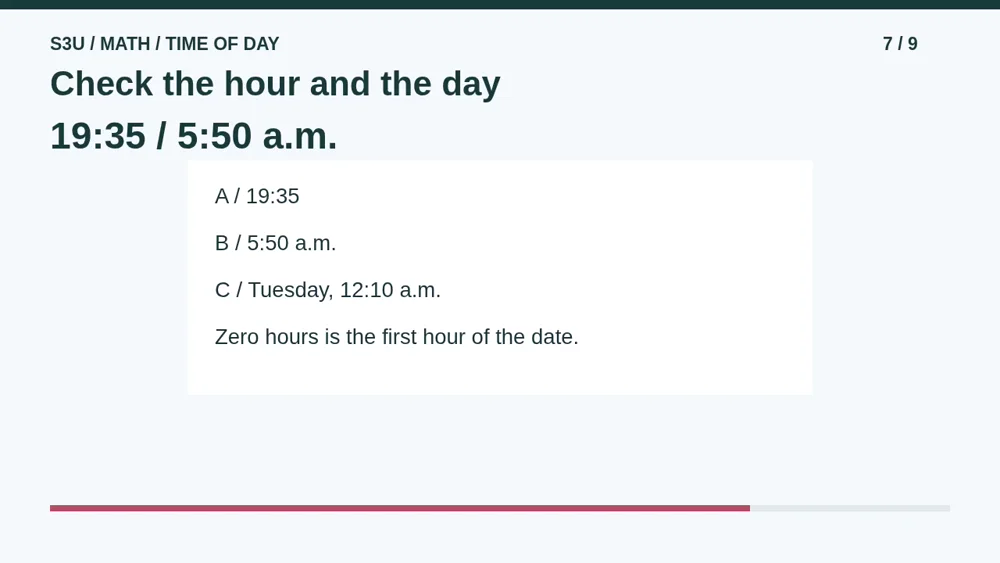
A is nineteen thirty-five. Seven plus twelve is nineteen. B is five fifty A M, a time before noon. C is twelve ten A M on Tuesday. It is ten minutes after midnight at the start of Tuesday, not Monday. Hour zero belongs to the new date. If you changed the minutes or lost the day label, try that reading again.
8. A short wait can cross midnight
Video: 3:10
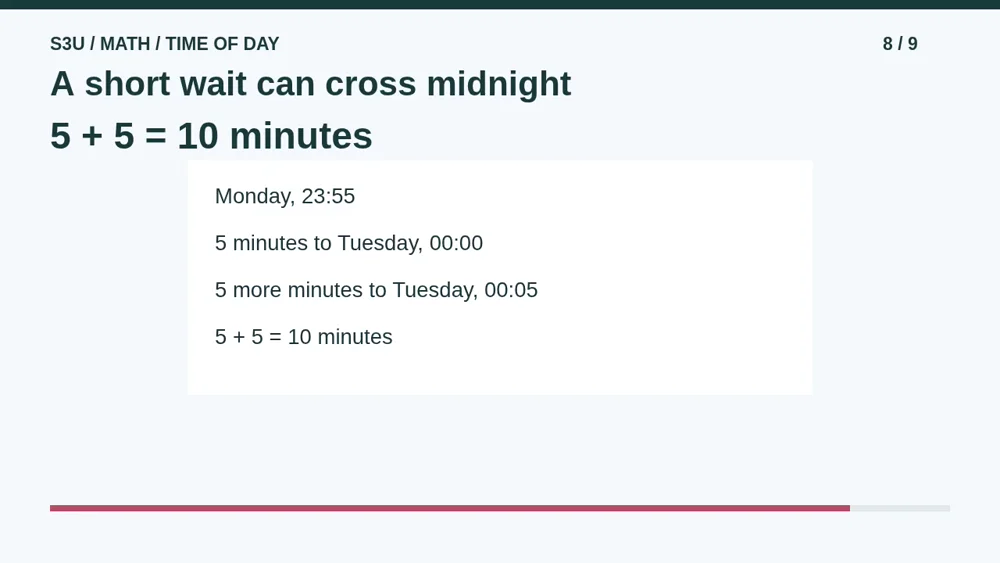
Use one time zone with no clock change. From Monday at twenty-three fifty-five, wait five minutes to midnight at the start of Tuesday. Wait five more minutes to Tuesday, zero zero, colon, zero five. Only ten minutes have passed. A new date does not always mean a long wait. Split the wait at midnight instead of subtracting the written hour numbers.
9. Continue with your own practice
Video: 3:37
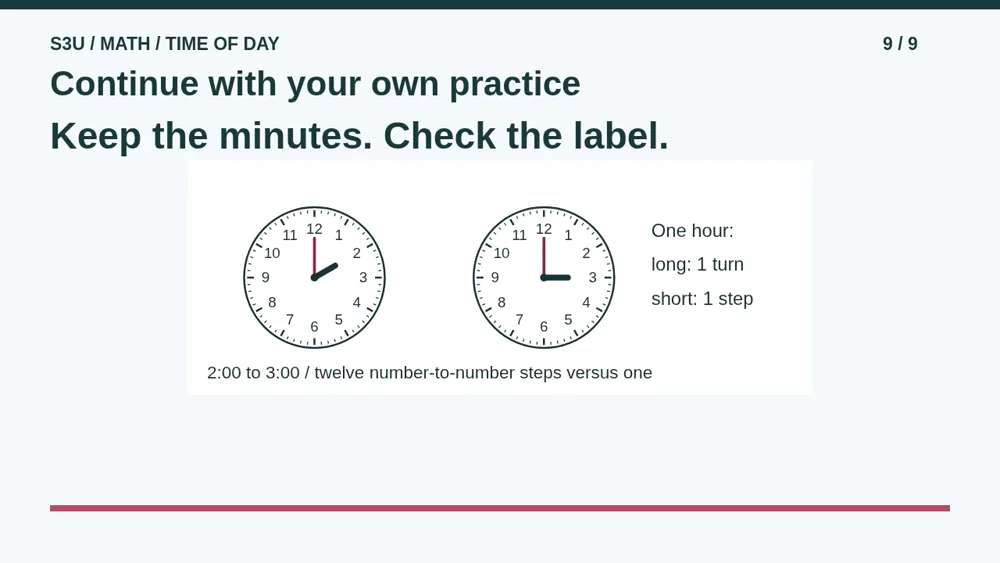
Here is a clock fact. In one hour, the long minute hand makes a full turn, while the short hour hand moves just one number-to-number step. The long hand turns through twelve times the angle. Now continue to the worksheet below. Its time labels are different from our examples. Check each hour, keep the minutes, and explain your choices. Try the other worksheet set another day.
Show your understanding
You can point, explain aloud, draw or write.
- Convert between a.m./p.m. and 24-hour readings, including the twelve o'clock hours, without changing the minutes.
- Explain why hands alone cannot give the part of the day and count a short wait across midnight while preserving the date.
Try it yourself
Pause at A, B and C. Change the time format, keep the minute digits and keep the day label for C. Explain the twelve o'clock cases.
Continue to the worksheet for fresh time labels. All examples use one time zone with no clock changes; this is not a time-zone or daylight-saving lesson.
Next: your worksheet
Morning, Evening and 24-Hour Time: Set Onehttps://s3u.com/me3t1
Lesson: https://s3u.com/lessons/two-ways-to-name-a-time