Science / Grade 9
Two recovery goals
Learning goal: Calculate data gaps and complete service interruptions, compare their separate limits and explain what a rehearsal can prove.
Before you start: Read a 24-hour clock, add whole-number minutes and count across an hour boundary. Distinguish a stored data copy from a working service. Use only the invented records.
Read or print this lesson What to practiceThe video could not load. The transcript is still available below.
Next: your worksheet
Recovery Goals: Compare Three Backups
Checking sign-in...
Read the transcript
Saved reading place
Video transcript and practice. Reading or printing does not count as playback time or an assessed grade.
1. Two questions, not one trophy
Video: 0:00
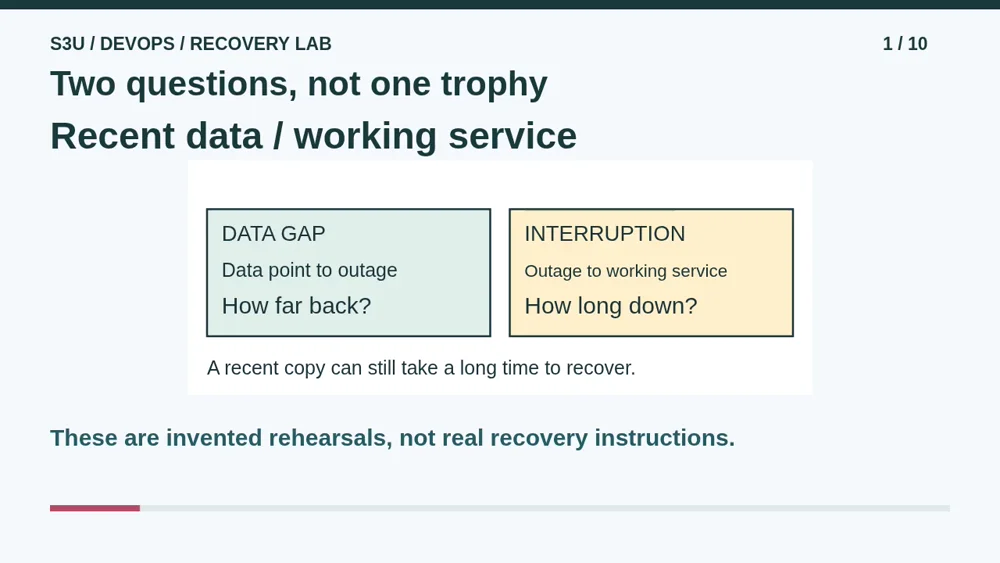
A pretend booking desk stops working. Someone announces, we have a backup, and reaches for a victory flag. Keep that flag on the desk for a moment. We still have two different questions. How recent is the data we can recover? How long does it take to get working service back? A recent copy might take too long to restore. A quick recovery might use data that is too old. We will read clock times and compare each result with its own limit. Everything here is invented. Do not restore, replace, or delete any real records.
2. The data point comes first
Video: 0:42
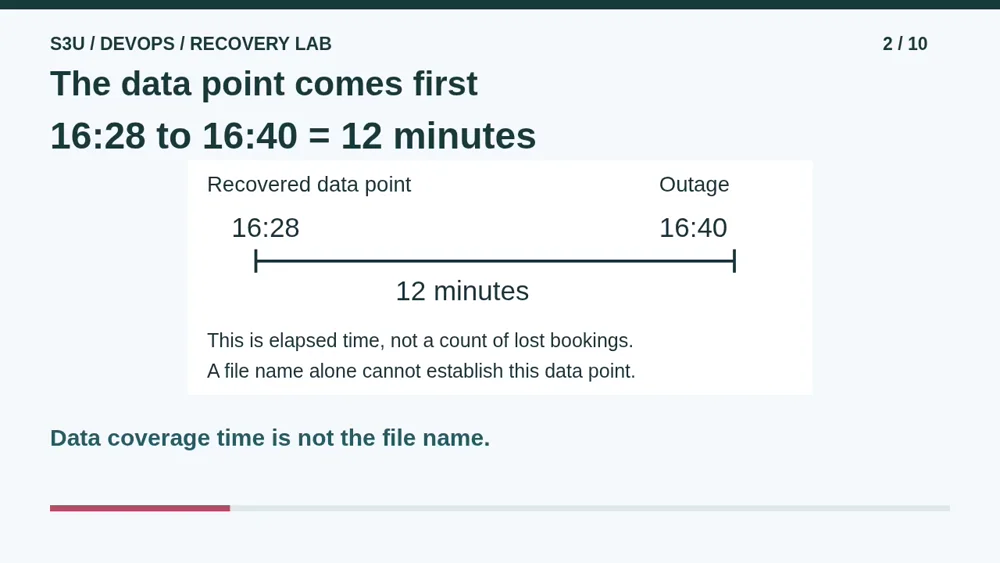
Our main example has an outage at sixteen forty, or four forty in the afternoon. The recovered copy contains the recorded data through sixteen twenty-eight. The time from sixteen twenty-eight to sixteen forty is twelve minutes. We call that the data gap. It describes how far back the recovered data point is from the outage. It does not tell us the number of missing bookings, because we have not been given how often bookings arrived. A file name such as latest does not prove what time the data covers. We need evidence of the recovered data point.
3. A goal is a maximum
Video: 1:23
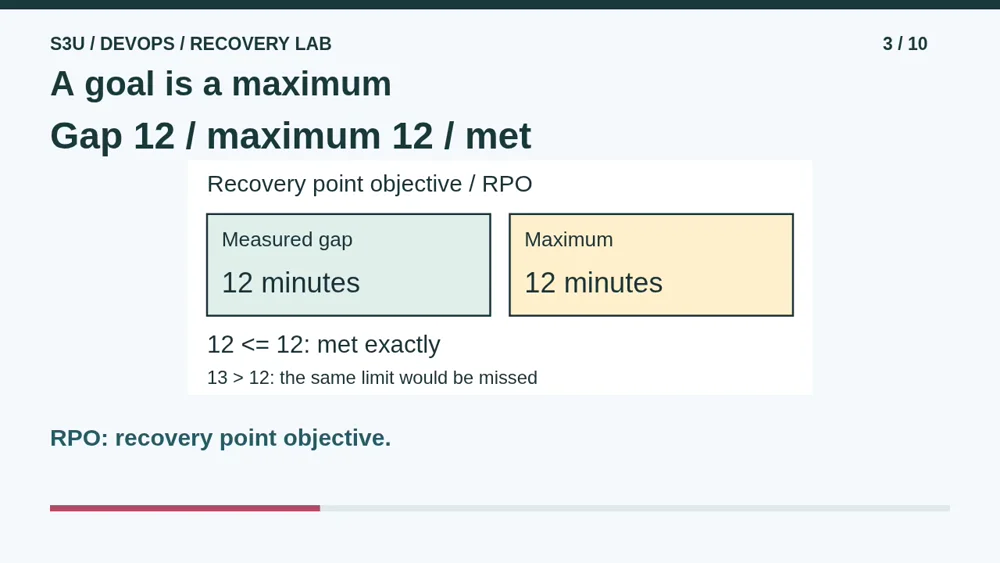
The recovery point objective is the maximum acceptable time gap between the recovered data point and the outage. Its initials are R P O. In our example the maximum data gap is twelve minutes. Our measured gap is also twelve minutes, so that limit is met exactly. A maximum includes equality. A thirteen-minute gap would miss this limit, even if thirteen sounds almost like twelve. These limits are chosen for the needs of a system, not by a universal rule that every system must use twelve minutes. We are applying the stated rule for this fictional desk.
4. Count the whole interruption
Video: 2:06
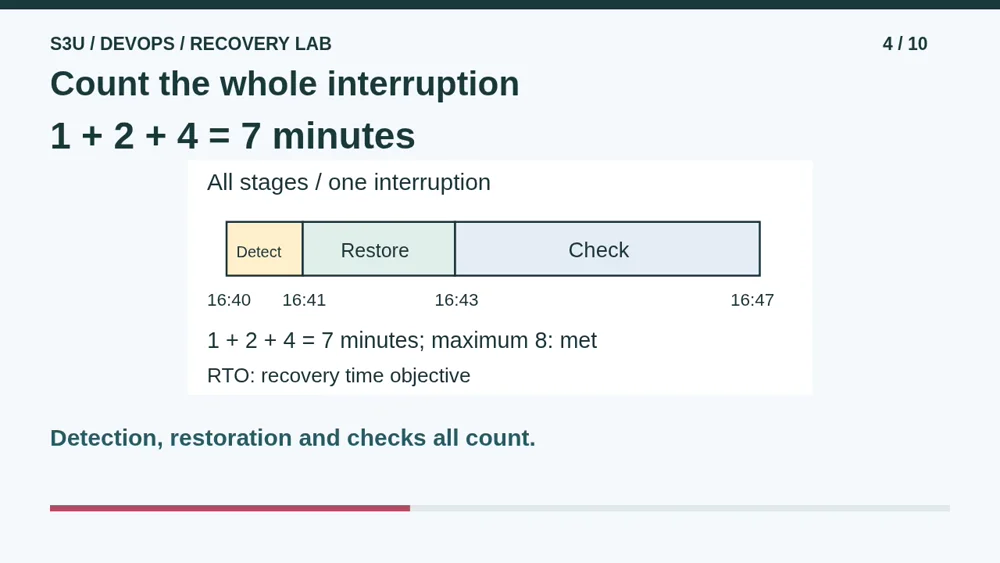
Now measure the other interval. Service stops at sixteen forty. Detection takes one minute, restoration takes two more, and checking takes four more. Working service returns at sixteen forty-seven. The whole interruption is seven minutes: one plus two plus four. Restoration alone took two minutes, but the service was not ready then. The recovery time objective, or R T O, is the maximum acceptable interruption before working service returns. Here that maximum is eight minutes, so seven meets it. These stages happen one after another and include every delay in this example. Real recovery plans must include their other delays too.
5. Recent does not mean fast
Video: 2:55
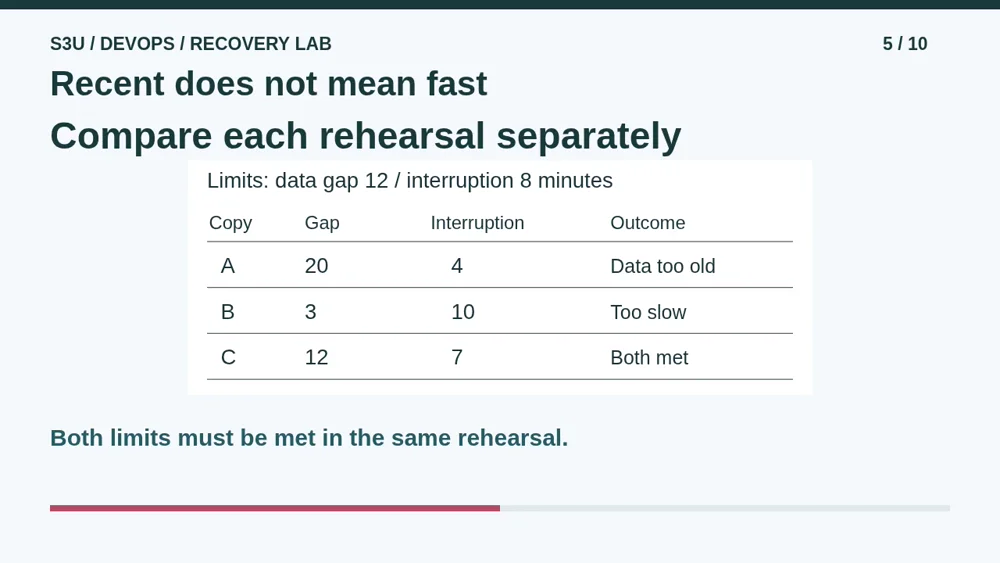
Compare three separate rehearsals for the same sixteen forty outage. Copy A covers through sixteen twenty, giving a twenty-minute data gap, and its whole interruption is four minutes. It is fast enough but its data is too old. Copy B covers through sixteen thirty-seven, giving a three-minute gap, but interruption lasts ten minutes. It is recent enough but too slow. Copy C is our worked example: a twelve-minute gap and seven-minute interruption. It meets both the twelve-minute data limit and the eight-minute time limit. Do not borrow the best result from different rows. We need both goals in the same rehearsal.
6. Across the hour
Video: 3:40
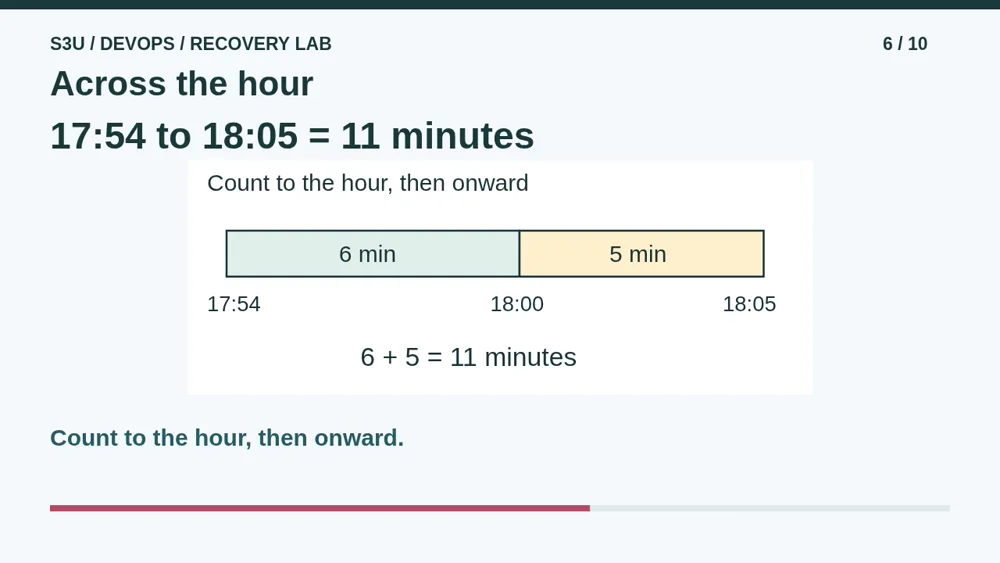
Clock subtraction needs care when the hour changes. Suppose data covers through seventeen fifty-four and an outage starts at eighteen oh five. Count six minutes from seventeen fifty-four to eighteen hundred, then five more to eighteen oh five. The data gap is eleven minutes. Do not subtract fifty-four from five as if the hour had not changed. Also do not measure this gap until service comes back. The recovered data point and the outage define this interval. The outage and working-service return define the separate interruption interval. They share the outage marker, but they answer different questions.
7. Pause: does this meet both?
Video: 4:25
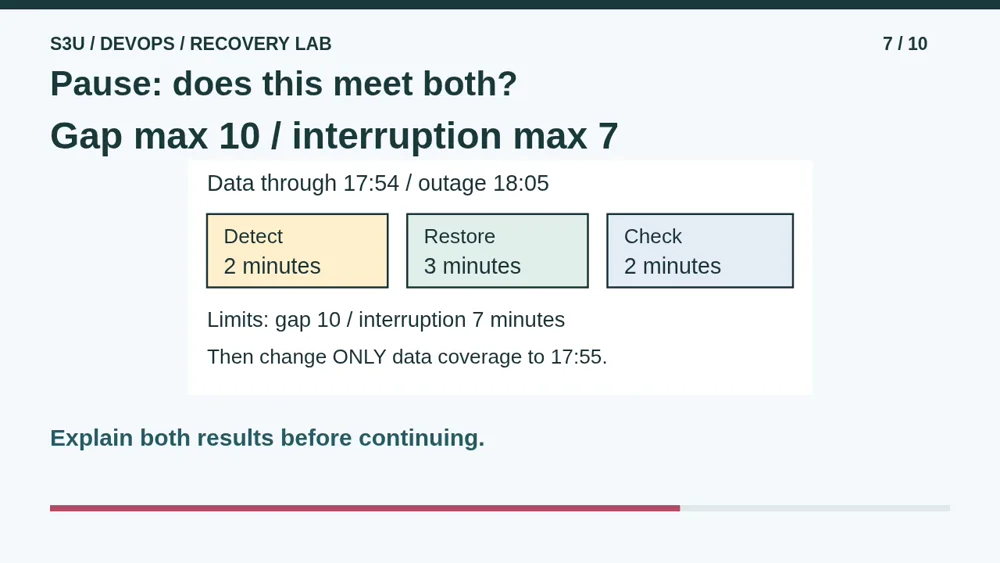
Pause for a fresh rehearsal. Data covers through seventeen fifty-four. The outage begins at eighteen oh five. Detection takes two minutes, restoration takes three, and checking takes two. The maximum data gap is ten minutes. The maximum interruption is seven minutes. Calculate both measured intervals, then say which goals are met. Now imagine a separate rehearsal with data through seventeen fifty-five and the same detection, restoration, and checking times. Which result changes? Which stays the same? You can explain aloud or write your reasoning. Keep the two goals separate, and continue when you have an explanation for both rehearsals.
8. Check each limit
Video: 5:15
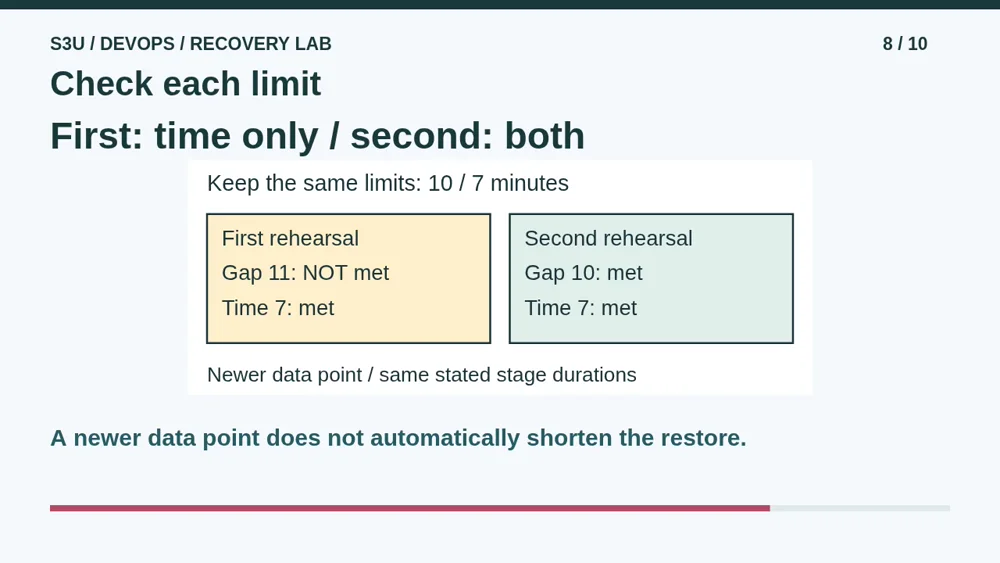
In the first fresh rehearsal, the data gap is eleven minutes: six to the hour and five onward. Eleven exceeds the allowed ten, so the data goal is missed. Interruption is two plus three plus two, or seven minutes. Seven equals the allowed maximum, so the time goal is met. In the second rehearsal, seventeen fifty-five to eighteen oh five is ten minutes, exactly the data limit. The given stage times still total seven. Both goals are now met. The newer data point changed one answer; it did not magically make the stated restoration or checking stages shorter.
9. A rehearsal is evidence, not a promise
Video: 5:59
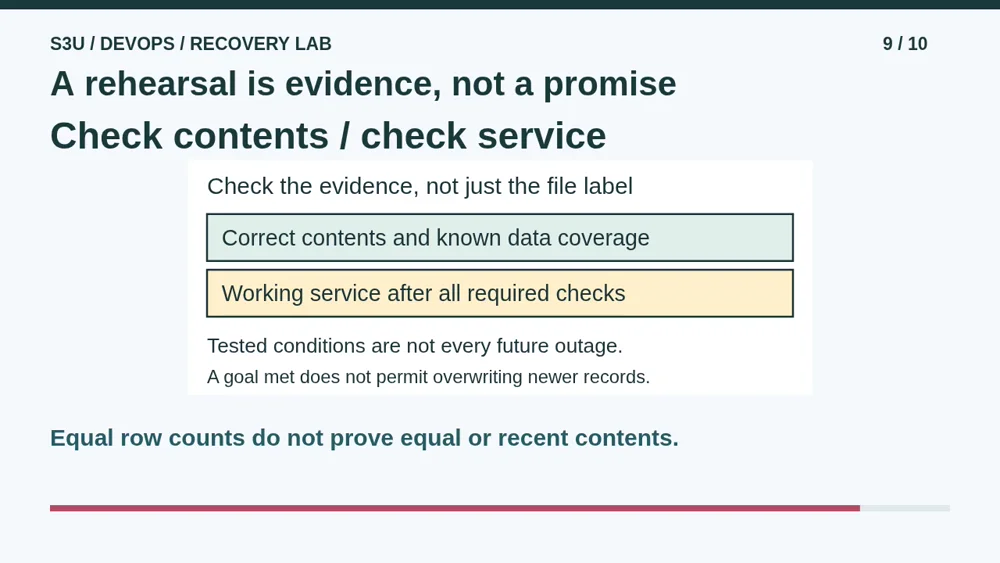
A rehearsal can tell us what happened under its tested conditions. It cannot guarantee that every future outage will behave the same way. We also need to check the recovered contents and whether the service works. Two copies could contain the same number of rows but have different values or different data coverage times. A readable file is not automatically a correct recovery. And meeting our time goals is not permission to overwrite newer records. Release Lab keeps recovery inside a pretend sandbox. The learning question is about evidence and limits, not about pressing a real reset button and hoping for applause.
10. Continue with new records
Video: 6:46
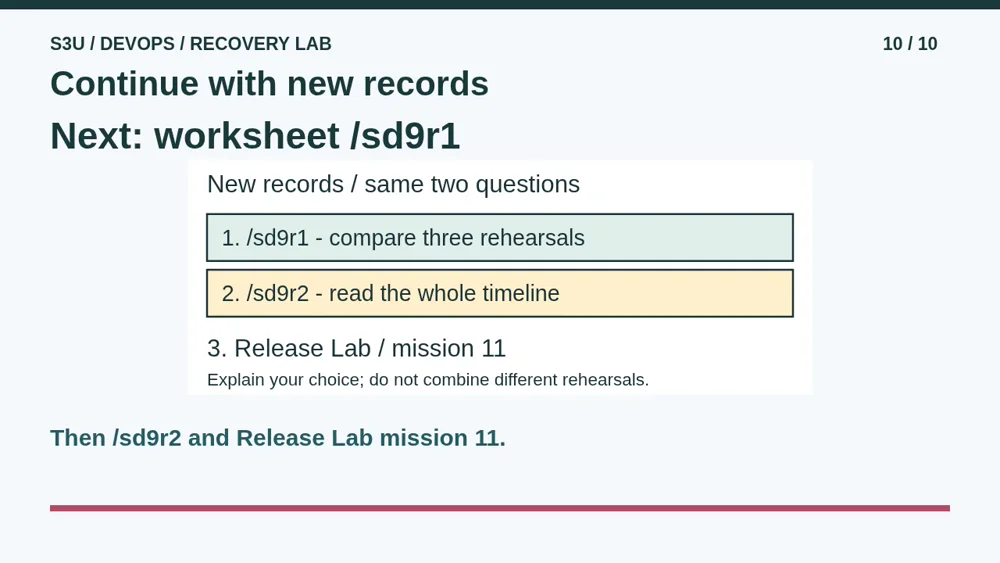
Fun fact: the most recent backup is not necessarily the one that meets both recovery goals. A recent copy can still take too long to recover. Before celebrating, name the data point, outage time, and return of working service. Calculate each interval and compare it with its own maximum. Continue to the first worksheet to compare three different rehearsals, then use the second worksheet to read a full recovery timeline. Their numbers are different from this lesson. After that, try mission eleven in Release Lab and explain your backup choice. Practicing a model builds reasoning; it does not certify a real recovery plan.
Show your understanding
You can point, explain aloud, draw or write.
- Calculate a data gap and complete interruption separately, including detection and checking, then compare each with its stated maximum.
- Explain exact-limit, one-goal-only and unknown-data-point cases without treating a rehearsal or row count as a guarantee.
Try it yourself
Pause at data through 17:54 and outage 18:05. Compare the gap with maximum 10 and the 2 + 3 + 2 interruption with maximum 7. Then change only coverage to 17:55.
Continue to the worksheets for different records, then Release Lab mission 11. Keep time goals, correct contents and permission to change records separate.
Next: your worksheet
Recovery Goals: Compare Three Backupshttps://s3u.com/sd9r1
Practice Two: read the whole timeline · Try the recovery-goals mission
Practice comparing recovery goals
Lesson: https://s3u.com/lessons/two-recovery-goals