Science / Grade 6
Earth tilt and opposite seasons
Learning goal: Keep the axis direction consistent, compare daylight and sunlight angle, and explain opposite hemispheres without treating seasons as a daily forecast.
Before you start: Identify north and south on a model globe, recognize an axis, and subtract daylight hours in a fictional record.
Read or print this lesson What to practiceThe video could not load. The transcript is still available below.
Next: your worksheet
Connect Earth's Tilt with Seasons
Checking sign-in...
Read the transcript
Saved reading place
Video transcript and practice. Reading or printing does not count as playback time or an assessed grade.
1. One Earth, opposite seasons
Video: 0:00
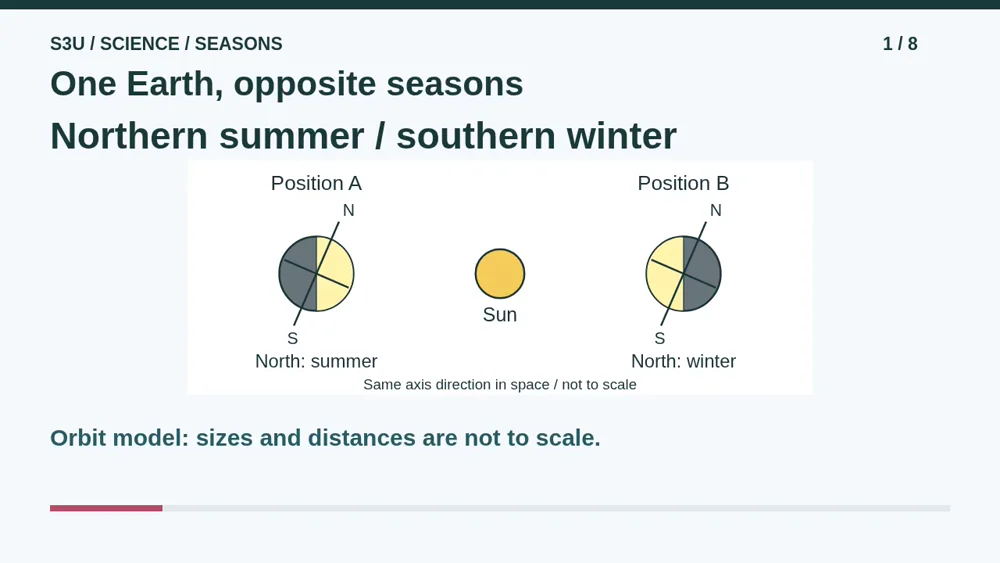
Imagine two friends comparing seasonal calendars, one in each hemisphere. One is planning summer activities while the other is in winter. They share the same planet, so a story about the entire Earth simply moving closer to the Sun cannot explain their opposite seasons. We need a model with Earth's tilt. Our drawing is a guide to direction, not a scale map or a weather forecast.
2. Keep the axis pointing consistently
Video: 0:29
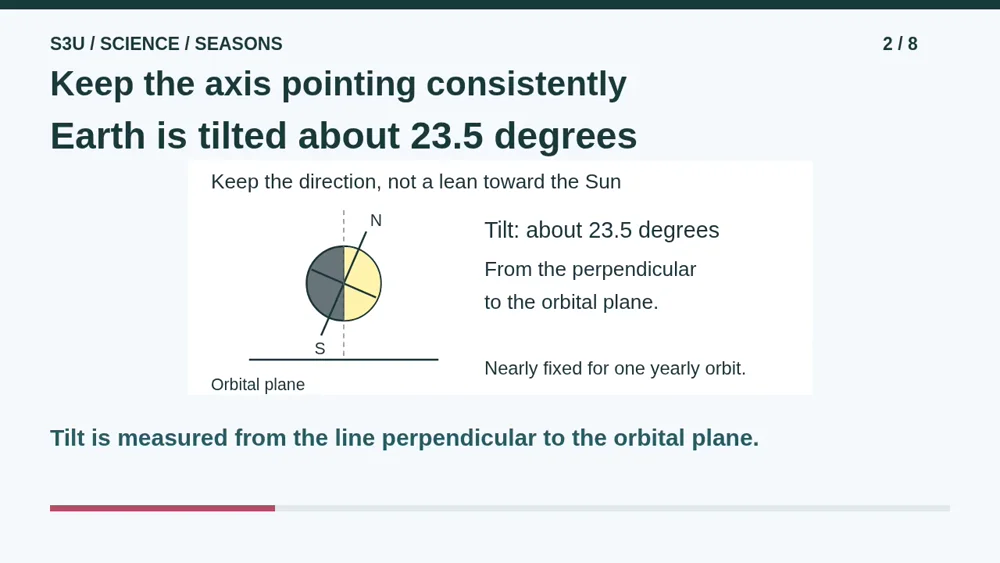
Earth turns around an imaginary line called its axis. That axis is tilted about twenty-three and a half degrees away from a line straight up from its orbital plane. Through one yearly trip around the Sun, the axis keeps pointing in nearly the same direction in space. Do not redraw the North Pole always leaning toward the Sun. That would change the model instead of explaining the seasons.
3. Sun angle changes the footprint
Video: 0:57
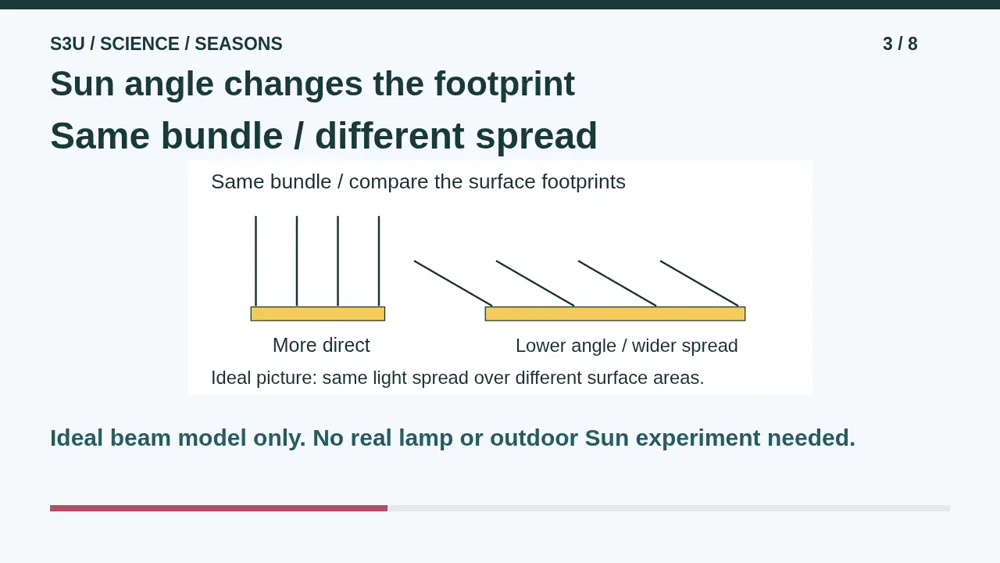
Picture the same bundle of light reaching two flat patches. When it arrives more directly, it covers a smaller area. At a lower angle, it spreads over a larger area. The energy is spread more thinly in that second picture. This is one part of the seasonal explanation. It does not mean the Sun turns its power knob down each winter. Our drawing is a comparison, not a temperature calculator.
4. Daylight duration matters too
Video: 1:28
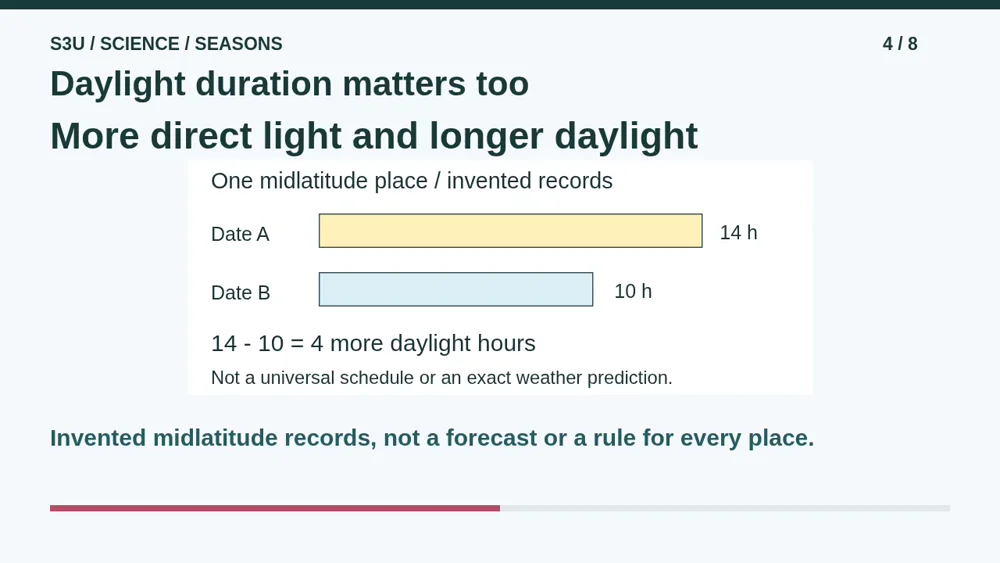
Daylight time also changes during the year. In these invented records for one midlatitude place, one date has fourteen hours of daylight and another has ten. Fourteen minus ten is four more hours. Longer daylight and a higher Sun path generally support summer warming there. Latitude and local conditions matter. The poles and equator do not follow one universal fourteen-hour rule, and a season cannot predict every afternoon.
5. Pause: reverse the hemisphere
Video: 2:02
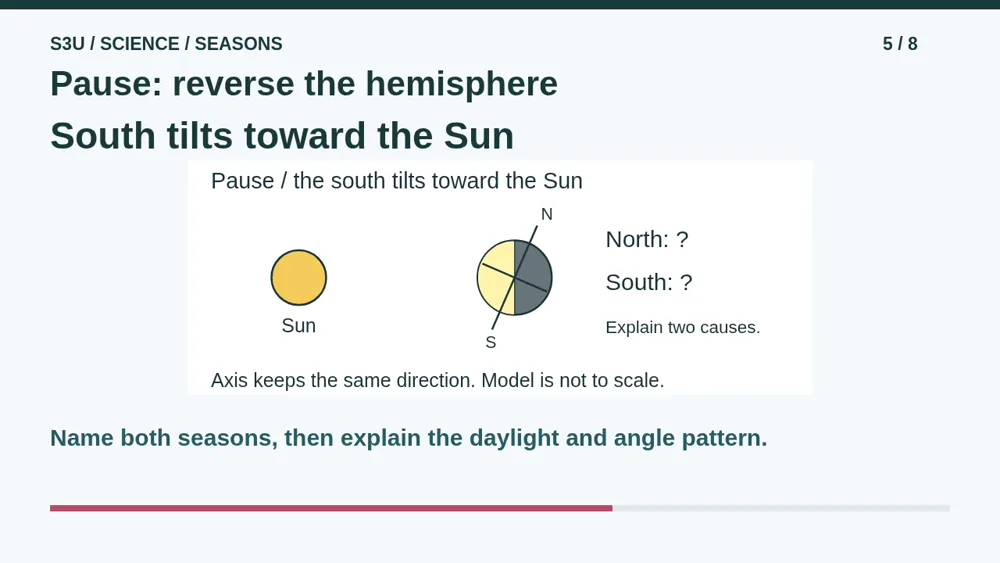
Try the other side of the yearly orbit. In this picture, the Southern Hemisphere tilts toward the Sun while the Northern Hemisphere tilts away. Pause and name the southern and northern seasons. Then name two parts of the sunlight explanation. Would the northern friend moving a chair closer to the window reverse the whole planet's seasons? Explain the large-scale pattern, not the temperature of one chair.
6. Check both halves of Earth
Video: 2:32
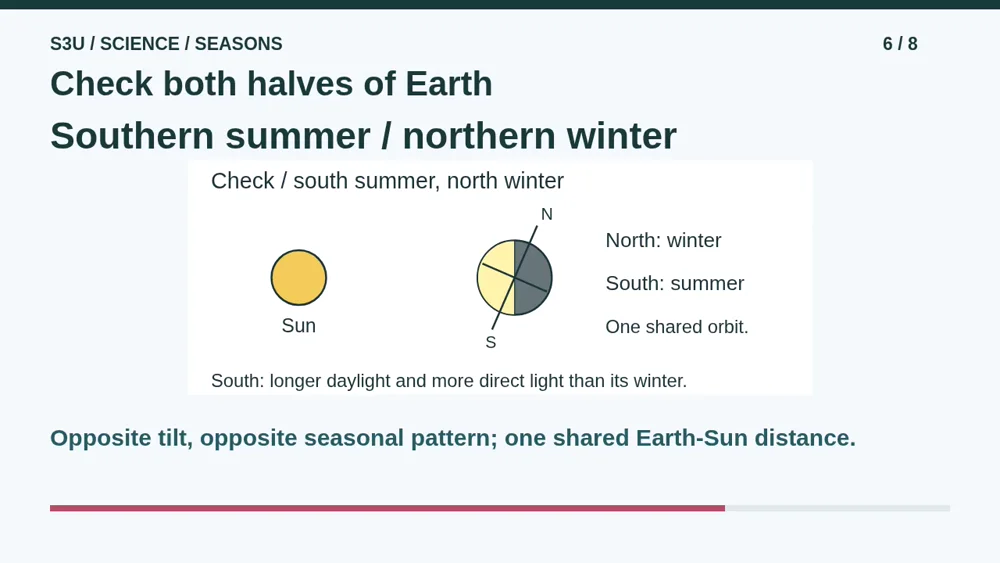
The south has summer and the north has winter. Compared with its own winter, the southern summer generally brings longer daylight and more direct sunlight. The northern pattern is opposite. Both hemispheres are on the same orbiting Earth at nearly the same distance from the Sun. That is why distance alone fails to explain their contrast. Daily weather can still vary within either seasonal pattern.
7. Closest does not mean summer everywhere
Video: 3:02
Fun fact: Earth is currently closest to the Sun in early January, during Northern Hemisphere winter. Our orbit is not a perfect circle, but that changing distance is not the main cause of the opposite northern and southern seasons. A closer label cannot replace the tilt explanation. Check both hemispheres before accepting a claim about the whole planet. The calendar has not accidentally put northern summer in the wrong folder.
8. Continue to the seasons worksheet
Video: 3:34
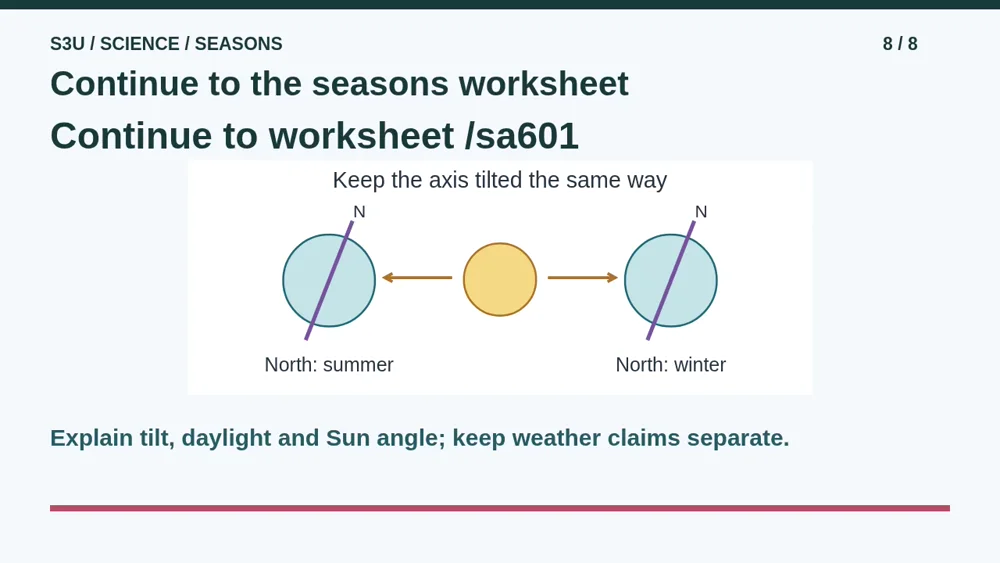
Continue to the worksheet below. For each picture or statement, identify which hemisphere tilts toward the Sun. Explain the daylight and sunlight-angle changes, then check the opposite hemisphere. You can print the sheet and draw matching axis directions beside both Earth positions. Keep the model's limits visible: it is not to scale, and it does not promise a particular temperature tomorrow. A good explanation fits both sides of Earth.
Show your understanding
You can point, explain aloud, draw or write.
- Keep the axis direction consistent across orbital positions and explain opposite hemispheric seasons with daylight duration and sunlight angle.
- Use the January distance counterexample to reject distance alone as the seasonal cause, without treating the model as a daily forecast.
Try it yourself
Pause when the south tilts toward the Sun. Name both seasons and explain the daylight and sunlight-angle pattern.
Continue to the worksheet. Draw consistent axis directions and distinguish the seasonal model from a particular afternoon's weather.
Next: your worksheet
Connect Earth's Tilt with Seasonshttps://s3u.com/sa601
Lesson: https://s3u.com/lessons/tilt-and-seasons