Science / Grade 7
Series resistance: the whole source load
Learning goal: Trace one complete path, add series resistances, check voltage drops and explain what an equivalent resistor preserves.
Before you start: Use I = V / R and V = I x R, convert amperes and milliamps, and trace a closed series loop.
Read or print this lesson What to practiceThe video could not load. The transcript is still available below.
Next: your worksheet
Series Resistance: The Whole Path
Checking sign-in...
Read the transcript
Saved reading place
Video transcript and practice. Reading or printing does not count as playback time or an assessed grade.
1. One path, one current
Video: 0:00
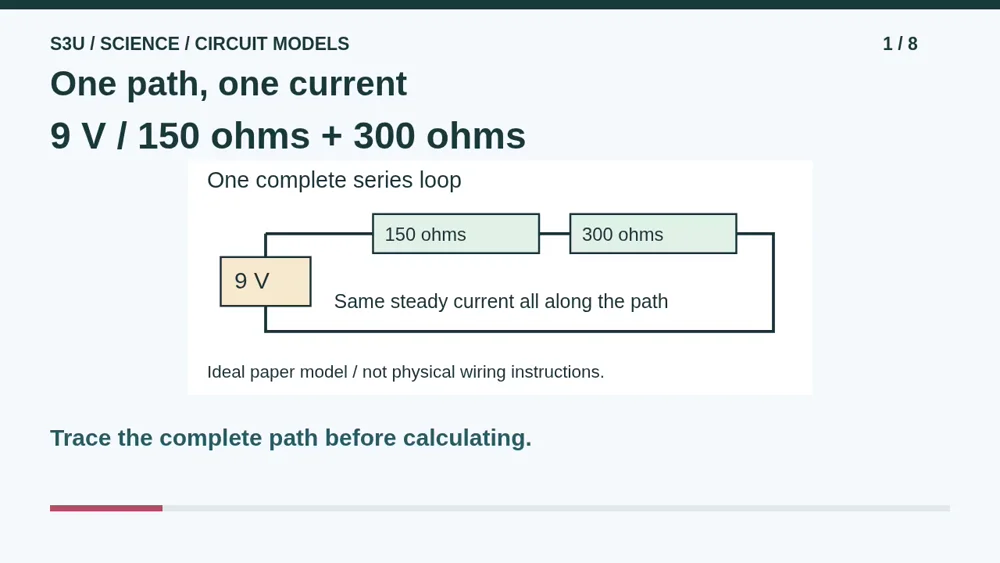
Imagine a paper circuit with a nine volt source and two resistors in one complete loop. The resistances are one hundred fifty ohms and three hundred ohms. There are no branches. In this steady ideal model, the same current passes through both resistors. Charge does not get used up at the first resistor. Trace the whole loop with your eyes. This is a diagram to reason about, not instructions to build or plug in a circuit.
2. Add the whole path
Video: 0:33
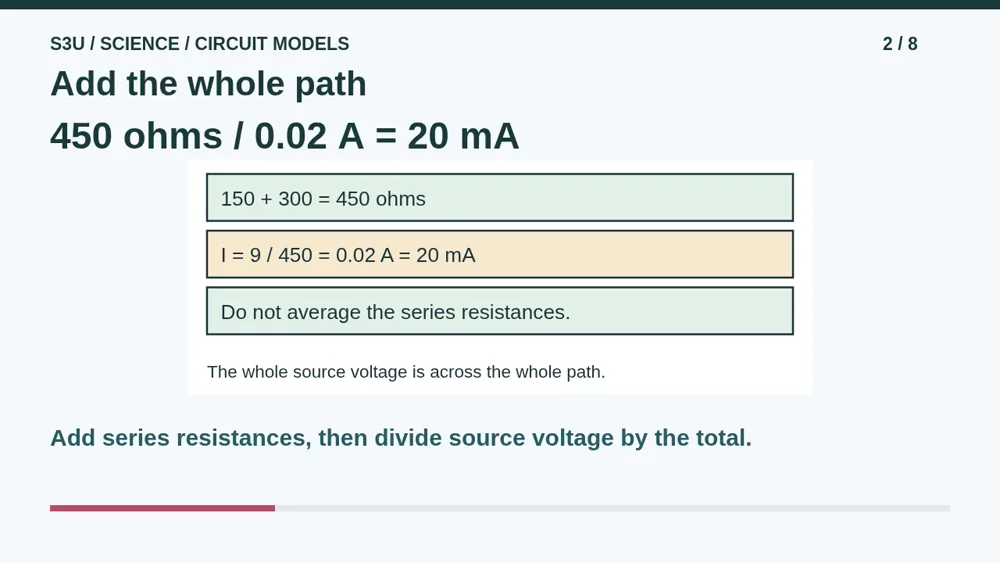
For resistors in series, add their resistances. One hundred fifty plus three hundred equals four hundred fifty ohms. Current equals source voltage divided by total resistance: nine divided by four hundred fifty is zero point zero two amperes, or twenty milliamps. Do not average the resistances. And do not give each resistor the full nine volts. The source voltage is across the whole path. Our calculator needs the circuit story before it needs the buttons.
3. Same source load, new interior
Video: 1:10
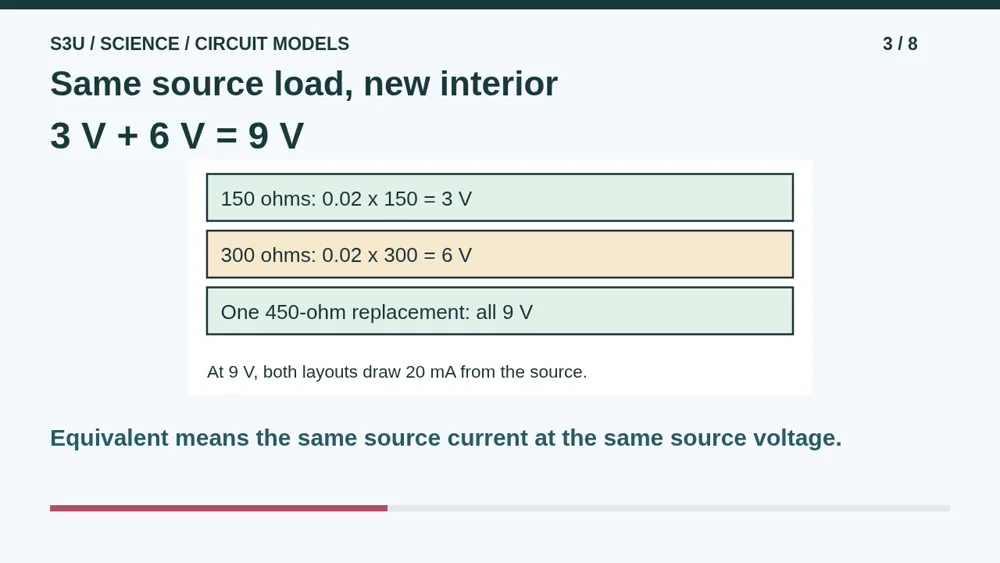
We could replace the two resistors with one four hundred fifty ohm ideal resistor. At nine volts, the source would still supply twenty milliamps. That is an equivalent resistance. But the inside is different. In the original path, twenty milliamps times one hundred fifty ohms gives a three volt drop. Across three hundred ohms, the drop is six volts. They add to nine. The single replacement has the whole nine volts across it, not two separate drops.
4. Swap is not the same as open
Video: 1:46
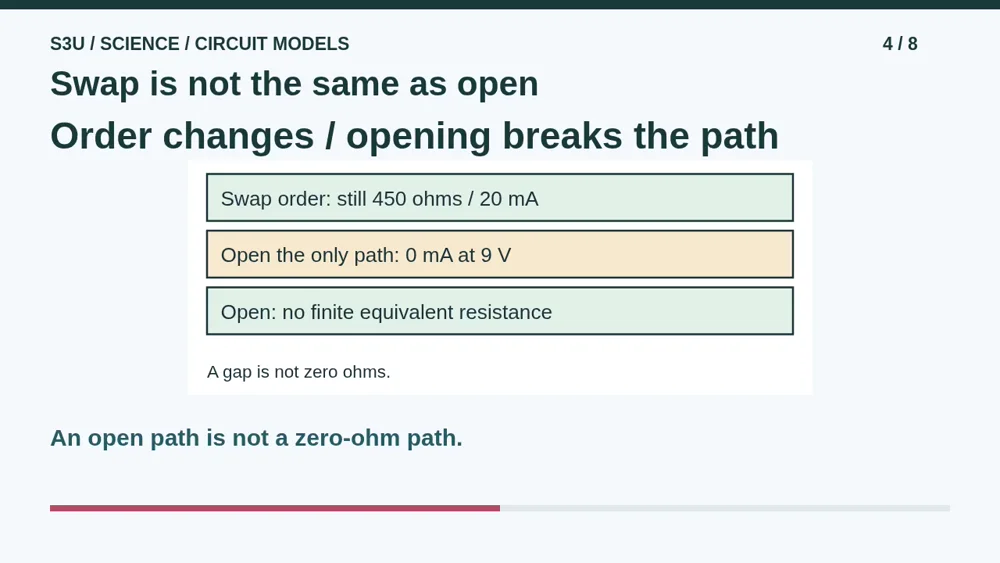
Swap the order of the two series resistors. The total is still four hundred fifty ohms, so the source current stays twenty milliamps. Now make a gap in the only path instead. The ideal steady current becomes zero even though the source is still nine volts. This open circuit has no finite equivalent resistance. It is not zero ohms. Nine divided by zero is not an ordinary resistance calculation. Check whether there is a complete path before using a formula.
5. Pause: a fresh series path
Video: 2:23
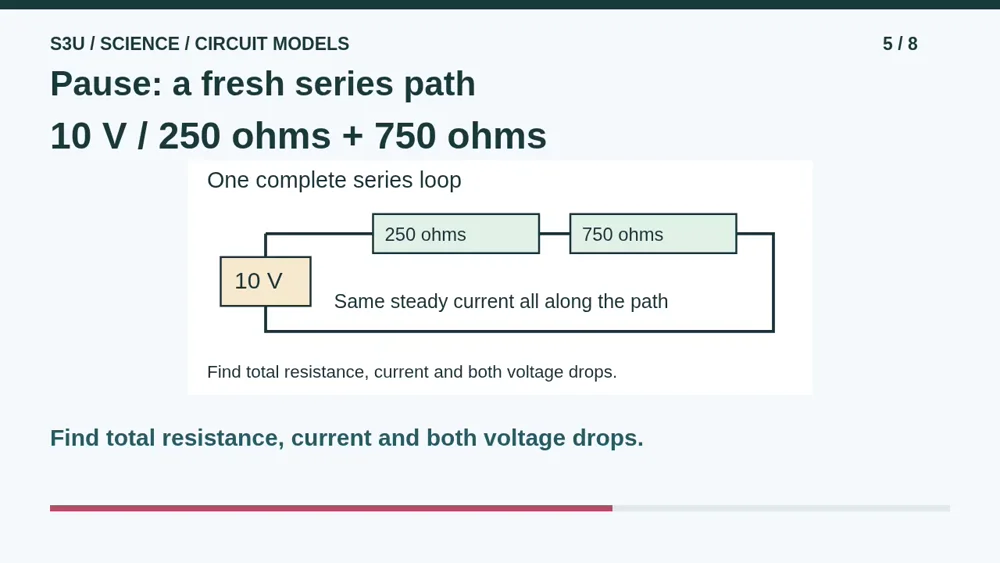
Pause for a different paper circuit. A ten volt ideal source supplies two resistors in series: two hundred fifty ohms and seven hundred fifty ohms. Find the total resistance. Find current in amperes and milliamps. Then find the voltage drop across each resistor, using the same current through both. Check that those two drops add to the source voltage. Explain what would stay the same if you replaced the pair with one equivalent resistor. Continue when your reasoning is ready.
6. Check the whole loop
Video: 3:00
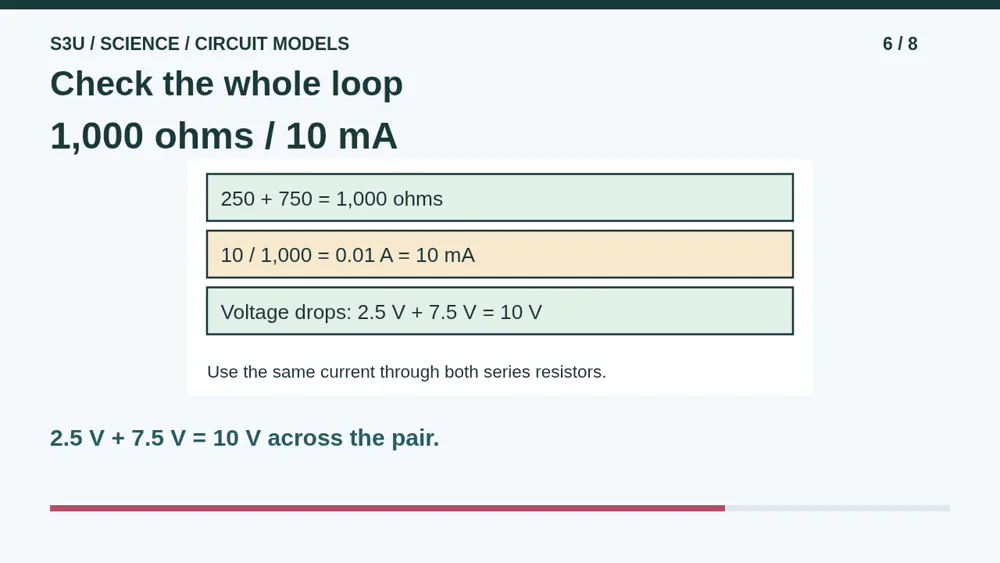
Two hundred fifty plus seven hundred fifty gives one thousand ohms. Ten divided by one thousand gives zero point zero one amperes, or ten milliamps. Across the first resistor, zero point zero one times two hundred fifty gives two point five volts. Across the second, it gives seven point five volts. Those drops add to ten. One thousand ohms would keep the same source current. If you got two different series currents, use the total resistance first, then check each drop.
7. One total can hide three parts
Video: 3:37
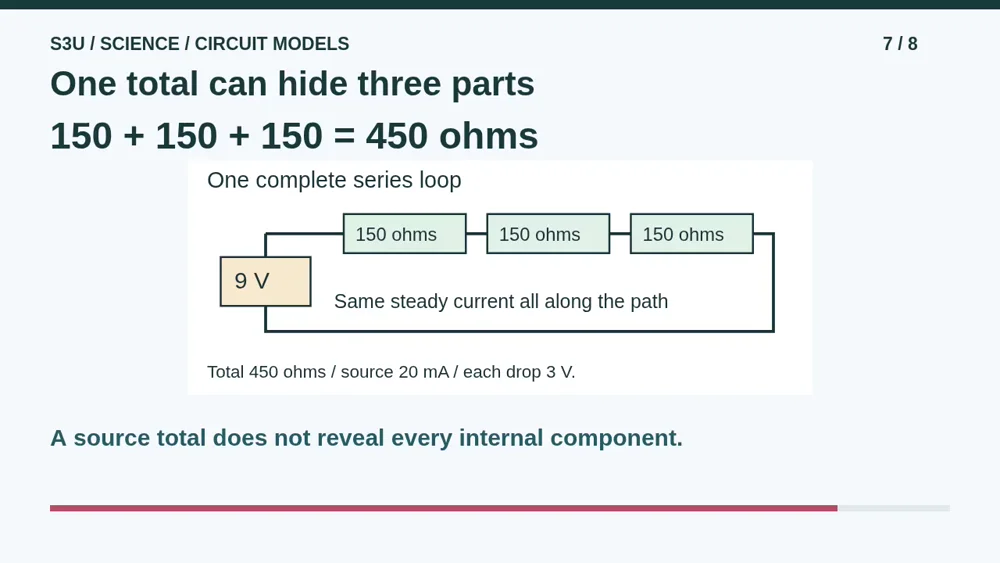
Fun fact: three one hundred fifty ohm resistors in series also total four hundred fifty ohms. At nine volts, they draw the same twenty milliamps as our first pair. Each of the three now has a three volt drop. A source current measurement by itself cannot tell whether the load contains one, two or three resistors. Equivalent is a useful promise about the source, not a promise that every hidden detail is identical. Always say what your model can and cannot tell you.
8. Continue to the worksheet
Video: 4:13
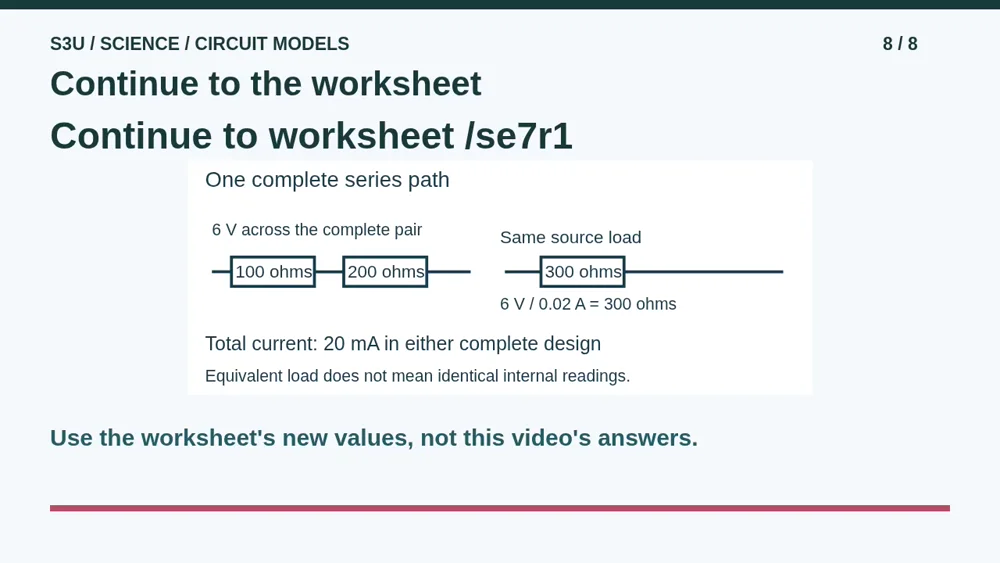
Continue to the series resistance worksheet below. Read its worked example, trace the complete path, then solve its new questions. Try the second form for another source load. Circuit Bench experiment fourteen lets you compare series models and their equivalent resistance. Keep the same source voltage when comparing their current. Watching a lesson, investigating a model and answering independently are different evidence. The video does not complete the daily skill for you; the worksheet is your next chance to explain the reasoning.
Show your understanding
You can point, explain aloud, draw or write.
- Add series resistances and use one steady current to check both voltage drops.
- Explain what equivalent resistance preserves at a fixed source voltage, and why an open path is not zero ohms.
Try it yourself
Pause at the 10-volt series path with 250 and 750 ohms. Find total resistance, current and both voltage drops.
Continue to both worksheets with their fresh values. Distinguish an equivalent source load from identical internal readings, and a swapped order from an open path.
Next: your worksheet
Series Resistance: The Whole Pathhttps://s3u.com/se7r1
Explore the model in Circuit Bench
Try another series worksheet · Next: Parallel resistance
Lesson: https://s3u.com/lessons/series-source-load