Science / Grade 8
Parallel resistance: more than one path
Learning goal: Calculate branch currents at a shared voltage, find the equivalent source load and compare open branches and different internal layouts.
Before you start: Use Ohm's law with amperes, add branch currents and identify the same two terminals. Review the series source-load lesson if needed.
Read or print this lesson What to practiceThe video could not load. The transcript is still available below.
Next: your worksheet
Parallel Resistance: More Than One Path
Checking sign-in...
Read the transcript
Saved reading place
Video transcript and practice. Reading or printing does not count as playback time or an assessed grade.
1. Two paths, the same voltage
Video: 0:00
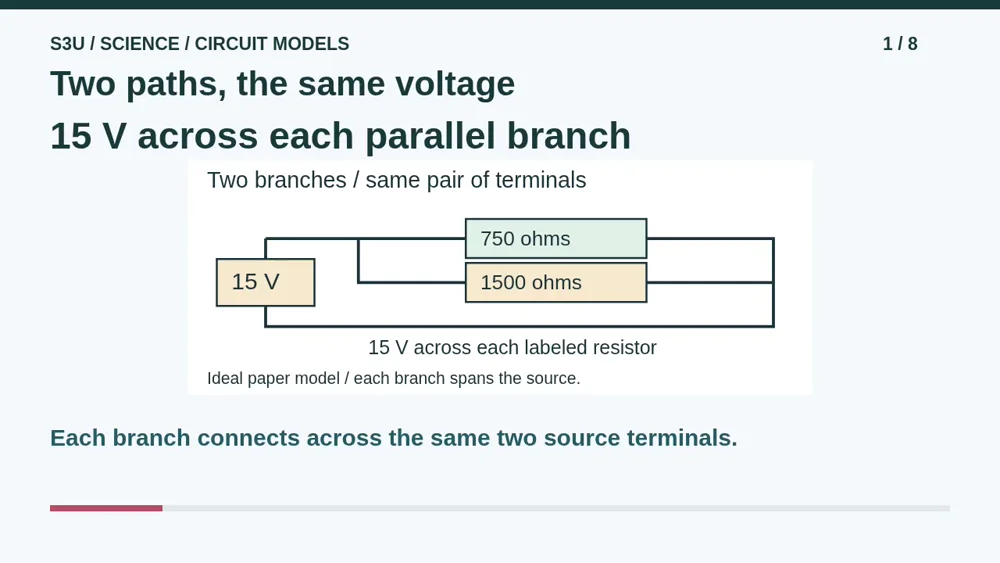
Now our paper circuit has two complete paths between the same source terminals. One branch contains seven hundred fifty ohms. The other contains one thousand five hundred ohms. The ideal source is fifteen volts, so each branch has fifteen volts across it. The voltage is not split in half. This is a steady ideal resistor model, not a plan for real wiring. Follow each branch back to the same two terminals before deciding whether the resistors are parallel.
2. Find each branch current
Video: 0:35
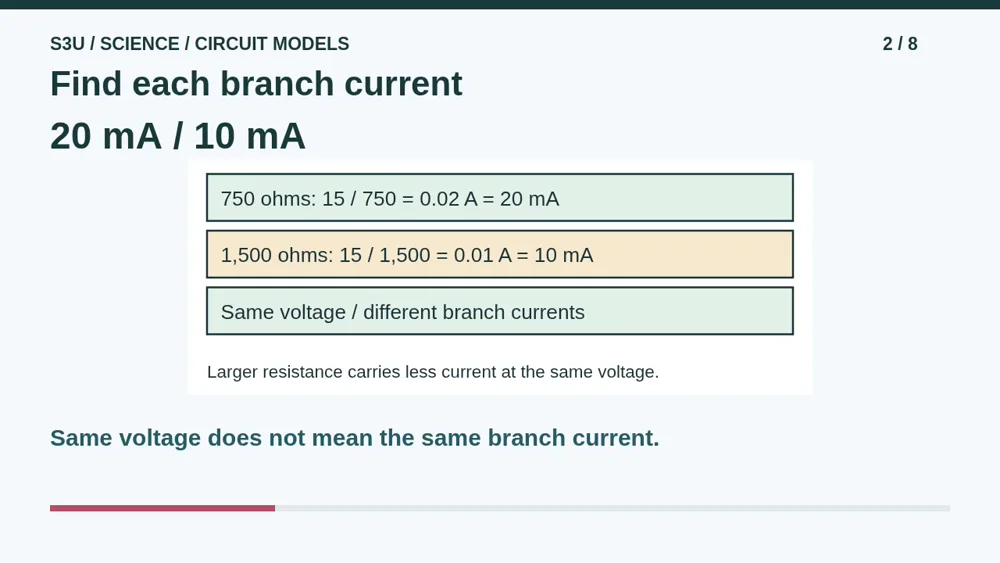
Use current equals voltage divided by resistance separately for each branch. Fifteen divided by seven hundred fifty is zero point zero two amperes, or twenty milliamps. Fifteen divided by one thousand five hundred is zero point zero one amperes, or ten milliamps. The larger resistance carries less current at the same voltage. Parallel branches do not vote to divide current equally. Equal current would require equal resistance in this particular ideal model. Keep each resistance beside its own calculation.
3. What load does the source see?
Video: 1:16
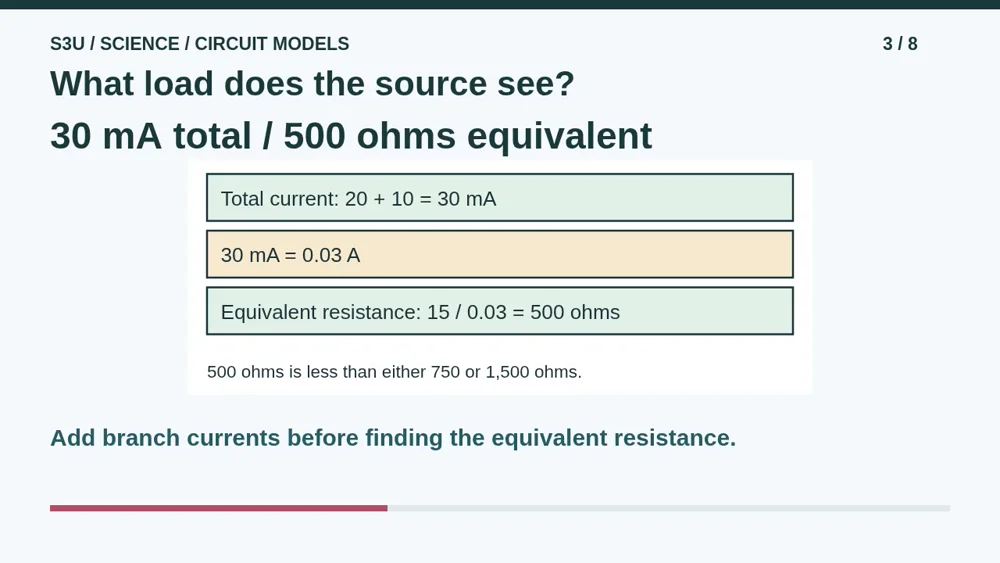
The source supplies both branches. Add twenty and ten milliamps to get thirty milliamps total. Convert that to zero point zero three amperes. Equivalent resistance equals source voltage divided by total current: fifteen divided by zero point zero three is five hundred ohms. That is smaller than either branch resistance. A second complete path adds current at the same fixed voltage. Adding the resistor values would describe a series path, not these parallel branches. Name what you are adding before you add it.
4. Open one branch, then both
Video: 1:56
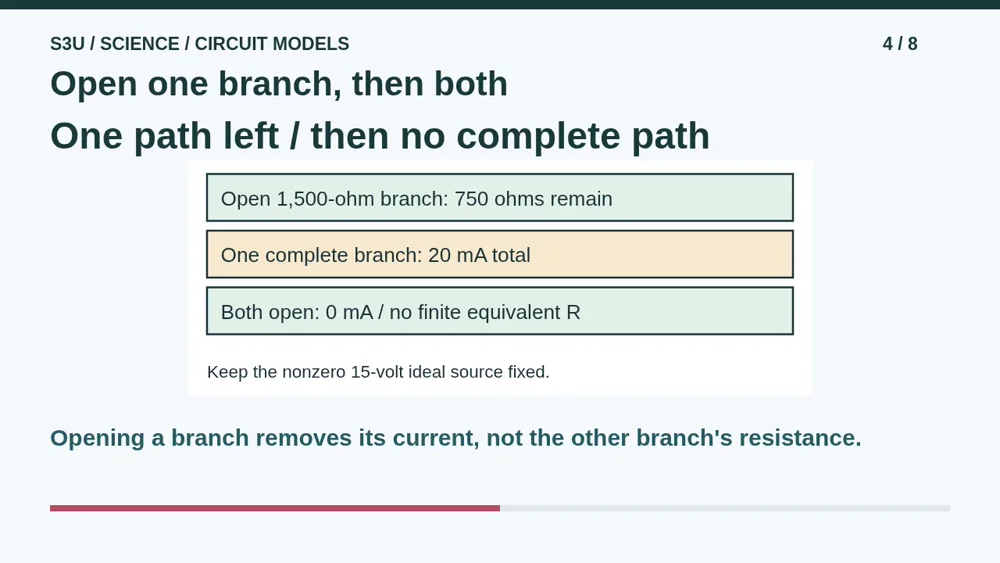
Open the one thousand five hundred ohm branch. The seven hundred fifty ohm branch is still complete and still has fifteen volts across it. Its twenty milliamps become the entire source current, and the equivalent resistance is seven hundred fifty ohms. Now open both branches. Total current is zero. With the nonzero ideal source still present, there is no finite equivalent resistance. Neither open branch becomes zero ohms. A gap removes a complete route; it does not create a perfect conducting shortcut.
5. Pause: equal branches
Video: 2:36
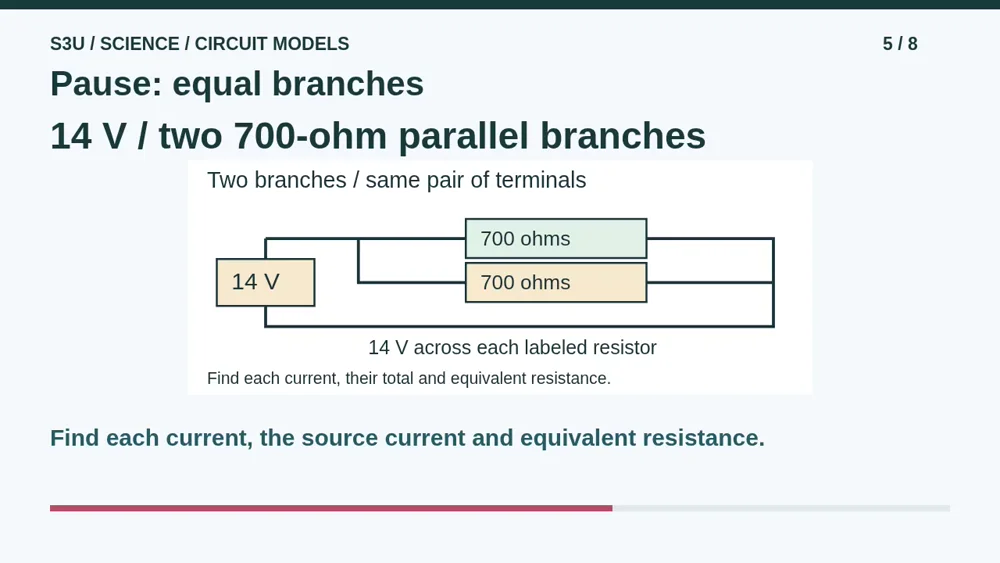
Pause at a new paper circuit. A fourteen volt ideal source connects across two parallel branches. Each branch contains seven hundred ohms. Find the voltage across each resistor first. Then find each branch current in amperes and milliamps. Add the branch currents to find the source current. Finally, use that total to find the equivalent resistance. Predict whether your result should be larger or smaller than seven hundred ohms, and explain why. Work out the numbers before continuing.
6. Check the parallel load
Video: 3:14
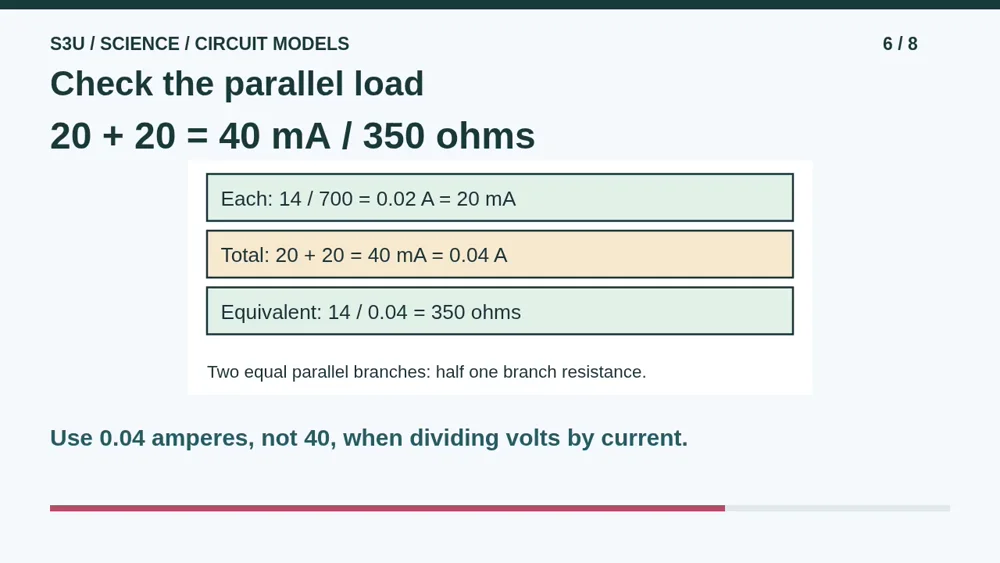
Each branch has fourteen volts. Fourteen divided by seven hundred gives zero point zero two amperes, or twenty milliamps, in each branch. Together they draw forty milliamps, or zero point zero four amperes. Fourteen divided by zero point zero four gives three hundred fifty ohms. That is half of one branch resistance. If you found one thousand four hundred ohms, you added resistances as though they were in series. Return to the drawing: there are two complete paths across the source.
7. Same total, different split
Video: 3:52
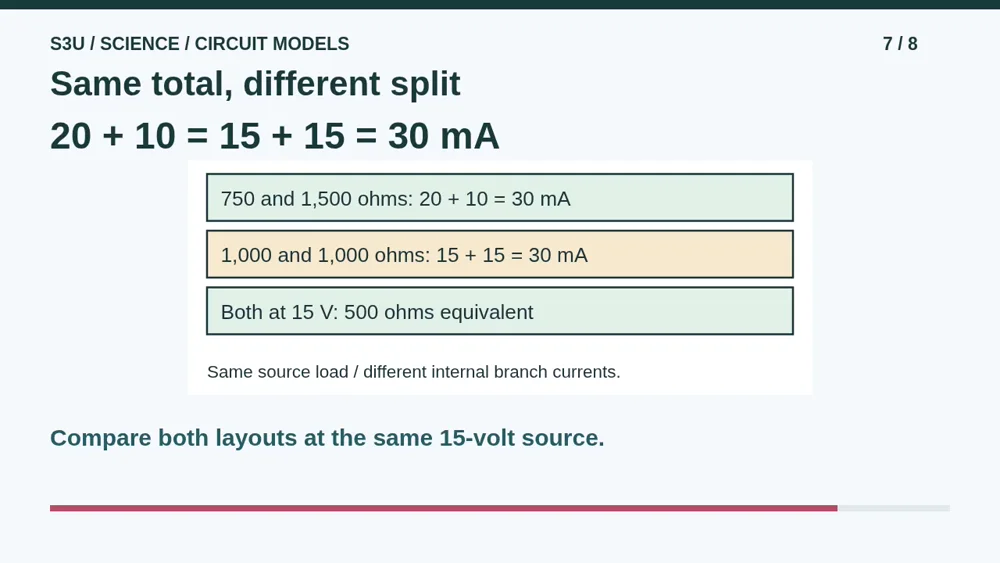
Fun fact: at fifteen volts, two one thousand ohm parallel branches also have five hundred ohms equivalent resistance. Each carries fifteen milliamps, for thirty milliamps total. Our first layout carried twenty and ten, with that same total. Both layouts draw the same source current at the same source voltage, but their branch currents differ. Equivalent resistance is a useful summary, not an inventory of everything inside. To explain an internal branch, you still need its resistance and connections.
8. Continue to the worksheet
Video: 4:30
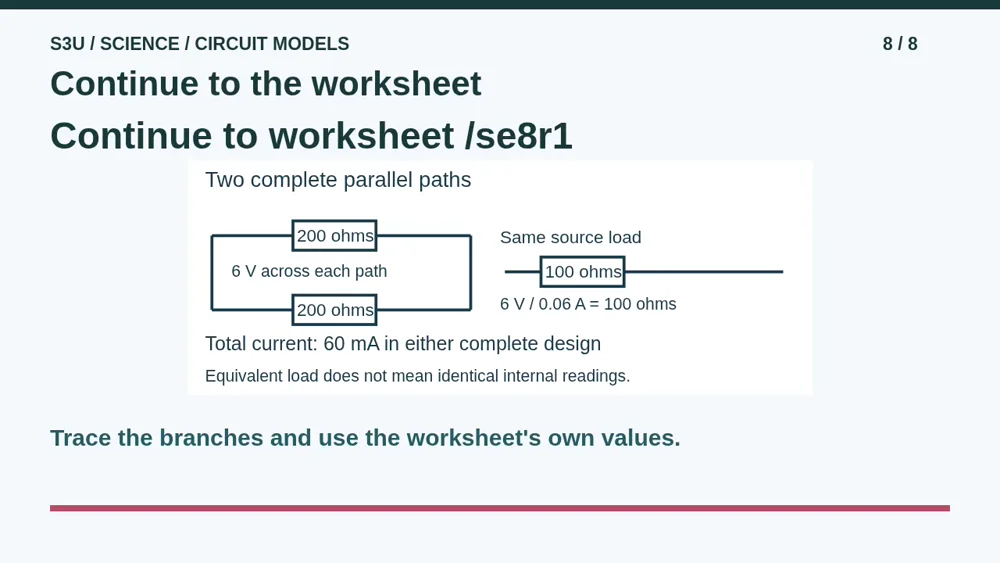
Continue to the parallel resistance worksheet below. Identify the shared source terminals, calculate branch currents, then add them before finding equivalent resistance. Try the alternate worksheet to compare layouts and open branches. Circuit Bench experiment fifteen lets you investigate the same ideas with ideal models. Keep source voltage fixed when comparing source loads. Watching does not award an independently checked grade or complete this daily skill. Use the worksheet to show what you can explain with a fresh set of values.
Show your understanding
You can point, explain aloud, draw or write.
- Calculate parallel branch currents, source current and equivalent resistance with clear units.
- Explain open-branch changes and compare equal source loads with different internal current splits.
Try it yourself
Pause at the 14-volt source with two 700-ohm parallel branches. Find each current, their total and equivalent resistance.
Continue to both worksheets. Trace shared terminals, keep voltage fixed when comparing loads, and distinguish total current from the branch split.
Next: your worksheet
Parallel Resistance: More Than One Pathhttps://s3u.com/se8r1
Explore the model in Circuit Bench
Try another parallel worksheet · Review series resistance
Lesson: https://s3u.com/lessons/parallel-source-load