Science / Grade 9
Neither, same and odd signals
Learning goal: Compare NOR and NAND, match two Boolean values with XNOR, and trace an XOR chain without confusing odd parity with exactly one.
Before you start: Use AND, inclusive OR, NOT and two-input XOR with Boolean 0 and 1. Count odd and even totals, and follow all rows of a truth table.
Read or print this lesson What to practiceThe video could not load. The transcript is still available below.
Next: your worksheet
Neither and Matching Signals
Checking sign-in...
Read the transcript
Saved reading place
Video transcript and practice. Reading or printing does not count as playback time or an assessed grade.
1. Three questions, different rules
Video: 0:00
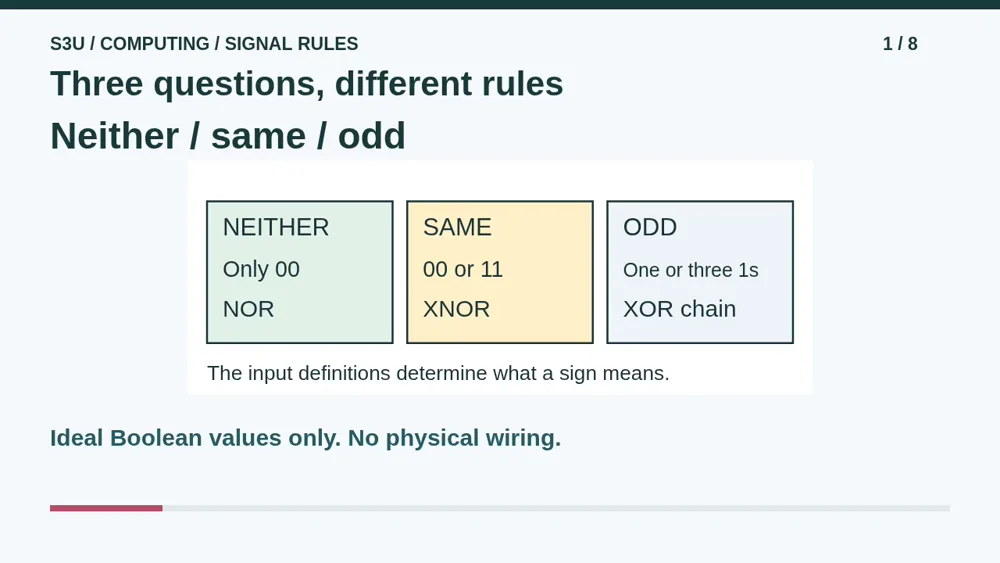
The signal desk has three new jobs, and one rule will not do them all. One sign asks whether neither route is ready. Another asks whether two signals match. A third asks whether an odd number of signals are one. We will use zero and one as Boolean values, not measurements of voltage. Everything stays on paper or screen. The desk has enough problems without anyone taking apart a real device.
2. Neither is not the same as not both
Video: 0:31
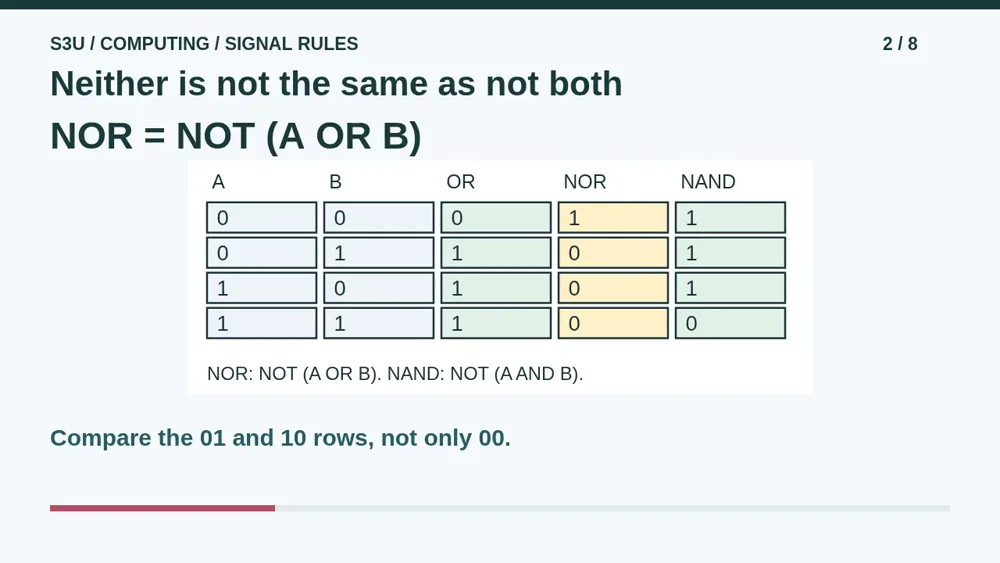
NOR means NOT of OR. Inclusive OR becomes one when at least one input is one, so NOR becomes one only when both inputs are zero. NAND instead means NOT of AND. At zero one, the inputs are not both one, so NAND is one. But one input is ready, so NOR is zero. The zero-zero row makes both rules one; that single agreement cannot prove the rules are the same.
3. Matching includes two zeros
Video: 1:01
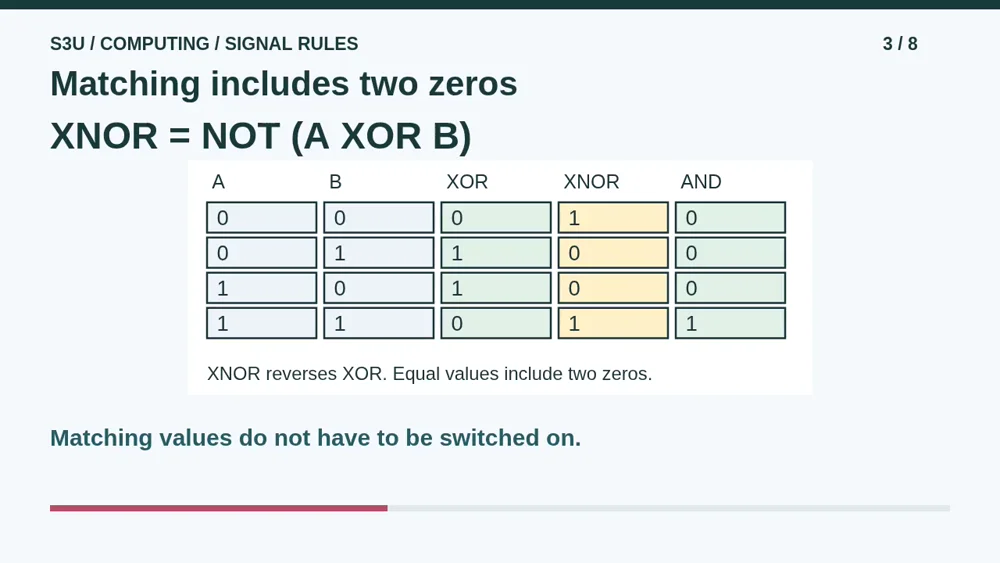
Two-input XOR is one when the inputs differ. Reversing it gives XNOR, which is one when the inputs match. Both zero-zero and one-one are matches. AND is not a matching rule because it misses zero-zero. Trace zero-one: XOR is one, then NOT changes that to zero. The values differ. Trace zero-zero: XOR is zero, then NOT gives one. Those two zeros may celebrate, quietly, because neither is switched on.
4. Trace a chain of two XOR gates
Video: 1:36
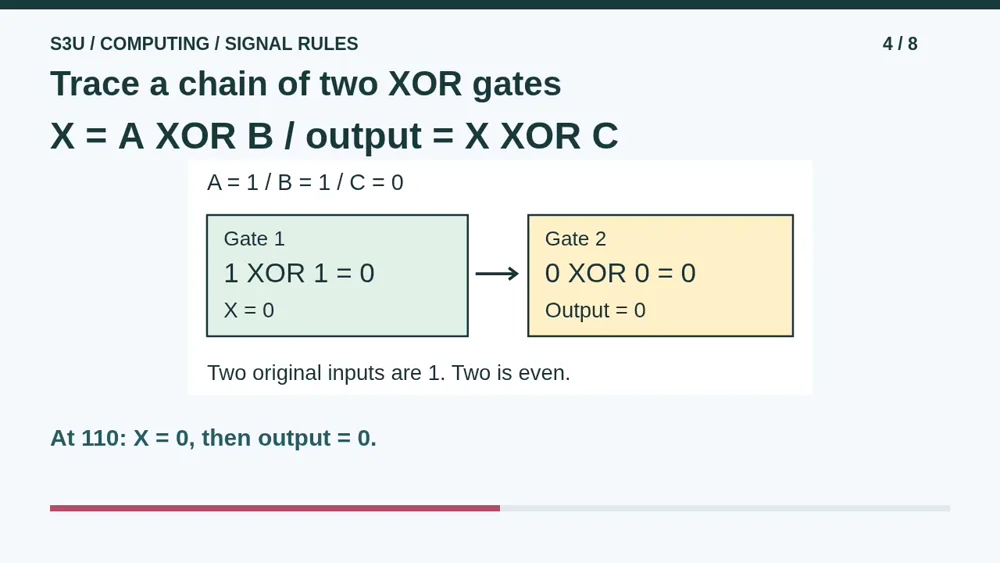
Now add a third input, C. Gate one applies XOR to A and B and names its result X. Gate two applies XOR to X and C. For inputs one, one, zero, the first two inputs match, so X is zero. The second gate compares zero with zero and also gives zero. Do not add the bits and use the sum as the output. The final output is still a single logical zero or one.
5. Pause: test all eight triples
Video: 2:07
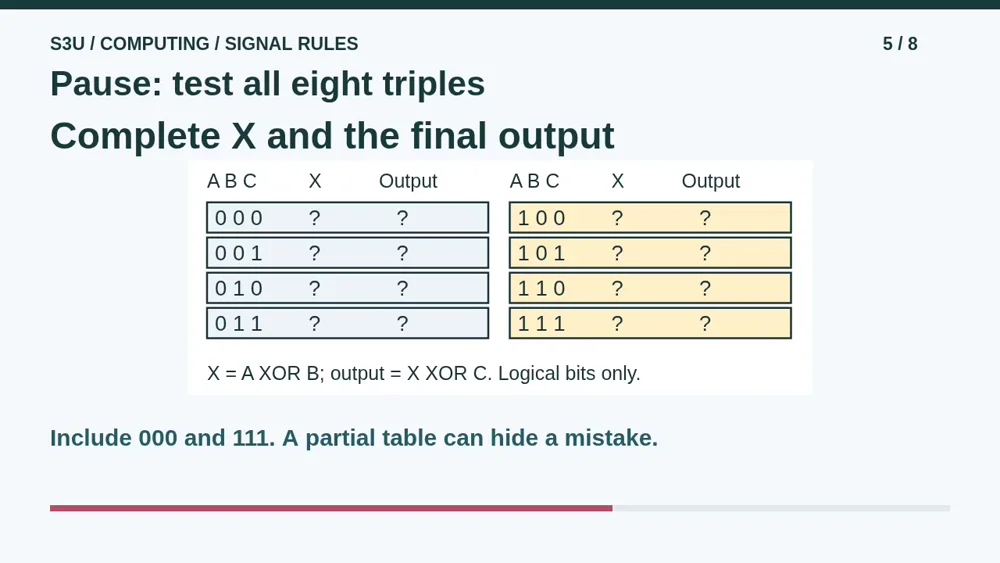
Pause here and complete the table for all eight input triples. First compare A and B to find X, then compare X and C for the final output. For each row, also count how many original inputs are one. Look for a connection between that count and the output. Do not assume that a chain with three inputs means exactly one input is one. Test the all-ones row before deciding what the rule means.
6. Check the odd-count pattern
Video: 2:37
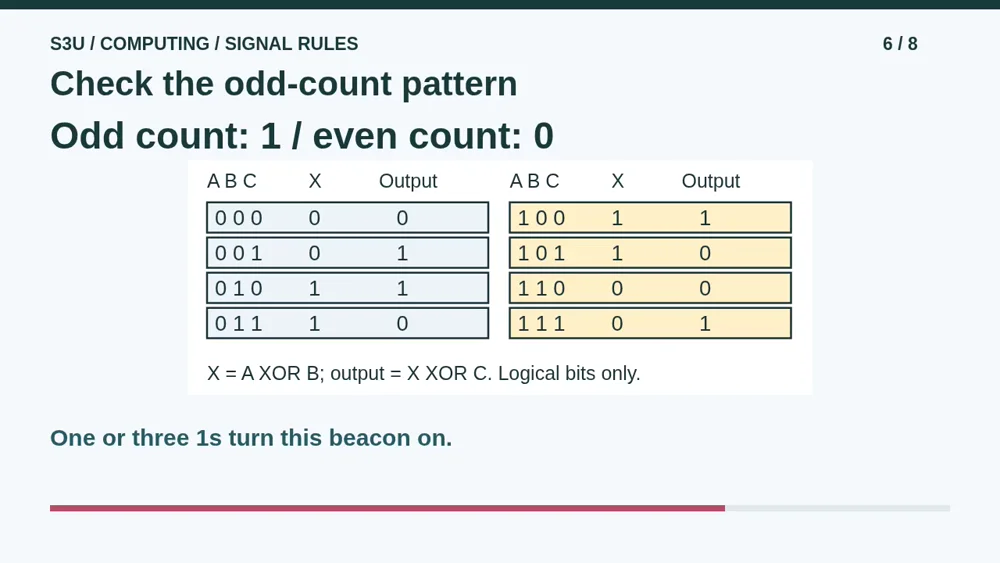
The final outputs, in the displayed order, are zero, one, one, zero, one, zero, zero, one. Rows with one or three ones give output one. Rows with zero or two ones give output zero. This is an odd-parity indicator. At one-one-one, X is zero and the second gate compares zero with one, giving one. Exactly one would reject that row. Three is odd, even if the beacon thinks three visitors are a crowd.
7. A parity value is not the whole message
Video: 3:09
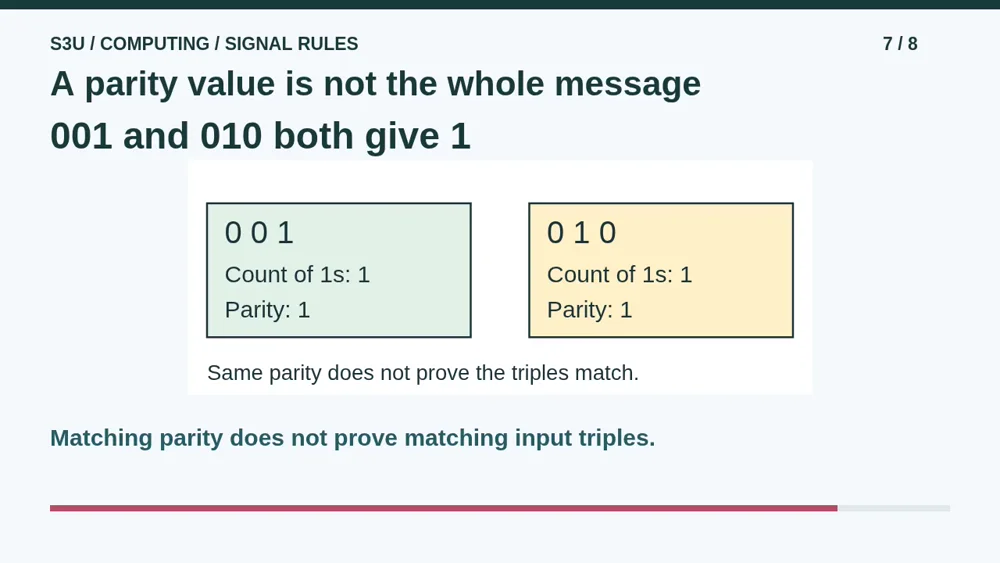
Fun fact: different input triples can have the same parity. Zero-zero-one and zero-one-zero each contain one one, so both give output one. Two positions changed, but the parity did not. The final bit cannot tell you which triple you had. Changing a single bit switches this odd-count result, but changes in two bits can keep it the same. Our little indicator is not an error-correction system or a guarantee that a message is unchanged.
8. Continue with the two worksheets
Video: 3:42
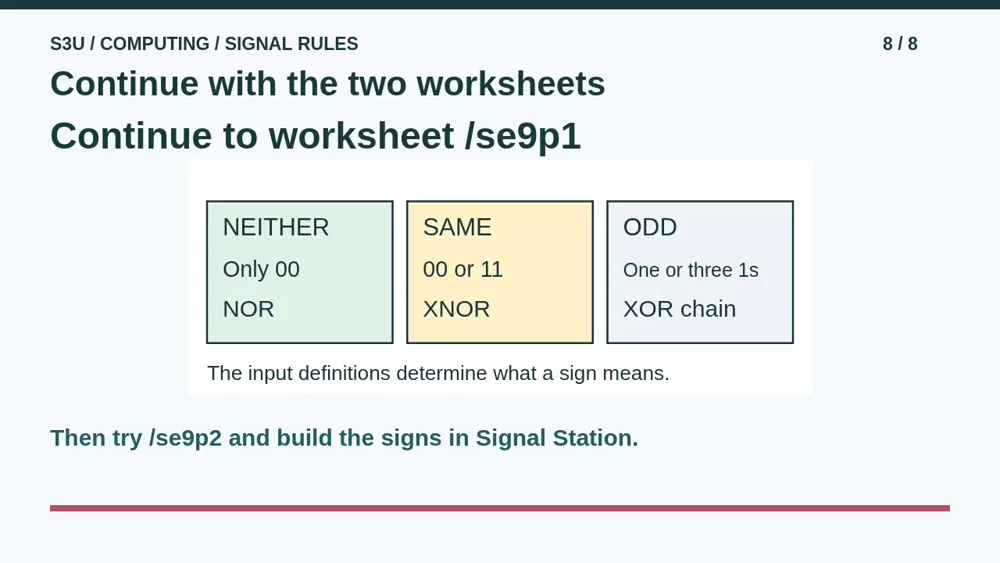
Continue to the first worksheet below for neither and matching rules. Its next-practice link opens the second sheet for XOR chains and parity. Use the given definitions, show the intermediate X when needed, and explain a row that separates two similar-looking rules. Then try the designs in Signal Station. Keep logical values separate from real voltages and wiring. The goal is to explain why a rule works across every allowed input, not to guess one lucky result.
Show your understanding
You can point, explain aloud, draw or write.
- Use counterexample rows to distinguish NOR from NAND and XNOR from AND, including matching zero values.
- Trace both stages of a three-input XOR chain, explain odd parity at 111 and show why matching parity does not prove matching triples.
Try it yourself
Pause to fill all eight XOR-chain rows. Record the intermediate X and count the original ones; explain why 111 differs from an exactly-one rule.
Continue to the two worksheets, then build the signs in Signal Station. These are ideal bits, not wiring instructions, universal voltages or a guarantee of error-free messages.
Next: your worksheet
Neither and Matching Signalshttps://s3u.com/se9p1
Build and test the rules in Signal Station
Next worksheet: trace an odd-parity chain · Review the basic gates and truth tables
Lesson: https://s3u.com/lessons/neither-same-and-odd