Science / Grade 6
Look beyond the mean
Learning goal: Compare recorded ranges, explain how rounding hides differences, and improve a method without mistaking extra digits for accuracy.
Before you start: Calculate a mean, subtract whole numbers and round positive decimal readings to a whole number. Review Compare repeated trials first if needed.
Read or print this lesson What to practiceThe video could not load. The transcript is still available below.
Next: your worksheet
Match Conclusions to Measurement Limits
Checking sign-in...
Read the transcript
Saved reading place
Video transcript and practice. Reading or printing does not count as playback time or an assessed grade.
1. Same mean, different spread
Video: 0:00
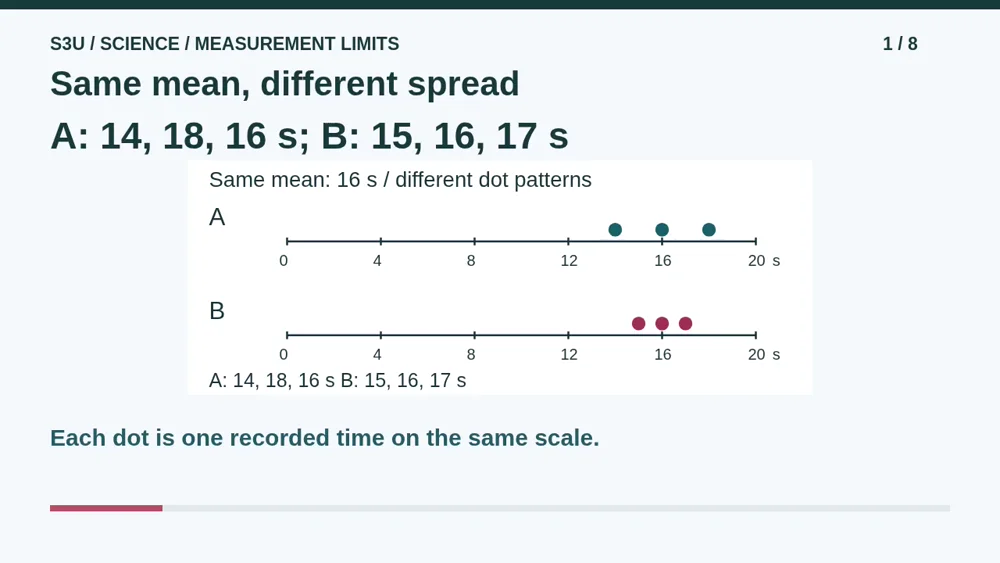
Two fictional tracks are tested with the same cart and timing method. Track A has recorded times of fourteen, eighteen and sixteen seconds. Track B has fifteen, sixteen and seventeen seconds. Each group totals forty-eight seconds over three trials, so both means are sixteen seconds. But look at the dots. They do not form the same pattern. The mean is a useful summary, not a photograph of every result.
2. Read the lowest and highest values
Video: 0:32
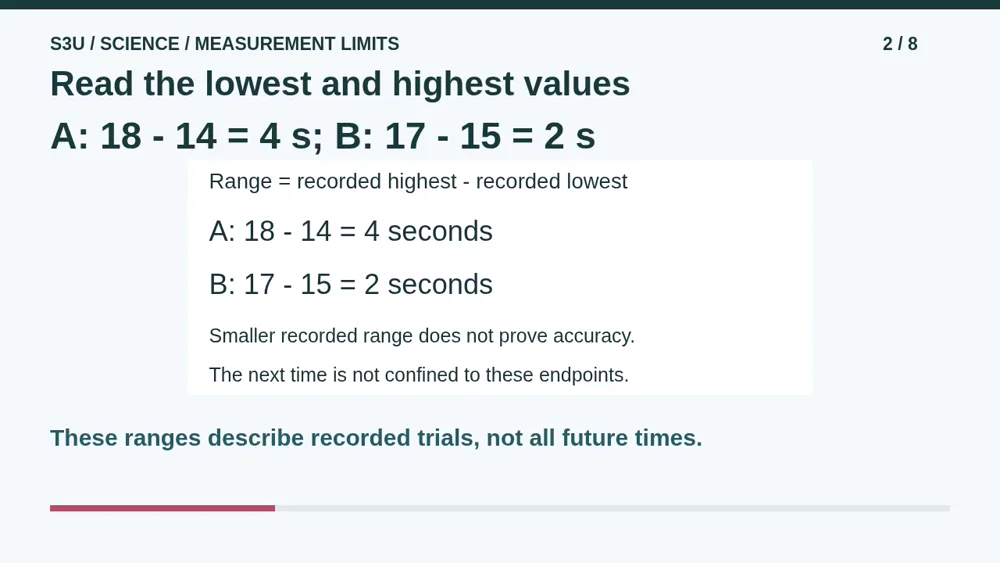
A runs from fourteen to eighteen seconds. Subtract the lowest from the highest to find a range of four seconds. B runs from fifteen to seventeen, a range of two. B has the smaller recorded range in this little test. That does not prove B is more accurate, or that future times must stay inside these ends. We have described three observations in each group, not discovered a fence that all future carts must obey.
3. Rounded matches can hide differences
Video: 1:04
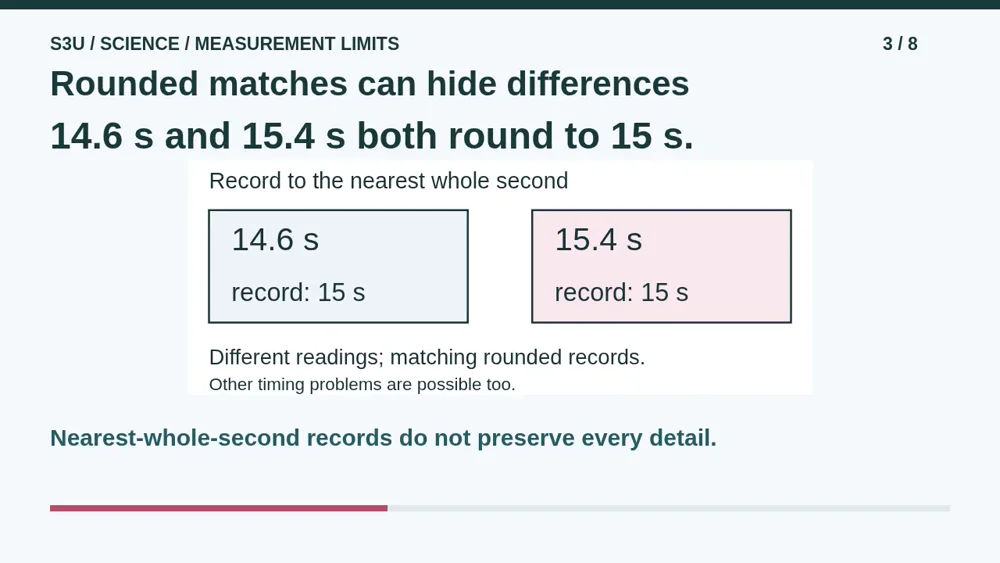
Imagine two timer readings, fourteen point six and fifteen point four seconds. Record each to the nearest whole second and both become fifteen. The original readings differ by eight tenths of a second, even though the rounded records match. This example is about rounding only. Real timing can have other problems, such as starting late. More digits on a display do not automatically make the whole measurement method correct.
4. Improve the method, not just the display
Video: 1:36
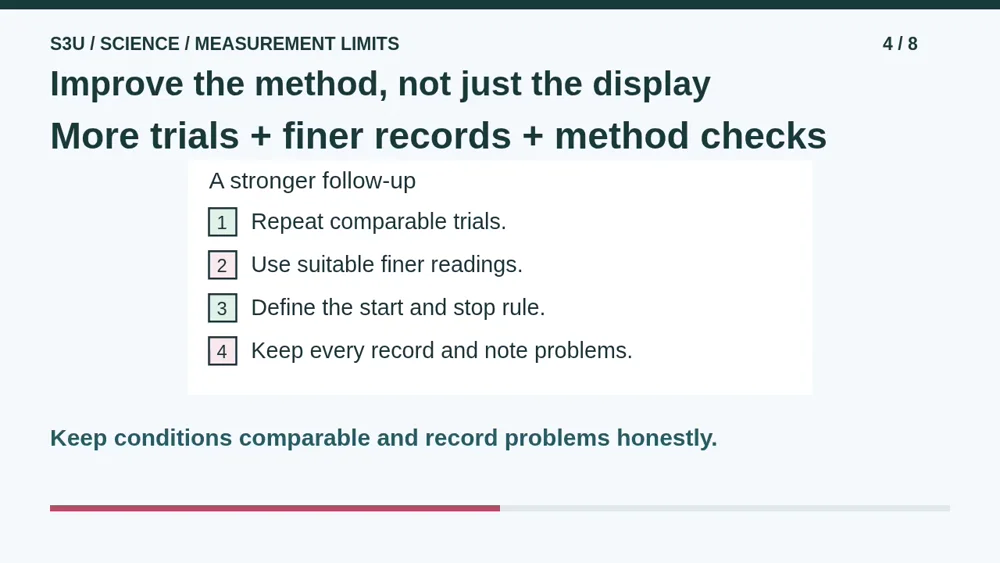
A better follow-up uses more trials, a suitable timer and a clear method. Decide exactly when timing starts and stops. Keep the cart and relevant conditions comparable, record finer readings when the instrument supports them, and keep every trial with notes about problems. Repeating the same mistake many times will not make it disappear. Extra decimal places are not tiny badges of truth. Check how the number was obtained as well as how it was written.
5. Pause: do matching records prove a match?
Video: 2:11
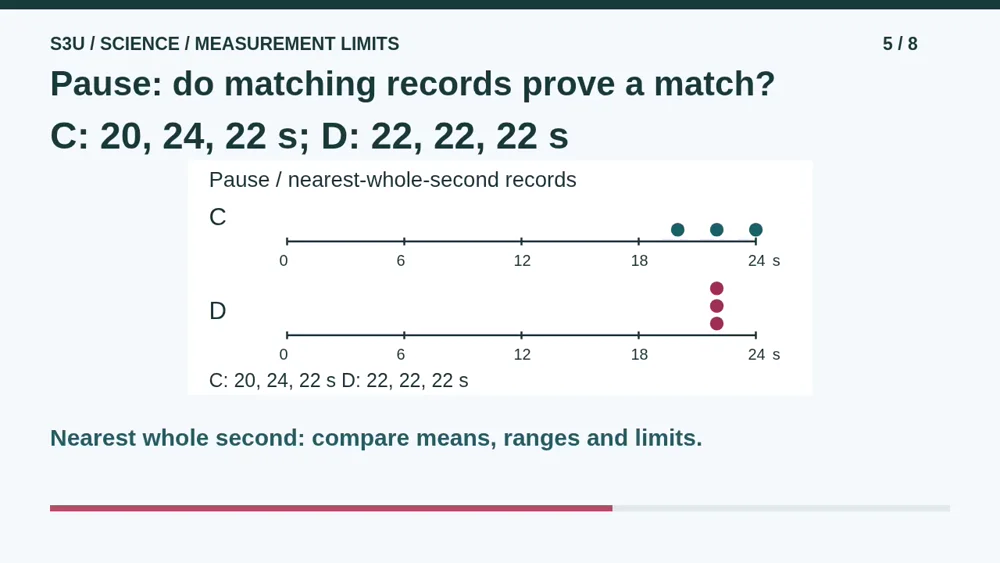
Pause at two new fictional records. C shows twenty, twenty-four and twenty-two seconds. D shows twenty-two, twenty-two and twenty-two. All times were recorded to the nearest whole second. Find the means and the recorded ranges. Does D prove that its exact times were identical? Give two different readings that would both round to twenty-two. Then suggest one change that could help the class learn more in a follow-up test.
6. Check what is known and what is not
Video: 2:44
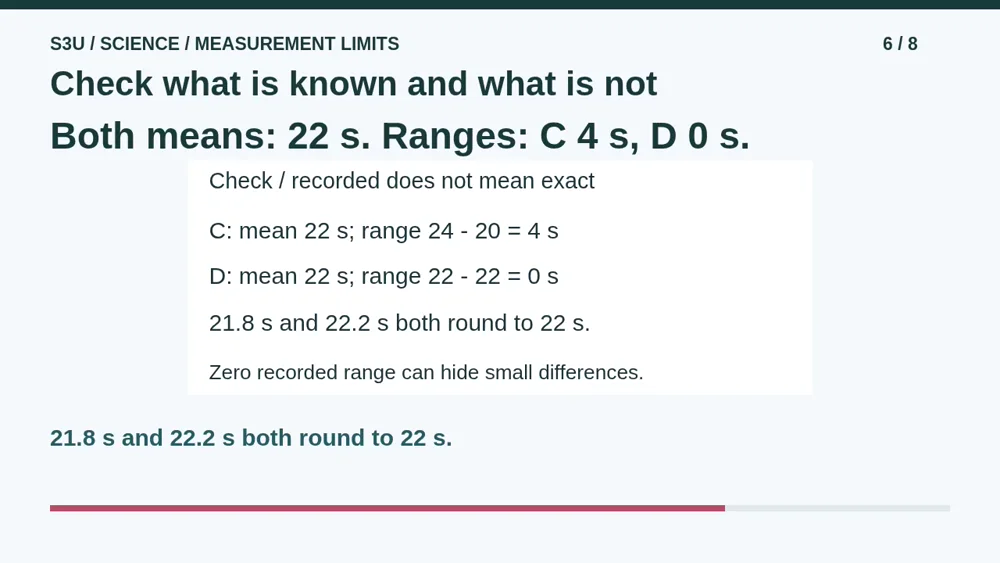
Each group totals sixty-six seconds across three trials, giving a mean of twenty-two. C has a recorded range of four seconds. D has a recorded range of zero. But twenty-one point eight and twenty-two point two both round to twenty-two. Matching rounded records do not prove matching exact times. More trials with suitable finer recording and clear start and stop rules could help. These ranges are not confidence intervals or guarantees about the next trial.
7. The far-end number is not always the length
Video: 3:20
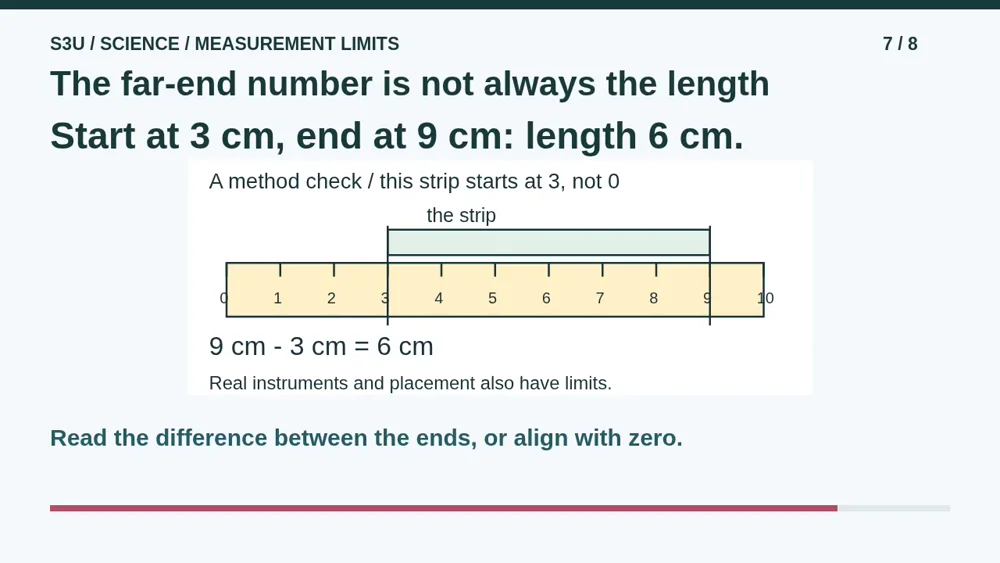
Fun fact: the number at the far end of an object is not always its length. In this drawing, a strip starts at the ruler mark three and ends at nine. Its length is nine minus three, or six centimeters, not nine. Repeatedly reading nine would repeat the same mistake. Line the strip up with zero, or subtract the starting reading. This exact drawing illustrates a method check; a real ruler and placement also have measurement limits.
8. Continue to the worksheet
Video: 3:52
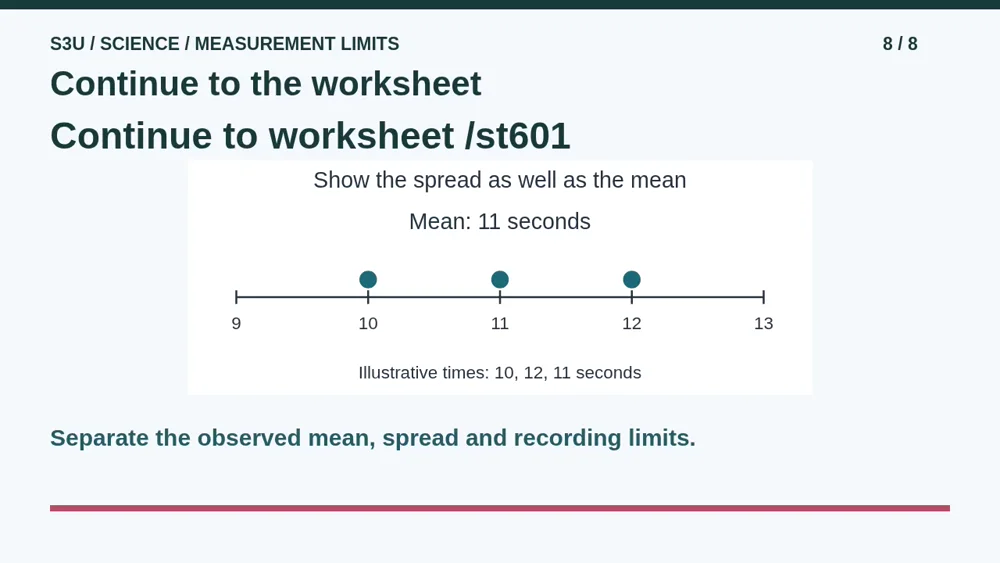
Continue to Match Conclusions to Measurement Limits below. Its cart records are different from the examples here. Calculate the means, inspect the lowest and highest recorded times, and explain what whole-second rounding can hide. Then choose a helpful follow-up. You can work on screen or print the worksheet. For more guided practice, Source Desk has measurement claims to investigate. Explain what the evidence supports and what remains unknown.
Show your understanding
You can point, explain aloud, draw or write.
- Compare recorded ranges beside equal means, without treating their endpoints as future guarantees or confidence intervals.
- Give distinct readings that round to the same whole second and propose a suitable method check, then explain fresh worksheet records.
Try it yourself
Pause at C: 20, 24, 22 seconds and D: 22, 22, 22 seconds. Compare means and recorded ranges; give different readings that round to 22.
Continue to the worksheet with its own cart records. Explain the recording limits and suggest a stronger follow-up method.
Next: your worksheet
Match Conclusions to Measurement Limitshttps://s3u.com/st601
Review: Compare repeated trials
Investigate measurement claims at Source Desk
Lesson: https://s3u.com/lessons/look-beyond-the-mean