Science / Grade 5
Compare repeated trials
Learning goal: Keep every measurement, compare means using the same method, and separate a test result from a promise about the next trial.
Before you start: Add whole numbers and divide a total by three. Review Share to find the mean if needed. All cart records are fictional; no physical experiment is required.
Read or print this lesson What to practiceThe video could not load. The transcript is still available below.
Next: your worksheet
Compare Repeated Trials
Checking sign-in...
Read the transcript
Saved reading place
Video transcript and practice. Reading or printing does not count as playback time or an assessed grade.
1. Give each test a fair chance
Video: 0:00
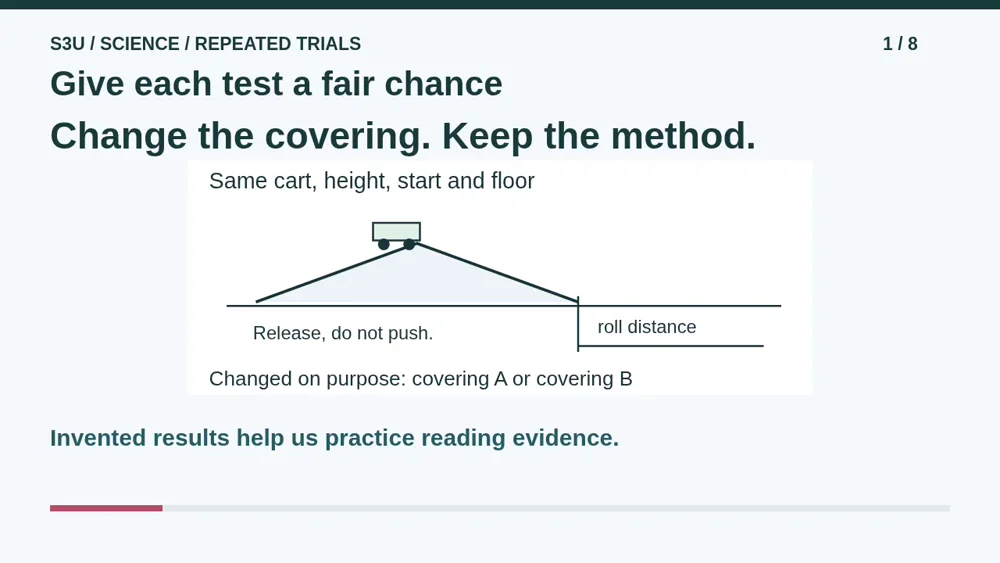
Imagine a class testing two ramp coverings, A and B. They use the same toy cart, ramp height, starting mark and floor. They release the cart without a push, then measure how far it rolls across the floor from the same line. Only the covering is deliberately changed. These are invented results, not a claim about real materials. A fair comparison needs a shared method, not a secret extra shove.
2. Keep every recorded trial
Video: 0:30
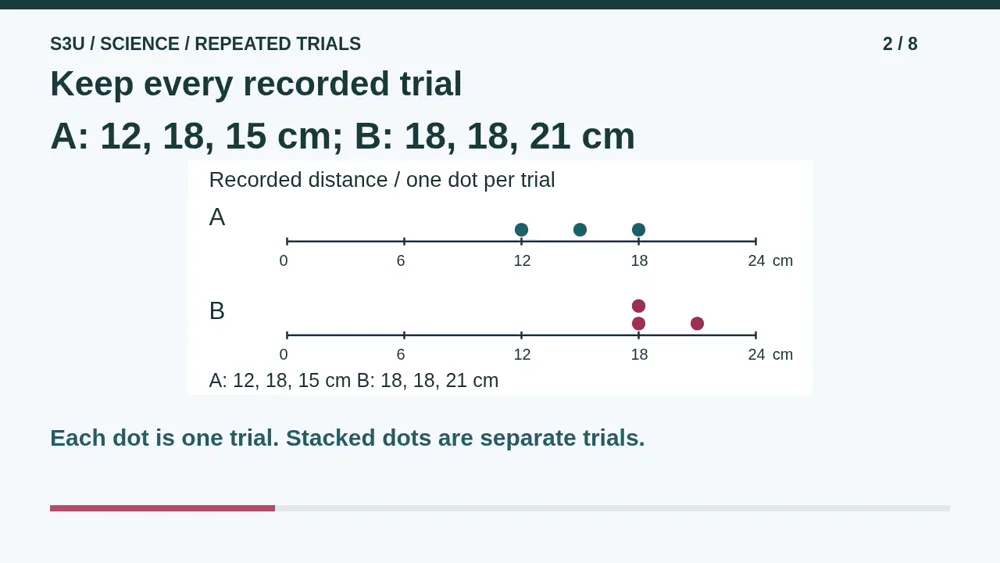
Covering A gives twelve, eighteen and fifteen centimeters. Covering B gives eighteen, eighteen and twenty-one centimeters. Each dot shows a recorded trial. Two B trials landed at eighteen, so their dots are stacked, not erased. The results vary even though the class tried to use the same method. Keep the individual records. Choosing only the longest roll would hide the other evidence. The cart does not get to edit its own report.
3. Compare means using all the trials
Video: 1:04
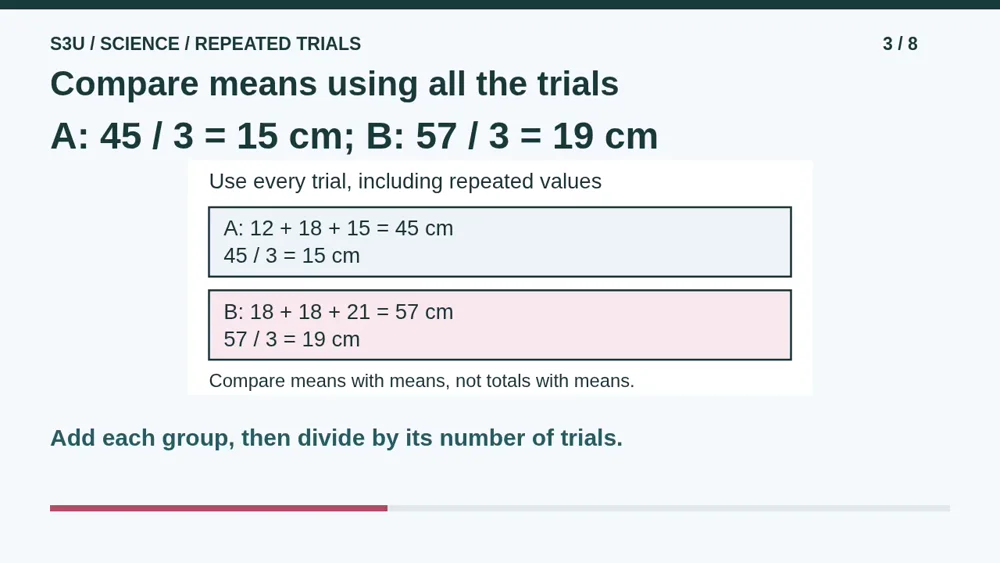
Find each mean by adding its distances and dividing by three trials. For A, twelve plus eighteen plus fifteen makes forty-five. Forty-five divided by three is fifteen centimeters. For B, eighteen plus eighteen plus twenty-one makes fifty-seven. Divide by three to get nineteen centimeters. Include both eighteens because they are different trials. Do not compare the sum for one group with the mean for the other. Compare the same kind of summary.
4. Say what this test supports
Video: 1:39
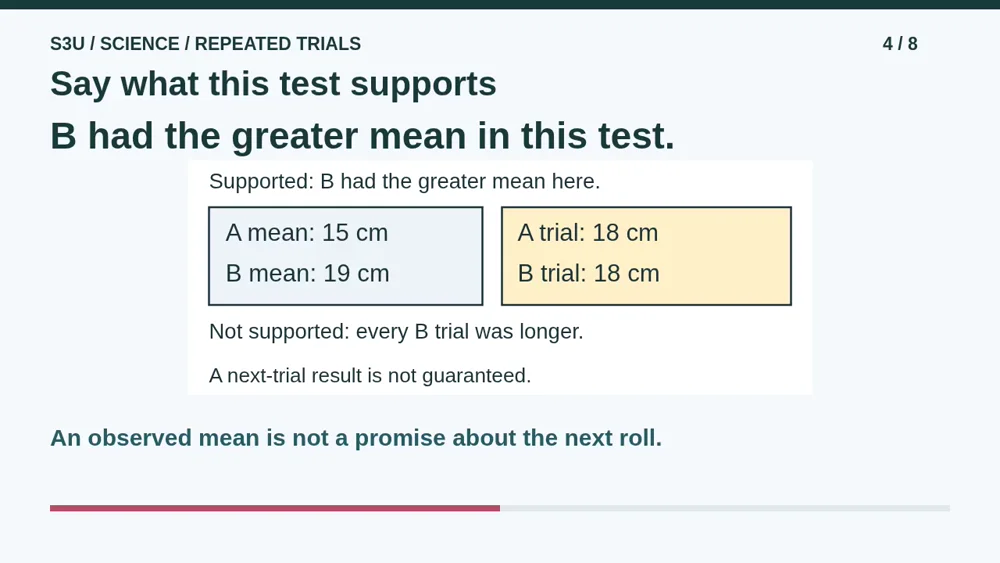
B had a mean distance four centimeters greater than A in these recorded trials. That is a supported description. It does not mean every B roll was longer than every A roll. A reached eighteen, and two B rolls also reached eighteen. Nor does it guarantee the next result. Describe what happened in this test, keep the original measurements, and plan more careful trials before making a much broader claim.
5. Pause: compare two new coverings
Video: 2:10
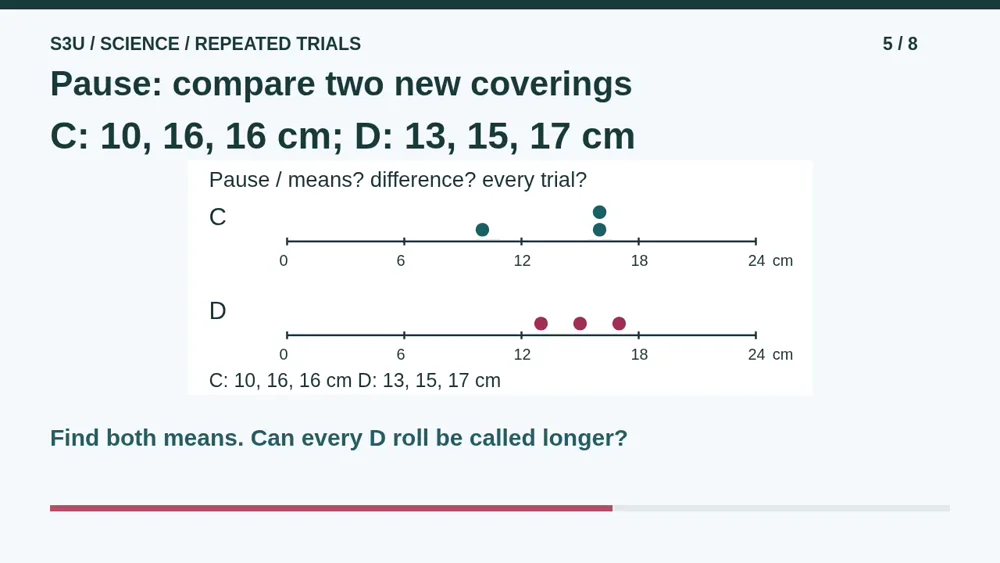
Pause for a new fictional test using the same fair method. Covering C gives ten, sixteen and sixteen centimeters. Covering D gives thirteen, fifteen and seventeen centimeters. Find both means. Which recorded mean is greater, and by how much? Then inspect the individual trials. Is every D distance greater than every C distance? Explain with two numbers from the record. You can write, draw or say your reasoning before continuing.
6. Check the summary and the records
Video: 2:46
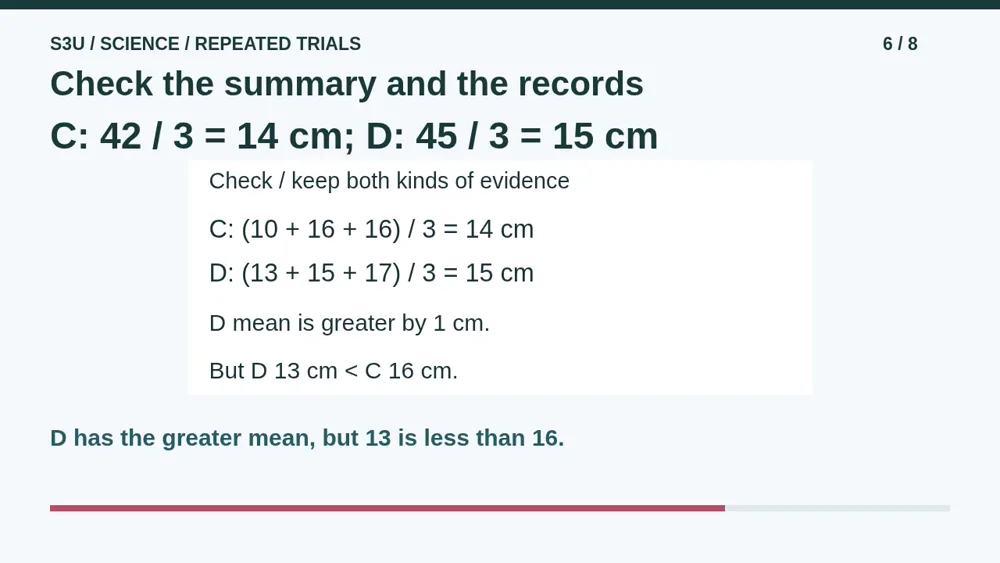
C totals forty-two centimeters across three trials, so its mean is fourteen. D totals forty-five, so its mean is fifteen. D has the greater recorded mean by one centimeter. But D also has a thirteen-centimeter roll, which is shorter than a sixteen-centimeter roll for C. That one comparison disproves the claim that every D roll is longer. A summary and the individual observations answer different questions. We need both.
7. A mean need not be a recorded value
Video: 3:21
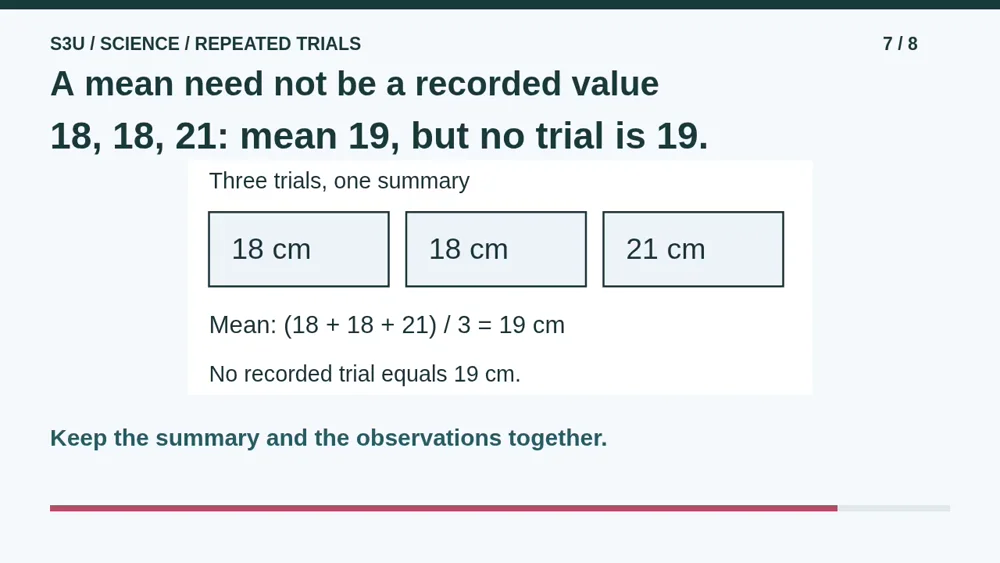
Fun fact: a mean can be a value that never appears in the measurements. Our B trials were eighteen, eighteen and twenty-one, but their mean was nineteen. No cart had to stop exactly there. A mean is the equal-share value of the total, not a fourth hidden trial. That is another reason to keep the list beside its summary. For real investigations, record the method and any problems too.
8. Continue to the worksheet
Video: 3:50
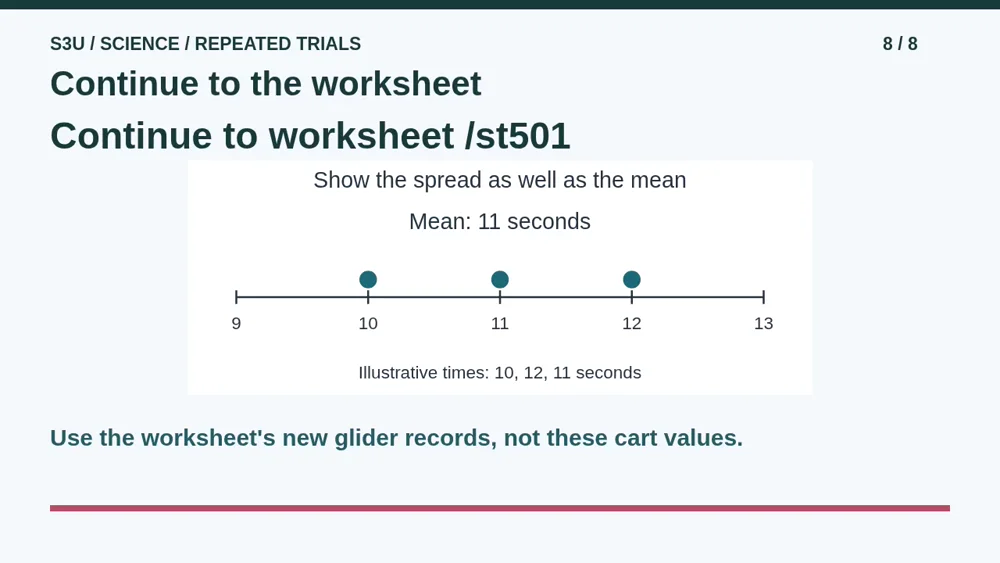
Continue to Compare Repeated Trials below. The worksheet uses paper gliders and different distances. Identify what was deliberately changed and what was kept the same. Calculate each mean from the worksheet records, then choose a conclusion that stays within the evidence. You can complete it on screen or print it. Next, the measurement limits lesson will show why matching means and matching rounded readings can still hide important differences.
Show your understanding
You can point, explain aloud, draw or write.
- Identify a deliberately changed factor and shared method, then calculate and compare means using every recorded trial.
- Use individual observations to challenge an every-trial claim, and write a conclusion limited to the recorded test before using fresh worksheet data.
Try it yourself
Pause at C: 10, 16, 16 cm and D: 13, 15, 17 cm. Calculate both means, then test whether every D roll is longer than every C roll.
Continue to the worksheet using its new glider data. State what the recorded trials support without promising the next result.
Next: your worksheet
Compare Repeated Trialshttps://s3u.com/st501
Next lesson: Look beyond the mean
Lesson: https://s3u.com/lessons/compare-repeated-trials