Math / Grade 6
A flag asks for evidence
Learning goal: Separate review flags from checked correctness, including false alarms, caught and missed errors, exact endpoints and missing evidence.
Before you start: Compare whole numbers and distinguish a recorded value from an independent check. Reading support is welcome.
Read or print this lesson What to practiceThe video could not load. The transcript is still available below.
Next: your worksheet
A Flag Is Not a Verdict
Checking sign-in...
Read the transcript
Saved reading place
Video transcript and practice. Reading or printing does not count as playback time or an assessed grade.
1. A flag asks a question
Video: 0:00
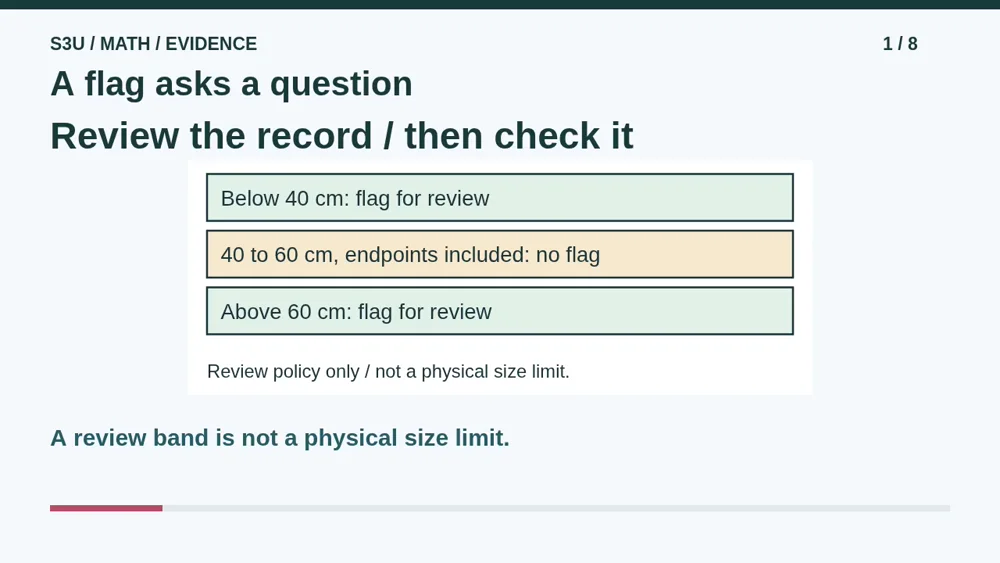
Imagine a notebook of crate lengths. Our review rule flags recorded lengths below forty centimeters or above sixty centimeters. Forty and sixty themselves are not flagged. The band tells us which records to inspect. It does not tell us which crate sizes are possible. A highlighter can mark a number, but it cannot measure a crate! These are invented records. We will treat the independent checks as reliable within this exercise; real measurements can have uncertainty.
2. Unusual, but correct
Video: 0:36
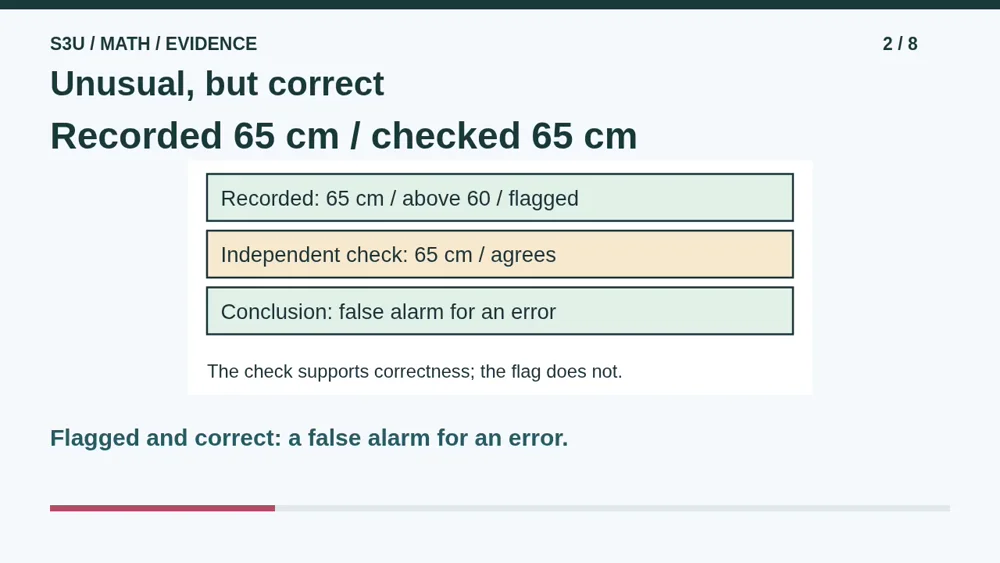
One record says sixty five centimeters. That is above sixty, so the rule flags it. Now inspect an independent check of the same crate: sixty five centimeters. The record agrees with the check. This is a false alarm for a recording error. The rule did flag the record, but the evidence says the record is correct in our exercise. Do not cross out a valid observation just because it surprised the highlighter.
3. An error that was caught
Video: 1:08
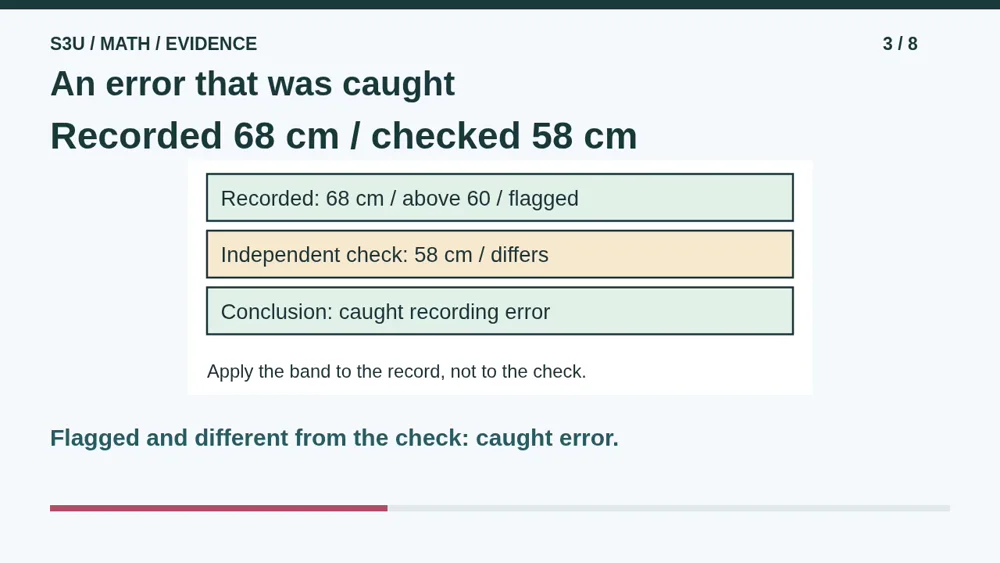
A second record says sixty eight centimeters, while the independent check says fifty eight. The rule flags the recorded sixty eight, because it is above sixty. The disagreement with the check tells us this record is wrong. Together, those two pieces tell us the rule caught a recording error. Apply the band to the recorded value, not to the checked value. The flag alone still did not prove the error.
4. No flag is not proof
Video: 1:38
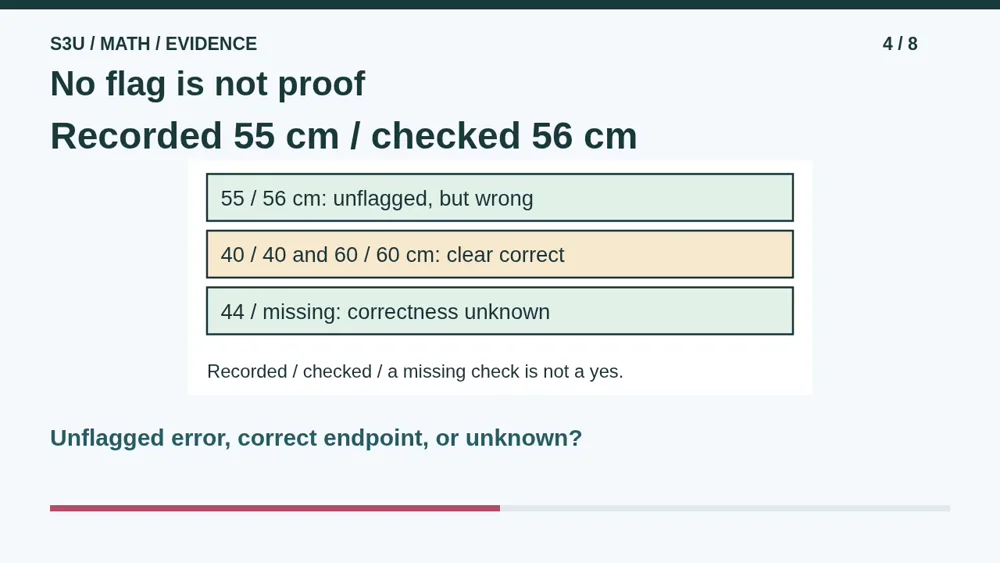
Now a record says fifty five, but its check says fifty six. Fifty five is inside the band, so there is no flag. Yet the record disagrees with the check: a missed error. A record of forty checked as forty is correct and unflagged. The same is true of sixty checked as sixty. But a record of forty four with no check stays unknown. An empty check box is not a secret yes.
5. Pause: three new records
Video: 2:08
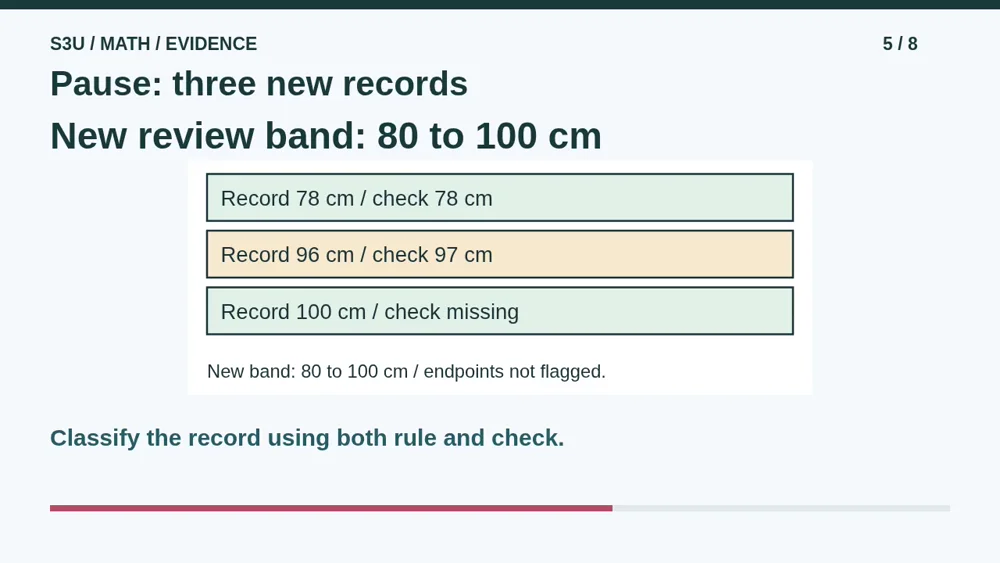
Pause for a fresh review band: flag records below eighty or above one hundred centimeters. First, a record of seventy eight is independently checked as seventy eight. Second, ninety six is checked as ninety seven. Third, one hundred has no independent check. For each record, decide whether it is flagged. Then decide what the evidence supports about correctness. Explain each answer aloud or on paper before continuing. You do not need to measure anything.
6. Check both questions
Video: 2:44
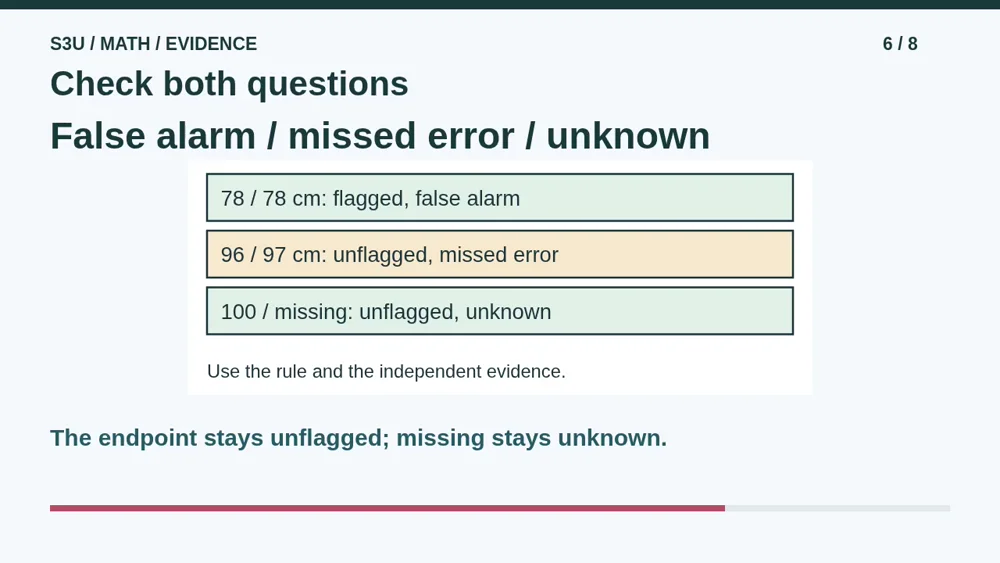
Seventy eight is below eighty, so it is flagged. The matching check makes it a false alarm for a recording error. Ninety six is inside the band, so it is not flagged. Its different check reveals a missed error. One hundred is exactly an endpoint, so it is not flagged. Without a check, correctness is unknown. If you called that last record correct, separate the two questions: did the rule flag it, and what evidence checks it?
7. A useful surprise
Video: 3:17
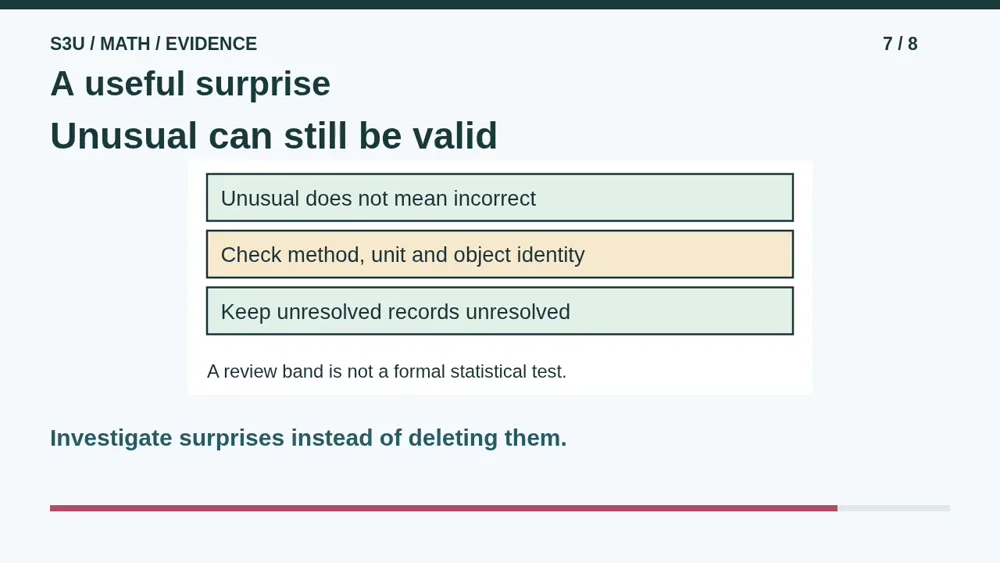
Fun fact: an unusual observation can be correct and scientifically interesting. The right response is investigation, not automatic deletion. Our simple band is only a review policy, not a formal statistical outlier test. A real investigation also checks measurement methods, units and whether the comparison refers to the same object. Keep the evidence and the limits with your conclusion. A tidy notebook is useful; a notebook that erased its surprises may have lost something important.
8. Continue to the worksheet
Video: 3:55
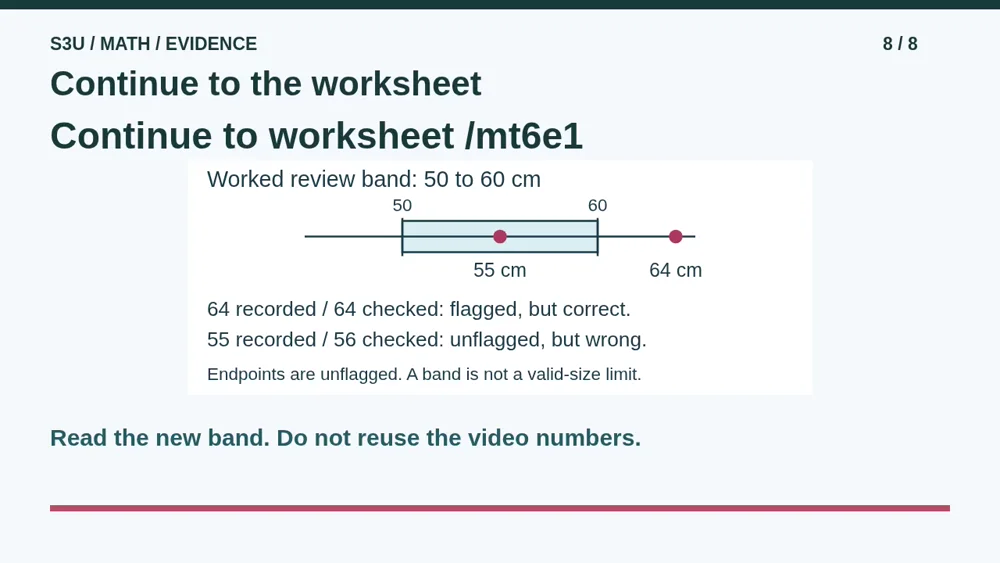
Continue to the evidence worksheet below. It has a different review band and different records, so read its worked example first. Use the rule to find flags, then use the independent checks to distinguish caught errors, false alarms, missed errors, clear correct records and unknown outcomes. Try the second version for another set of records. Rule Patrol offers related practice too. Watching or playing is practice, not proof that every future record will be judged correctly.
Show your understanding
You can point, explain aloud, draw or write.
- Apply an outside-band rule to recorded values, with both endpoints unflagged.
- Use independent checks to distinguish false alarms, caught errors, missed errors, clear correct records and unknown outcomes.
Try it yourself
Pause at the 80-to-100-centimeter band. For each of the three records, distinguish the flag result from evidence of correctness.
Continue to the two evidence worksheets. Read their new bands, and keep missing checks unresolved.
Next: your worksheet
A Flag Is Not a Verdicthttps://s3u.com/mt6e1
Try Rule Patrol: choose Flags need evidence
Try another evidence worksheet · Continue to Two questions, two fractions
Lesson: https://s3u.com/lessons/flags-need-evidence