Math / Grade 2 / supported practice
Five-minute clock times
Learning goal: Count clock minutes by fives, match digital displays and distinguish quarter past from quarter to.
Before you start: Read hours and half-hours and count by fives to sixty. Review the first clock lesson when needed.
Read or print this lesson What to practiceThe video could not load. The transcript is still available below.
Next: your worksheet
Five-Minute Times: Clock Set One
Checking sign-in...
Read the transcript
Saved reading place
Video transcript and practice. Reading or printing does not count as playback time or an assessed grade.
1. Count minutes by fives
Video: 0:00
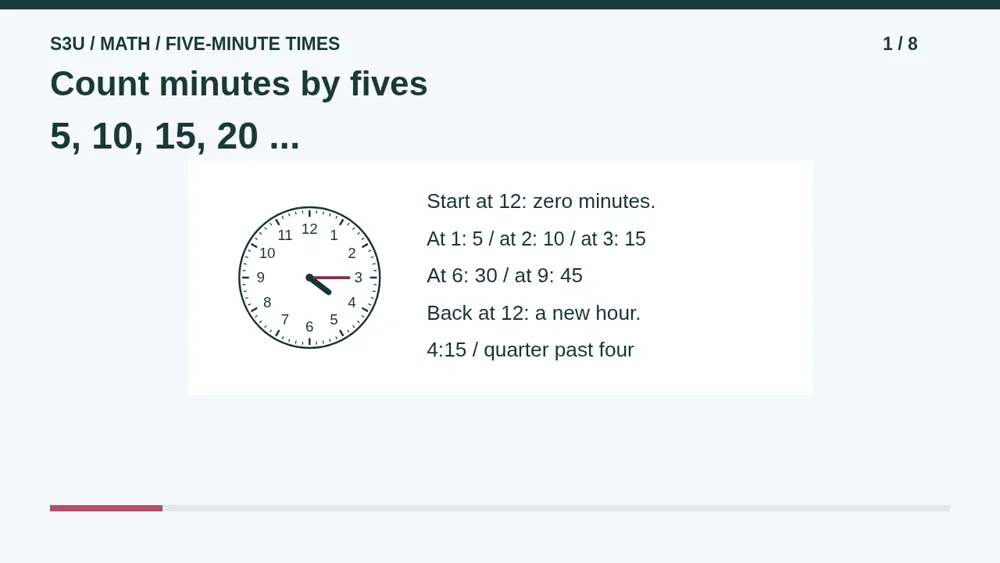
The long hand tells minutes. Start at twelve with zero minutes. Move around the clock in the usual direction, toward one. At one, count five. At two, count ten. At three, count fifteen. Keep counting by fives. At six, you reach thirty. At nine, forty-five. When the long hand returns to twelve, sixty minutes have passed and a new hour starts.
2. A quarter of an hour
Video: 0:31
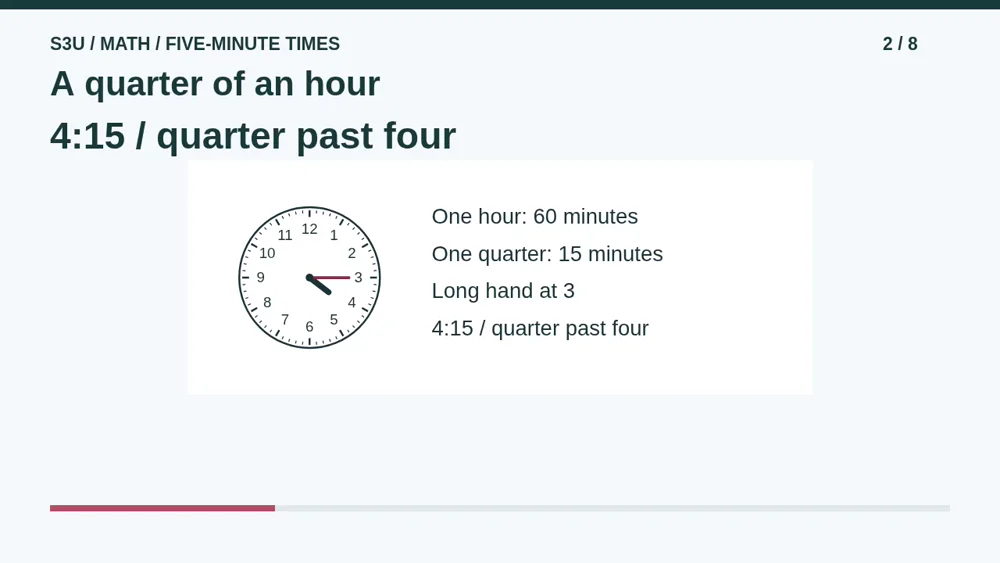
Sixty minutes split into four equal parts gives fifteen minutes in each part. That is a quarter of an hour. Here the long hand is at three, so fifteen minutes have passed. The short hand is just past four. Read four fifteen. We can also say quarter past four. Do not call it four oh three: the three on the clock face stands for fifteen minutes.
3. Quarter to the next hour
Video: 0:58
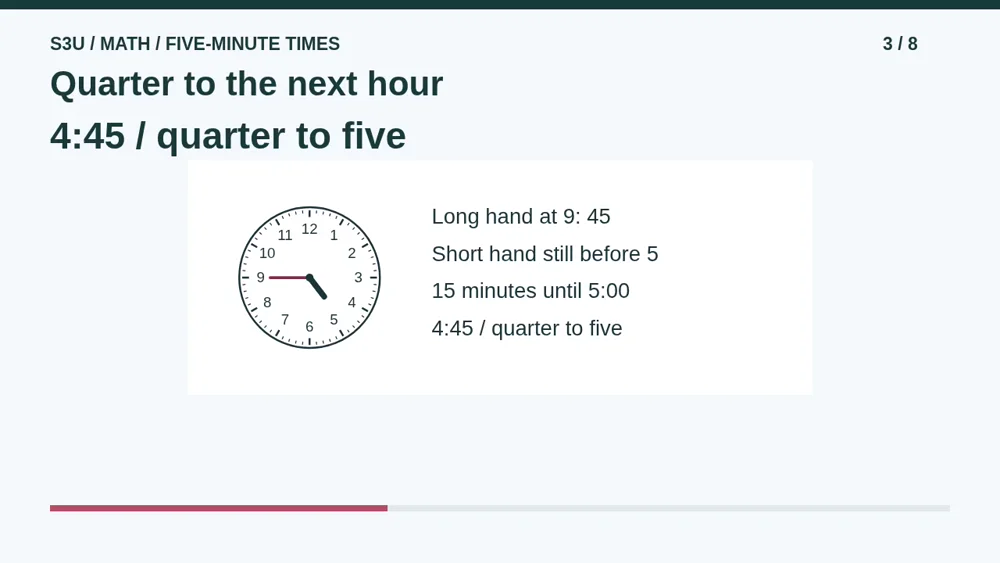
Now the long hand is at nine. Count forty-five minutes. The short hand is between four and five, quite close to five. The time is four forty-five. Fifteen more minutes will reach five o'clock. That is why we can say quarter to five. Past tells how far into an hour we are. To tells how long until the named hour.
4. Almost twelve
Video: 1:24
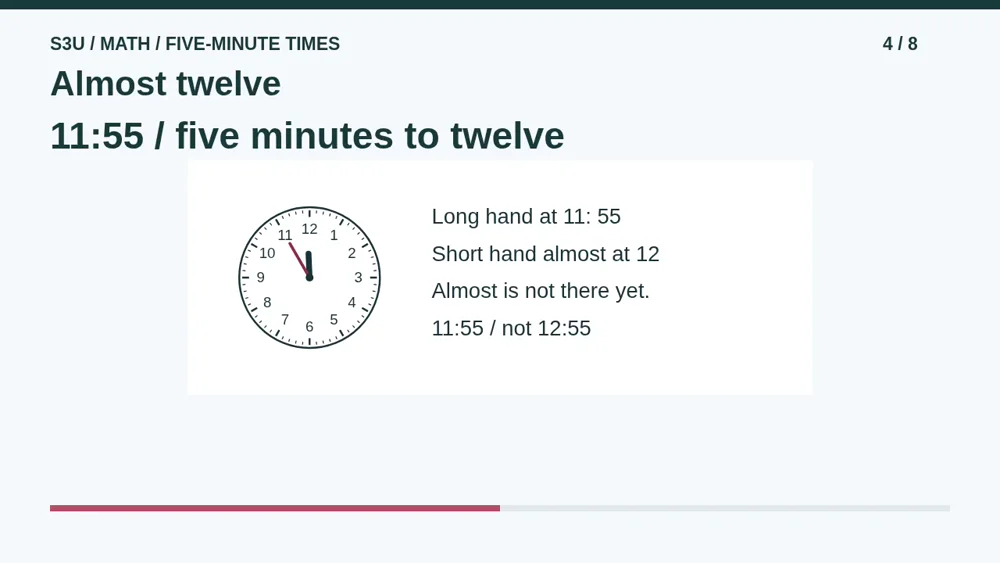
Our impatient clock robot sees the short hand close to twelve and says twelve fifty-five. Not yet! The short hand is still before twelve. The hour that started is eleven. The long hand points to eleven, which means fifty-five minutes. The time is eleven fifty-five. Five more minutes will make twelve o'clock. Nearly reaching a number does not mean the next hour has started.
5. Keep the zero
Video: 1:55
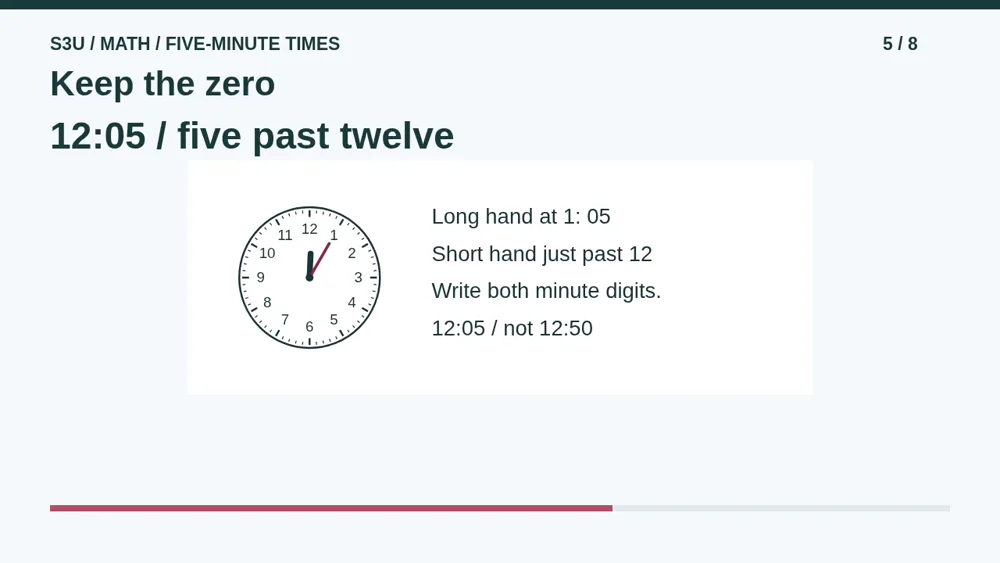
At twelve oh five, the long hand is at one. That means five minutes, not one minute. The short hand has moved a little past twelve. Digital clocks normally use two minute digits. Write zero five after the colon, not fifty. Twelve oh five and twelve fifty are very different times. Check which place the zero is in.
6. Pause: two new times
Video: 2:21
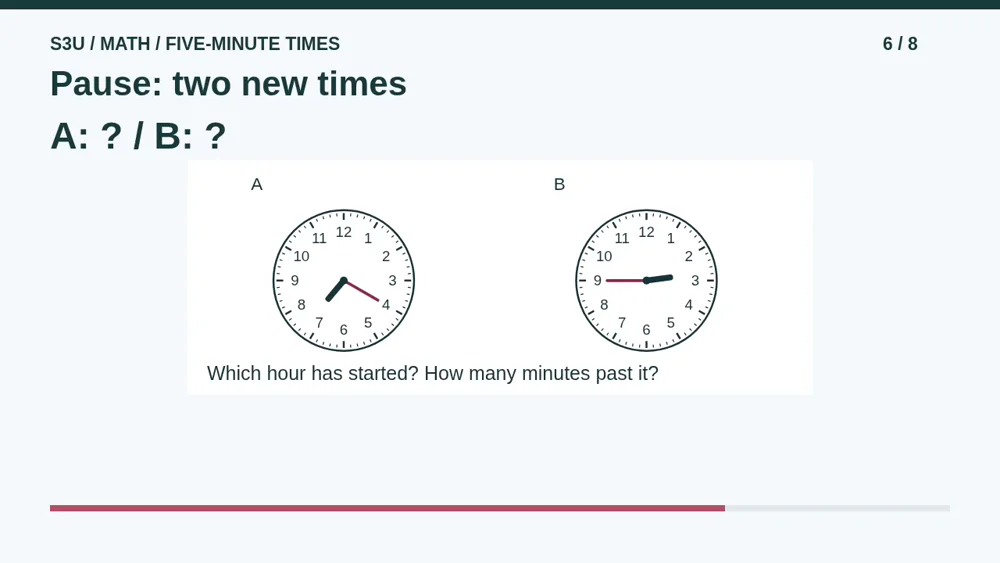
Pause for two new clocks. For A, name the hour that has started. Count the minutes by fives. Write the digital time. Now do the same for B. Can you also say B using quarter to? Explain which hour is coming next. No racing is needed. A careful explanation matters more than a quick guess.
7. Check and explain
Video: 2:47
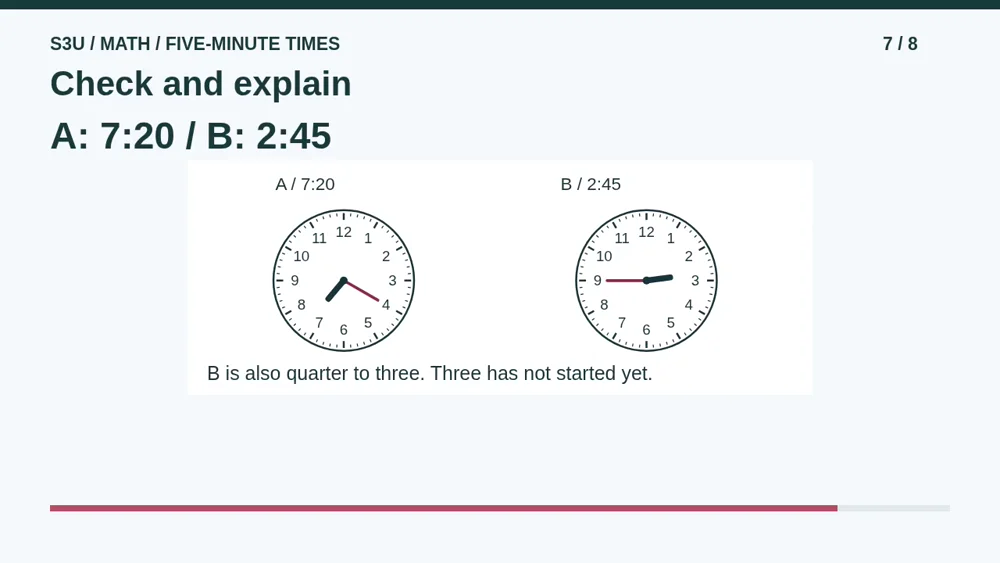
Clock A is seven twenty. Its minute hand is at four: five, ten, fifteen, twenty. Its hour hand is past seven. Clock B is two forty-five. Its minute hand is at nine and its hour hand is still before three. We can say quarter to three, because fifteen minutes remain until three o'clock. Quarter to three does not mean three forty-five.
8. Continue with fresh clocks
Video: 3:16
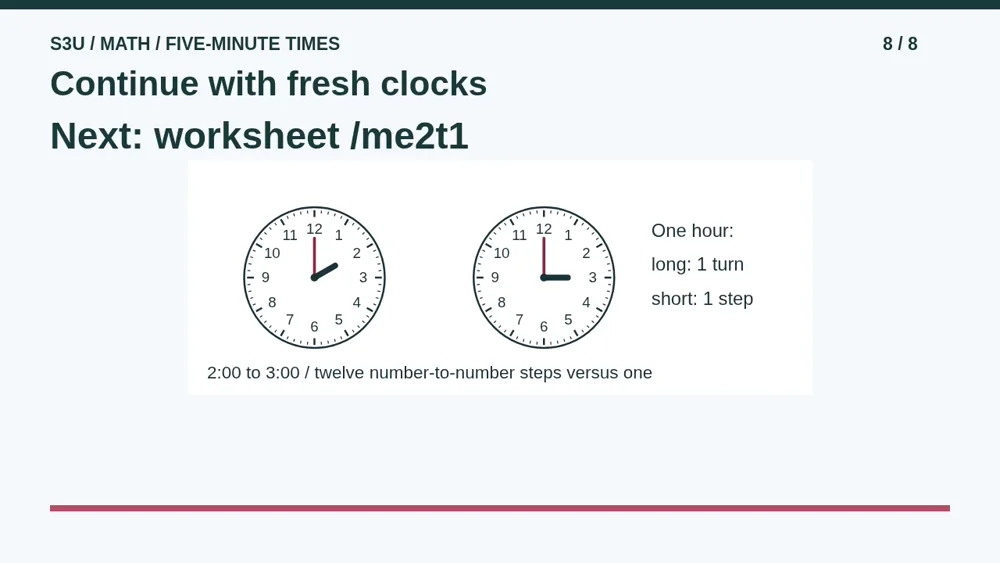
Fun fact: in one hour, the minute hand passes twelve number-to-number spaces while the hour hand passes just one. Both hands keep moving, but at different speeds. Continue to the worksheet below for four new clocks. Match hands to digital times and explain quarter to. Try the second set another day. These clocks have no morning or afternoon label, so do not guess one from the hands alone.
Show your understanding
You can point, explain aloud, draw or write.
- Read five-minute intervals and write two minute digits on a digital clock.
- Explain quarter past, quarter to and a near-hour clock without choosing the next hour too early.
Try it yourself
Pause at the two new clocks. Name the hour already started and count minutes, then explain quarter to.
Continue to the worksheet. Keep both minute digits and do not guess daytime or nighttime from unlabeled hands.
Next: your worksheet
Five-Minute Times: Clock Set Onehttps://s3u.com/me2t1
Lesson: https://s3u.com/lessons/five-minute-clock-times