Math / Grade 8 / algebra extension
Expand and check equations
Learning goal: Distribute to every term, solve signed linear equations and distinguish one solution from none or all real numbers.
Before you start: Solve linear equations with x on both sides and multiply signed numbers. Review The unknown on both sides first when needed.
Read or print this lesson What to practiceThe video could not load. The transcript is still available below.
Next: your worksheet
Expand and Solve Equations - Practice 1
Checking sign-in...
Read the transcript
Saved reading place
Video transcript and practice. Reading or printing does not count as playback time or an assessed grade.
1. Multiply every term inside
Video: 0:00
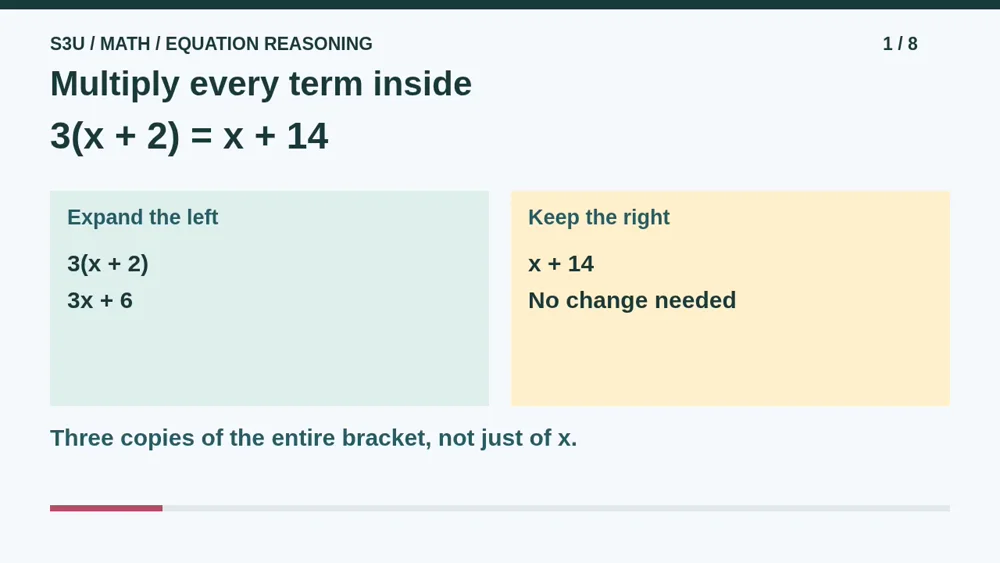
Brackets ask us to keep an expression together. Three times the bracket x plus two means three copies of x plus two. Distribute the three to every term inside: three times x plus three times two. That becomes three times x plus six, not three times x plus two. The extra two has to ride in every copy; it cannot buy one ticket and bring two free copies along.
2. Simplify, solve, then check
Video: 0:29
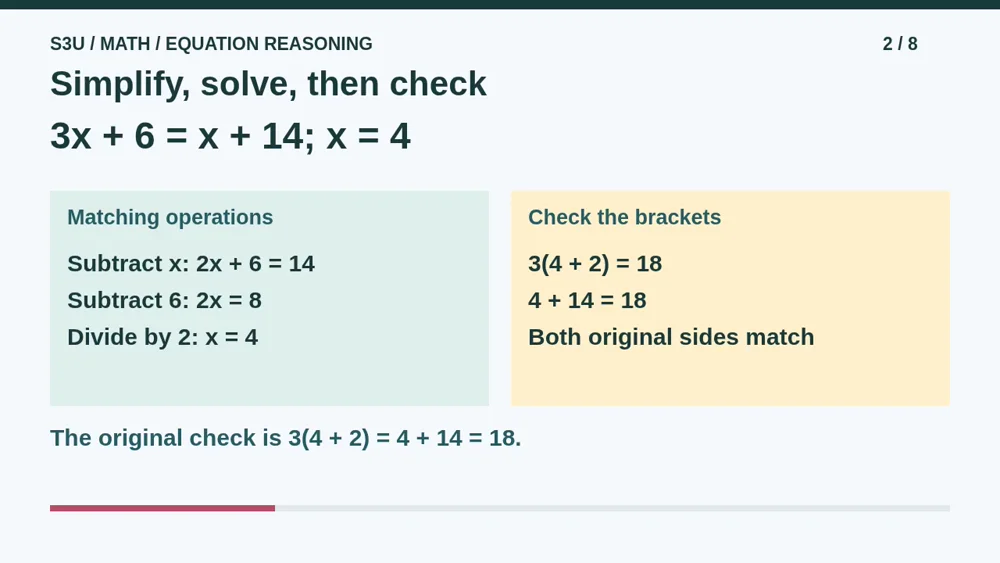
After expanding, subtract x from both sides. Two times x plus six equals fourteen. Subtract six on both sides, then divide both sides by two. We get x equals four. Check the original brackets: three times the sum four plus two equals eighteen. The right side, four plus fourteen, is eighteen too. Expansion and solving are different jobs: first rewrite an expression correctly, then preserve equality as you solve.
3. A negative multiplier reaches all terms
Video: 1:03
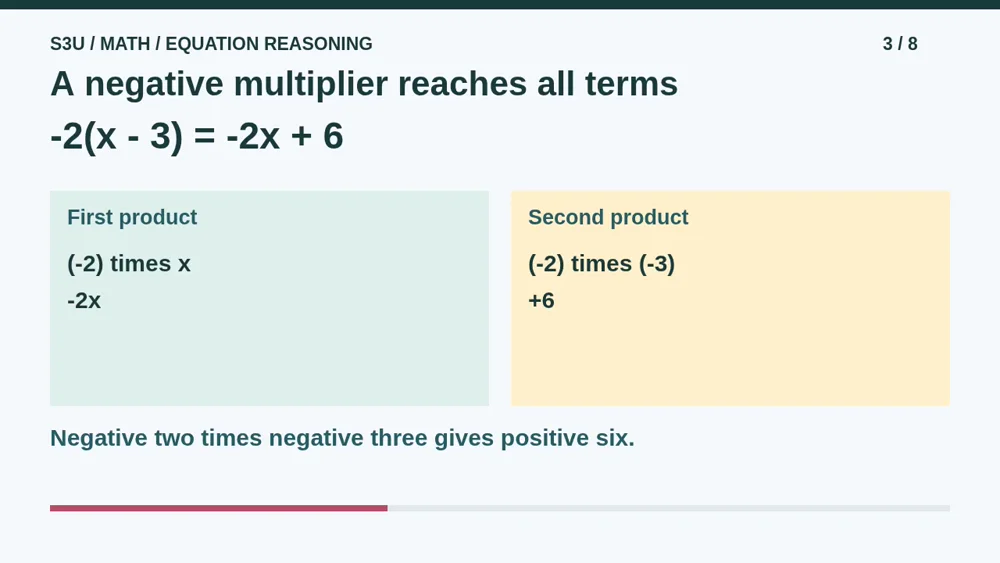
A negative multiplier also reaches every term. Negative two times the bracket x minus three becomes negative two times x plus six. The second product is negative two times negative three, which is positive six. Writing negative two times x minus six would be a sign error. You can test expansion separately: at x equals one, the original expression and the expanded expression both give four. That single test catches this error, though one test alone is not a general proof.
4. Pause: expand before solving
Video: 1:41
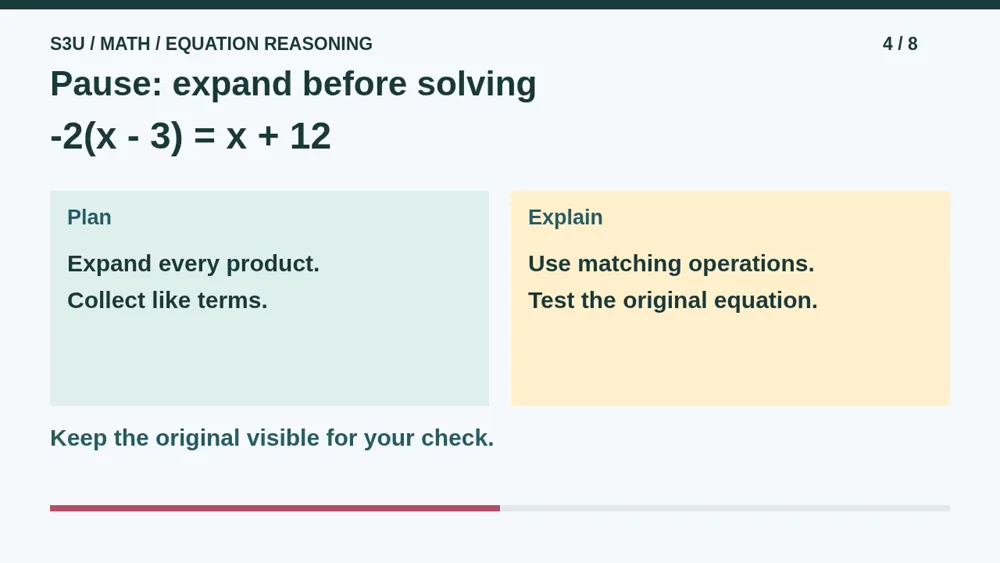
Pause and solve negative two times the bracket x minus three equals x plus twelve. Start by expanding the left correctly. Then choose the same operation for both whole sides until you can isolate x. Check your proposed number in the original equation with its brackets. You can say each step aloud or write it. Do not remove a negative sign merely because it makes the next line easier to look at.
5. Check the signed solution
Video: 2:12
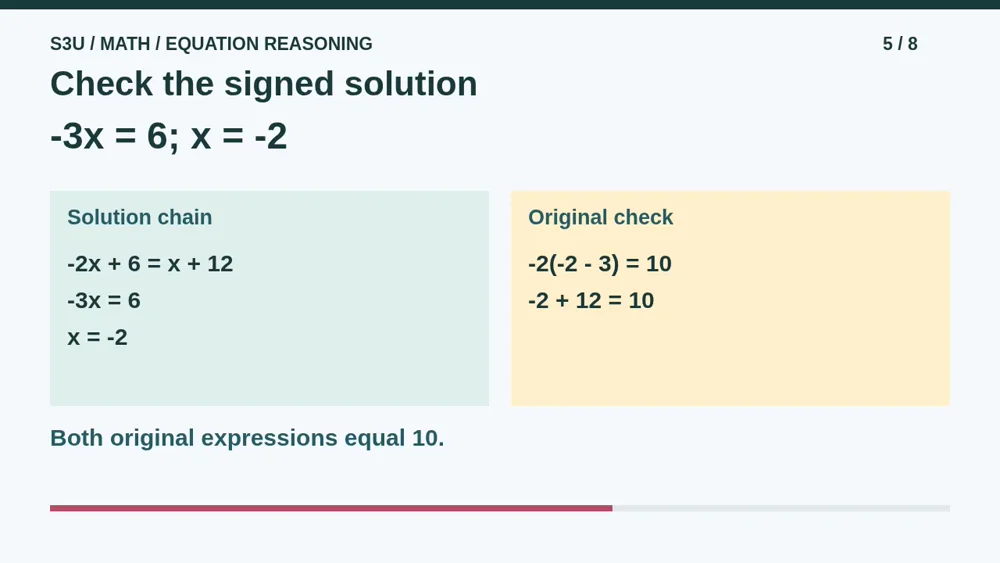
Expansion gives negative two times x plus six equals x plus twelve. Subtract x and six from both sides to get negative three times x equals six. Divide by negative three, giving x equals negative two. In the original, negative two minus three is negative five, and multiplying by negative two gives ten. The right gives negative two plus twelve, also ten. The signs agree because we kept track of every product.
6. No number can repair a contradiction
Video: 2:46
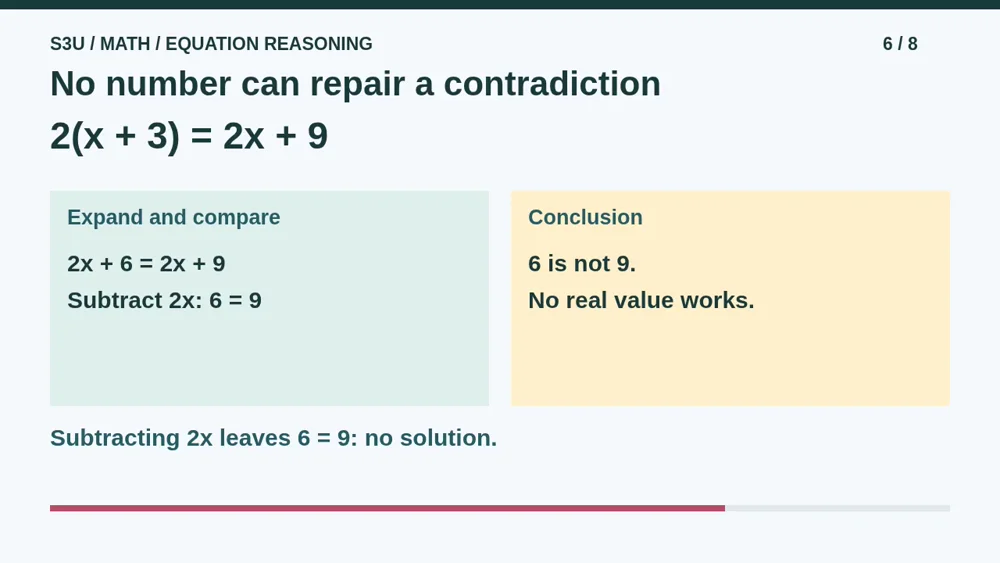
Now try two times x plus three in brackets equals two times x plus nine. Expanding the left gives two times x plus six. Subtract two times x from both sides and we get six equals nine. That is false whatever x was. This equation has no solution. It is not an instruction to choose x equals zero. Substituting zero would still give six on one side and nine on the other.
7. A true identity keeps every value
Video: 3:17
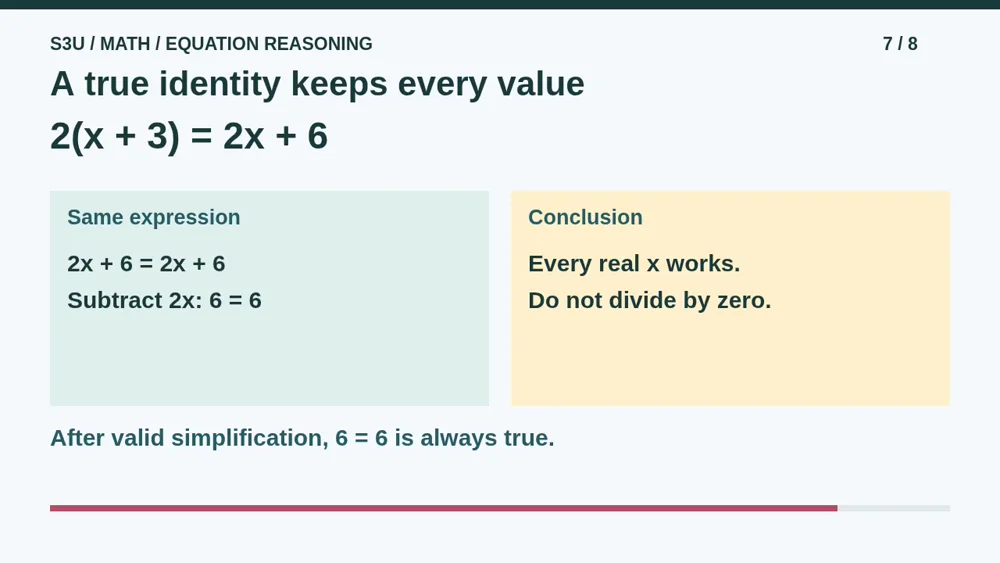
Fun fact: changing the last nine to six turns our impossible equation into an identity. Both sides now simplify to the same expression, so every real value of x works. A true numerical statement after valid reversible steps means all real values here; a false statement means none. If no variable term remains, stop and read that statement. Do not try to divide by a zero coefficient to manufacture a single answer.
8. Solve and classify new equations
Video: 3:51
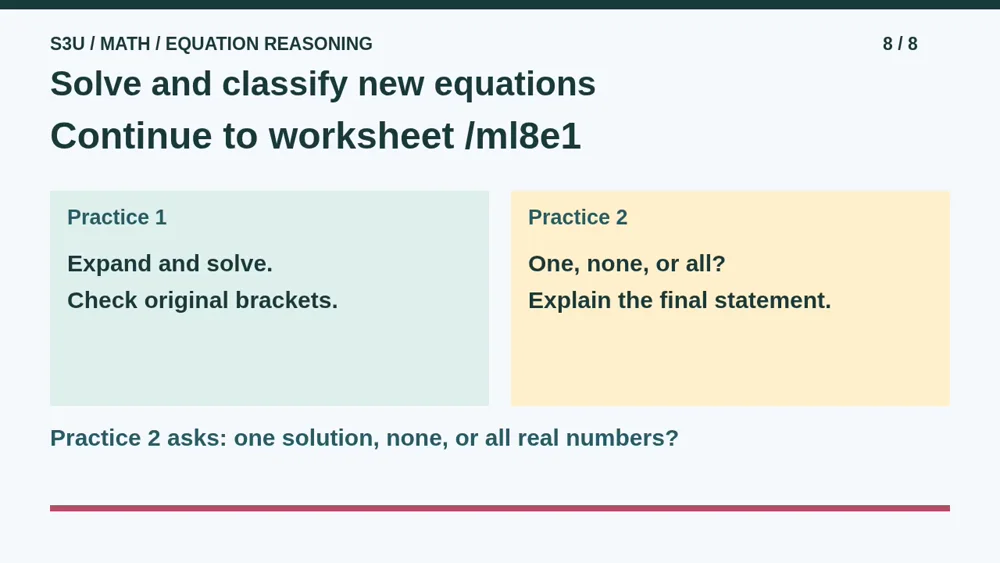
Continue to the worksheet for fresh equations with brackets, then use Practice Two to classify new examples. Some have one solution, some have none, and some work for every real number. Show the expanded expression and the final statement that supports your decision. These are linear equations with no variable denominators. More advanced equations need additional checks, so do not apply the three short examples as a shortcut for every equation you meet.
Show your understanding
You can point, explain aloud, draw or write.
- Distribute positive and negative factors to every term and check a solution in the original brackets.
- Distinguish one solution, no solution and all real numbers using valid algebra, without dividing by a zero coefficient.
Try it yourself
Pause at -2(x - 3) = x + 12. Expand with signs attached, solve and check the original brackets.
Continue to Practice 1, then classify equations in Practice 2. Explain the final statement instead of guessing from test values.
Next: your worksheet
Expand and Solve Equations - Practice 1https://s3u.com/ml8e1
Lesson: https://s3u.com/lessons/expand-and-check-equations