Science / Grade 9
Equal current, different power
Learning goal: Compare ideal series designs, check source and resistor powers, and distinguish equal-current designs from a controlled voltage-only experiment.
Before you start: Add series resistances, use I = V / R and P = V x I, and distinguish a ratio from a power value.
Read or print this lesson What to practiceThe video could not load. The transcript is still available below.
Next: your worksheet
Equal Current: Compare Three Designs
Checking sign-in...
Read the transcript
Saved reading place
Video transcript and practice. Reading or printing does not count as playback time or an assessed grade.
1. Same current, different designs
Video: 0:00
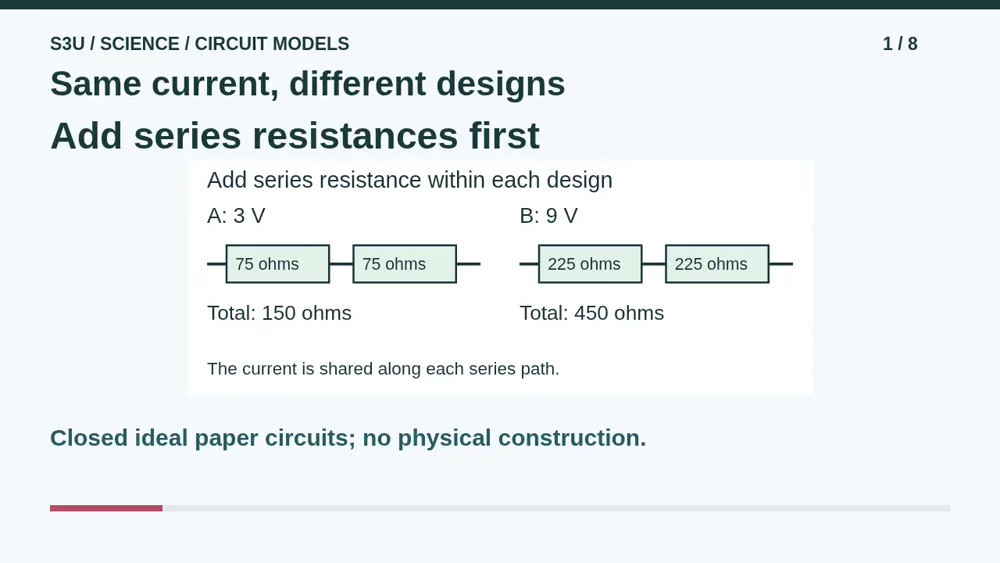
Two paper circuits can have the same current without having the same power. We will compare closed series paths with two ideal resistors in each path. Add the two resistances before dividing source voltage by total resistance. These are steady ideal models with constant resistances and no wire loss, not instructions for building a circuit. The current is shared along each series path. It does not split into two equal pieces just because we drew two resistors.
2. Calculate each design
Video: 0:36
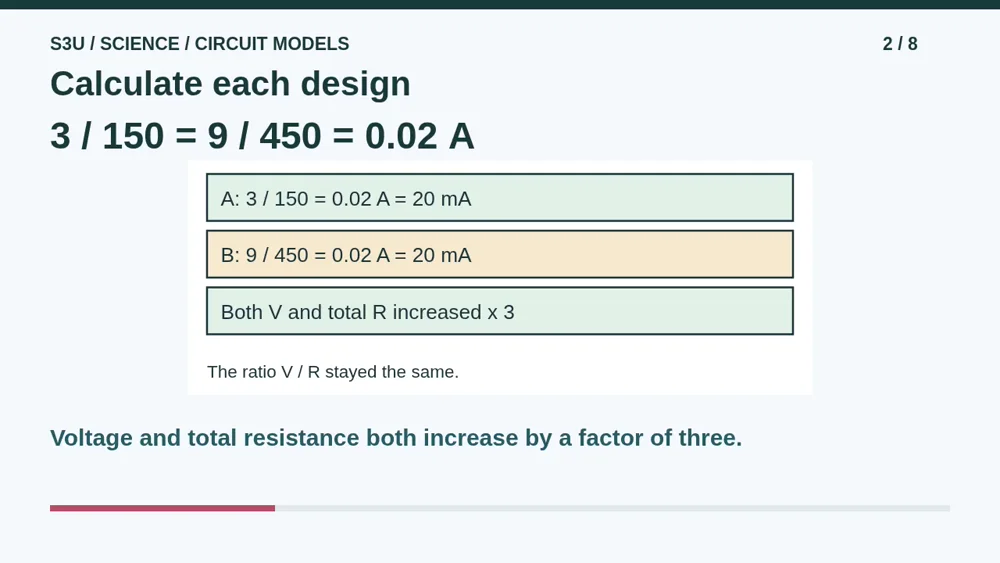
Design A uses three volts and two seventy five ohm resistors in series. Total resistance is one hundred fifty ohms, so current is zero point zero two amperes, or twenty milliamps. Design B uses nine volts and two two hundred twenty five ohm resistors. Its total is four hundred fifty ohms, and current is also twenty milliamps. Voltage and resistance both tripled. Their ratio stayed the same. Equal current is the result of this paired change, not evidence that voltage never matters.
3. Check source and resistor power
Video: 1:16
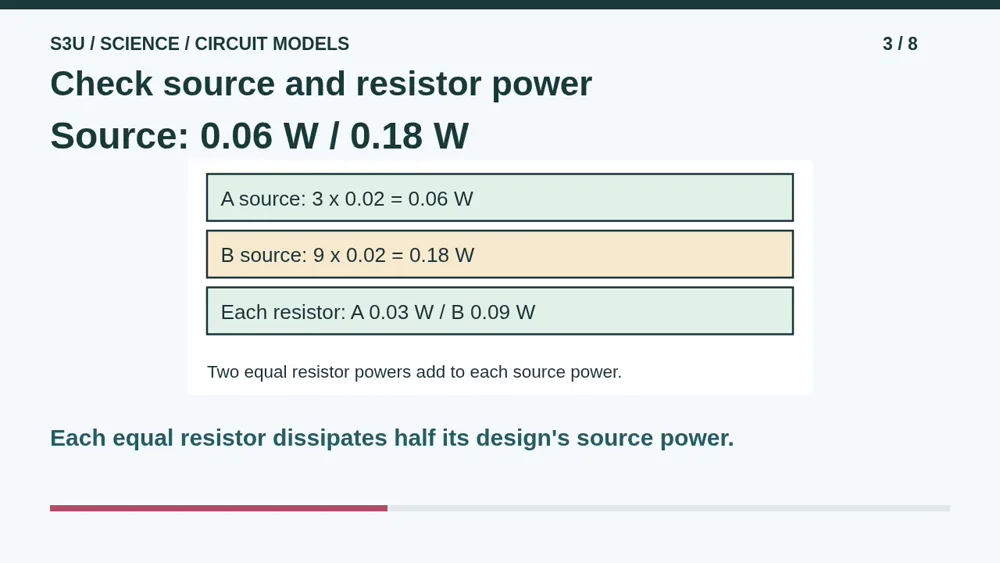
Source power is voltage times current. Design A supplies three times zero point zero two, or zero point zero six watts. Design B supplies nine times zero point zero two, or zero point one eight watts. In each design the two resistors are equal, so they share the power equally: zero point zero three watts each in A, and zero point zero nine watts each in B. Check by adding the two resistor powers. Equal current did not produce equal power.
4. What did this comparison test?
Video: 1:51
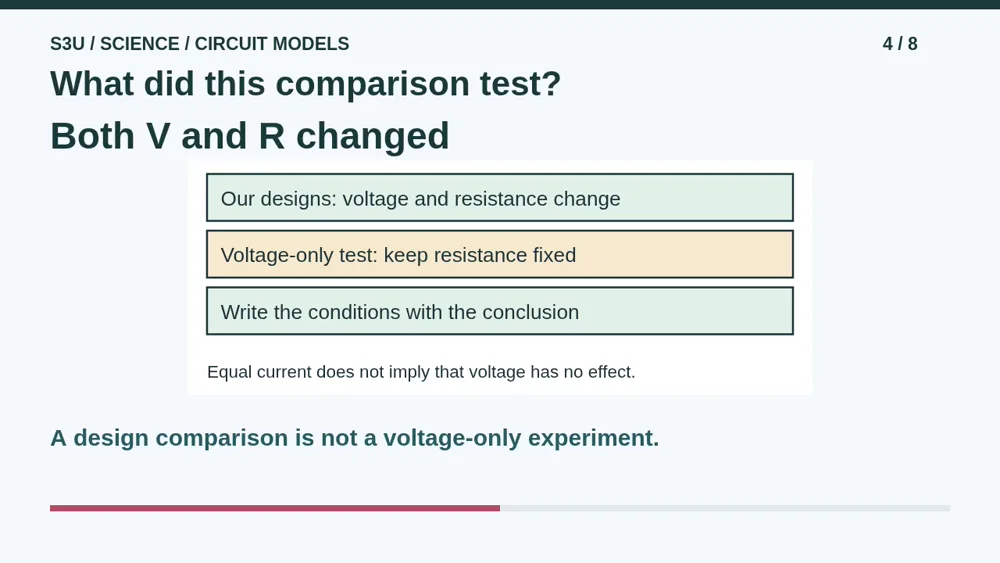
Can we conclude that tripling voltage leaves current unchanged? Not from this comparison. Total resistance tripled too. We changed two quantities together to design equal currents. For a test of voltage alone, keep the same resistance at both settings. With the same resistance, tripling voltage would triple current. Say the conditions with the conclusion. Our model notebook needs more than a headline saying, Current refuses to move! It needs the resistance values as well.
5. Pause: compare two new designs
Video: 2:29
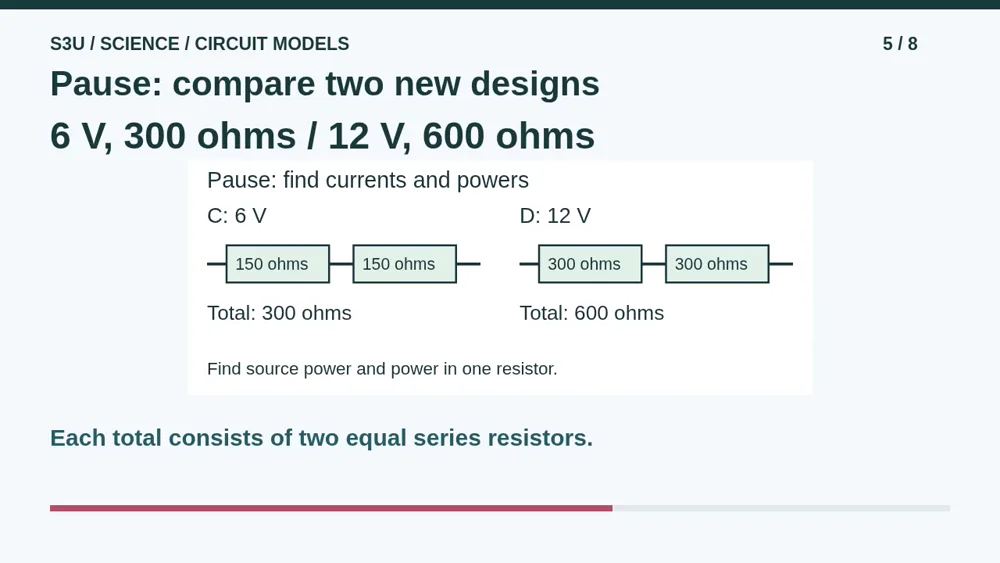
Pause and compare two new designs. C has six volts and two one hundred fifty ohm resistors, for three hundred ohms total. D has twelve volts and two three hundred ohm resistors, for six hundred ohms total. Calculate each current, source power and power in one resistor. Are the currents equal? Are the source powers equal? Then explain why these two designs are not a test of changing voltage alone. Use paper calculations, not physical components.
6. Check the powers as well
Video: 3:05
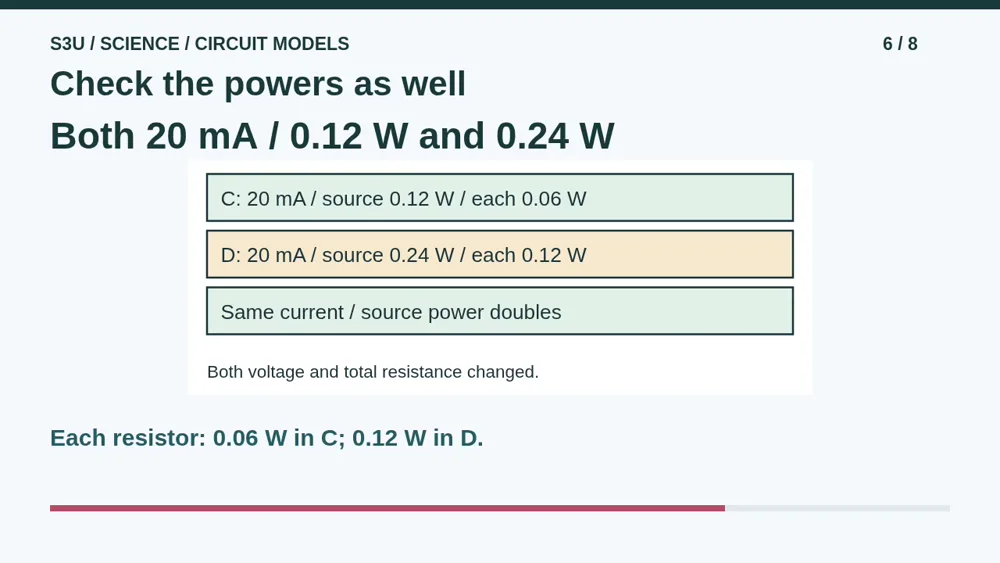
Six divided by three hundred and twelve divided by six hundred both equal zero point zero two amperes, or twenty milliamps. C supplies six times zero point zero two: zero point one two watts. D supplies twelve times zero point zero two: zero point two four watts. Each equal resistor receives half: zero point zero six watts in C, zero point one two in D. The current matches, but source power doubles. Both voltage and total resistance changed, so keep that limitation in your conclusion.
7. Now hold voltage fixed
Video: 3:44
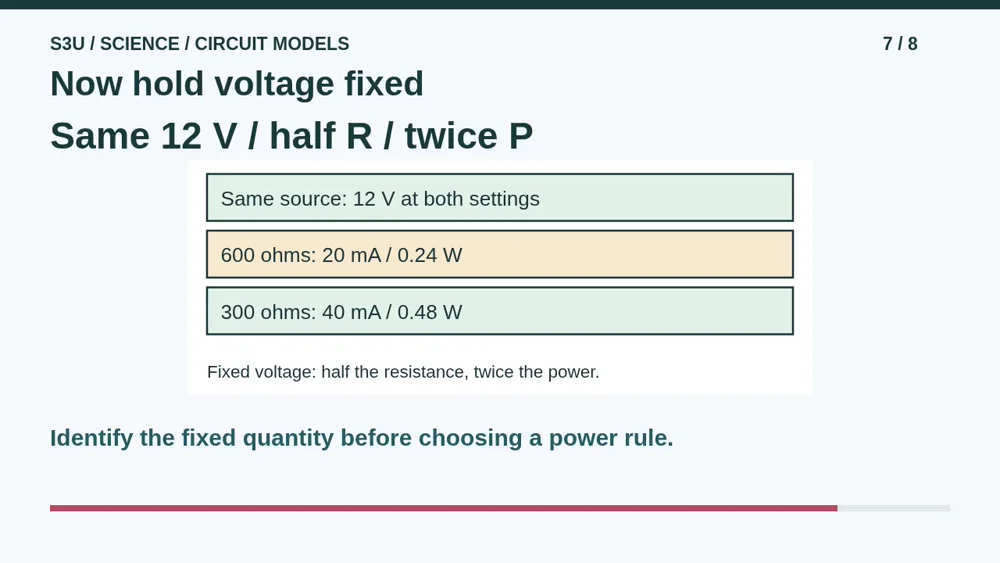
Fun fact: a larger resistor can have more power at equal current, but less power at equal voltage. The condition changes the comparison. Return to design D at twelve volts. Replace its total of six hundred ohms in our paper model with three hundred ohms, keeping twelve volts fixed. Current becomes zero point zero four amperes, and source power becomes zero point four eight watts. Halving total resistance doubled both. Do not confuse that fixed voltage test with our earlier equal current designs.
8. Continue to the worksheet
Video: 4:23
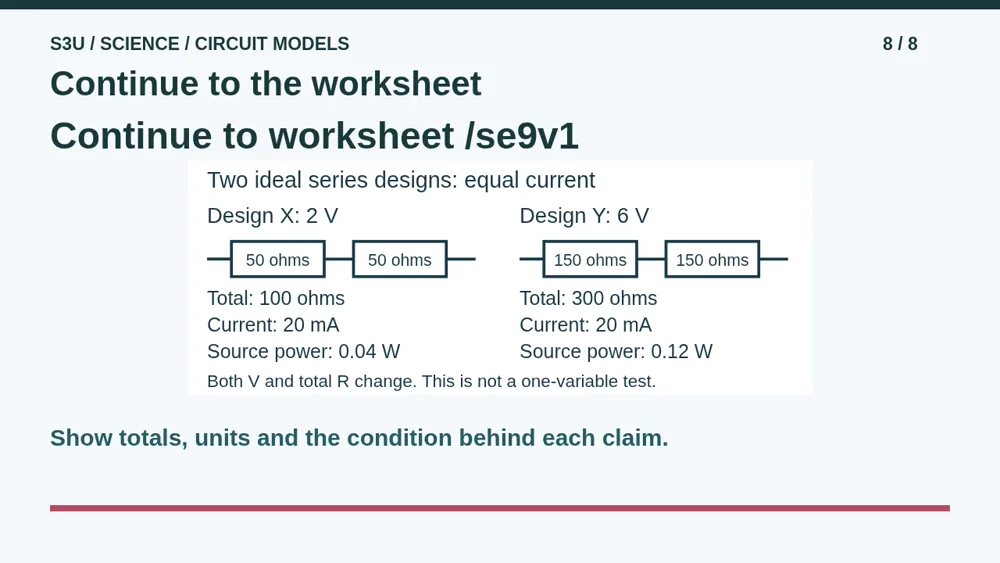
Continue to the equal current worksheet below. Its three designs use different values from this video, so start by adding each pair of series resistances. Calculate current, source power and power in one resistor. Check that the resistor powers add to the ideal source power. Decide which quantities changed before explaining the pattern. Try the second worksheet and Circuit Bench experiment thirteen for more practice. These model calculations do not establish real component temperatures, safe ratings or independent mastery from watching alone.
Show your understanding
You can point, explain aloud, draw or write.
- Calculate equal currents with different source and resistor powers in ideal series designs.
- Distinguish a two-variable design comparison from a fixed-resistance or fixed-voltage test.
Try it yourself
Pause at designs C and D. Add series resistances and calculate current, source power and power in one resistor.
Continue to the design worksheets. Explain which quantities changed and why equal current does not guarantee equal power.
Next: your worksheet
Equal Current: Compare Three Designshttps://s3u.com/se9v1
Explore the model in Circuit Bench
Try another design comparison · Review fixed-resistance comparisons
Lesson: https://s3u.com/lessons/equal-current-different-power