Science / Grade 8
Change voltage, compare power
Learning goal: Hold resistance fixed, calculate current and power with clear units, and explain why doubling voltage quadruples ideal resistor power.
Before you start: Divide decimals, convert amperes to milliamps, and recognize current, voltage, resistance and power. Review Watts and joules when needed.
Read or print this lesson What to practiceThe video could not load. The transcript is still available below.
Next: your worksheet
Changing Voltage: Current and Power
Checking sign-in...
Read the transcript
Saved reading place
Video transcript and practice. Reading or printing does not count as playback time or an assessed grade.
1. Keep one thing fixed
Video: 0:00
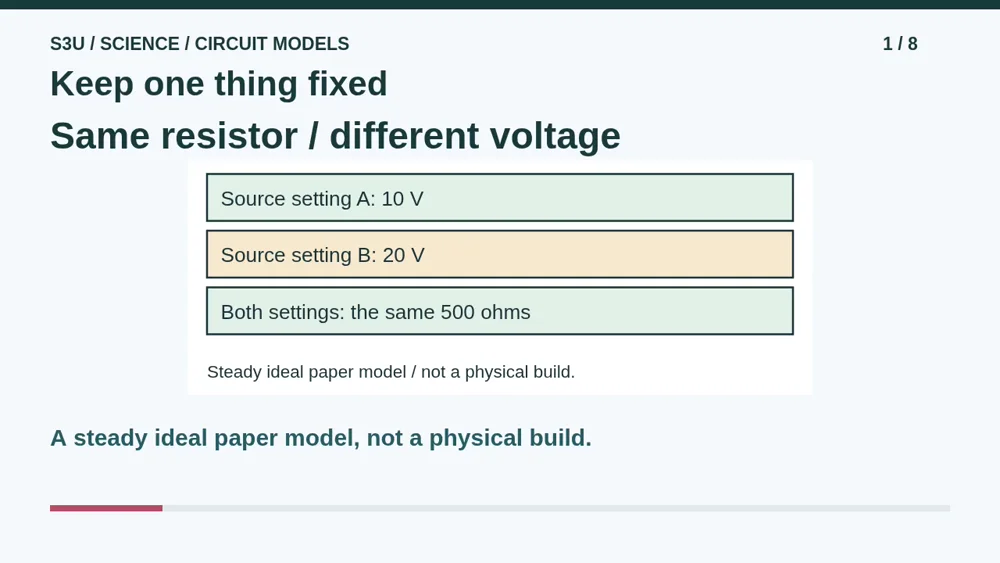
A model circuit has one source and one five hundred ohm resistor. We can change the source voltage, but the resistance stays exactly the same. That condition matters. We are comparing steady ideal paper models, not choosing parts for a real circuit. There is nothing to plug in. Before calculating, name what changes and what stays fixed. Voltage changes; resistance does not. Our resistor is very committed to its job description.
2. Find the first current
Video: 0:35
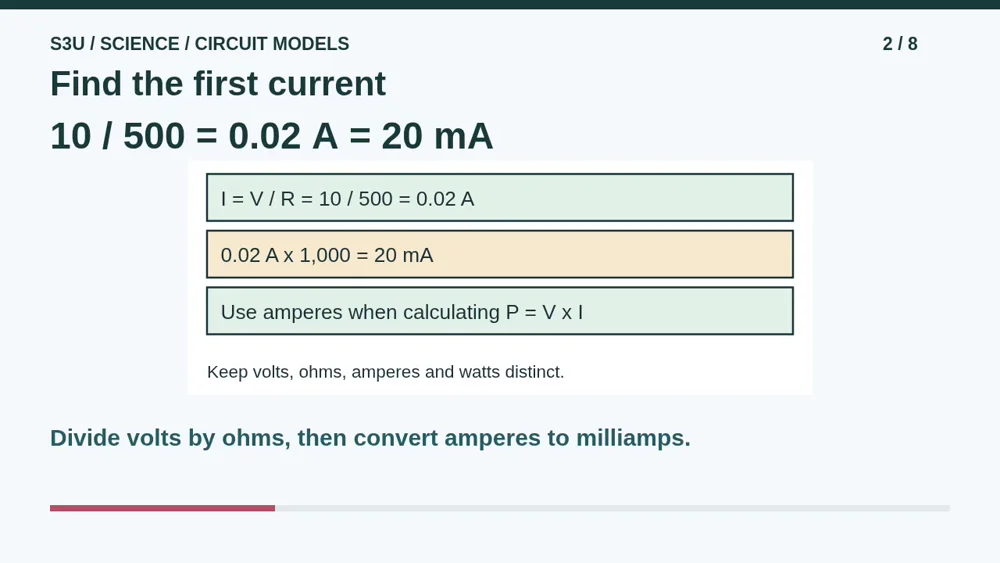
Start with ten volts across the five hundred ohm resistor. Current equals voltage divided by resistance: ten divided by five hundred is zero point zero two amperes. One ampere is one thousand milliamps, so this is twenty milliamps. Keep the unit beside every result. Ten times five hundred is not the current, and twenty amperes is not twenty milliamps. A decimal point is small, but it is not optional decoration.
3. Double both power factors
Video: 1:08
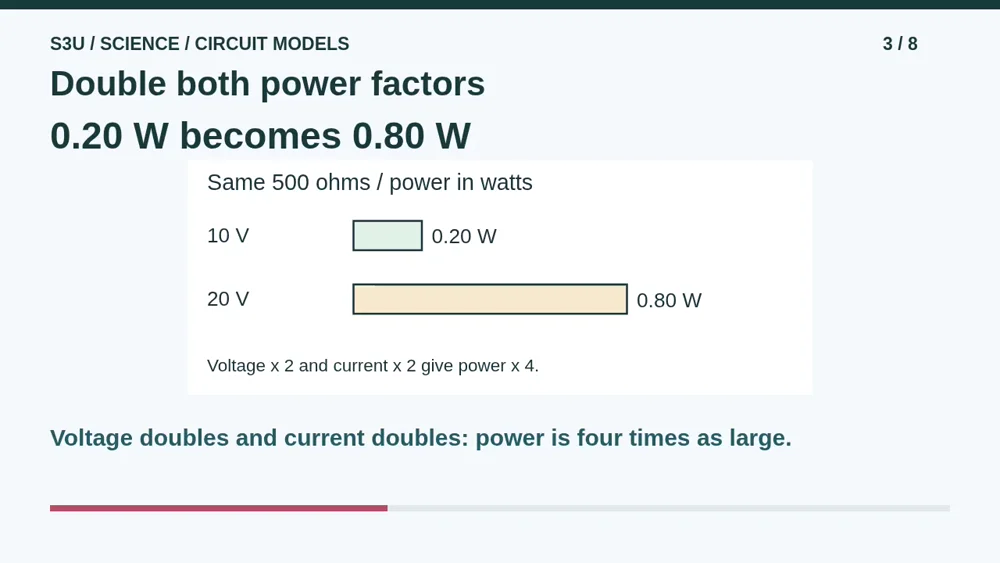
At ten volts, power equals voltage times current: ten times zero point zero two is zero point two watts. Now set the model source to twenty volts. The same resistance gives twenty divided by five hundred, or zero point zero four amperes. Current doubled. Power is twenty times zero point zero four: zero point eight watts. That is four times the original power. Both factors in voltage times current doubled, not just one.
4. Compare factors, not guesses
Video: 1:43
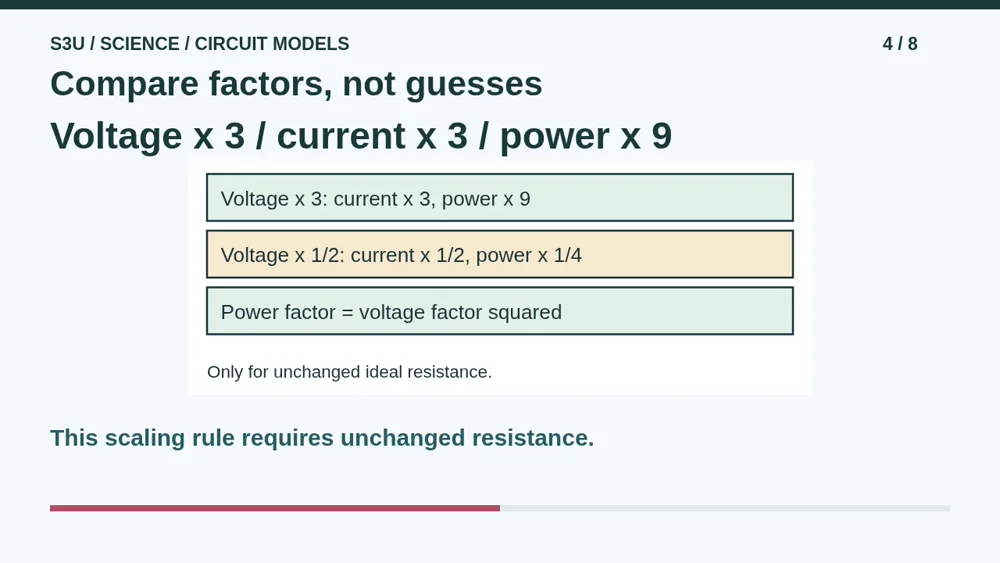
For this unchanged ideal resistor, tripling voltage triples current. Multiplying the two factors makes power nine times as large. Halving voltage halves current and makes power one quarter as large. These are ratios between two settings, not units of power. You still need a starting value to find watts. And keep the condition attached: unchanged resistance. If resistance changes too, calculate again instead of carrying this shortcut into a different experiment.
5. Pause: a different resistor
Video: 2:19
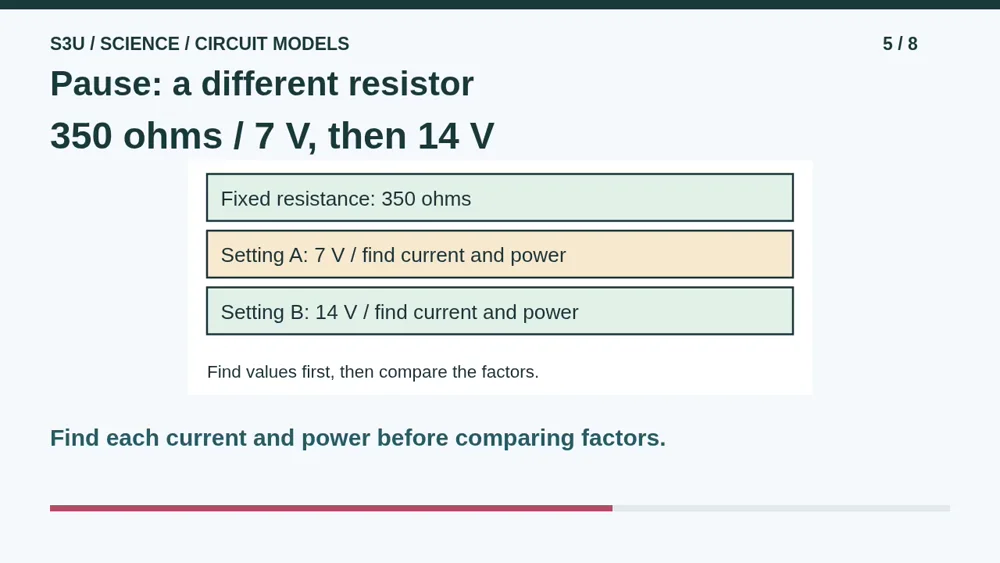
Pause for a new paper circuit with a three hundred fifty ohm resistor. First use seven volts. Then use fourteen volts across that same resistor. Find the current in amperes and milliamps at each setting. Find the power in watts at each setting. Finally, compare the two current values and the two power values. Write the fixed condition beside your explanation. These are different numbers from the first example; work them out before continuing.
6. Check the new comparison
Video: 2:53
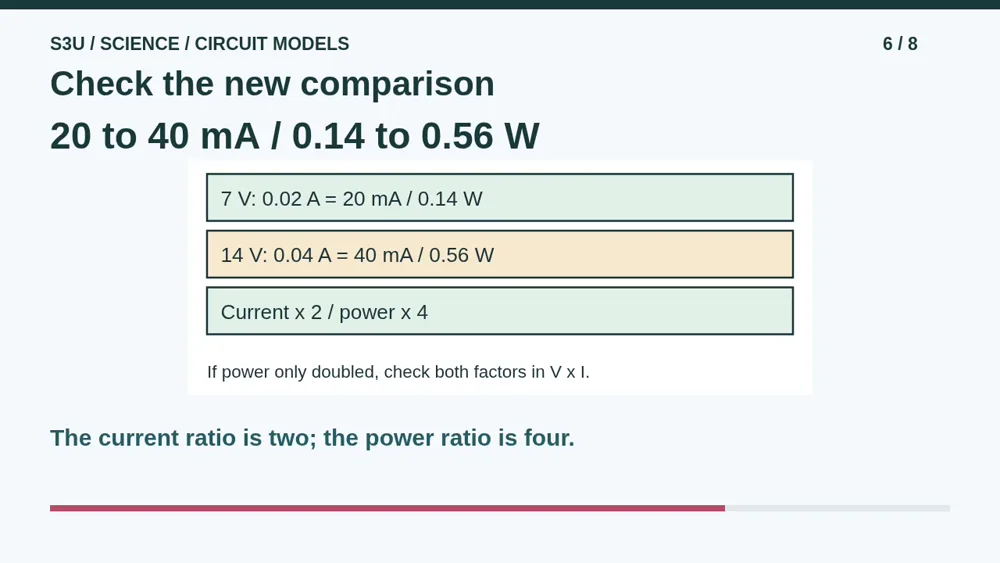
Seven divided by three hundred fifty is zero point zero two amperes, or twenty milliamps. Seven times zero point zero two gives zero point one four watts. At fourteen volts, the current is zero point zero four amperes, or forty milliamps. Fourteen times zero point zero four gives zero point five six watts. Current doubled and power quadrupled. If you got zero point two eight watts, you doubled only one power factor. Check the new current as well as the new voltage.
7. A small change has two effects
Video: 3:31
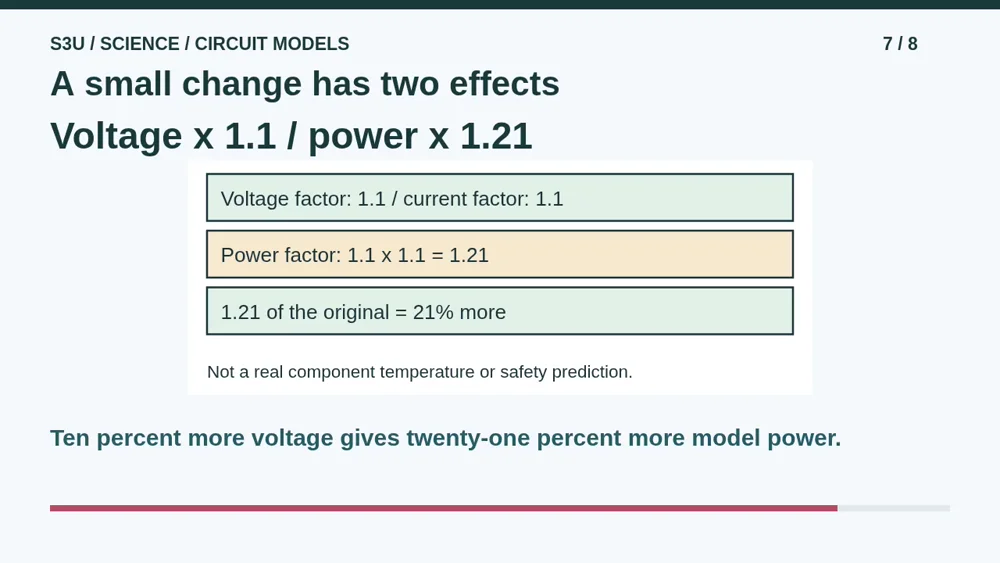
Fun fact: in this constant resistance model, ten percent more voltage means twenty one percent more power. The voltage factor is one point one. Current also has factor one point one. Multiply them: one point one times one point one equals one point two one. That is twenty one percent above the starting power, not one hundred twenty one percent more. Real components can change resistance as conditions change, so the model is not a temperature prediction or a safety rating.
8. Continue to the worksheet
Video: 4:07
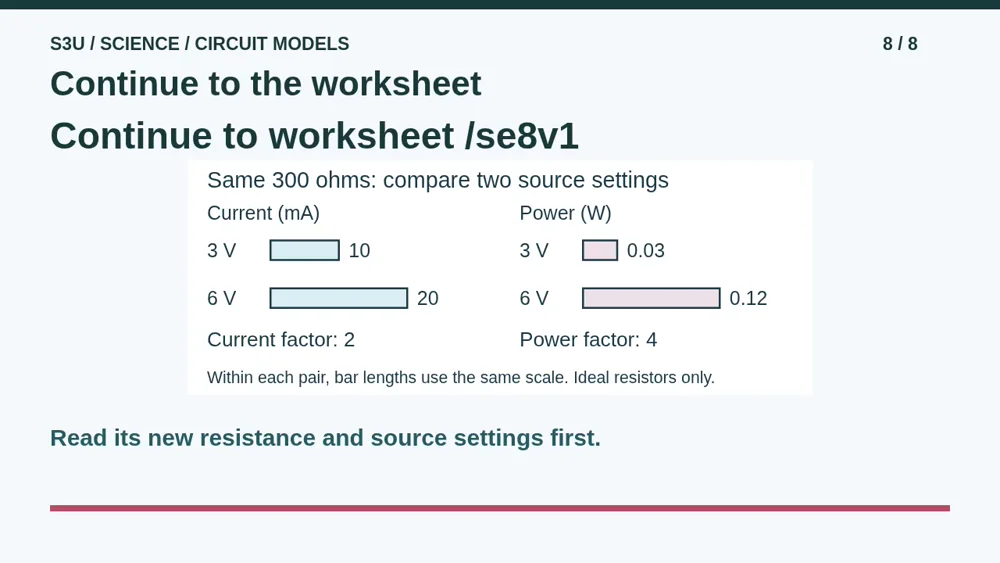
Continue to the voltage comparison worksheet below. Read its worked example, then use the new values in each question. Keep amperes, milliamps and watts separate. Explain the power factor using both voltage and current, not just a remembered answer. The second worksheet gives another set of comparisons. Circuit Bench experiments eleven and twelve let you investigate the same model idea. Watching, playing and solving a worksheet are different kinds of practice; a video alone does not demonstrate independent reasoning.
Show your understanding
You can point, explain aloud, draw or write.
- Calculate ideal resistor current and power at two voltages with resistance held fixed.
- Explain direct current scaling and squared power scaling, including the condition that makes the rule valid.
Try it yourself
Pause at the 350-ohm example. Calculate current and power at 7 and 14 volts, then explain each factor.
Continue to the voltage worksheets using their new values. State the fixed-resistance condition and keep units beside results.
Next: your worksheet
Changing Voltage: Current and Powerhttps://s3u.com/se8v1
Explore the model in Circuit Bench
Try another voltage worksheet · Next: Equal current, different power
Lesson: https://s3u.com/lessons/change-voltage-compare-power