Science / Grade 3
Dissolved, not gone
Learning goal: Explain why dissolved sugar stays present, what an ordinary sand filter can catch, and how to count mass when nothing enters or leaves.
Before you start: Recognize sugar, sand and water in drawings. Add small whole numbers and read g as grams with help. Use the paper records; no experiment is needed.
Read or print this lesson What to practiceThe video could not load. The transcript is still available below.
Next: your worksheet
Investigate Mixtures and Dissolving
Checking sign-in...
Read the transcript
Saved reading place
Video transcript and practice. Reading or printing does not count as playback time or an assessed grade.
1. Where did the grains go?
Video: 0:00
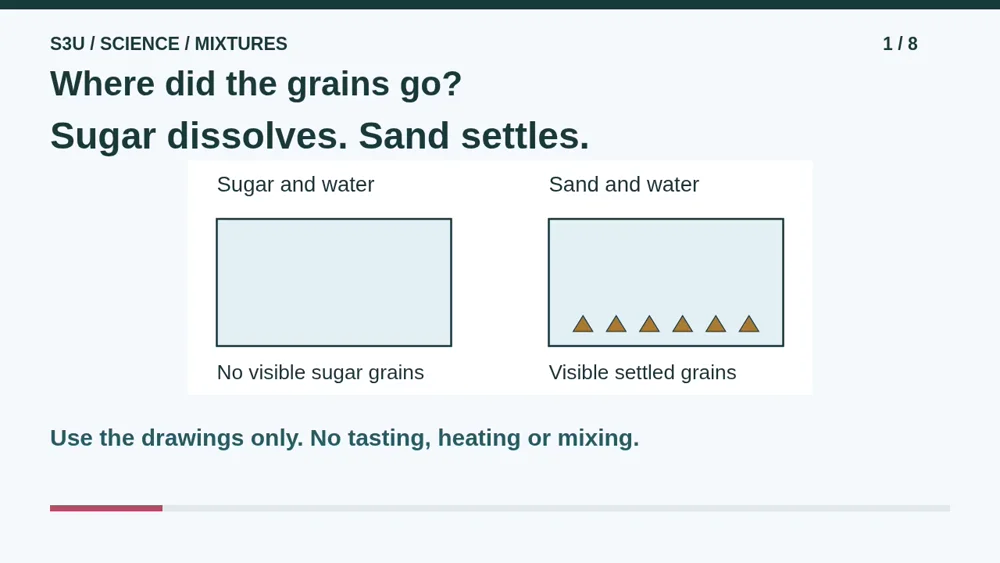
Imagine two cups of water. A little sugar is stirred into one. Sand is stirred into the other. Later, we cannot see sugar grains, but sand grains collect at the bottom. The sugar has dissolved. It has not turned into water or stopped existing. We will use drawings, not a kitchen experiment. Do not taste, heat or mix anything for this lesson.
2. A model helps us explain
Video: 0:29
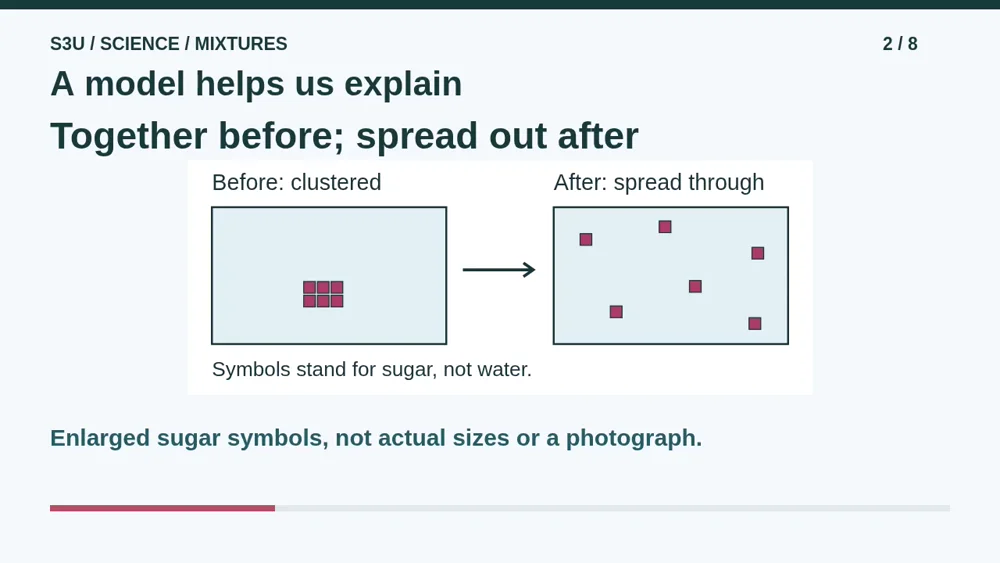
Sugar is made of tiny pieces called molecules. Water can pull these molecules away from one another and let them spread through the water. Our six symbols show this idea. They are much too large, and real sugar has far more than six molecules. Each symbol stays a sugar symbol. The sugar has not put on an invisible cape. Its molecules are too small to see individually.
3. A filter has limits
Video: 0:58
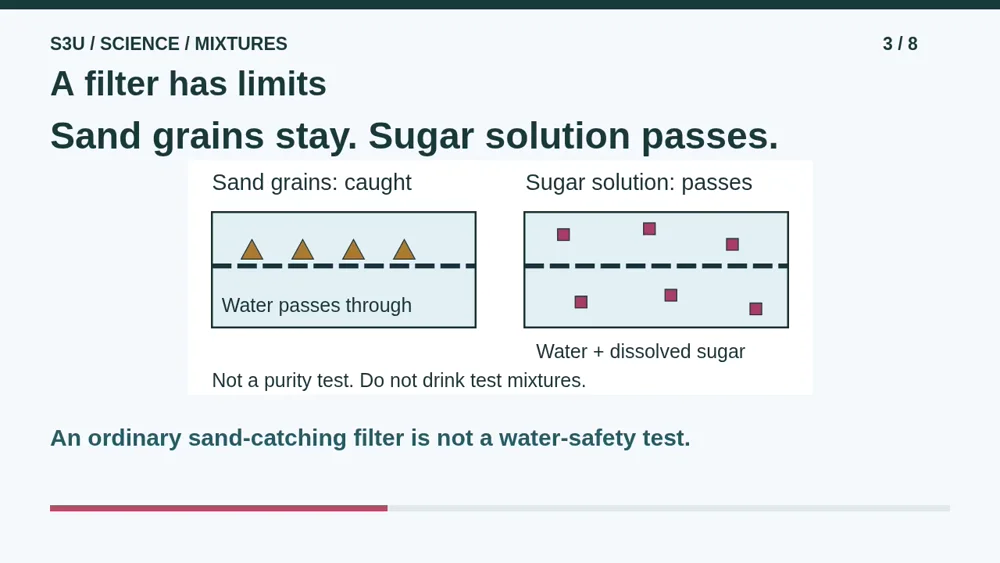
Think about an ordinary filter that catches the sand grains. Water can pass through its small openings. Dissolved sugar can go through with the water, so this filter does not remove it. Dissolved salt also passes through an ordinary sand-catching filter. There are special ways to separate other mixtures, but not every filter does every job. Clear-looking water is not automatically safe to drink.
4. Count all the material
Video: 1:29
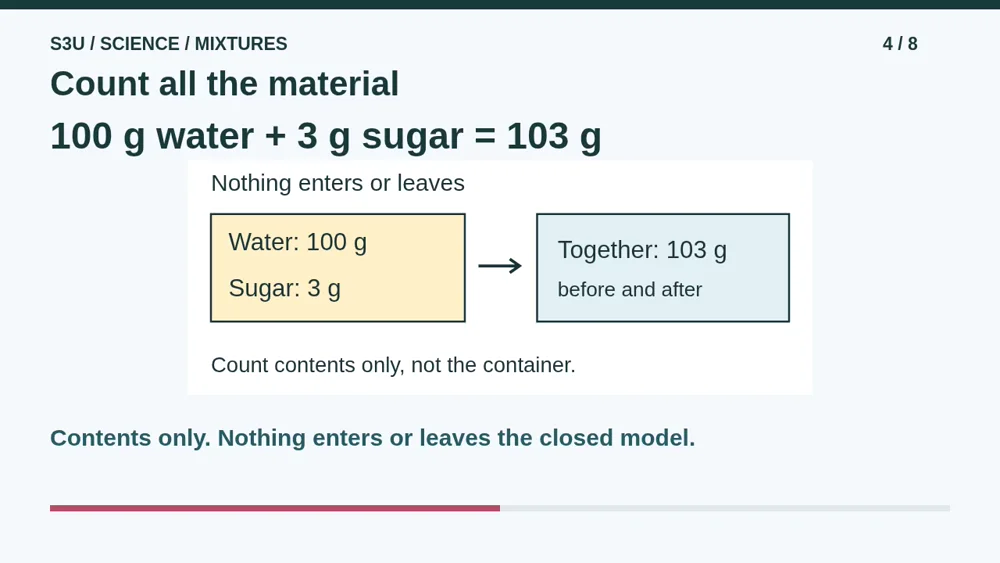
Here is an invented mass record. We count only the contents, not the container. There are one hundred grams of water and three grams of sugar. Nothing spills, enters or leaves while the sugar dissolves. The total is one hundred three grams before and after. Not seeing grains does not remove those three grams. We add masses here, not cupfuls or liquid volumes.
5. Pause: a fresh cup record
Video: 1:59
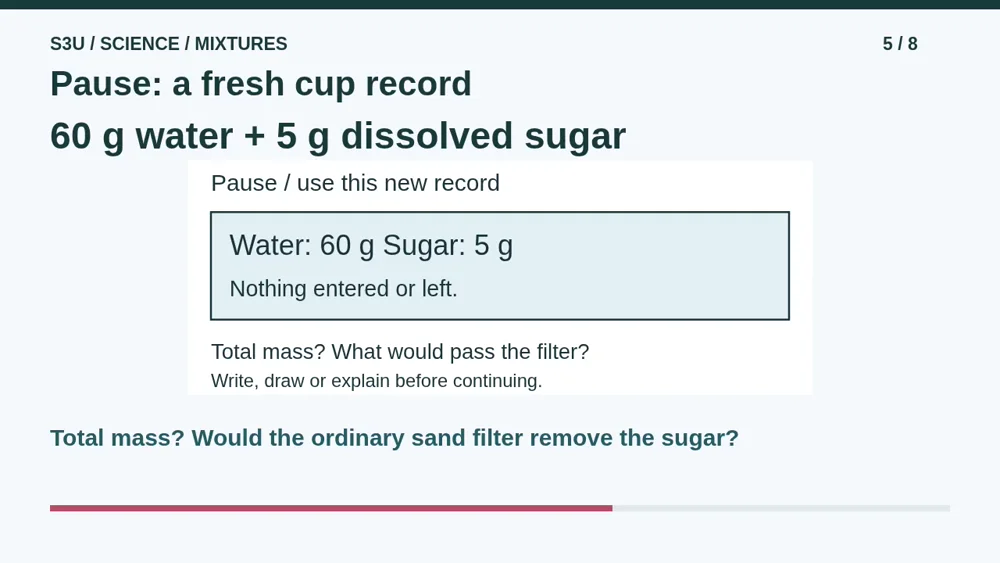
Pause for a new paper case. A closed container holds sixty grams of water and five grams of dissolved sugar. Count just the contents. Nothing has entered or left. What total mass should the model have? Would the same ordinary sand filter remove the dissolved sugar? Explain what would pass through. Write, draw or say your reasoning. You do not need to test a real mixture.
6. Check what stays present
Video: 2:31
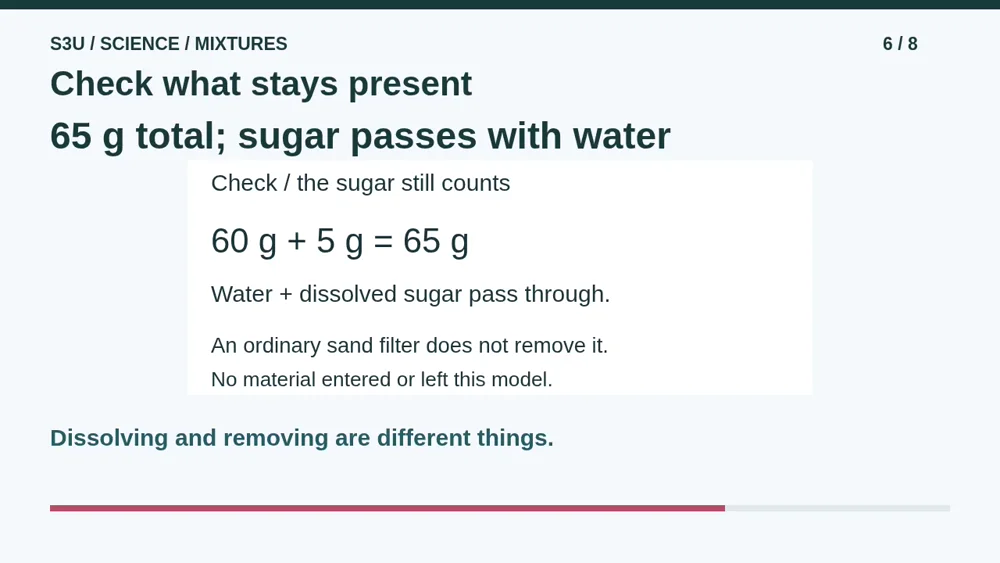
Sixty plus five is sixty-five grams. The five grams of sugar still count even though separate grains are not visible. The ordinary sand-catching filter lets the dissolved sugar pass with the water. Stirring more does not make it disappear from the total. If material spills or water leaves, that would be a different case. Always check what the record says entered or left.
7. Water can leave the mixture
Video: 3:00
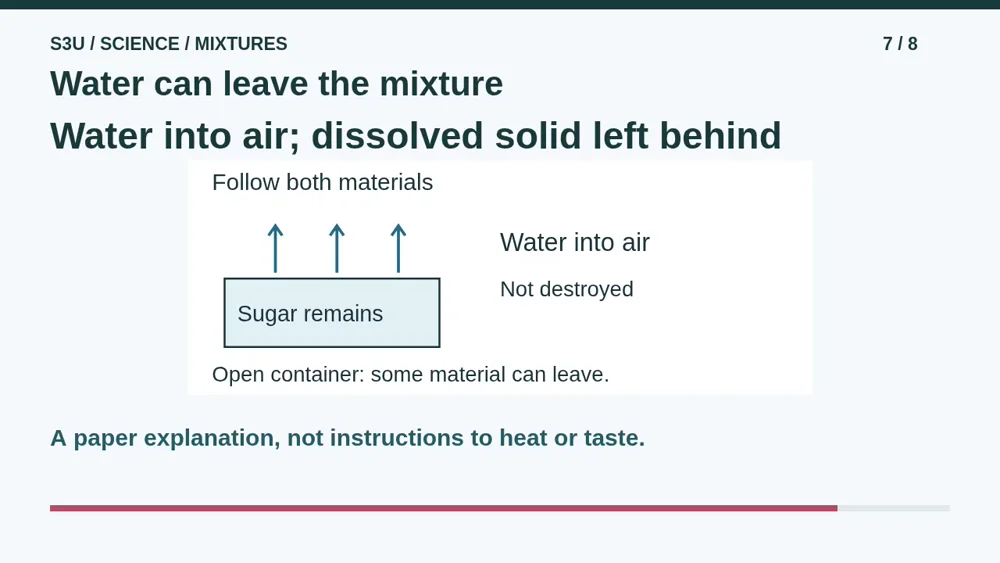
Fun fact: water can leave a solution by evaporating into the air, while a dissolved solid such as sugar can remain behind. That is different from saying the sugar vanished when it dissolved. Our drawing tracks two materials with different paths. We are not giving heating instructions or making drinking water. When water leaves an open container, count it in the air too if you want to follow all the material.
8. Continue to the worksheet
Video: 3:29
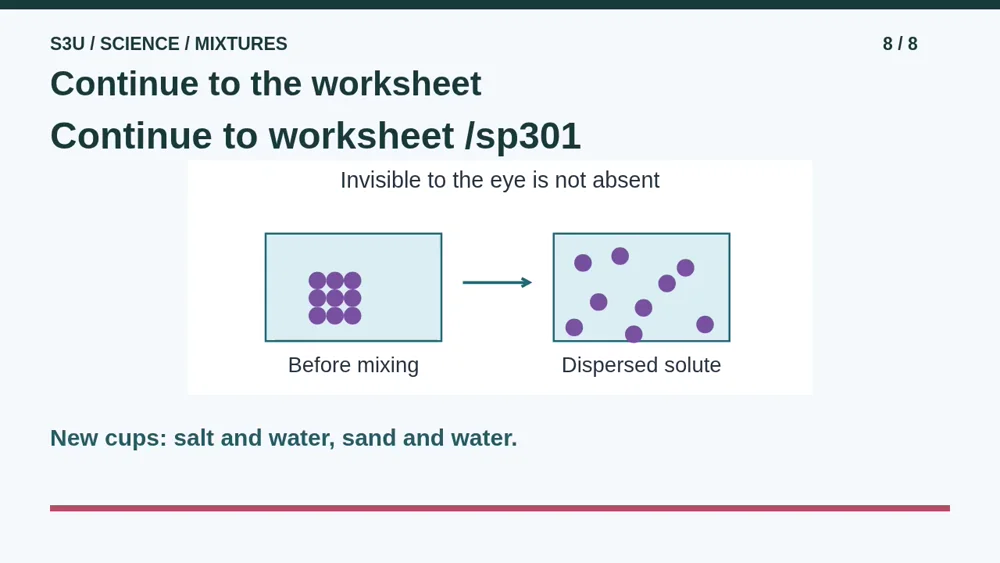
Continue to Investigate Mixtures and Dissolving below. Its two cups contain salt and sand, not our sugar example. Use its own observations to decide what dissolved, what settled and what an ordinary sand filter would catch. The dots are a simple model, not a photograph of particles. You can answer on screen or print the worksheet. Explain why out of sight does not mean no longer present.
Show your understanding
You can point, explain aloud, draw or write.
- Distinguish dissolved sugar from settled sand and explain why an ordinary sand-catching filter lets dissolved material pass with water.
- Keep dissolved material in a closed contents-only mass total, then apply the idea to a fresh record and the worksheet without treating clear appearance as proof of safety.
Try it yourself
Pause at 60 grams water and 5 grams dissolved sugar in the closed paper model. Find the contents mass and explain what an ordinary sand filter would remove.
Continue to the worksheet with its separate salt-and-sand observations. Draw or explain why dissolved material remains present. No tasting, heating or mixing is required.
Next: your worksheet
Investigate Mixtures and Dissolvinghttps://s3u.com/sp301
More practice: sugar and sand together · Practice dissolving and filtering
Lesson: https://s3u.com/lessons/dissolved-not-gone