Math / Grade 4
Make copies of fractions
Learning goal: Count repeated copies of equal fraction parts, regroup amounts above one whole, and explain why the piece size stays fixed.
Before you start: Name equal parts of a fixed whole, add matching fractions and multiply whole-number counts.
Read or print this lesson What to practiceThe video could not load. The transcript is still available below.
Next: your worksheet
Whole-Number Copies of Fractions - Practice 1
Checking sign-in...
Read the transcript
Saved reading place
Video transcript and practice. Reading or printing does not count as playback time or an assessed grade.
1. Four small ribbon orders
Video: 0:00
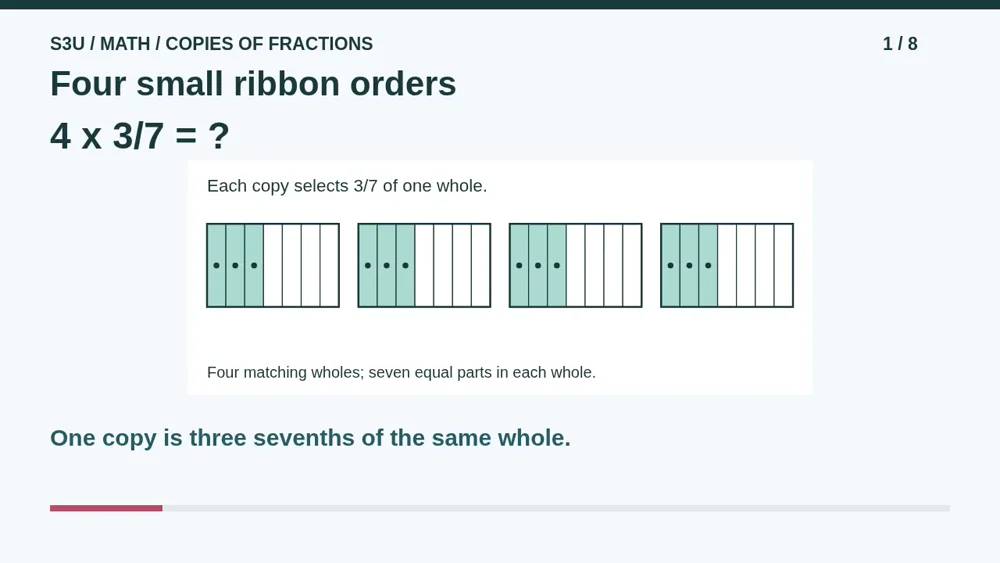
Our pretend ribbon shop needs four copies of three sevenths of a strip. What total should we send? Each outlined frame is one whole strip of the same size. Each copy selects three of its seven equal pieces. The empty spaces are not extra ribbon. We can make more copies without making our ruler longer. The ruler has politely declined a promotion.
2. Count the seventh-size pieces
Video: 0:28
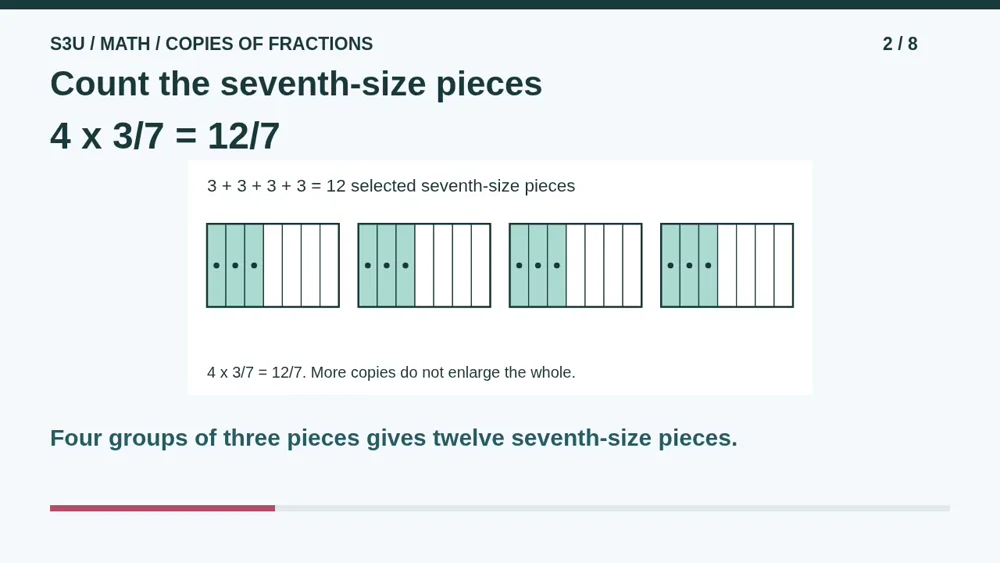
Count three selected pieces in each of four copies. Three plus three plus three plus three is twelve. Four times three is also twelve. Every piece is still one seventh of our original whole. The result is twelve sevenths. We multiply the number of copies by the numerator, and keep the denominator that names the piece size.
3. Keep a full whole in the answer
Video: 0:54
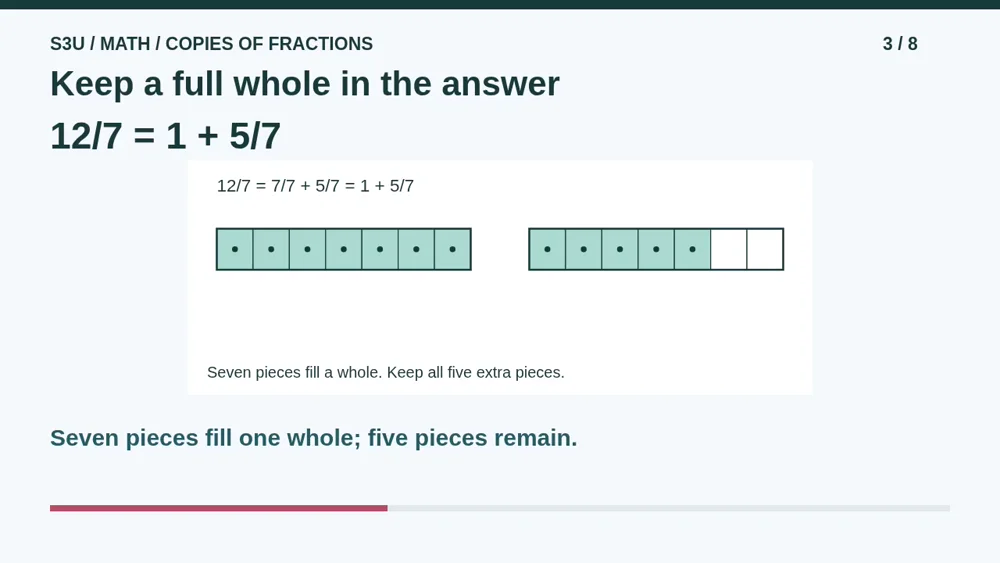
Gather the twelve seventh-size pieces. Seven fill one whole strip, and five go into a second matching strip. Twelve sevenths is one whole and five sevenths. A fraction above one whole is allowed. Do not change the denominator to twenty-eight because the first picture showed four frames. Seven pieces, not twenty-eight, still make one reference whole.
4. One copy or no copies
Video: 1:21
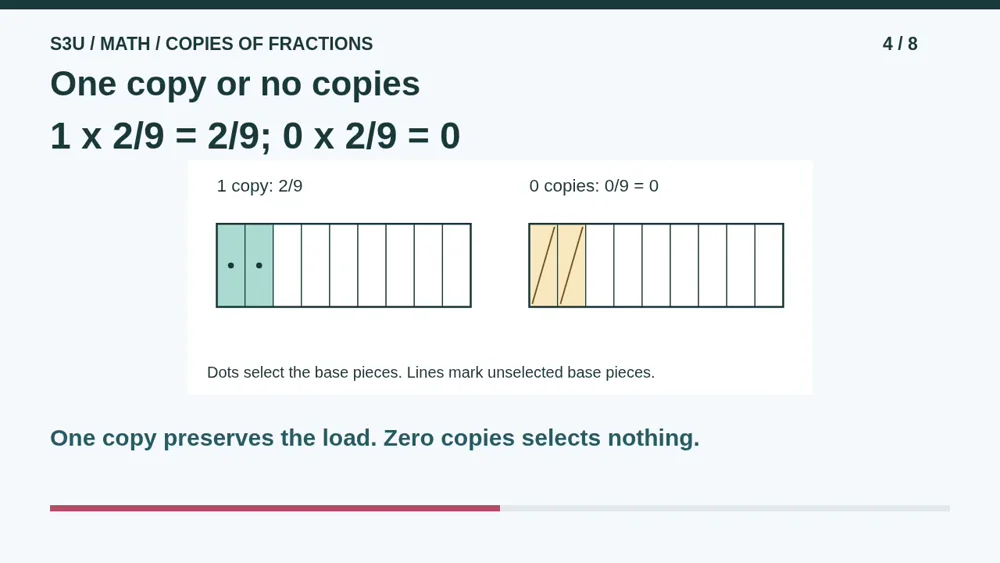
Here is a different base load: two ninths. One copy keeps those two ninths unchanged. Zero copies selects no ribbon, so the result is zero. The right picture keeps the base pieces marked with lines, but none has a selection dot. A zero numerator is fine. A zero denominator would not name a valid size of equal pieces.
5. Pause: two new orders
Video: 1:48
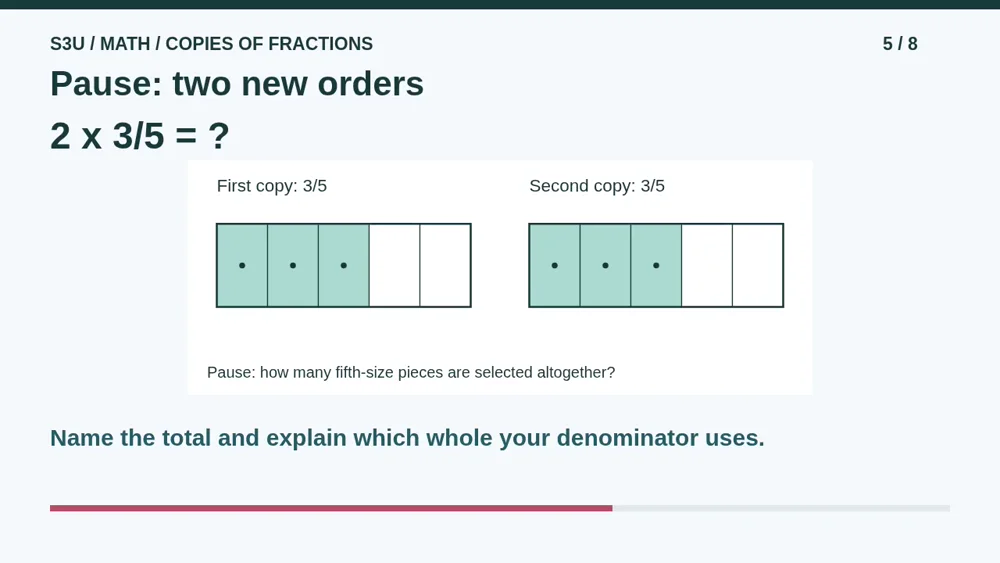
Try two copies of three fifths. Pause the video. How many fifth-size pieces are selected altogether? Name that amount as a fraction. If it fills more than one whole, say how many full wholes and what extra part remain. You can draw, count the dots, write a calculation, or explain aloud. Keep each whole exactly the same size.
6. Check six fifth-size pieces
Video: 2:15
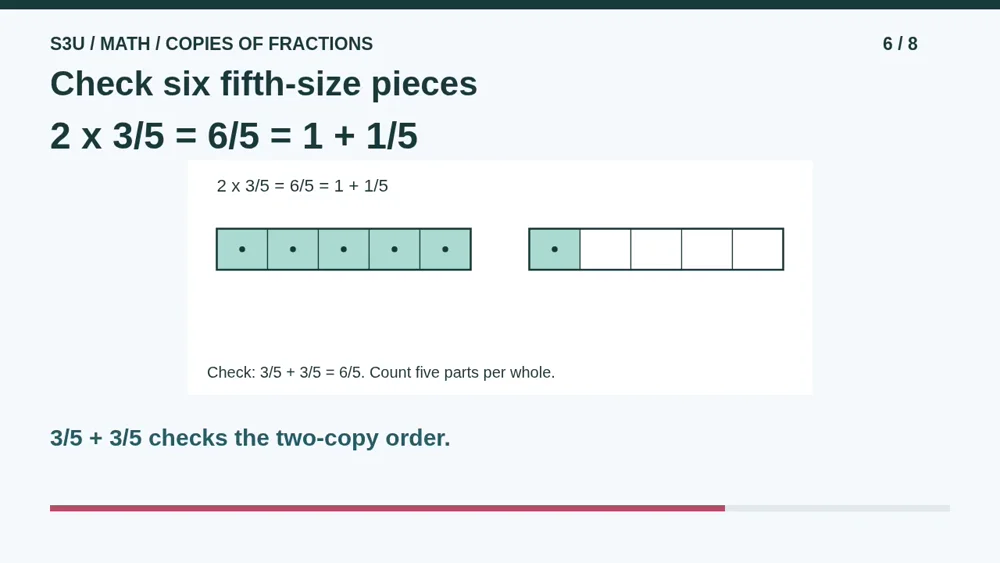
Two groups of three pieces give six pieces. Each is one fifth, so the total is six fifths. Five fifths fill a whole, leaving one more fifth. Check by adding three fifths and three fifths: that gives six fifths too. If you wrote one whole and one fifth, you used a different correct name for the same amount.
7. Different groups can match
Video: 2:39
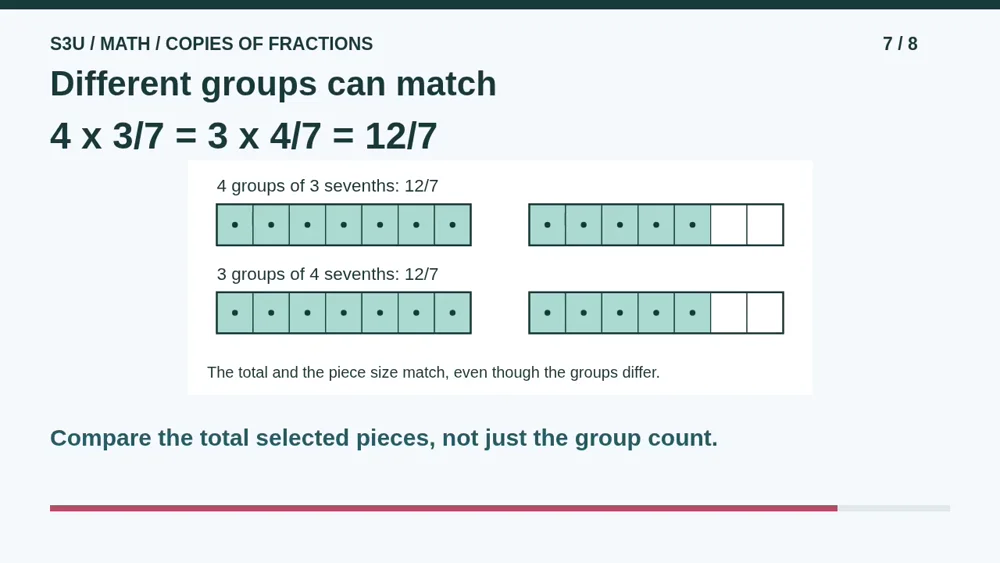
Fun fact: four groups of three seventh-size pieces and three groups of four seventh-size pieces have the same total. Both select twelve sevenths. The group count changes, but the number of pieces in each group changes too. This does not mean any two orders match. Count carefully, and keep every piece tied to the same whole. No mystery ribbon is appearing.
8. Continue to the worksheet
Video: 3:07
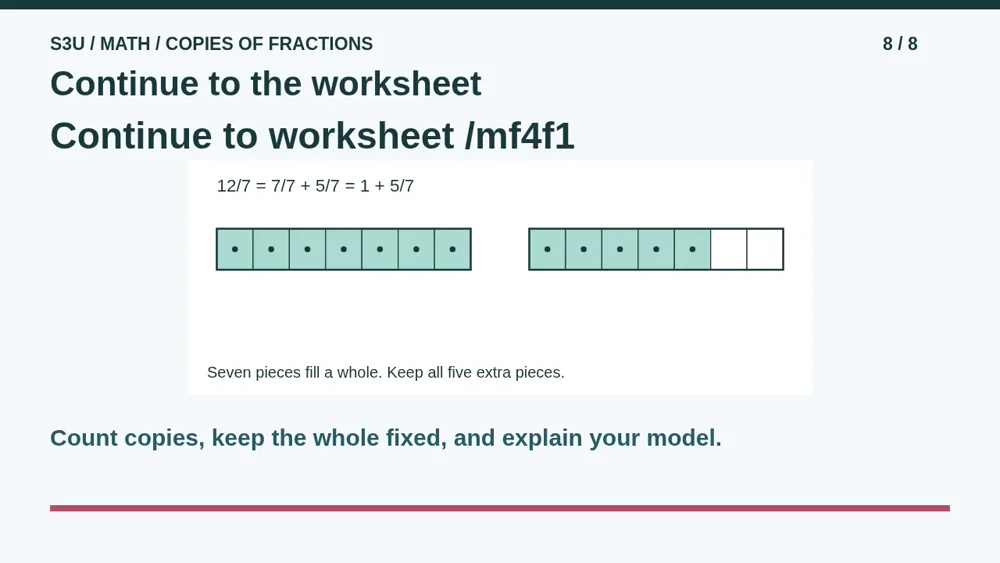
Continue to the worksheet below for fresh orders. Count how many copies you need and how many equal parts each copy selects. Keep the whole fixed, allow zero, and keep any full whole in the answer. Show a model or calculation in the working space. Then try Practice Two, or explore fractional copies with the Scaling route at Fraction Dock.
Show your understanding
You can point, explain aloud, draw or write.
- Model whole-number copies of a fraction by repeated addition while keeping the denominator tied to one whole.
- Regroup products above one whole and explain one-copy and zero-copy cases.
Try it yourself
Pause at two copies of three fifths. Count the selected pieces and explain how many fit in one whole.
Continue to the worksheet with fresh amounts, then try Practice 2 or choose Scaling at Fraction Dock.
Next: your worksheet
Whole-Number Copies of Fractions - Practice 1https://s3u.com/mf4f1
Try Fraction Dock: choose Scaling
Lesson: https://s3u.com/lessons/copies-of-fractions