Math / Grade 12
Approach from both sides
Learning goal: Use nearby rules and labeled graphs to separate a two-sided limit from a point value, test a jump and explain continuity.
Before you start: Evaluate a linear rule and read input/output coordinates. Know that smaller and larger inputs can approach a target from either side; compare the labeled scales rather than a graph's screen angle.
Read or print this lesson What to practiceThe video could not load. The transcript is still available below.
Next: your worksheet
Separate a Limit from a Point Value
Checking sign-in...
Read the transcript
Saved reading place
Video transcript and practice. Reading or printing does not count as playback time or an assessed grade.
1. Nearby is a different question
Video: 0:00
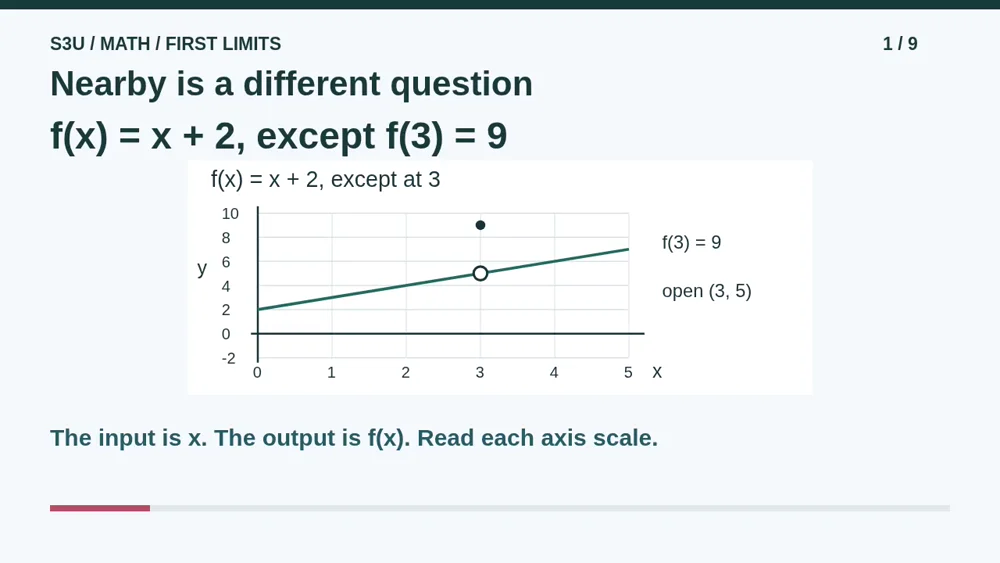
A function gives an output for an input. Here, use x plus two for every input except three. At exactly three, the output is nine instead. The graph follows a line, with an open circle at three, five and a filled point at three, nine. We can ask for the output at three, or ask what nearby outputs approach. Those are different questions. One dot has moved, but the nearby line has not.
2. Approach from smaller and larger inputs
Video: 0:31
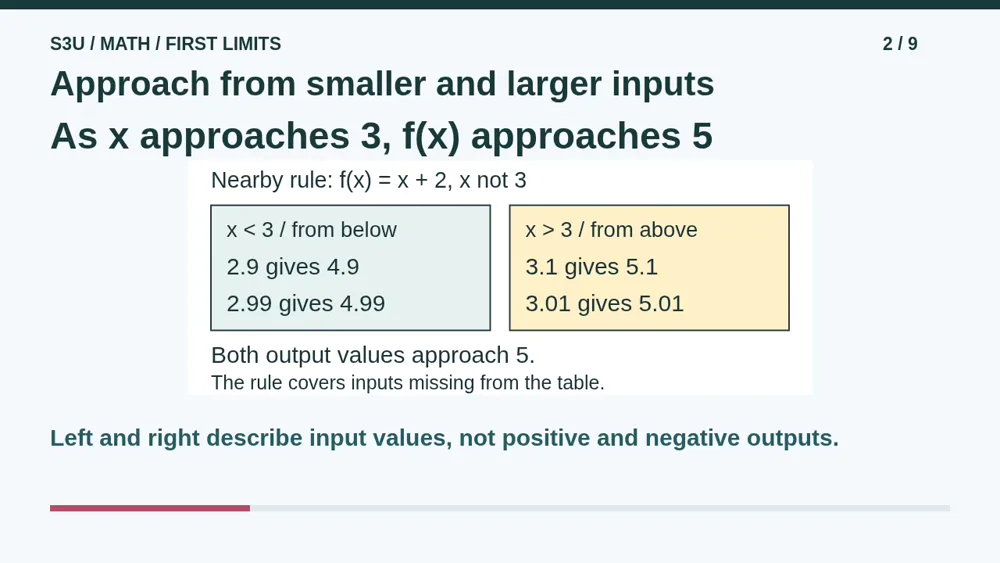
From below three, try two point nine and two point nine nine. Their outputs are four point nine and four point nine nine. From above three, try three point one and three point zero one. Their outputs are five point one and five point zero one. Both sides head toward five. The table illustrates the behavior. The rule x plus two tells us it continues as the inputs get arbitrarily close to three, without using three itself.
3. Keep the point value separate
Video: 1:04
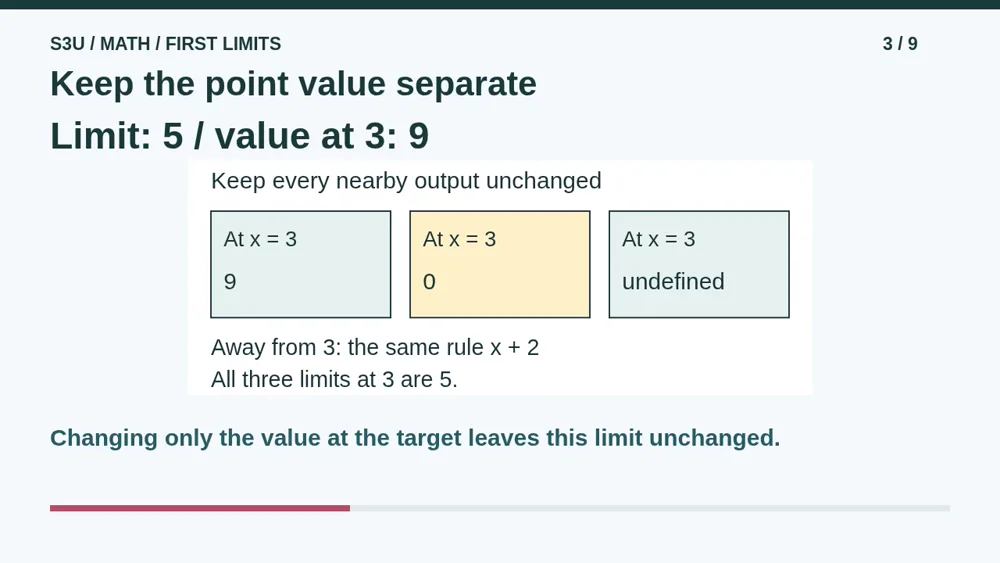
We say the limit of f of x, as x approaches three, is five. But f of three is nine. There is no contradiction: the limit concerns nearby inputs different from three. If we change only f of three to zero, the limit stays five. If we leave f of three undefined, the limit still stays five. The nearby rule has not changed. A blank point is not a command to throw away all its neighbors.
4. Both sides must agree
Video: 1:36
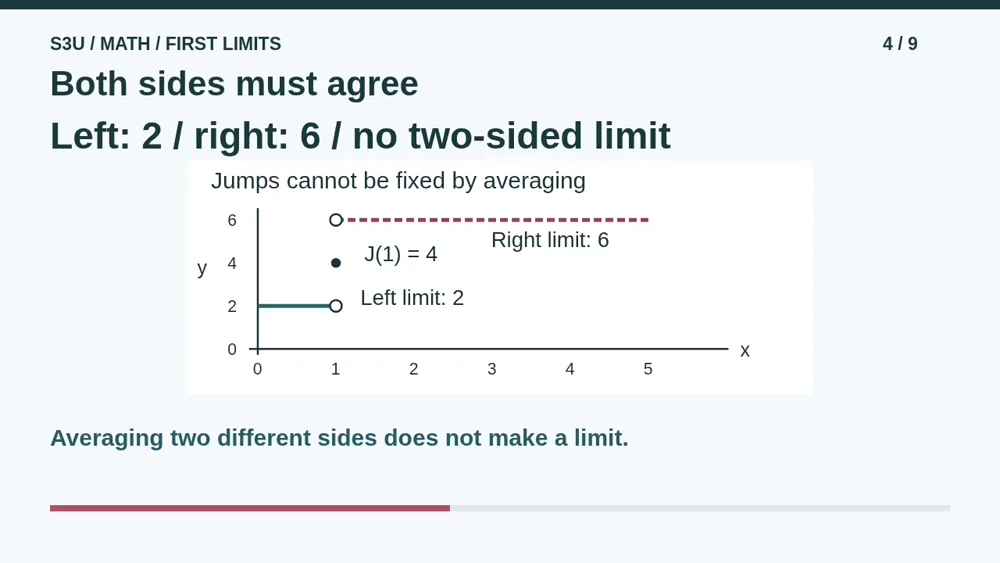
Now consider a different function, J. For inputs below one, J is two. For inputs above one, J is six. At one itself, J is four. The left-hand limit is two; the right-hand limit is six. They disagree, so there is no two-sided finite limit at one. Four may be halfway between them, but averaging is not a vote that settles this disagreement. The filled value at one cannot make the two nearby sides match.
5. A limit can already be reached
Video: 2:09
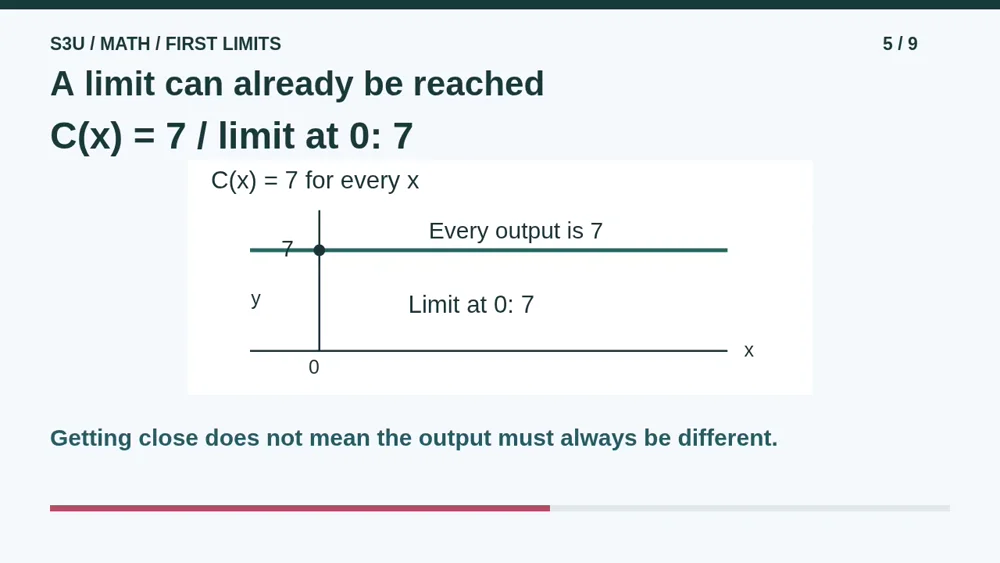
A limit does not mean a number that the outputs can never reach. For the constant function C of x equals seven, every nearby output is already seven. Its limit as x approaches zero is seven too. Also, be careful with a short table: a few selected rows can suggest a limit, but they cannot specify every other nearby output. Our earlier rules covered those other inputs. The table by itself was not the proof.
6. Pause: read a fresh rule
Video: 2:42
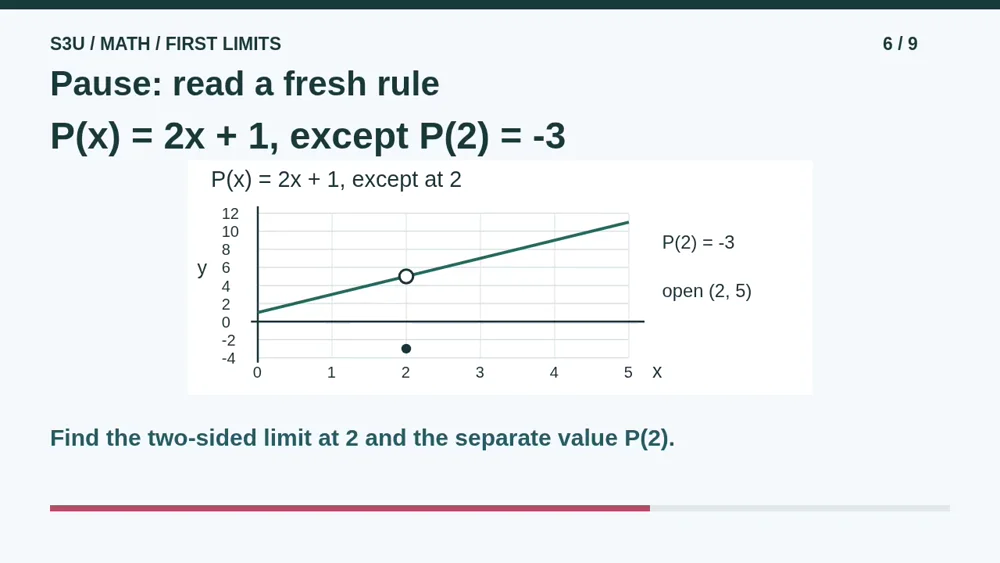
Pause for a new function. P of x equals two x plus one for every input other than two. At exactly two, P of two is negative three. From below two, one point nine gives four point eight. From above two, two point one gives five point two. What do both sides approach? What is the actual value at two? Explain why the two answers need not match. Write your reasoning or say it aloud before continuing.
7. Check the limit and the value
Video: 3:16
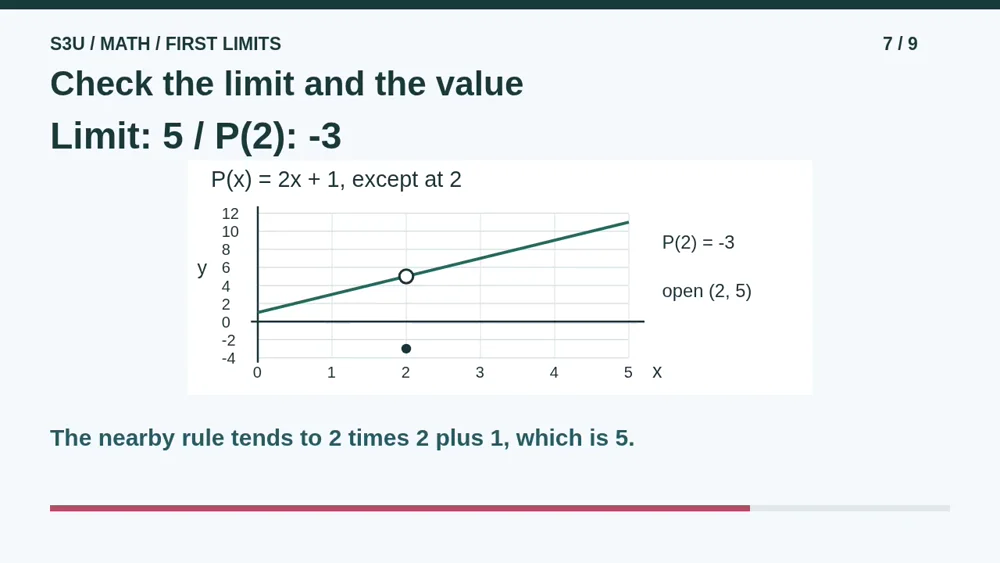
The nearby expression two x plus one approaches five from both sides as x approaches two. The two-sided limit is five. The actual point value is negative three because that is how P of two was defined. Negative three does not change the surrounding rule. If you answered two for the limit, you named the input being approached instead of the output. If you answered negative three, you read the point value rather than the nearby behavior.
8. Make the dot match
Video: 3:50
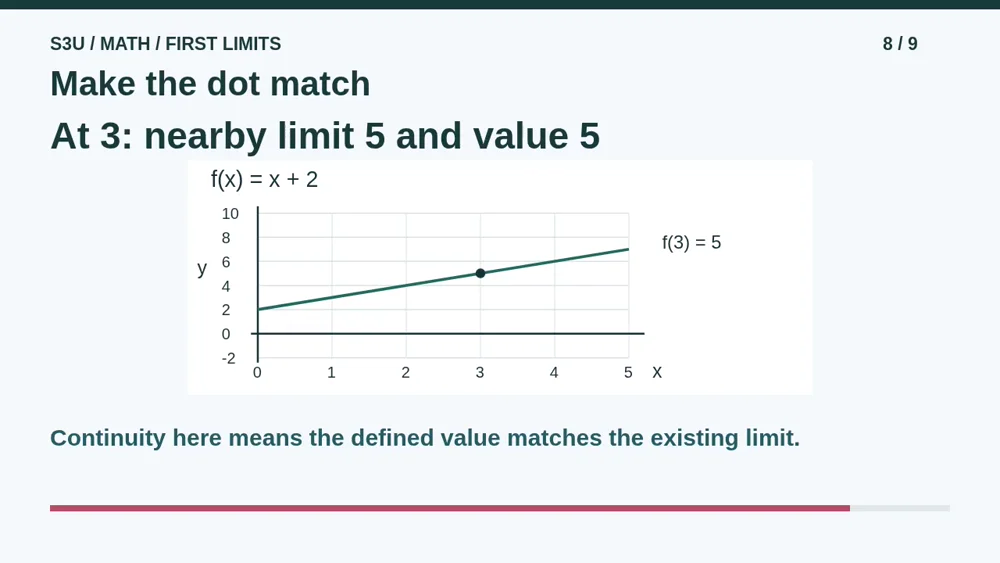
Return to our first rule, x plus two away from three. Its limit at three is five. Set the value at three to five as well, and the function is continuous there: the value is defined, the two-sided limit exists, and they match. Fun fact: changing a single point can break continuity without changing the nearby limit. But no choice for J of one can repair its jump, because its left and right limits already disagree.
9. Continue to the limits worksheet
Video: 4:22
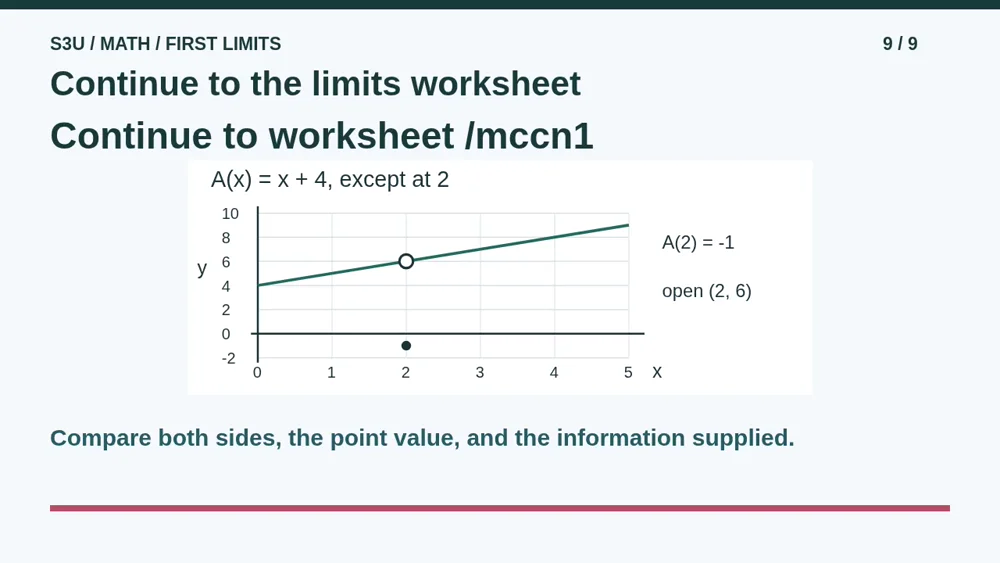
Continue to the worksheet below, then try Practice Two with fresh functions. First identify the target input. Follow the stated nearby rule from smaller and larger inputs. Compare the two sides before reading the filled point separately. Explain whether changing one point can make the function continuous, and notice when a table leaves the nearby rule unspecified. These examples introduce finite limits with simple rules. Infinite limits, oscillating functions and formal error bounds need further study.
Show your understanding
You can point, explain aloud, draw or write.
- Use a stated nearby rule to distinguish one-sided and two-sided finite limits from a function value at a point.
- Explain why a jump has no shared limit, why a finite table alone is insufficient, and when changing one point can make the value match the existing limit.
Try it yourself
Pause at P(x) = 2x + 1 away from 2, with P(2) = -3. Explain the two-sided limit and the actual value separately.
Continue to both worksheets. Compare both sides, read the filled point separately, and distinguish a rule from a few selected table entries.
Next: your worksheet
Separate a Limit from a Point Valuehttps://s3u.com/mccn1
Practice Two: new limits and point values · Practice limits from both sides
Lesson: https://s3u.com/lessons/approach-from-both-sides