Reading / Grade 4
Word parts are meaning clues
Learning goal: Use bio, geo, tele and micro with whole-word notes, and explain what a useful clue cannot tell you.
Before you start: Read short word notes or ask a trusted adult to read them. Notice a familiar letter group without assuming every match is a meaningful part.
Read or print this lesson What to practiceThe video could not load. The transcript is still available below.
Next: your worksheet
Word Parts: Meaning Clues
Checking sign-in...
Read the transcript
Saved reading place
Video transcript and practice. Reading or printing does not count as playback time or an assessed grade.
1. Small parts, useful clues
Video: 0:00
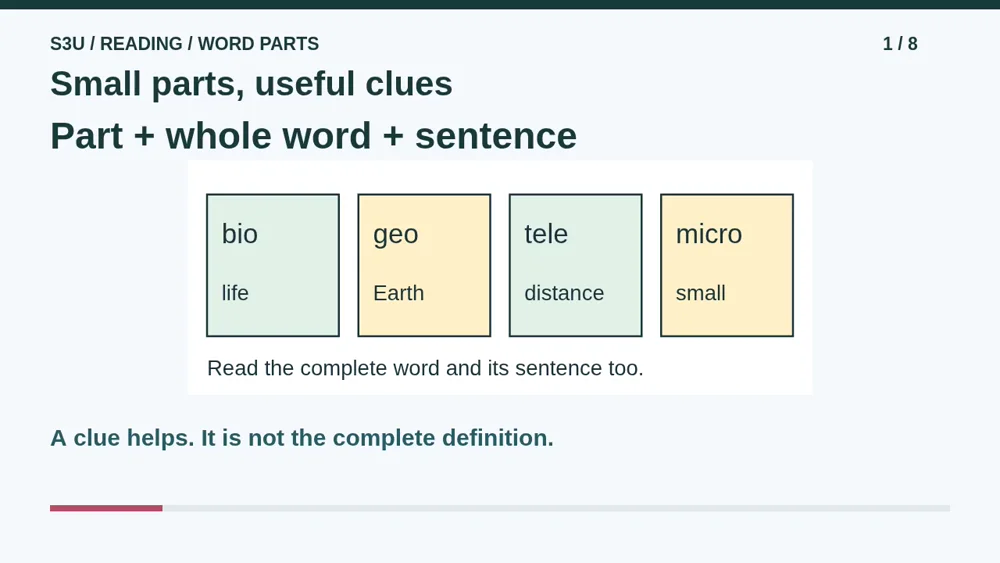
A long word can look like a train with too many carriages. We can inspect a familiar part before trying to understand the whole train. Today, bio connects with life, geo with Earth, tele with distance, and micro with small things. These parts come from Greek. We will read each whole-word note too. A clue helps us think, but it does not carry the entire meaning by itself.
2. Life and Earth clues
Video: 0:28
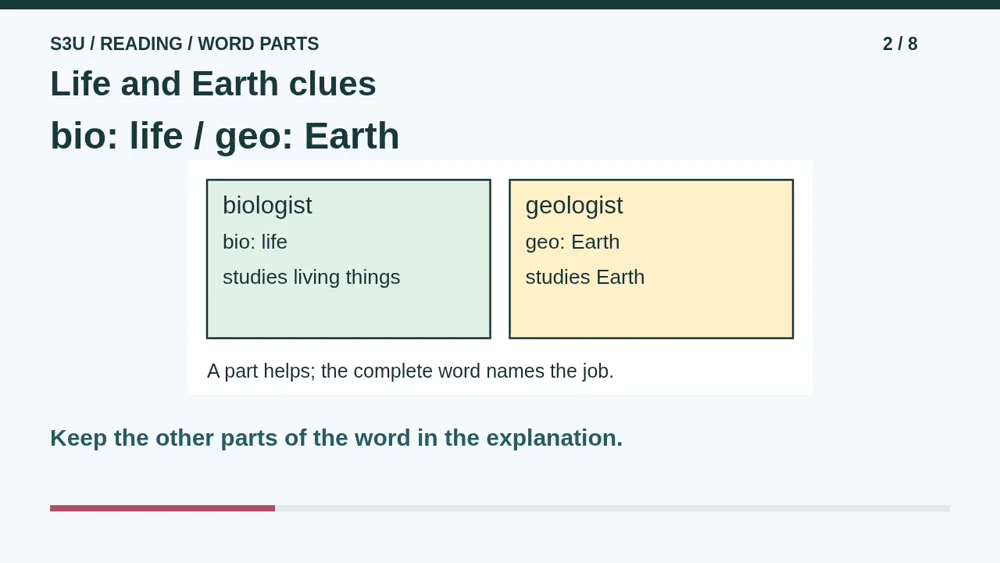
A biologist studies living things. The bio part helps connect that job with life. A geologist studies Earth, including rocks. Geo supplies the Earth clue. Compare the complete words: neither word names the planet itself or a single living thing. Both name people who study something. The shared ending and our notes help with that detail. Start with a familiar clue, then put it back into the complete word.
3. Distance does not tell the whole job
Video: 1:00
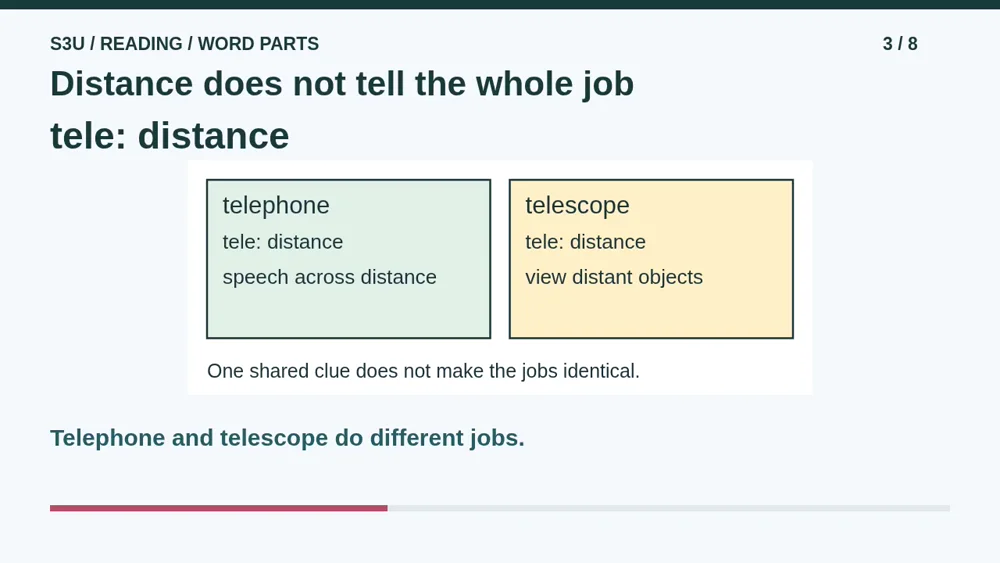
A telephone carries speech across a distance. A telescope helps us view distant objects. Tele gives a distance clue in both words, but that does not turn a telephone into a telescope. Holding a phone to your eye will not improve this explanation. The rest of each word and its note tell us the different jobs. We are studying their meanings with drawings, not looking through equipment.
4. Small does not tell every size
Video: 1:29
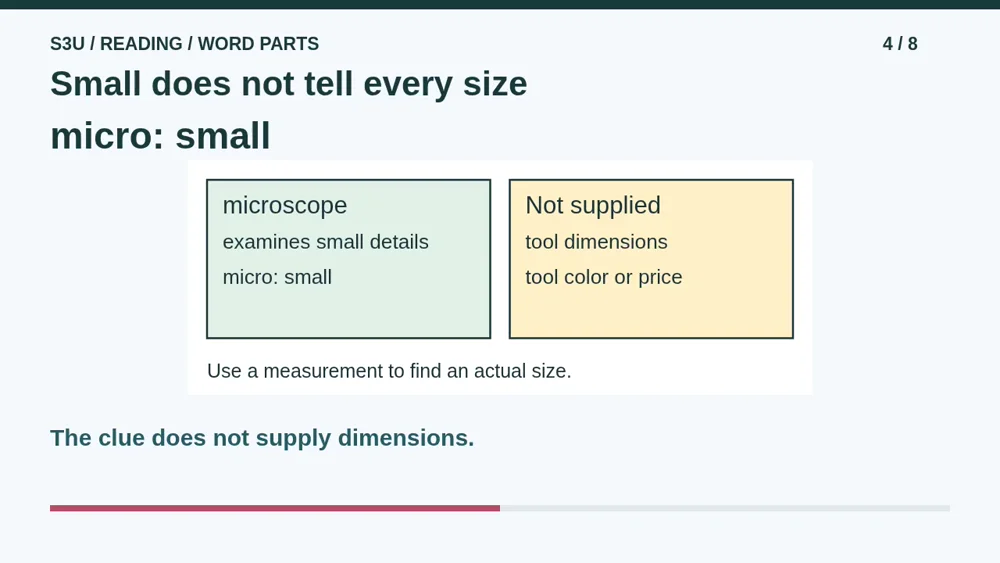
A microscope helps us examine very small details. Micro gives us the small clue, but it does not tell us how large the microscope itself is. A microscope could be much too big for your pocket. Ask what the complete word describes. Here it is a tool for examining small details, not a promise that the tool is tiny. Use a measurement or a specific description when you need an actual size.
5. Pause: read the new word notes
Video: 1:59
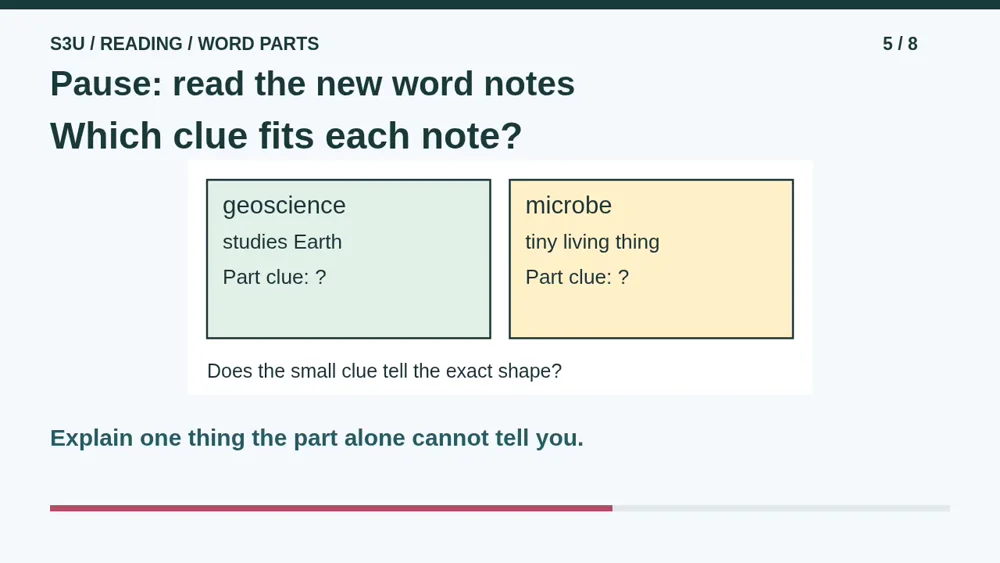
Pause here for two new word notes. Geoscience studies Earth. A microbe is a very small living thing. Which familiar part connects geoscience with Earth? Which part in microbe gives the small clue? Then think about this: does the small clue tell you the exact shape of every microbe? Say your choices and explain your reasoning. You may look back at the four clues or ask someone to read the notes with you.
6. Check the clue and its limit
Video: 2:30
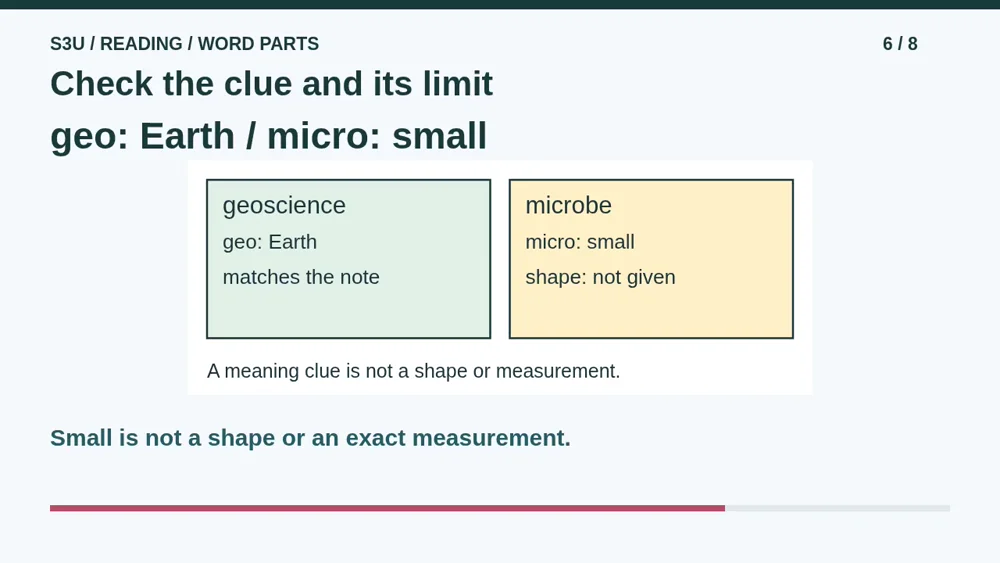
Geo connects geoscience with Earth. Micro supplies the small clue in microbe. That clue does not tell us an exact shape. It also does not give a measurement. The whole-word note adds that a microbe is a living thing. We combined the familiar part with the note rather than asking one little part to explain everything. If a word is unfamiliar, checking a dictionary or asking a trusted adult is a sensible next step.
7. One clue can travel to different words
Video: 3:02
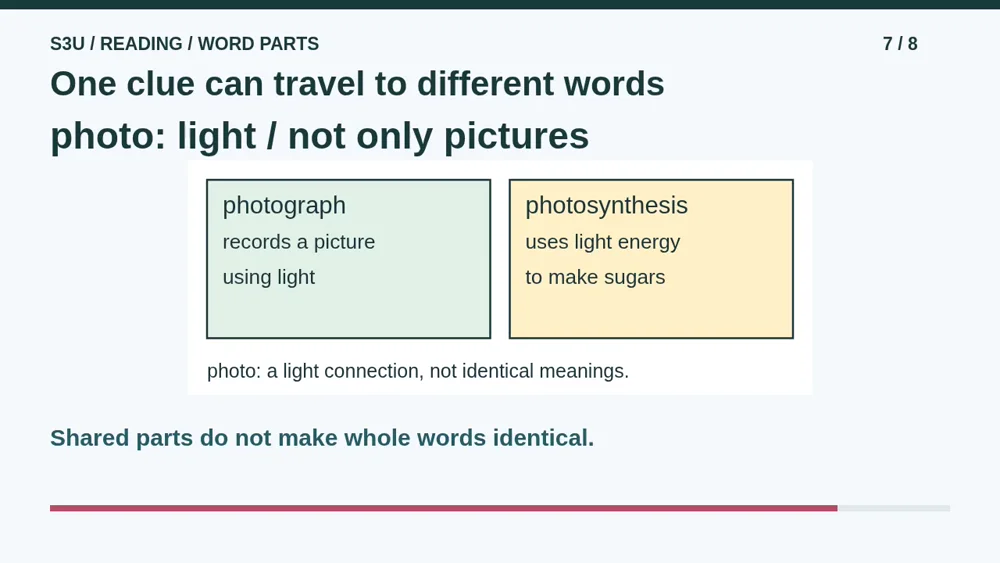
Fun fact: photo can connect with light, not only photographs. A photograph records a picture using light. Photosynthesis uses light energy to make sugars. The shared photo clue does not mean that a plant is taking pictures. Its leaves do not need a camera bag. These are different complete meanings. A useful part can connect two words while the remaining parts and context tell us how the words differ.
8. Now try the meaning worksheets
Video: 3:34
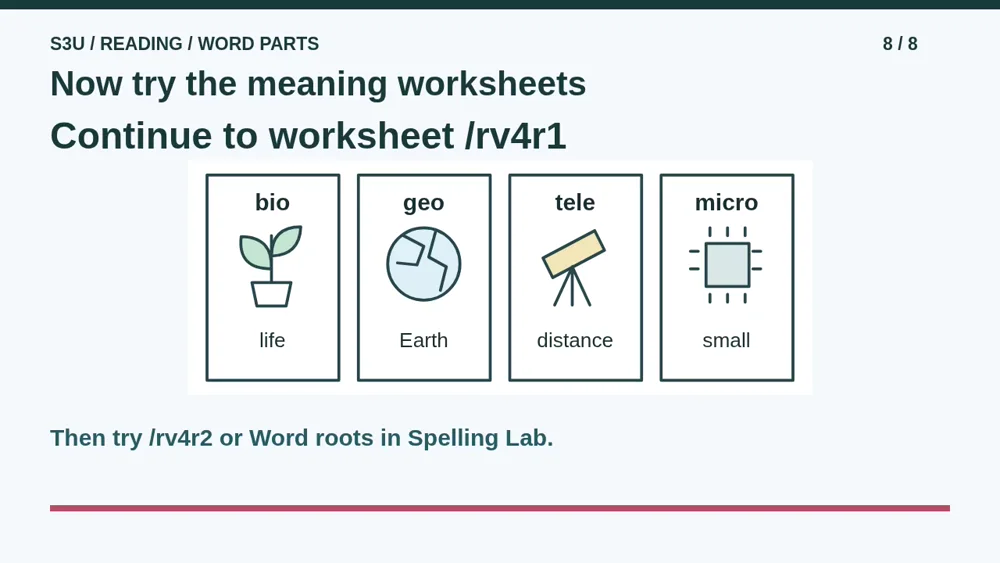
Continue to the meaning worksheet below. Read its word notes, match a familiar part to its clue, and explain what you can and cannot conclude. The second worksheet gives another set of notes. For spelling practice, choose Word roots and meaning in Spelling Lab. Use clues as helpers, not as a machine that splits every matching letter group. Our goal is to understand a whole word in context, one careful step at a time.
Show your understanding
You can point, explain aloud, draw or write.
- Connect bio, geo, tele and micro with the supplied life, Earth, distance and small clues, then return to the whole-word note.
- Use new notes for geoscience and microbe and explain why a meaning clue does not give an exact shape or instrument size.
Try it yourself
Pause at geoscience and microbe. Match the Earth and small clues, then explain whether small supplies an exact shape.
Continue to the meaning worksheet and its alternate form. Use the complete word notes; Spelling Lab offers separate guided spelling practice.
Next: your worksheet
Word Parts: Meaning Clueshttps://s3u.com/rv4r1
Lesson: https://s3u.com/lessons/word-parts-are-clues