Math / Grade 7
Why two negative factors make a positive product
Learning goal: Explain signed multiplication with equal negative changes, a pattern through zero and a distributive check. Separate multiplication, addition and zero.
Before you start: Add signed integers, identify opposites and use multiplication for a positive number of equal copies. Review the integer position and signed-change lessons when needed.
Read or print this lesson What to practiceThe video could not load. The transcript is still available below.
Next: your worksheet
Multiply Signed Numbers - Practice 1
Checking sign-in...
Read the transcript
Saved reading place
Video transcript and practice. Reading or printing does not count as playback time or an assessed grade.
1. Three changes, each negative four
Video: 0:00
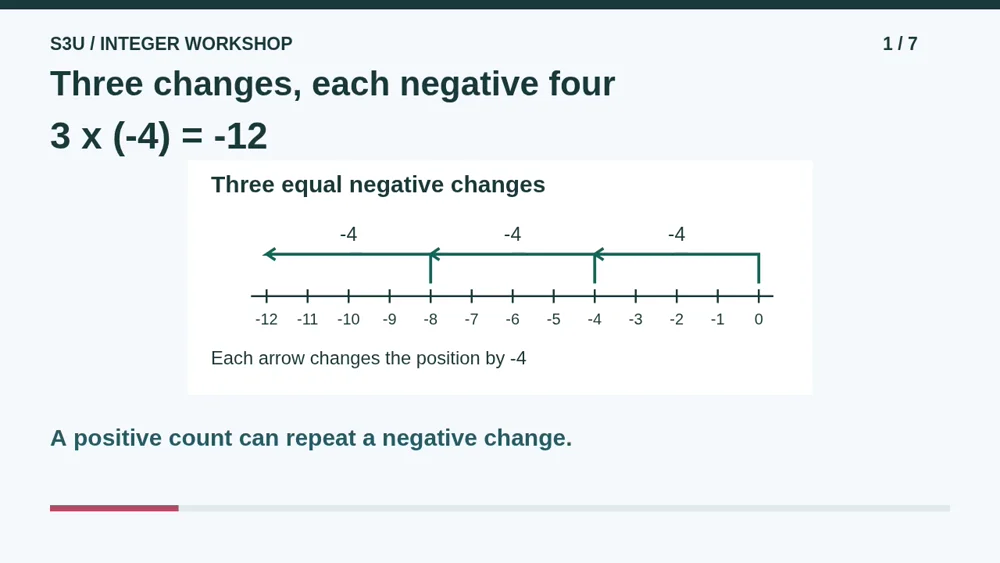
Our pretend lift has received three instructions to go down four levels. It starts at zero. After one change it is at negative four, after two at negative eight, and after three at negative twelve. Three times negative four means three copies of that negative change. We can write negative four plus negative four plus negative four. The positive three counts the copies; it does not turn their direction positive. Use an imaginary lift or a drawing, not real lift buttons. This lift is very patient, but it would still appreciate a delivery address before we press anything.
2. Keep the pattern through zero
Video: 0:44
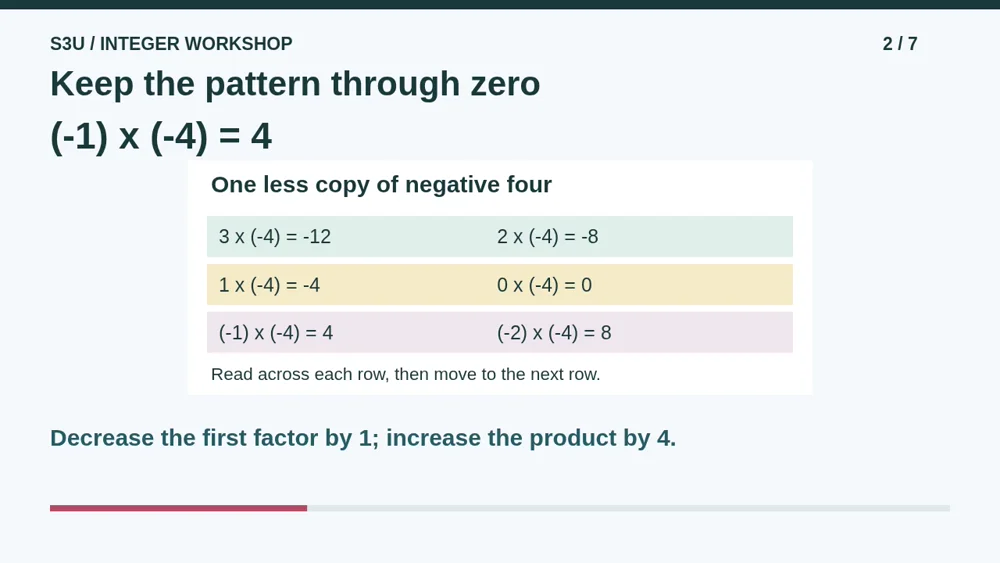
Keep the second factor at negative four and reduce the first factor by one each time. Three times negative four is negative twelve. Two times negative four is negative eight. One times negative four is negative four. Zero times negative four is zero. Each product increased by four because we removed one negative four from the previous total. Continue that same change: negative one times negative four is positive four, and negative two times negative four is positive eight. Do not imagine a negative number of lift buttons. We are extending a number pattern while keeping the same multiplication relationships.
3. Why the pattern makes sense
Video: 1:32
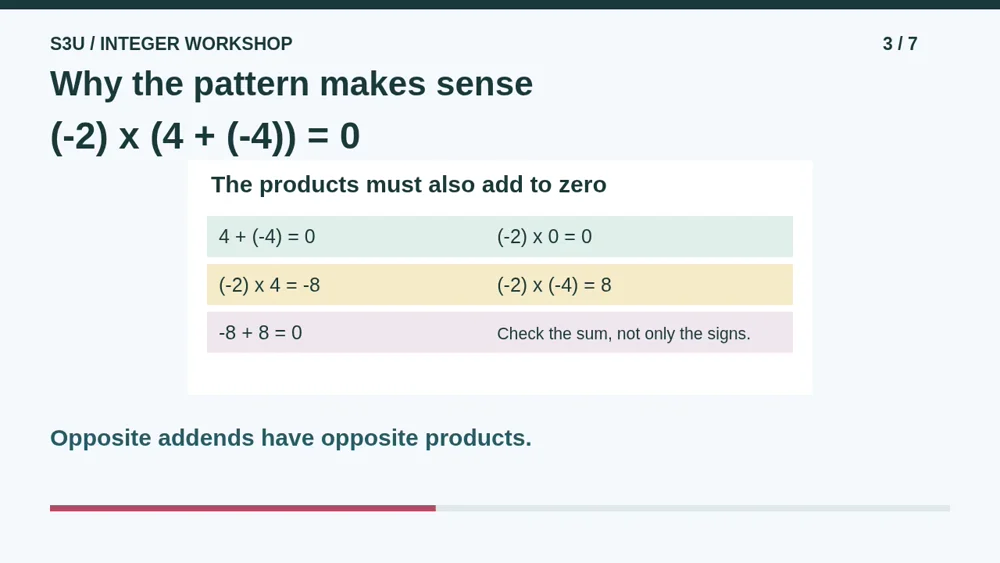
A pattern is a useful clue. Now check it using addition. Positive four and negative four add to zero, so negative two times their sum must be zero. Multiplication distributes across addition: multiply negative two by each addend, then add the products. Negative two times positive four is negative eight. To make a total of zero, negative two times negative four must therefore be positive eight. Negative eight plus positive eight is zero. If both products were negative eight, their sum would not be zero. The positive result keeps multiplication and addition working together; it is not a special rule invented to annoy the lift.
4. Size, sign, and the zero case
Video: 2:21
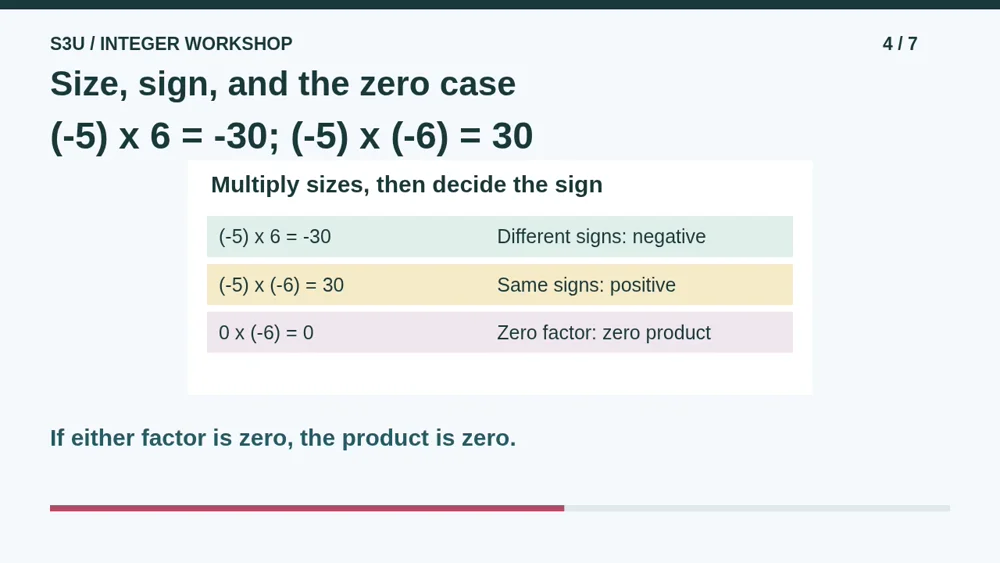
For two nonzero integers, multiply their distances from zero to get the size of the product. Five times six gives thirty. Different signs make a negative product, so negative five times positive six is negative thirty. Matching signs make a positive product, so negative five times negative six is positive thirty. Two positive factors also give a positive product. Check zero separately: zero times negative six is zero, not a negative amount. Zero is neither positive nor negative. These sign rules describe multiplication. Adding two negative numbers does not give a positive result, so always read the operation before choosing a rule.
5. Pause: read the operation first
Video: 3:13
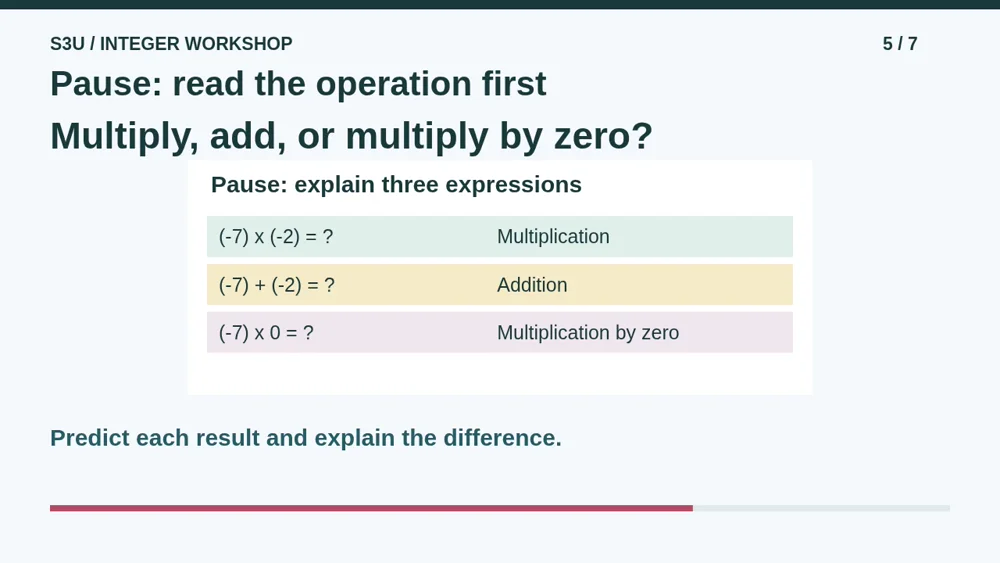
Pause the video and compare three expressions. First, negative seven times negative two. Second, negative seven plus negative two. Third, negative seven times zero. Write a result and a reason for each. For the first, decide the size and explain why the sign makes sense. For the second, think about two changes in the same direction. For the third, remember the separate zero case. A friend says that seeing two negative numbers always means a positive answer. Decide which of your expressions can show why that advice needs an operation attached to it. Continue when your explanations are ready.
6. Check three different results
Video: 4:00
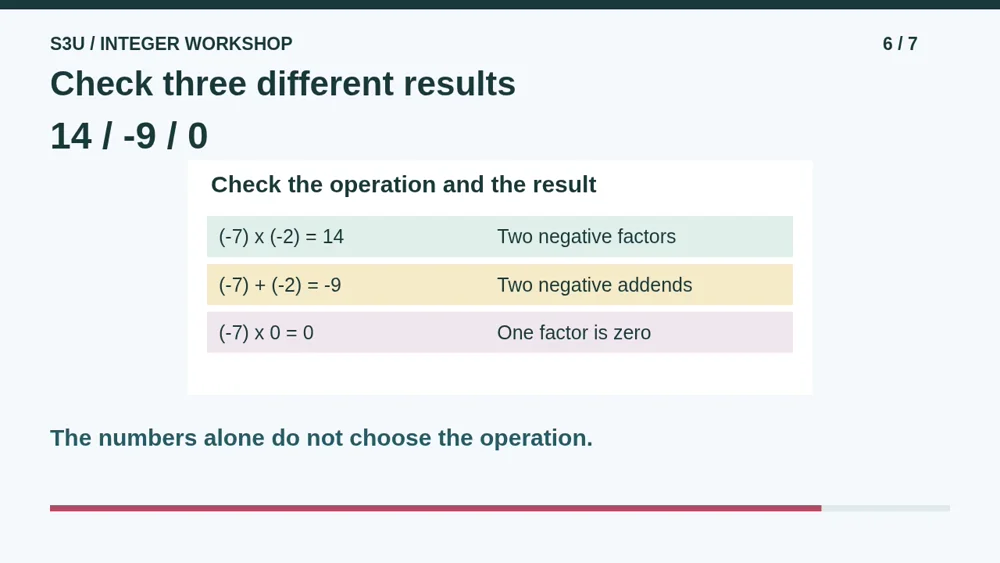
Negative seven times negative two is positive fourteen. The size is seven times two, and two negative factors give a positive product. You can check the sign by distributing negative seven across positive two plus negative two: negative fourteen and positive fourteen add to zero. Negative seven plus negative two is negative nine. That is addition of two negative changes, not multiplication. Negative seven times zero is zero. Our friend confused a multiplication rule with a rule for every expression. Repair the advice: two nonzero factors with matching signs have a positive product. The word factors tells us which operation the advice belongs to.
7. Two reversals and fresh practice
Video: 4:53
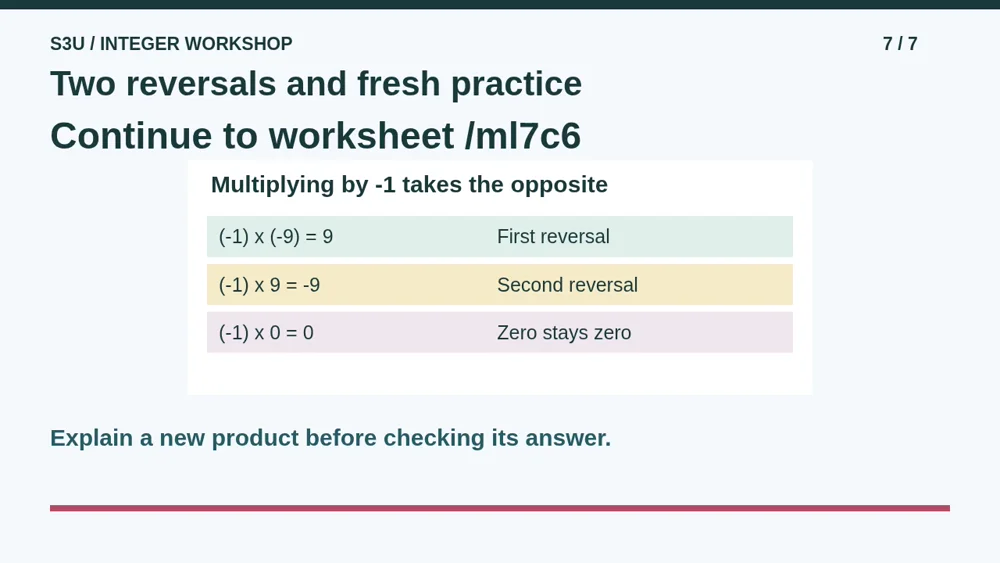
Fun fact: multiplying a number by negative one gives its opposite. Do it twice and you return to the original number. Start with negative nine: one reversal gives positive nine, and a second reversal gives negative nine again. Zero stays zero through both reversals. Continue to the first worksheet and then the second form for fresh signed products. Find the size, choose the sign, and explain one result using a pattern or a sum of opposites. You can return to the worked pictures when needed. Watching a method and using it independently are different steps, so give the new practice your own explanation.
Show your understanding
You can point, explain aloud, draw or write.
- Explain why two negative factors give a positive product using a pattern and a distributive check.
- Calculate a fresh signed product, handle a zero factor and distinguish multiplication from addition.
Try it yourself
Pause and compare negative seven times negative two, negative seven plus negative two, and negative seven times zero. Explain each operation.
Continue to both worksheets. Use a pattern or a sum of opposite addends to justify one fresh product.
Next: your worksheet
Multiply Signed Numbers - Practice 1https://s3u.com/ml7c6
Lesson: https://s3u.com/lessons/why-signs-multiply