Math / Grade 7 / algebra extension
The unknown on both sides
Learning goal: Collect variable terms with matching operations, check both original expressions and recognize an identity.
Before you start: Solve two-step equations and add, subtract, multiply and divide signed numbers. The same x always means the same number within an equation.
Read or print this lesson What to practiceThe video could not load. The transcript is still available below.
Next: your worksheet
The Unknown on Both Sides - Practice 1
Checking sign-in...
Read the transcript
Saved reading place
Video transcript and practice. Reading or printing does not count as playback time or an assessed grade.
1. The same unknown, twice
Video: 0:00
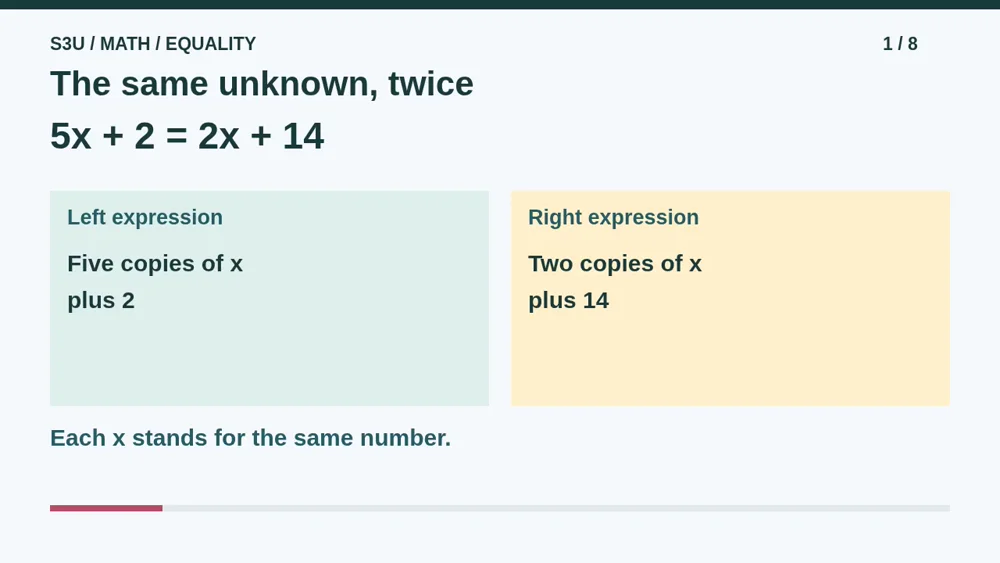
The letter x can appear on both sides of an equation. Every x here stands for the same number. Five times x plus two must match two times x plus fourteen. We are not hunting for two different answers because the letter appears twice. Think of one mystery number making two expressions agree. The mystery has two addresses, but it is still the same mystery.
2. Remove matching variable terms
Video: 0:28
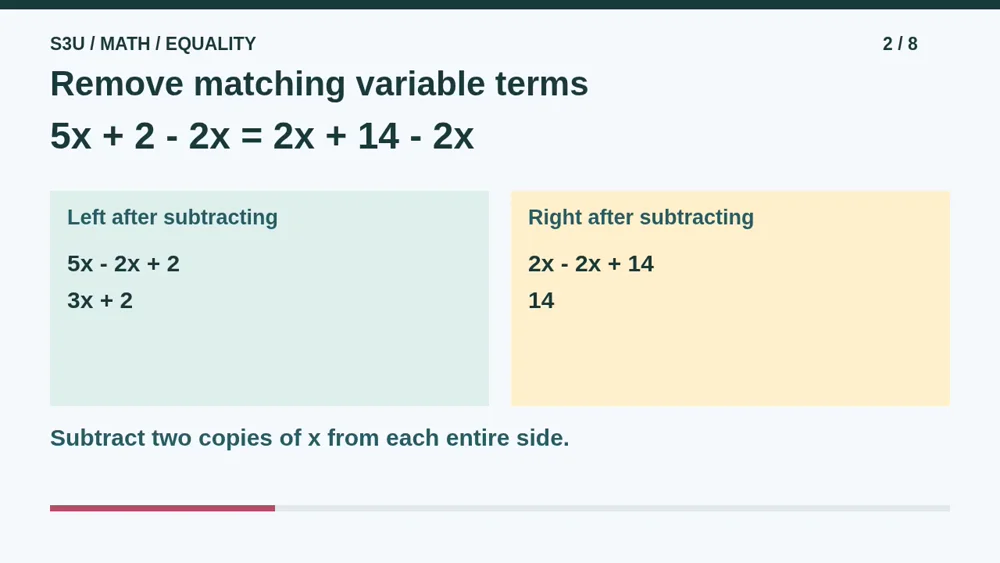
Subtract two times x from each entire side. Five copies minus two copies leaves three copies, so the left becomes three times x plus two. On the right, the two variable terms cancel, leaving fourteen. We have not guessed the value of x. We have applied the same subtraction on both sides, and adding two times x back would reverse our step.
3. Finish the smaller equation
Video: 0:55
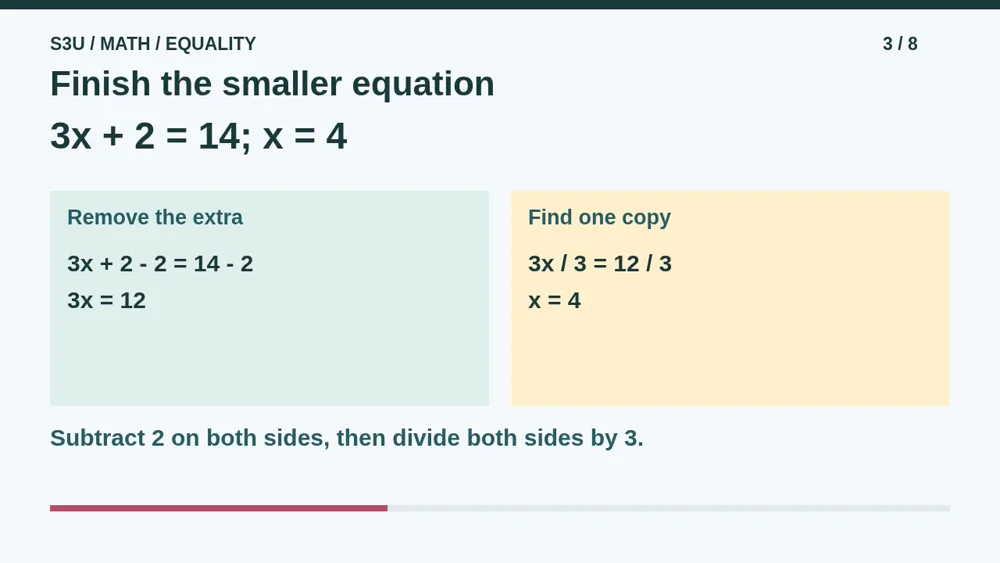
Now the equation looks like our earlier two step work. Subtract two from both sides to get three times x equals twelve. Divide both sides by three, giving x equals four. The variable terms did not hop across the equals sign and magically change their signs. Each new line has a reason. Say the operation before writing the line; it is harder for a missing sign to sneak past you.
4. Check both original expressions
Video: 1:25
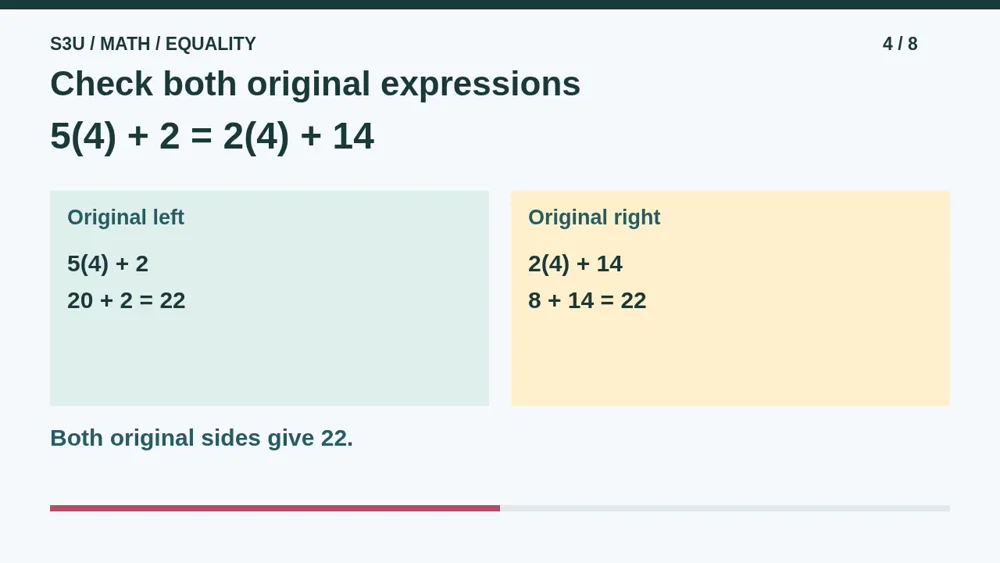
Put four into every x in the original equation. The left gives five times four plus two, which is twenty two. The right gives two times four plus fourteen, also twenty two. The check works. Checking only three times four equals twelve would miss an earlier copying error. Return to the original so your answer is tested against the actual question, not just your latest line.
5. Pause: a negative answer?
Video: 1:54
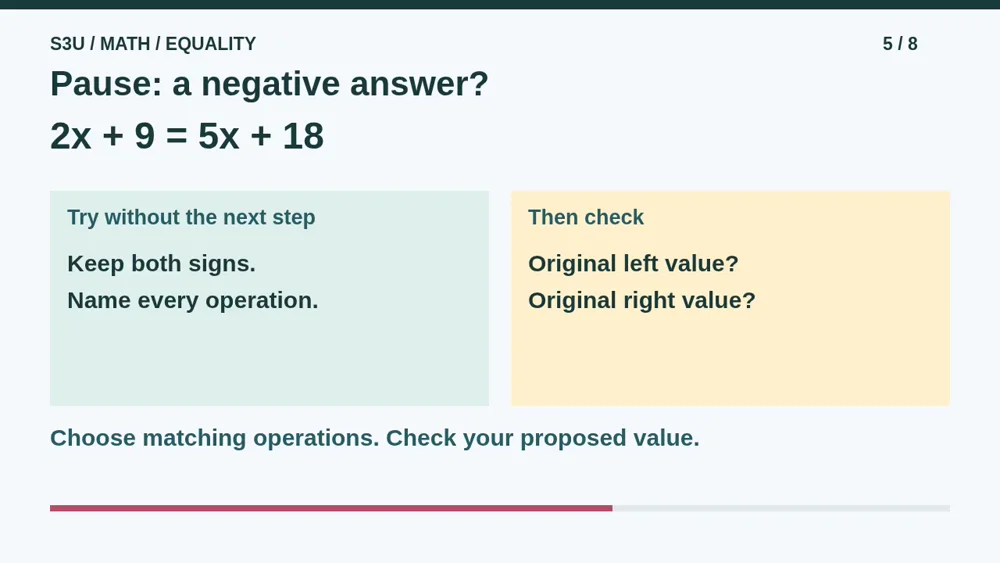
Pause and solve a new equation: two times x plus nine equals five times x plus eighteen. You can remove the smaller or larger variable term, as long as you do the same thing on both sides. Write your operations, find a candidate and check both original expressions. A negative answer is allowed. The equals sign does not have a favorites list of positive numbers.
6. Two valid routes, one answer
Video: 2:23
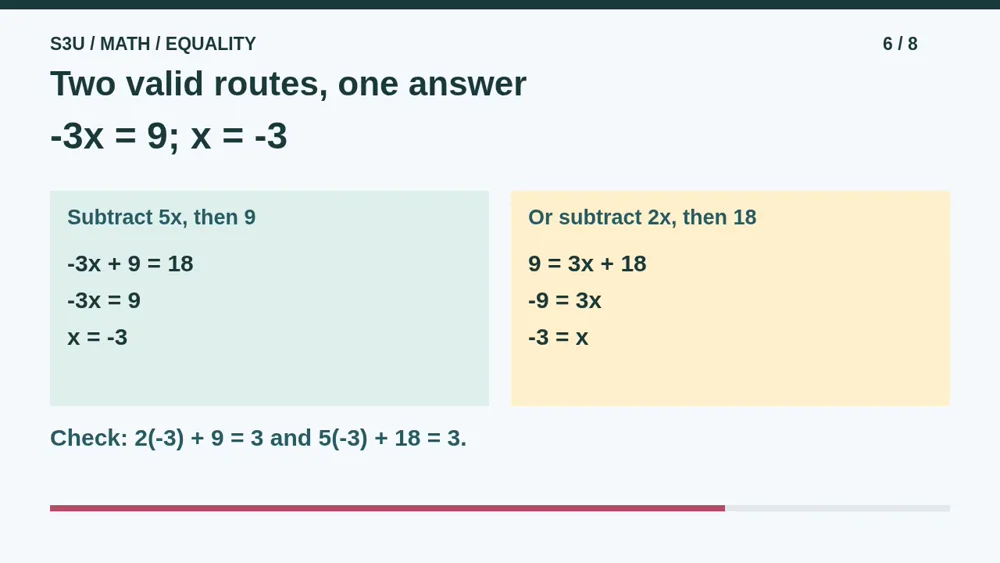
One route subtracts five times x from both sides, then subtracts nine. Negative three times x equals nine, so x is negative three. Another route subtracts two times x, then eighteen. That gives negative nine equals three times x, again x equals negative three. The original left and right both give three. The route can change while the checked solution stays the same.
7. When the letters disappear
Video: 2:53
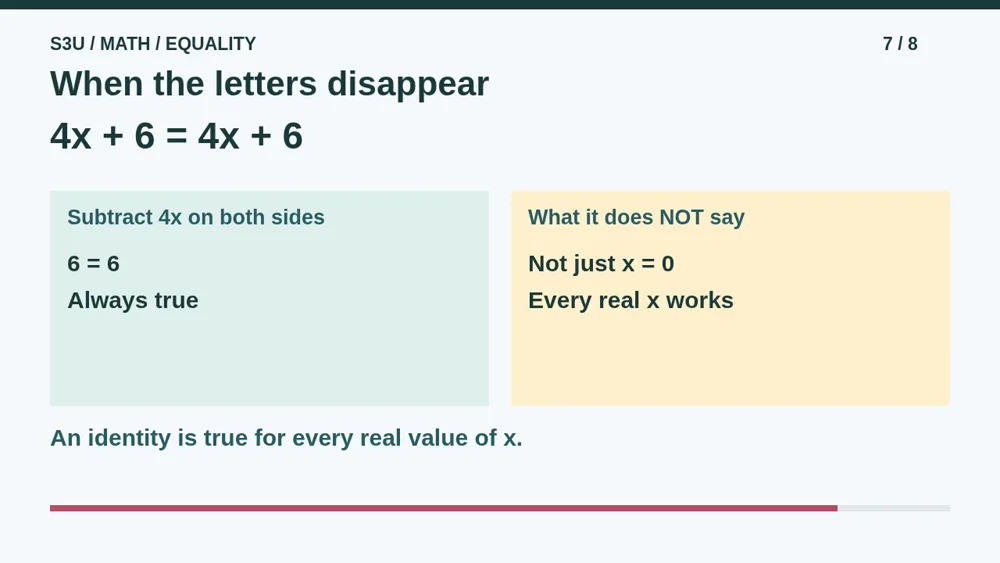
Fun fact: sometimes every real number works. In four times x plus six equals four times x plus six, the two expressions are identical. Subtracting four times x leaves six equals six. That true statement does not say x is zero. Zero, one, negative three and every other real value work here. In the next lesson we will also meet equations where no value works.
8. Try new numbers on paper
Video: 3:23
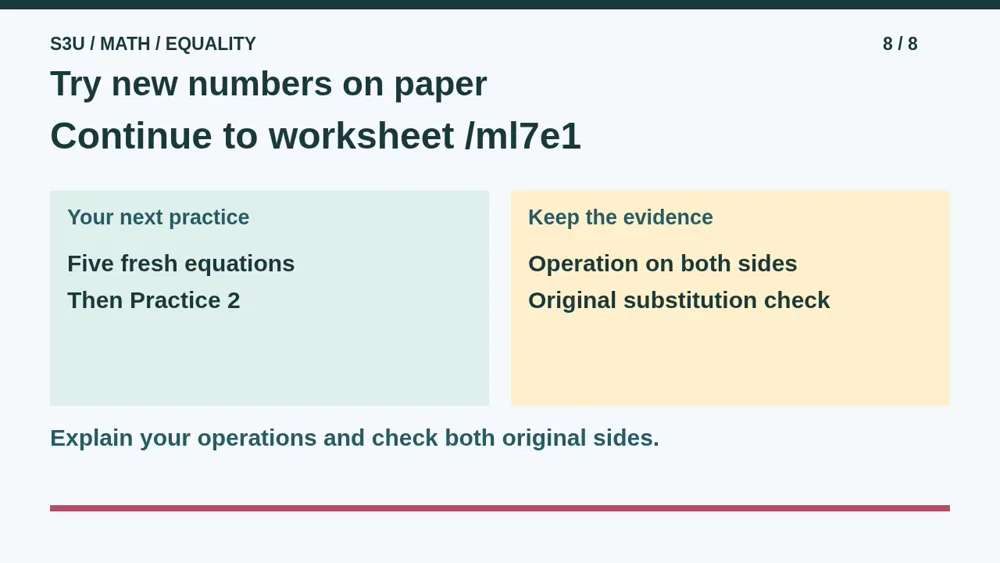
Continue to the worksheet below and then its second practice sheet. These questions have one solution each, with different coefficients and signs. Write a reason for each operation and substitute your proposed value into both original sides. If signed arithmetic is getting in the way, return to the earlier equation lesson and take one line at a time. A correct final number is a start; your explanation shows how you kept equality.
Show your understanding
You can point, explain aloud, draw or write.
- Collect variable terms with explicitly matching operations and verify both original expressions.
- Explain why a true numerical statement after valid simplification of these linear equations can mean every real value works, not only zero.
Try it yourself
Pause at 2x + 9 = 5x + 18. Solve with matching operations and check both original values.
Continue to both practice sheets. Explain each operation; the displayed numeric answer alone does not show the reasoning.
Next: your worksheet
The Unknown on Both Sides - Practice 1https://s3u.com/ml7e1
Lesson: https://s3u.com/lessons/unknown-on-both-sides