History / Grade 7
Trace the original account
Learning goal: Follow copying paths, distinguish documents from independent origins, and explain why agreement still needs investigation.
Before you start: Read a short record and distinguish a writer from an intended reader. Every copying relationship in the lesson is explicitly fictional.
Read or print this lesson What to practiceThe video could not load. The transcript is still available below.
Next: your worksheet
Check Whether Sources Are Independent - Practice 1
Checking sign-in...
Read the transcript
Saved reading place
Video transcript and practice. Reading or printing does not count as playback time or an assessed grade.
1. Five records, how many origins?
Video: 0:00
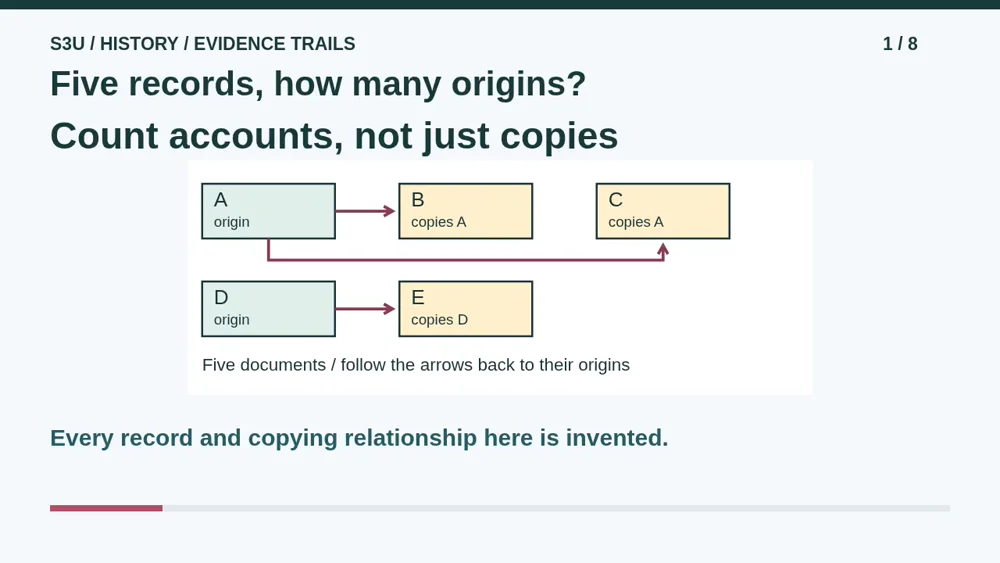
A pretend museum has five reports about a bell ringing at noon. Five reports sound impressive, but where did their information come from? A copied report is another document, not automatically another observation. We will trace the stated paths back to their origins. These records are invented teaching models, not real historical quotations. We are counting where a claim began, not deciding truth by a popularity contest.
2. Follow the first copying path
Video: 0:33
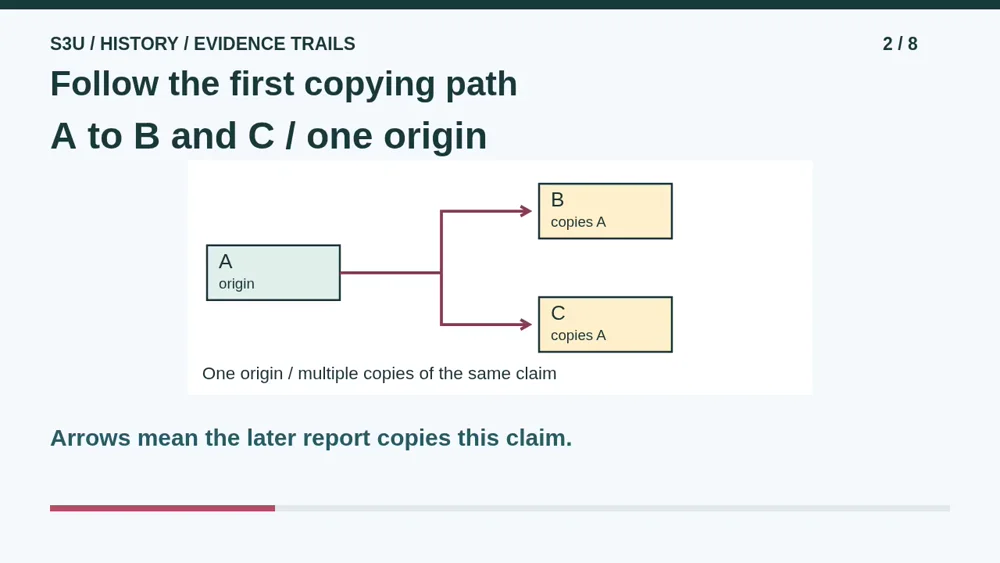
Record A is a keeper's account. The model tells us that B copied A, and C also copied A. For the claim about the noon bell, all three texts lead back to A. That is one originating account, represented by three documents. The photocopier has been busy, but it did not grow two extra pairs of ears. Copies can preserve evidence without creating independent observations.
3. Add a separately recorded account
Video: 1:02
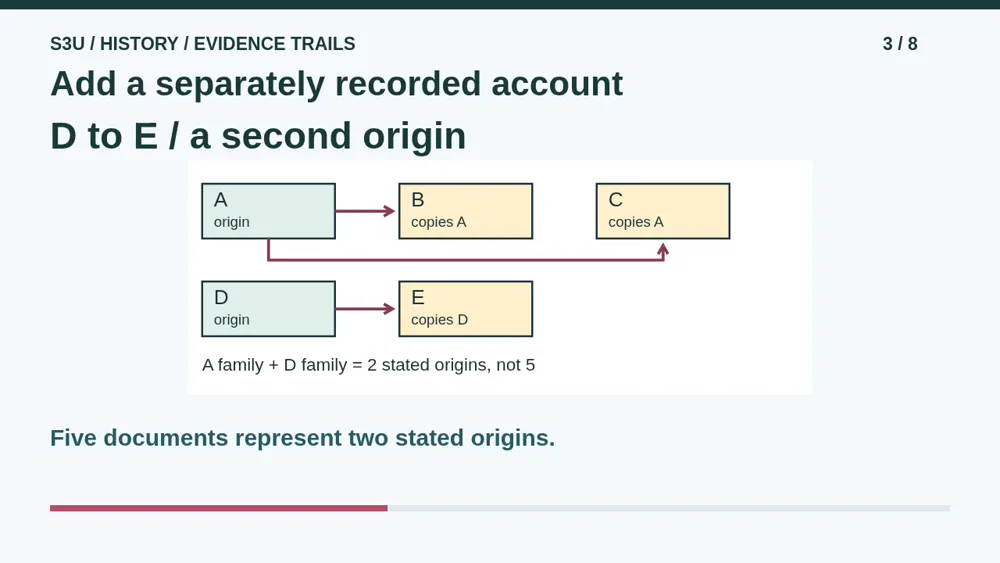
The model also gives us D, a separately recorded visitor account, and E, which copied D. We now have two stated origins: A and D. Their three copies do not raise that number to five. In an actual investigation, we must check how the writers got their information. Different names, paper colors, or websites do not by themselves establish that the accounts were independent.
4. Agreement still needs investigation
Video: 1:31
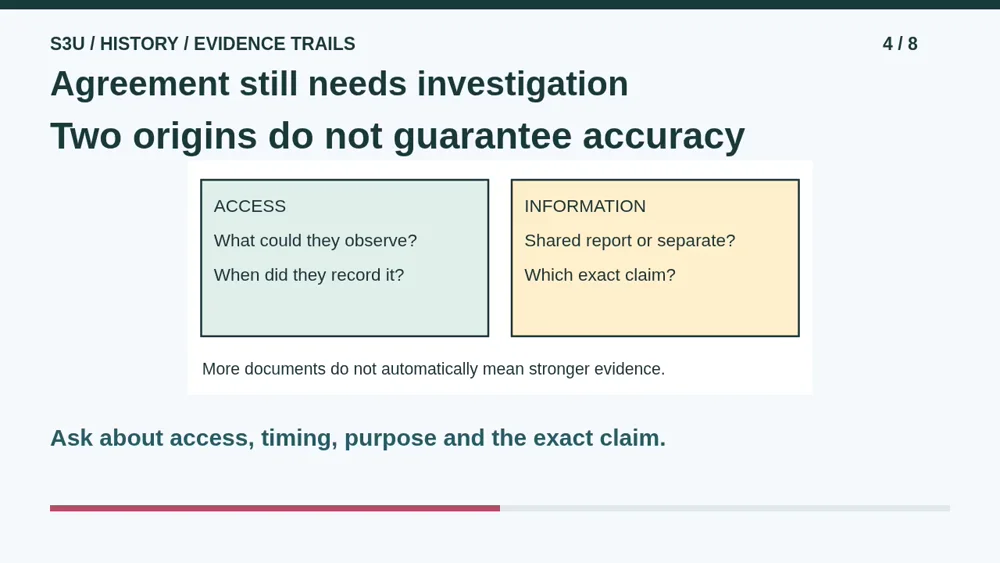
Suppose both originating accounts say the bell rang at noon. Their agreement may help our investigation, but two accounts can still be mistaken. Ask where each person was, when they wrote, what they could observe, and whether they shared an information source. Similar wording is a clue to investigate, not automatic proof of copying. Independence is about the particular information being compared, not a permanent badge attached to a person.
5. Pause: untangle a new record set
Video: 2:03
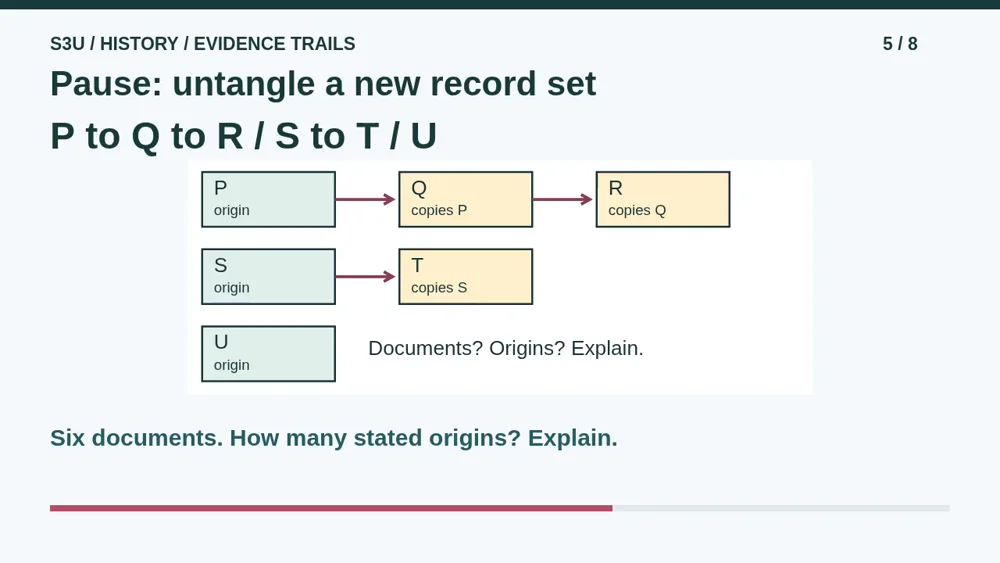
Pause for a fresh fictional case. P is an originating account. Q copies P, and R copies Q. S is separately recorded, and T copies S. U is a third separately recorded account. How many documents are there, and how many originating accounts do they represent? Trace every path back. Then explain why the origin count alone cannot prove the claim is correct.
6. Check the roots of each path
Video: 2:34
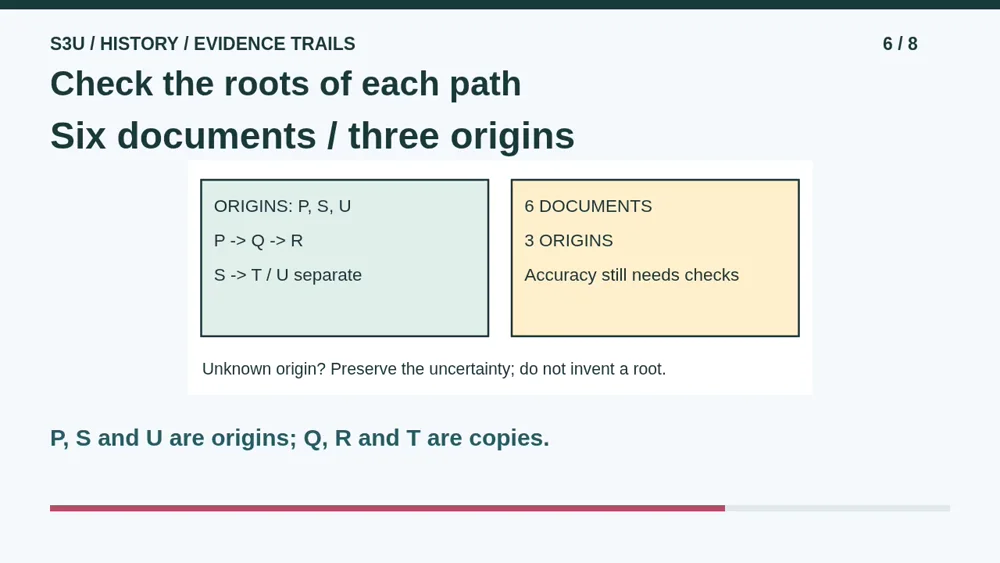
There are six documents, but three stated origins: P, S, and U. R still traces back through Q to P. Copying a copy does not add another origin. We can count these because the fictional relationships are supplied. If U's source were unknown instead, we would mark that uncertainty rather than assume a third independent account. Counting helps organize the evidence; evaluating its quality is a separate job.
7. A copy can have a different use
Video: 3:06
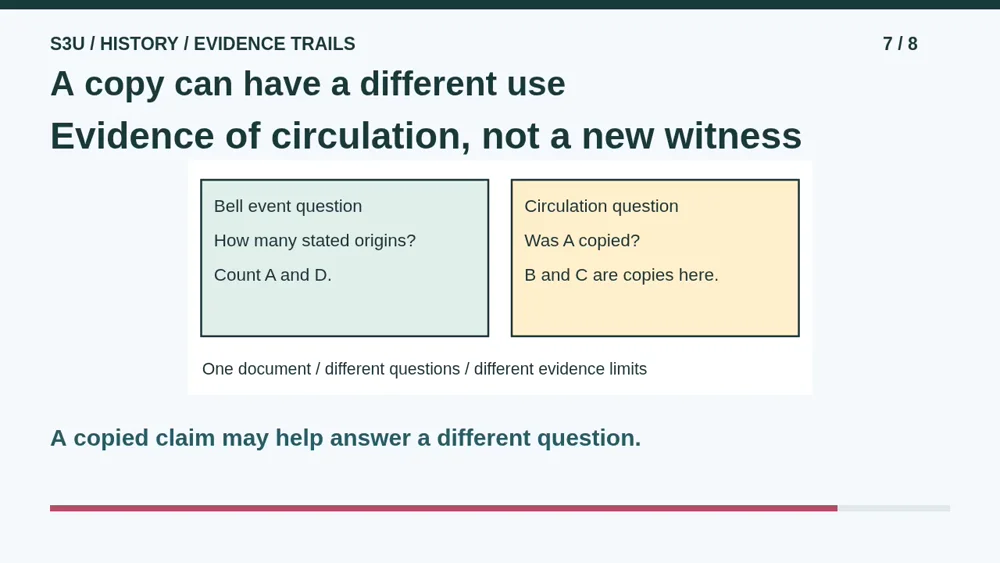
Fun fact: a copy can be useful evidence even when it is not an independent account of the original event. In our model, B and C show that A's report was copied. That can help us ask how the report circulated. It does not show how many people heard the bell. The same document can help answer one question while being insufficient for another.
8. Continue the evidence trail
Video: 3:33
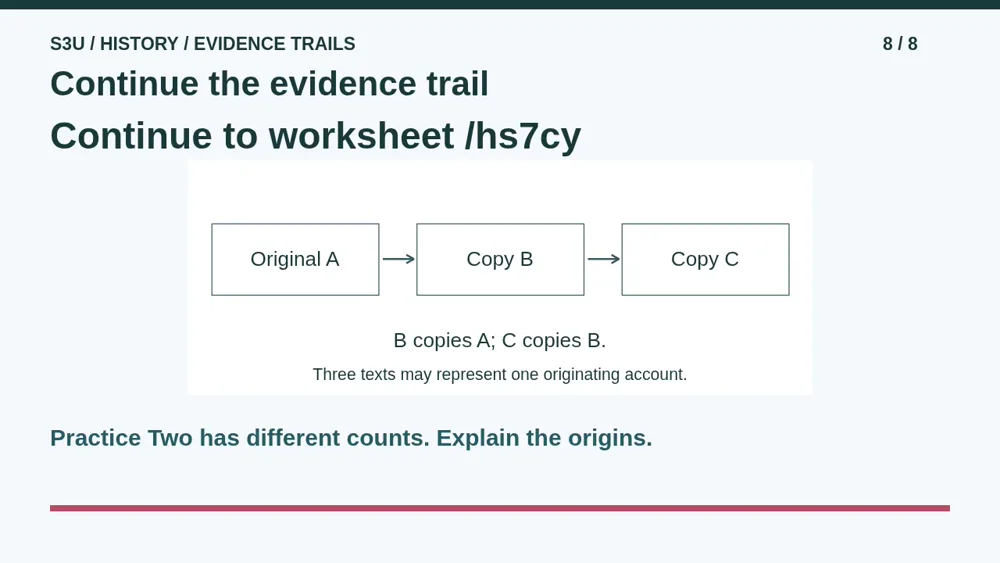
Continue to the worksheet below. Each problem gives one original account, a number of copies, and some separately recorded accounts. Count the first origin once, then add the other stated origins. Do not add the copies to that total. Try Practice Two for fresh counts, and explain why agreement still needs checking. Use only the provided fictional records; no personal documents or uploads are needed.
Show your understanding
You can point, explain aloud, draw or write.
- Trace copied claims to their stated origins, distinguishing the number of surviving documents from the number of originating accounts.
- Explain why agreement and origin counts do not guarantee accuracy, and preserve an unknown information source as uncertain.
Try it yourself
Pause at P, Q, R, S, T and U. Trace each copying path and distinguish six documents from their originating accounts.
Continue to both worksheets with their new counts. Explain why counting origins is not a vote on truth.
Next: your worksheet
Check Whether Sources Are Independent - Practice 1https://s3u.com/hs7cy
Lesson: https://s3u.com/lessons/trace-the-original-account