Math / Grade 6
Ten percent is a tenth
Learning goal: Name the whole, find ten percent using equal portions, and distinguish that portion from what remains.
Before you start: Divide whole numbers by ten, subtract amounts and recognize equal fractional parts. Review decimal place value for the optional length example.
Read or print this lesson What to practiceThe video could not load. The transcript is still available below.
Next: your worksheet
Find Ten Percent - Practice 1
Checking sign-in...
Read the transcript
Saved reading place
Video transcript and practice. Reading or printing does not count as playback time or an assessed grade.
1. Name the whole first
Video: 0:00
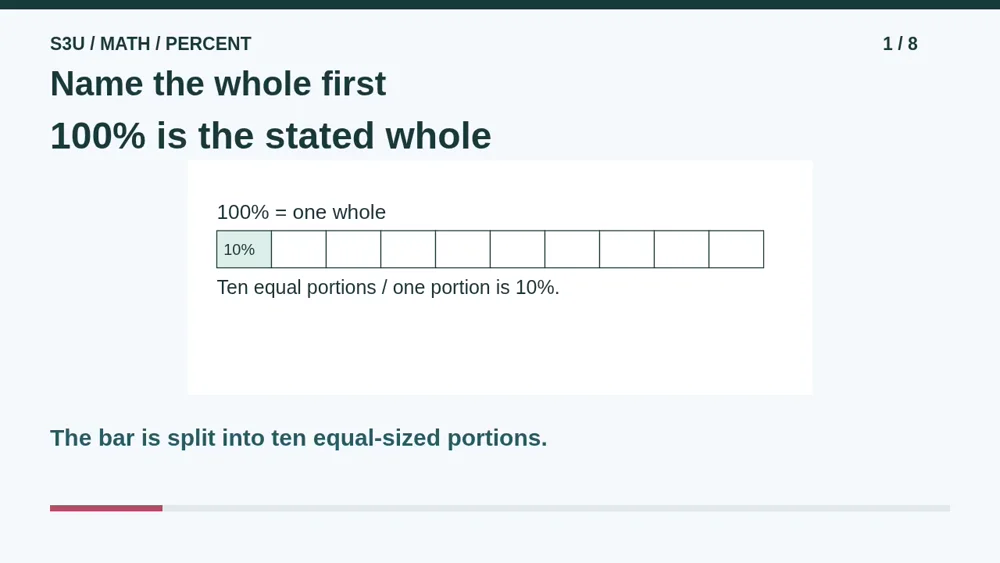
Percent compares an amount with a stated whole. One hundred percent means all of that whole. Our bar has ten equal portions, so each portion represents ten percent. That does not mean the bar contains only ten things. It could represent a length, a number of points or another quantity. First name the whole, then find the share. Otherwise the percent sign is wearing a name tag with no name.
2. Ten per hundred is one tenth
Video: 0:30
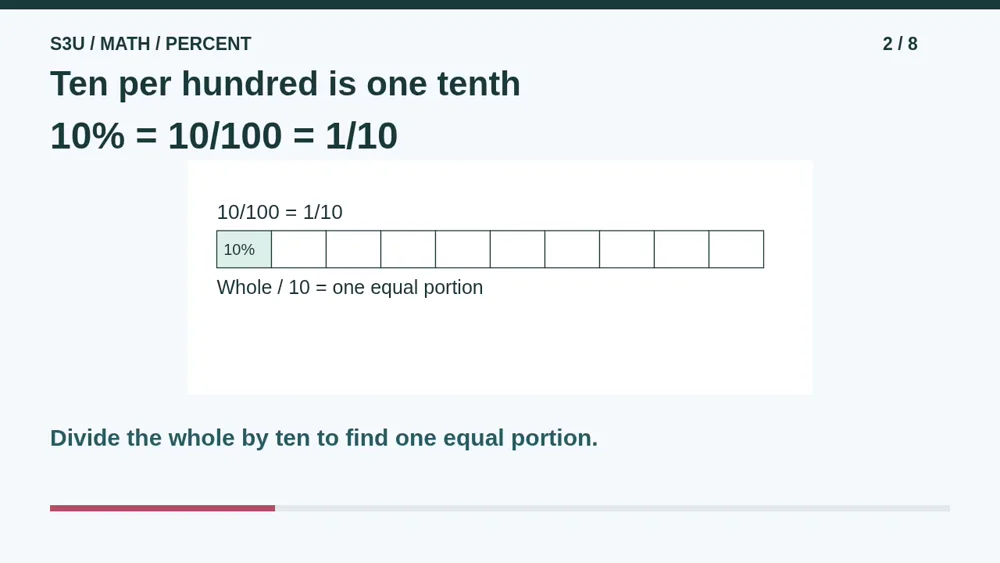
Ten percent means ten per hundred. The fraction ten over one hundred simplifies to one tenth because we divide its numerator and denominator by ten. So ten percent of a quantity is one of ten equal portions of that quantity. Divide the whole by ten. We are finding a portion, not subtracting ten objects and not dividing by one hundred. The equal parts are what make the shortcut work.
3. Work with the actual quantity
Video: 1:01
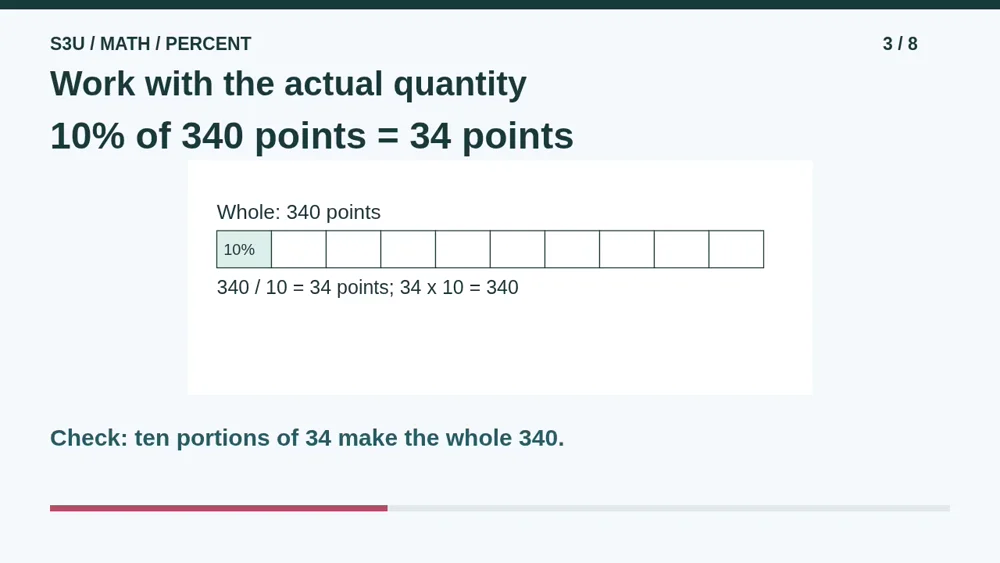
Imagine an invented game score of three hundred forty points. Ten percent of that whole is three hundred forty divided by ten, which is thirty four points. Check by multiplying thirty four by ten: we return to three hundred forty. The result keeps the unit points. Subtracting ten points would give three hundred thirty points, a very different amount. This paper example does not change any real game score or coins.
4. Same percent, different whole
Video: 1:33
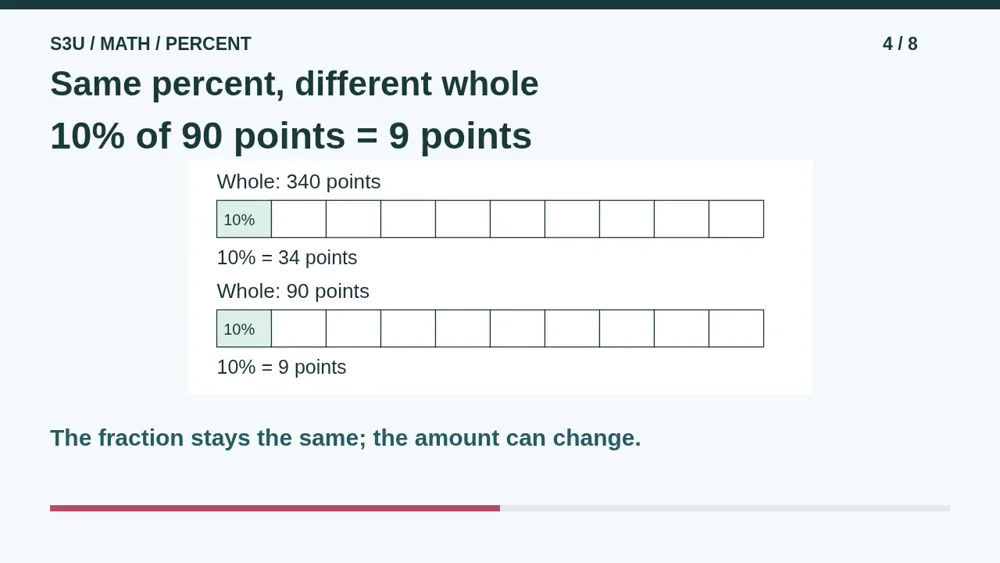
Now the whole is ninety points. Ten percent is nine points, not thirty four. The fraction is still one tenth, but it is a tenth of a different whole. Two players saying ten percent do not necessarily mean the same number of points. Compare the reference quantities before comparing the amounts. The bars show equal fractions; their outlines are fraction models, not a claim that ninety and three hundred forty are equal.
5. Pause: portion and remainder
Video: 2:04
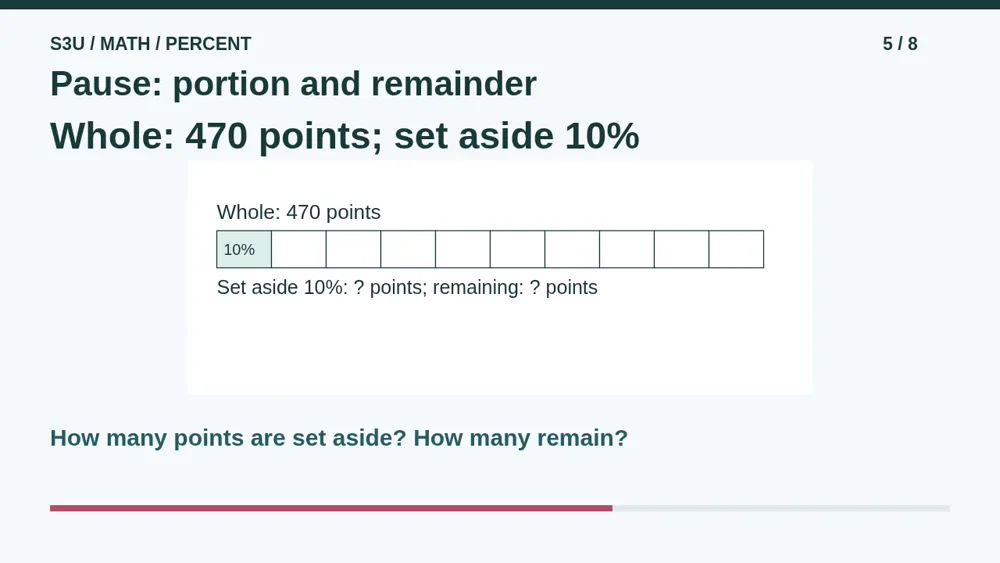
Pause and use a fresh invented total of four hundred seventy points. Set aside ten percent of those points. How many points are set aside, and how many remain? Explain which answer comes from dividing and which comes from subtracting. Do not treat ten percent as ten points. Keep the same starting whole for both steps. You can draw ten equal boxes, write a calculation or explain it aloud.
6. Use the portion in the subtraction
Video: 2:35
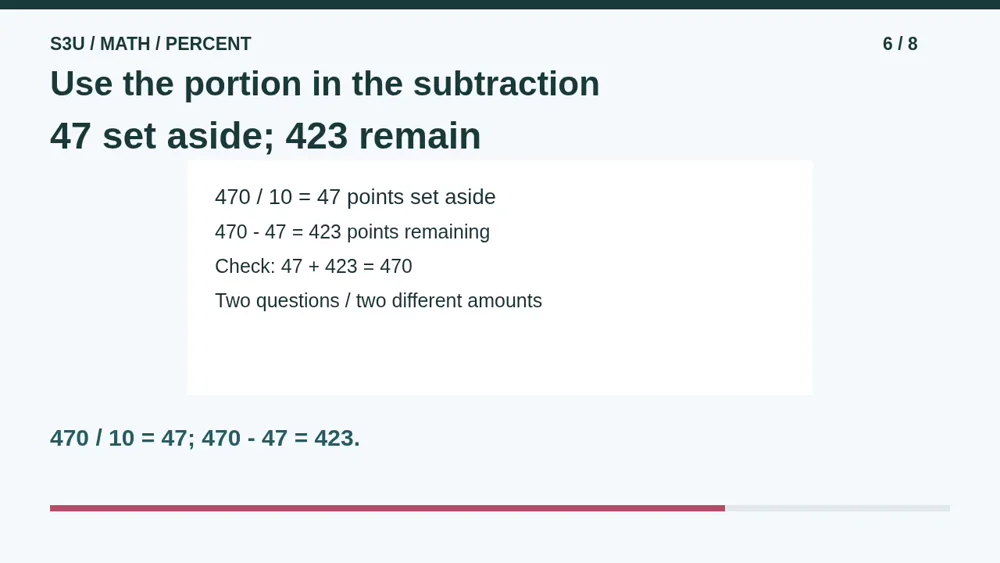
Four hundred seventy divided by ten is forty seven, so forty seven points are set aside. Subtract forty seven from four hundred seventy to get four hundred twenty three remaining. Check by adding the set aside and remaining amounts: forty seven plus four hundred twenty three is four hundred seventy. The portion and the remainder answer different questions. A correct division is not yet the answer when the question asks what remains.
7. A tenth need not be a whole number
Video: 3:08
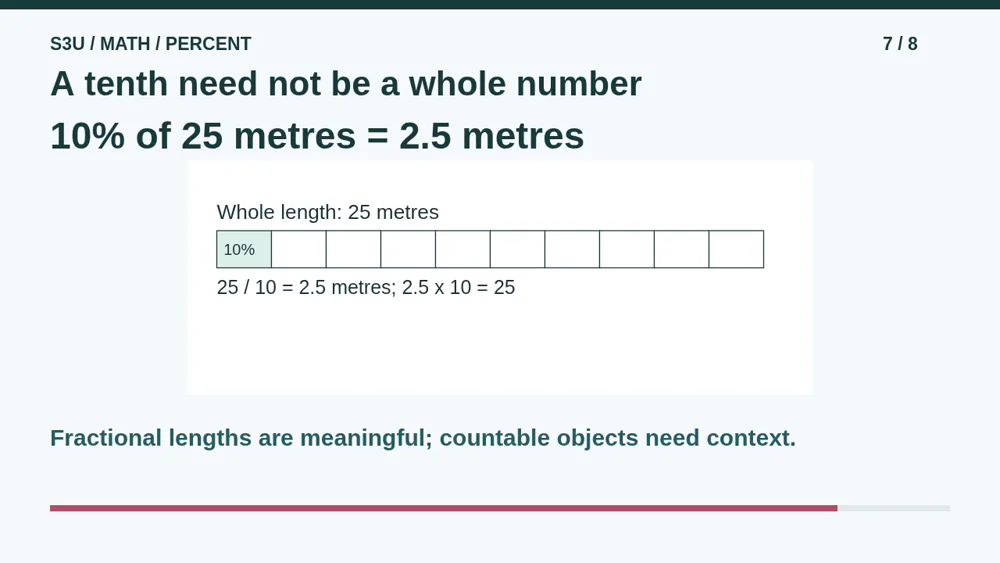
Fun fact: ten percent can give a decimal even when the starting number is a whole number. Ten percent of twenty five metres is two point five metres. Ten lengths of two point five metres make twenty five metres. That is a meaningful length. With indivisible objects, a fractional result may describe a mathematical share rather than a possible exact selection. Keep the quantity and the situation in your explanation.
8. Continue to percent practice
Video: 3:41
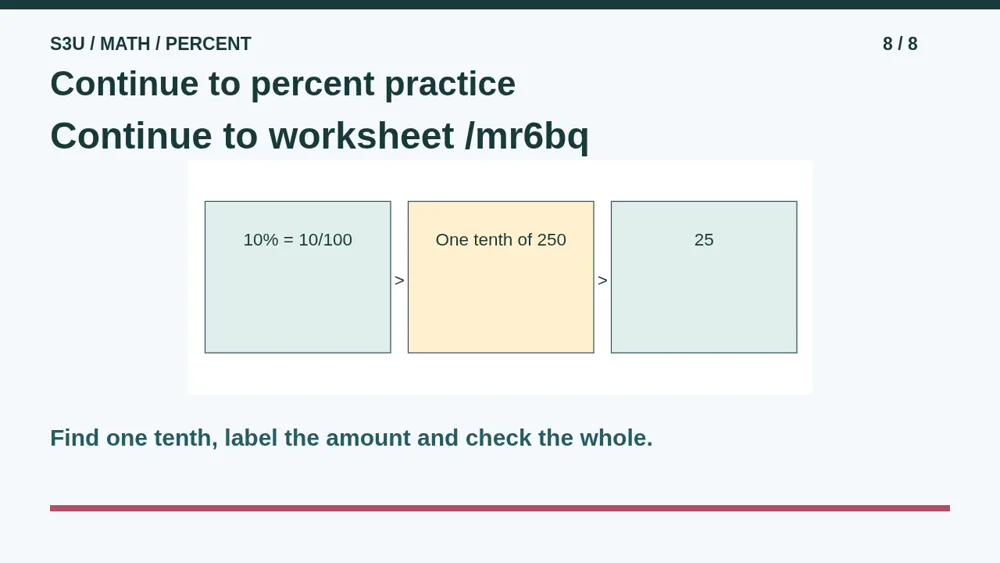
Continue to the worksheet below, then use Practice Two for more examples. Each question asks for ten percent of its own stated number. Divide that number by ten and multiply your answer by ten to check. When you later use percentages for remainders or comparisons, name the whole again instead of carrying an old amount into a new problem. The lesson prepares you; the worksheet is separate practice.
Show your understanding
You can point, explain aloud, draw or write.
- Explain 10% as 10/100 or one tenth of the stated whole and verify the resulting portion.
- Distinguish a ten-percent portion from the remainder and explain why the same percent can represent different amounts.
Try it yourself
Pause at 470 points. Find the ten-percent portion and the remainder, explaining why they require different operations.
Continue to both practice sheets. Use each stated whole and check by multiplying the tenth by ten.
Next: your worksheet
Find Ten Percent - Practice 1https://s3u.com/mr6bq
Lesson: https://s3u.com/lessons/ten-percent-is-a-tenth