Math / Grade 5
Subtract fractions with common-sized parts
Learning goal: Rename unlike fractions without changing their amounts, subtract common-sized parts, and check remainders including amounts above one.
Before you start: Find equivalent fractions using multiplication facts through twelve and subtract fractions with matching denominators.
Read or print this lesson What to practiceThe video could not load. The transcript is still available below.
Next: your worksheet
Subtract With Common Fraction Parts - Practice 1
Checking sign-in...
Read the transcript
Saved reading place
Video transcript and practice. Reading or printing does not count as playback time or an assessed grade.
1. Two names, two piece sizes
Video: 0:00
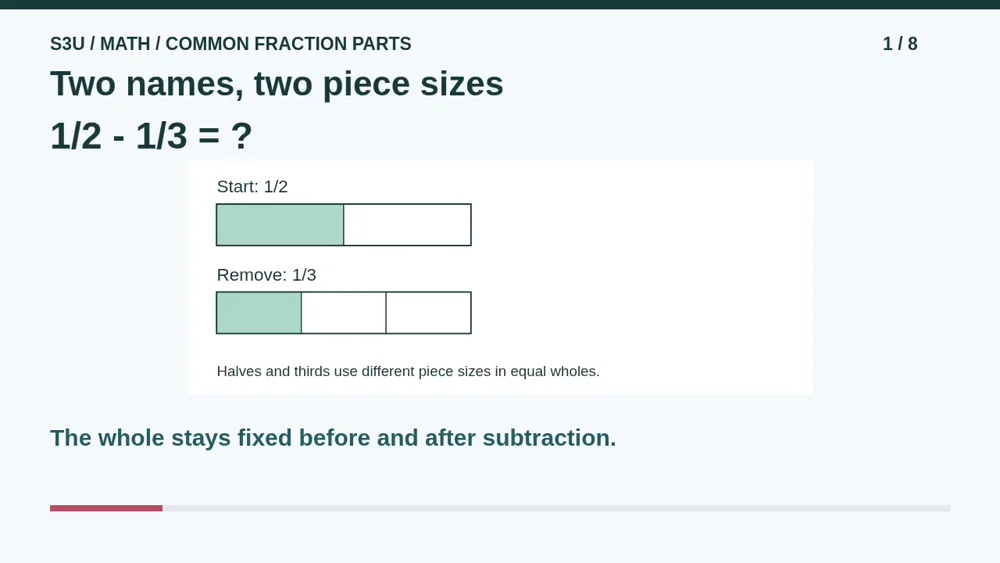
Start with one half of a paper strip and remove one third of that same whole strip. What remains? A half-piece is larger than a third-piece. We cannot subtract their piece counts until the pieces use a shared size. The two measurements must refer to the same-sized whole. Our paper shop has strict ruler rules, but thankfully no paperwork about the rulers.
2. Rename before subtracting
Video: 0:28
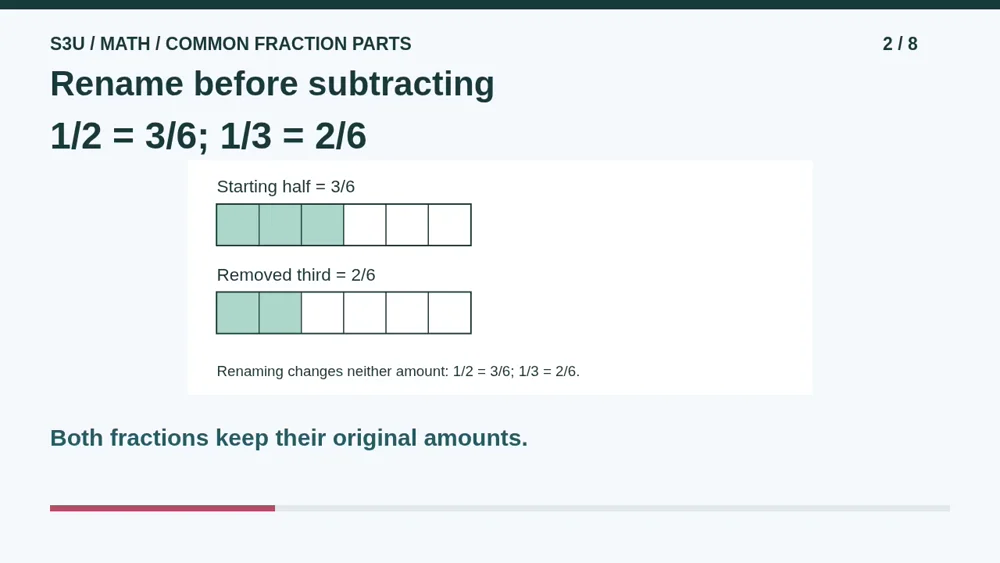
Use sixths. Split each half into three equal pieces, making three sixths. Split each third into two equal pieces, making two sixths. The whole strip has six equal parts in both cases. We changed the names and the piece size, but not the amounts. Writing one half as one sixth would change the amount and would not be a valid renaming.
3. One sixth stays
Video: 0:55
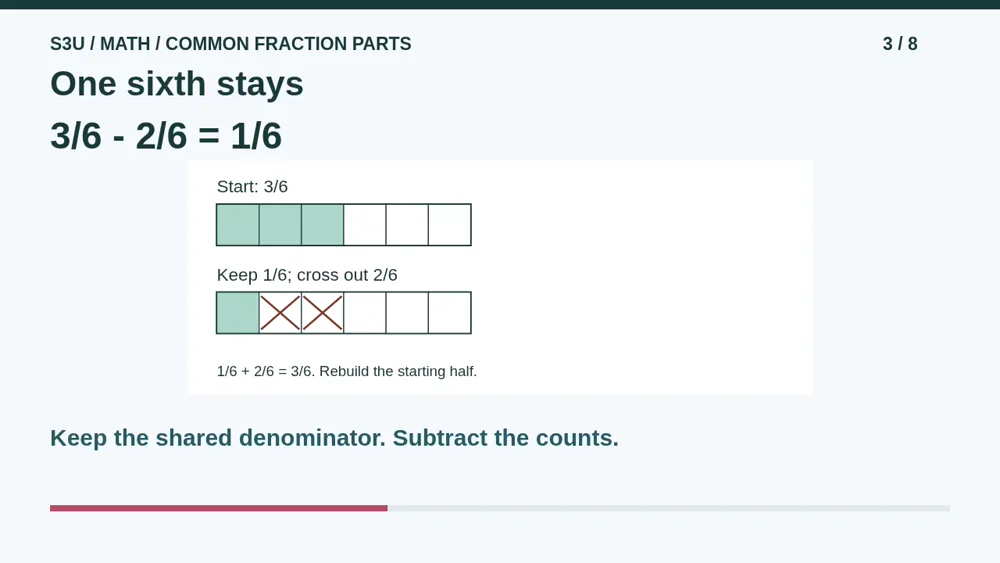
Three sixths started in our order. Two sixths leave, so one sixth stays. The denominator remains six because every part is still one sixth of the same whole. Check by adding: one sixth plus two sixths equals three sixths, which is our starting half. Subtracting the original top and bottom numbers would not give a correct piece-size calculation.
4. A remainder can pass one
Video: 1:22
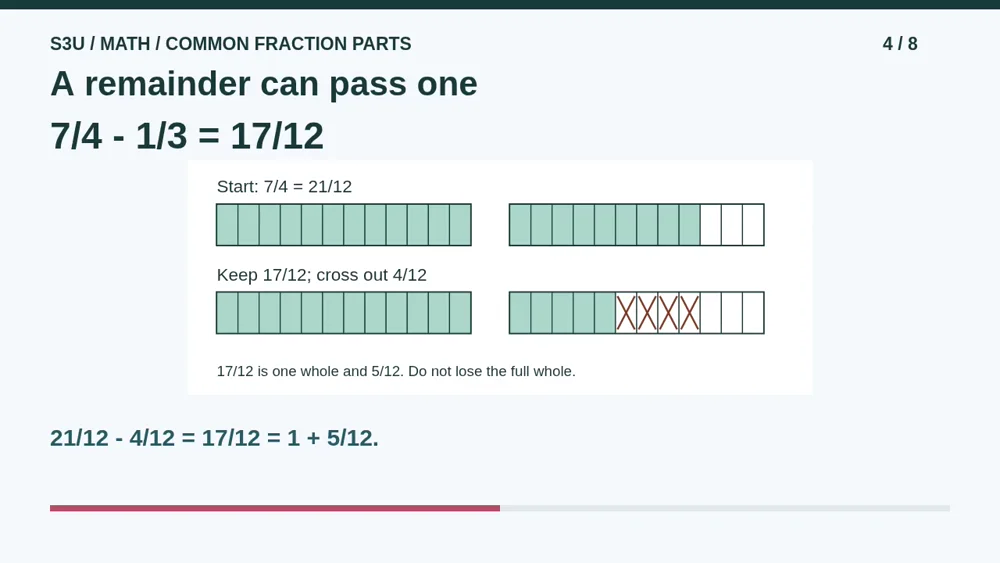
Try seven fourths minus one third. One whole is four fourths, so seven fourths fills a whole and three more fourths. Rename all seven fourths as twenty-one twelfths, not just the leftover fourths. One third is four twelfths. Twenty-one minus four is seventeen. Seventeen twelfths is one whole and five twelfths. The full whole stays part of our answer.
5. Pause: unload a new amount
Video: 1:50
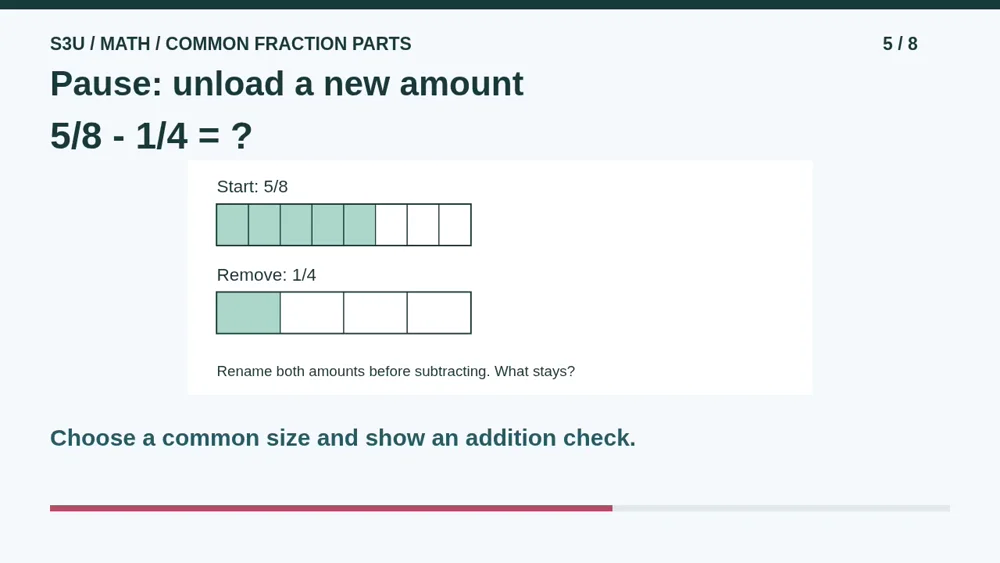
Here is your new order: five eighths minus one fourth. Pause the video. Rename both fractions with a common denominator, then subtract their counts. Check the result by adding the removed one fourth back. You can sketch matching whole strips, speak your reasoning, or write the calculation. The picture gives the two starting measurements, not the answer.
6. Check with eighths
Video: 2:17
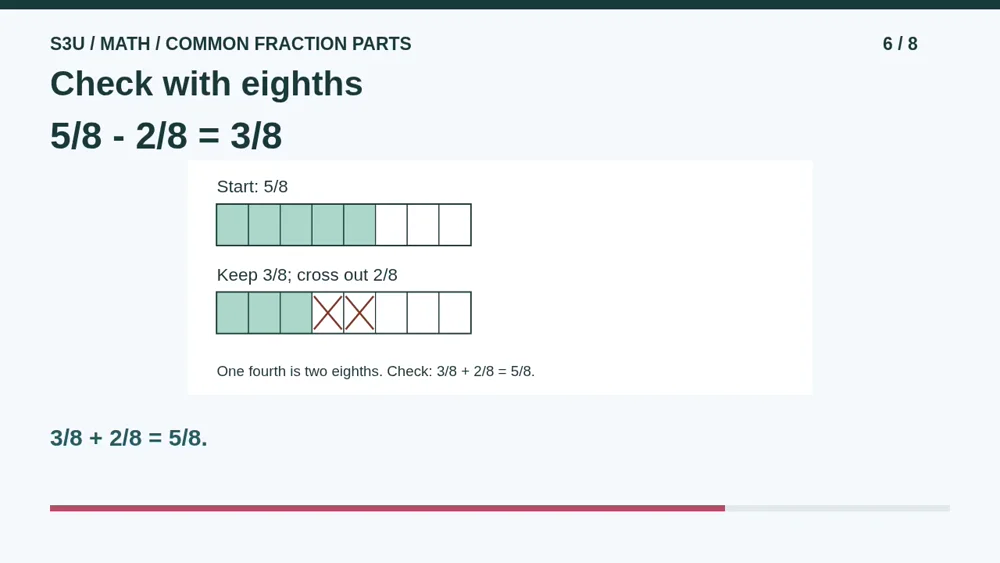
One fourth is two eighths. Five eighths minus two eighths leaves three eighths. Three eighths plus two eighths rebuilds five eighths, so the addition check agrees. If you used sixteenths, ten sixteenths minus four sixteenths gives six sixteenths, which is also three eighths. More pieces can name the same amount when each piece is smaller.
7. Check a different common size
Video: 2:42
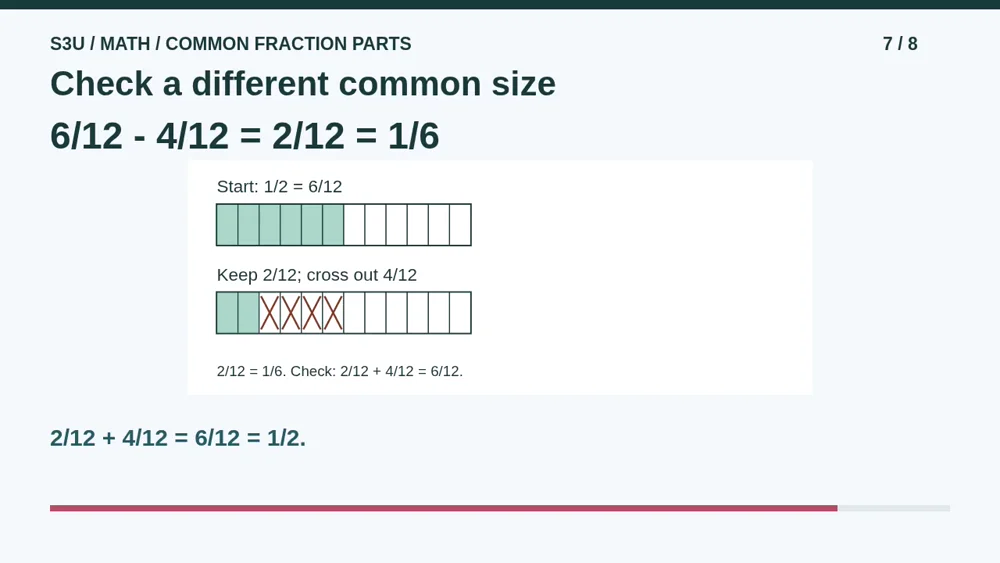
Fun fact: addition can check subtraction even when you choose a different common denominator. For our first order, one half minus one third, use twelfths instead of sixths. Six twelfths minus four twelfths leaves two twelfths, or one sixth. Two twelfths plus four twelfths rebuilds six twelfths, our starting half. The shortest method is handy, but it is not the only correct method.
8. Continue to the worksheet
Video: 3:11
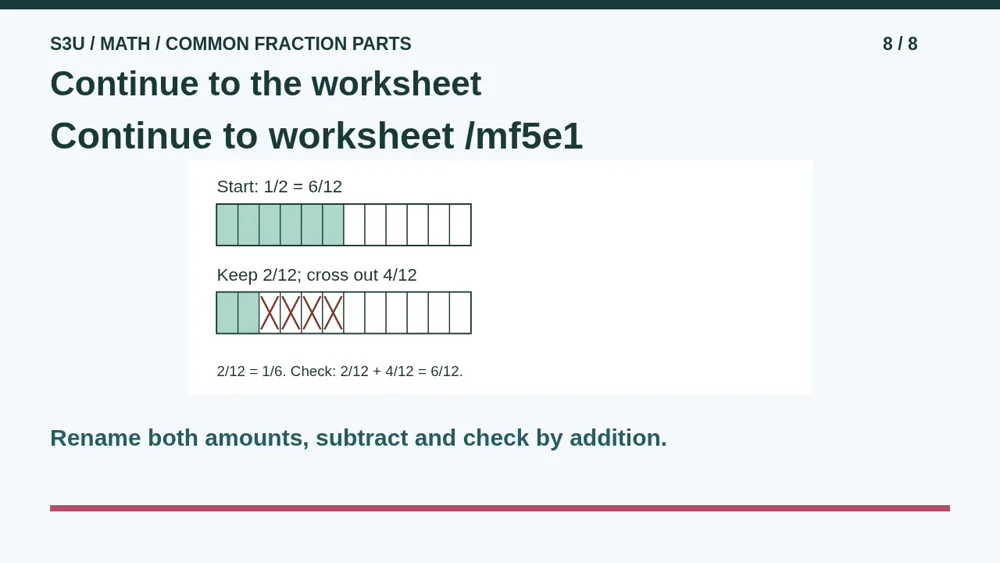
Continue to the worksheet below. Its questions use fresh amounts, including a whole that needs to be renamed and a remainder above one. Choose common parts, preserve both amounts, and subtract only the counts. Then rebuild the start by addition. Try the alternate sheet or the Unloading route in Fraction Dock afterward. Watching, practicing, and explaining your own answer are different steps.
Show your understanding
You can point, explain aloud, draw or write.
- Rename unlike fractions into common-sized parts without changing either amount, then subtract their counts.
- Check the remainder by addition and explain why another valid common denominator gives an equivalent answer.
Try it yourself
Pause at five eighths minus one fourth. Rename the fourth in eighths before subtracting, then check by addition.
Continue to the worksheet with its own amounts, then try Practice 2 or choose Unloading at Fraction Dock.
Next: your worksheet
Subtract With Common Fraction Parts - Practice 1https://s3u.com/mf5e1
Try Fraction Dock: choose Unloading
Lesson: https://s3u.com/lessons/subtract-common-parts