Math / Grade 8
Slope is a ratio of changes
Learning goal: Use signed coordinate differences to find slope, explain the sign and distinguish zero from undefined.
Before you start: Locate ordered pairs and subtract and divide signed numbers. Read x as the horizontal coordinate and y as the vertical coordinate.
Read or print this lesson What to practiceThe video could not load. The transcript is still available below.
Next: your worksheet
Calculate Rise per Run - Practice 1
Checking sign-in...
Read the transcript
Saved reading place
Video transcript and practice. Reading or printing does not count as playback time or an assessed grade.
1. Slope compares two changes
Video: 0:00
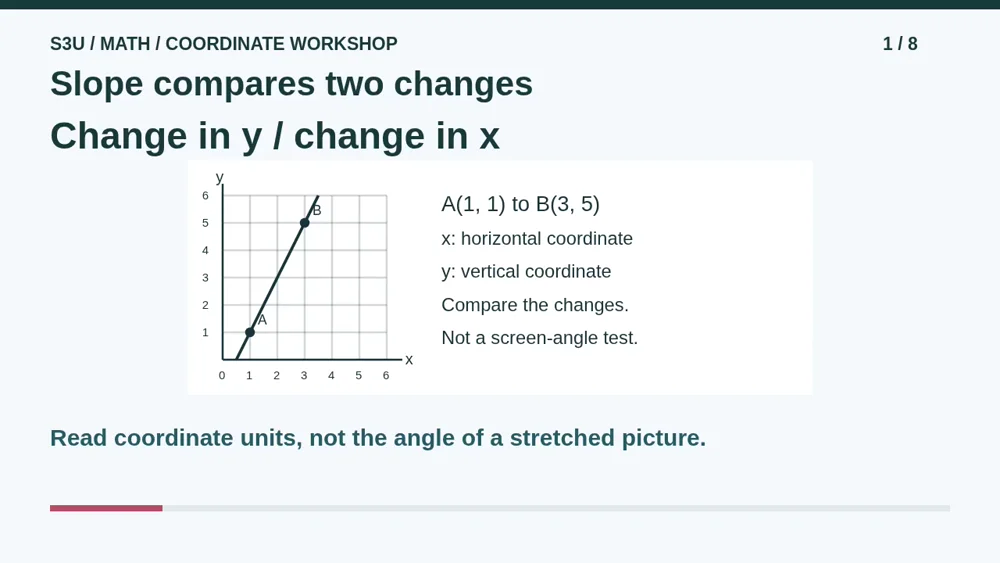
A line can rise, fall, or stay level as you move to the right. Slope describes how much y changes for each unit of change in x. We compare two different points on a straight line. The coordinate values matter more than the picture's apparent steepness. Stretching a screenshot does not change its labeled coordinates. A screenshot is not allowed to rewrite the mathematics.
2. Trace the run, then the rise
Video: 0:28
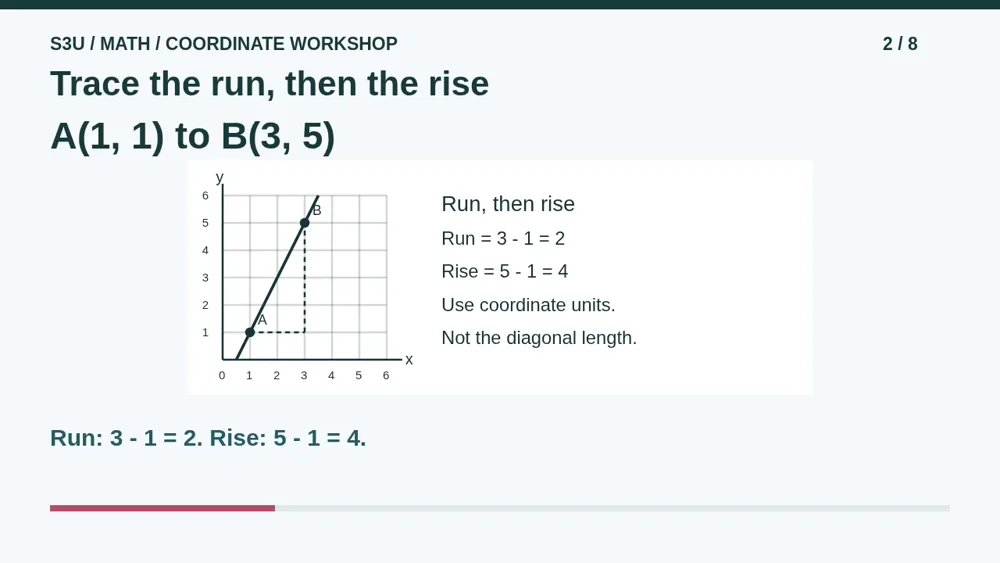
Start at point A, one across and one up. Point B is three across and five up. Moving from A to B, x changes by three minus one, which is two. That is the run. The change in y is five minus one, which is four. That is the rise. The dashed steps help us count coordinate changes; their combined length is not the slope.
3. Divide rise by run
Video: 0:55
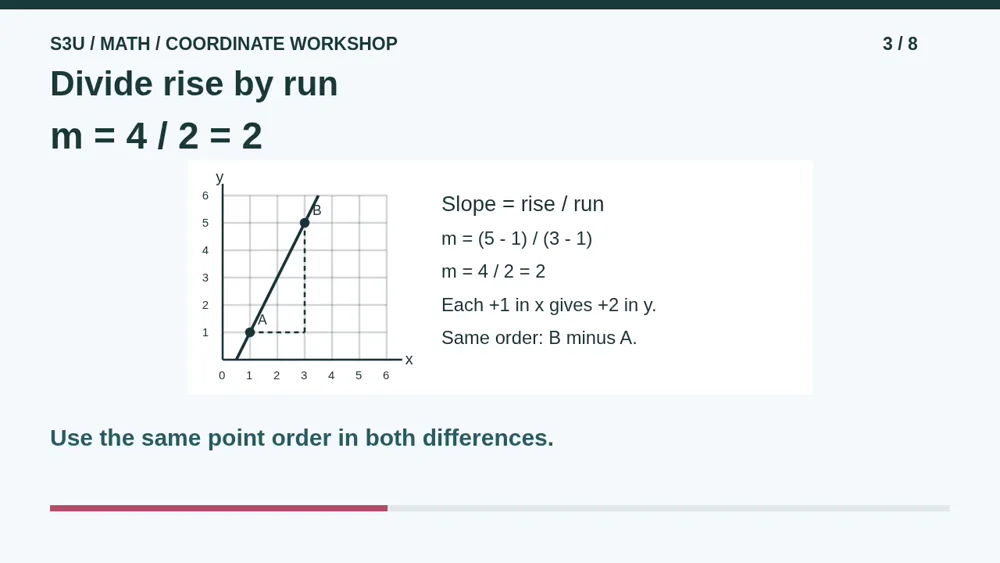
Divide the change in y by the change in x: four divided by two equals two. We use the letter m for slope. For each increase of one in x on this line, y increases by two. Do not add rise and run or reverse just the fraction. Keep the point order consistent: B minus A for y, and B minus A for x.
4. Reverse both differences, not just one
Video: 1:21
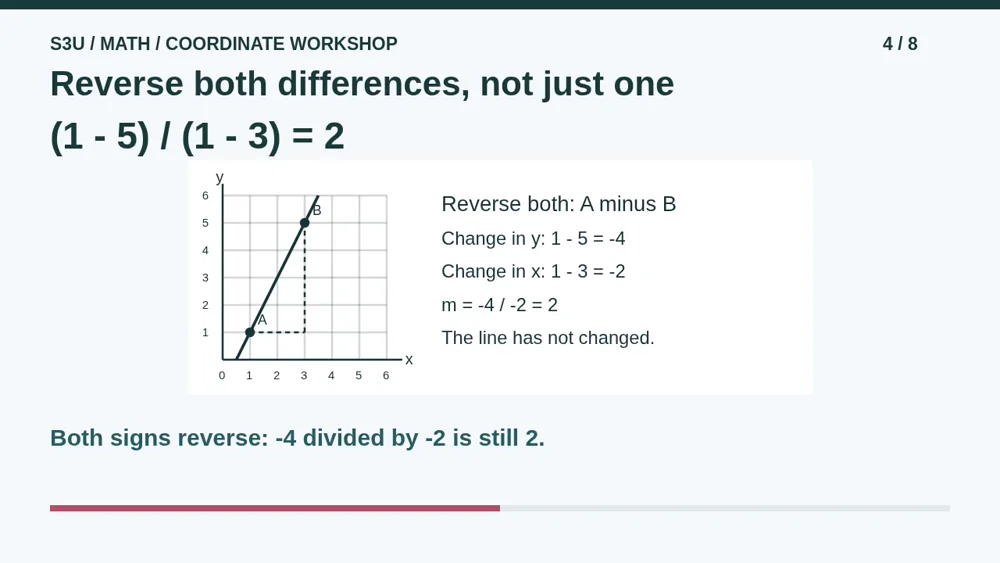
What happens if we travel from B back to A? Now the change in y is one minus five, negative four. The change in x is one minus three, negative two. Negative four divided by negative two is still two. The line has not changed. Reversing only one difference would give the wrong sign. Choose either direction, but use that direction in both differences.
5. Pause: a line that falls to the right
Video: 1:50
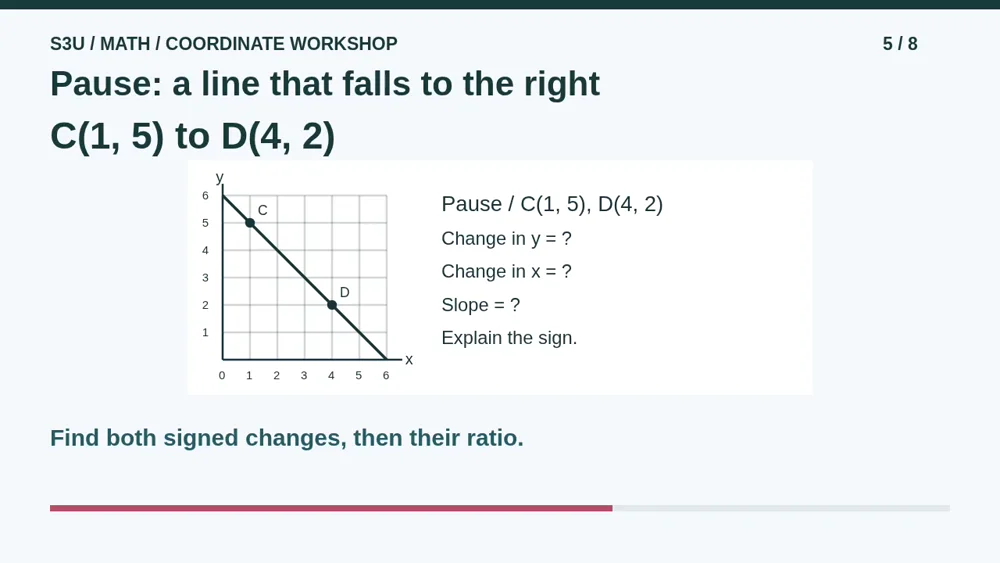
Pause for a fresh pair of points. C is one, five. D is four, two. Moving from C to D, what are the signed changes in x and y? Divide the change in y by the change in x, then explain whether the sign matches a line that falls as x increases. Use the labels, not a ruler on the screen. A downward change in y is negative.
6. A negative slope matches the fall
Video: 2:18
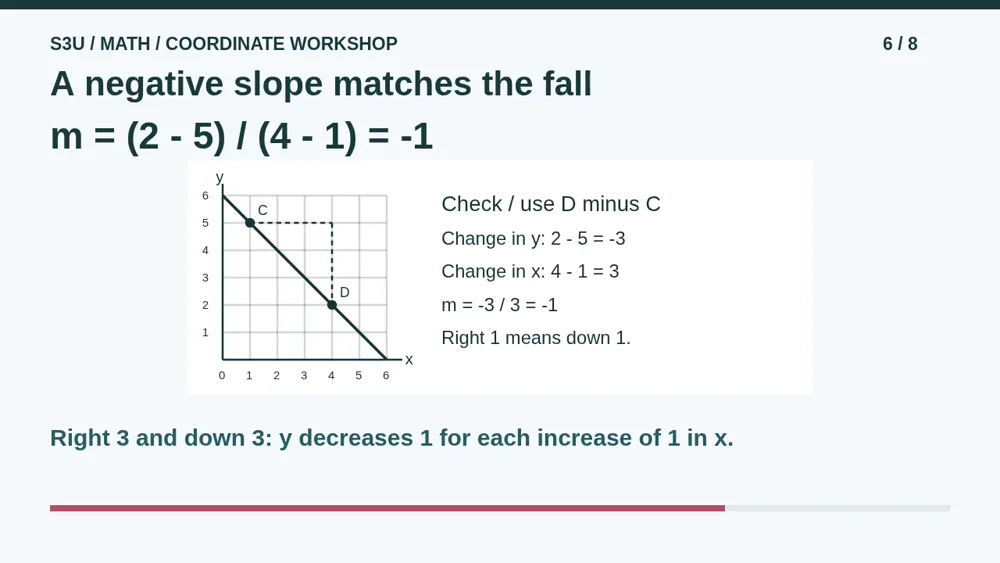
The change in x is four minus one, positive three. The change in y is two minus five, negative three. Negative three divided by positive three is negative one. For each increase of one in x, y decreases by one. That agrees with the downward direction to the right. A negative slope is not a mistake or a negative distance; it describes a signed rate of change.
7. Flat and vertical are different
Video: 2:48
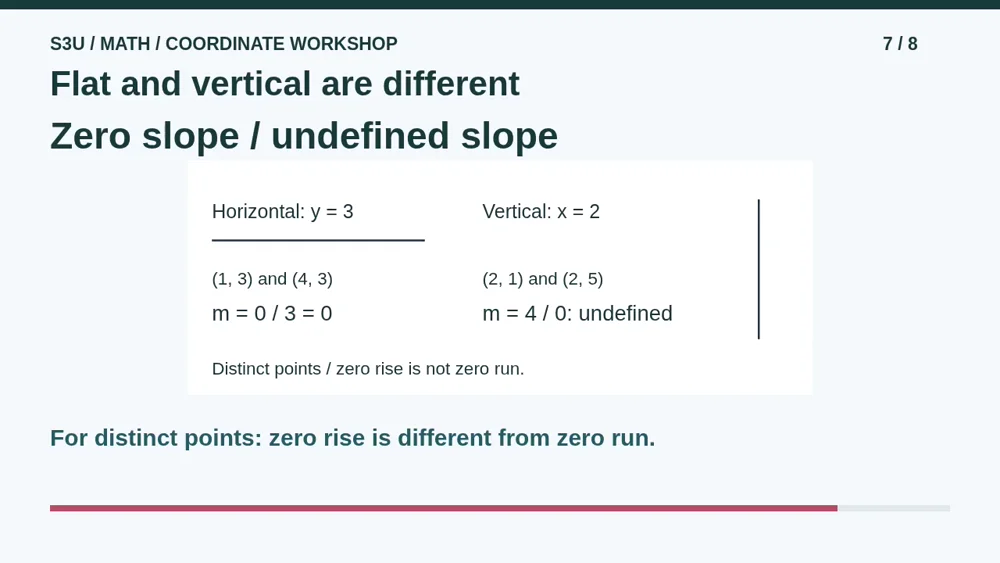
Fun fact: a horizontal line has slope zero, but a vertical line does not have a defined slope in this form. Our horizontal points have change in y equal to zero and change in x equal to three: zero divided by three is zero. Our vertical points have change in x equal to zero. Dividing by zero is undefined, not zero. The two cases must not share an answer.
8. Continue to the slope worksheet
Video: 3:18
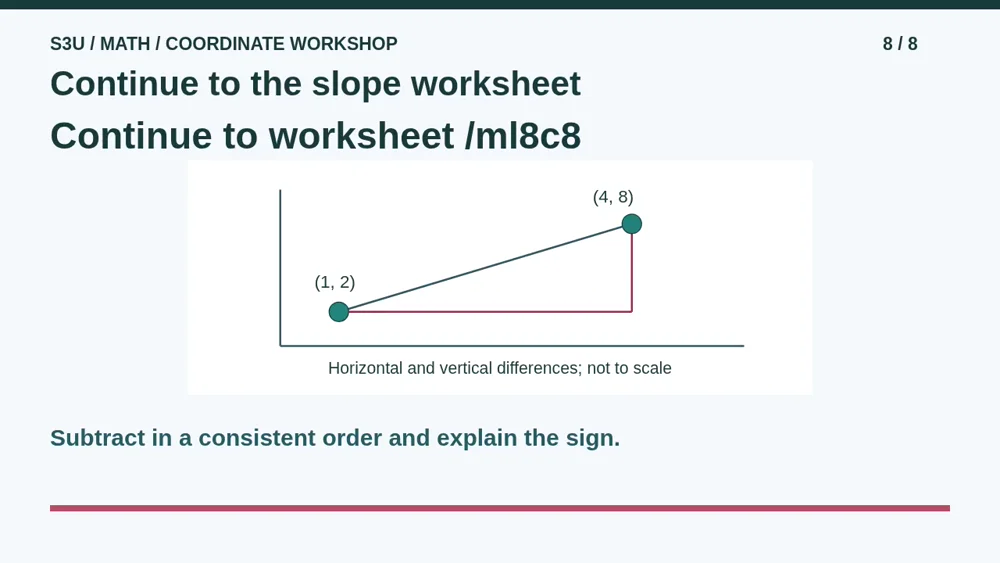
Continue to the worksheet below. Write the two coordinate differences in the same point order before dividing. Check the sign against how y changes as x increases. Practice Two gives another set of lines. A straight line keeps the same slope between distinct points, except that vertical slope is undefined. A curve can have different rates in different places, which belongs to a later lesson.
Show your understanding
You can point, explain aloud, draw or write.
- Calculate slope from two distinct points using the same subtraction order and explain its sign.
- Distinguish a horizontal line with zero slope from a vertical line with undefined slope using the denominator.
Try it yourself
Pause at C(1, 5) and D(4, 2). Find signed y and x changes in the same order, then explain the slope.
Continue to the slope worksheet and Practice Two. Use coordinate values rather than the apparent angle of a picture.
Next: your worksheet
Calculate Rise per Run - Practice 1https://s3u.com/ml8c8
Lesson: https://s3u.com/lessons/slope-is-change