Math / Grade 7
Divide signed numbers with missing factors
Learning goal: Use multiplication to explain signed quotients, distinguish a count from a change per step, and explain why a zero divisor is undefined.
Before you start: Multiply signed integers and distinguish a signed change from a count of equal steps. Review Why Signs Multiply if needed.
Read or print this lesson What to practiceThe video could not load. The transcript is still available below.
Next: your worksheet
Signed Division: Find the Missing Factor
Checking sign-in...
Read the transcript
Saved reading place
Video transcript and practice. Reading or printing does not count as playback time or an assessed grade.
1. Division asks for a missing factor
Video: 0:00
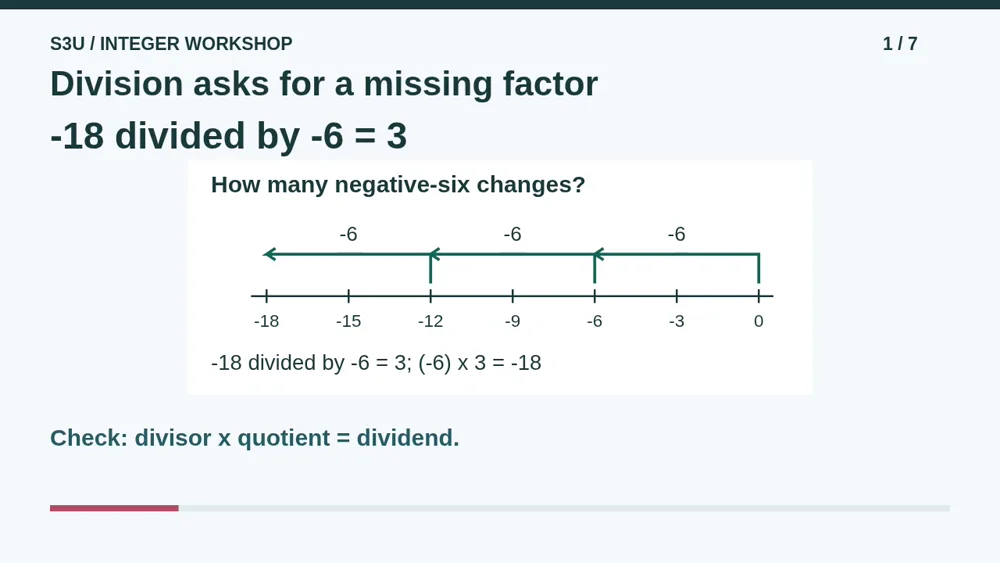
Our imaginary delivery lift moves down six levels each time. Three equal changes take it from zero to negative eighteen. How many negative-six changes made that total? Negative eighteen divided by negative six is three, because negative six times three is negative eighteen. Division asks for a missing multiplication factor. The first number is the dividend, the number we divide by is the divisor, and the result is the quotient. Check by multiplying the divisor by the quotient to recover the dividend. The lift has lost its instruction sheet, but multiplication can reconstruct the missing instruction without pressing any real buttons.
2. Same total, a different question
Video: 0:48
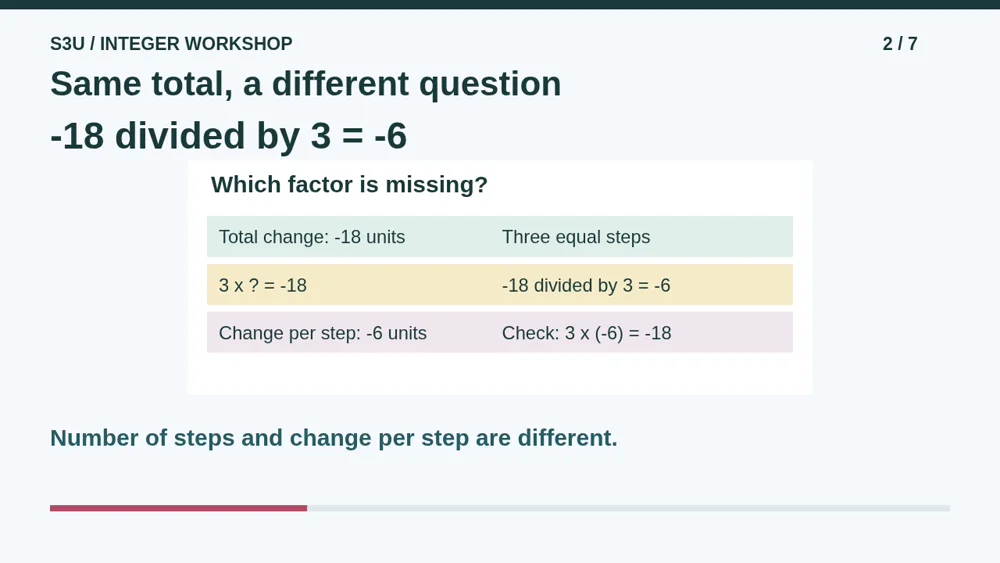
Keep the total change at negative eighteen. This time we know there were three equal steps and ask for the change in each step. Negative eighteen divided by three is negative six: three copies of negative six make the total. In the first question, we knew the signed change per step and found a positive count of steps. In this question, we knew the count and found a negative change per step. Negative six describes direction, not a negative number of instructions. Say what each number represents. A correct calculation with the wrong label would send our imaginary delivery to a very confused floor.
3. Use multiplication to choose the sign
Video: 1:33
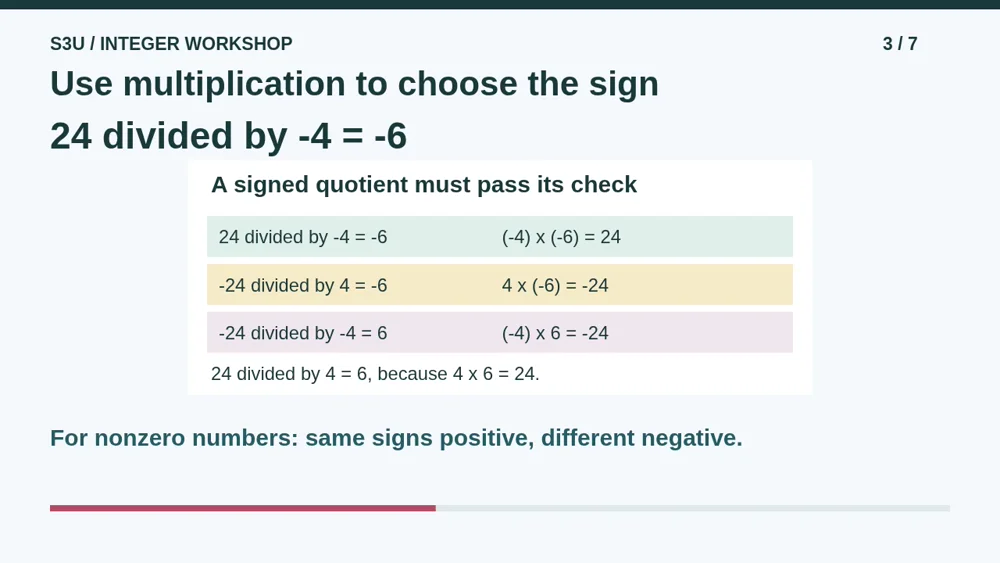
What happens when the dividend is positive and the divisor is negative? For twenty-four divided by negative four, ask which number times negative four gives positive twenty-four. It must be negative six, because two negative factors have a positive product. The diagram checks the other sign combinations too. With two nonzero numbers, matching signs give a positive quotient and different signs give a negative quotient. Find the size using ordinary division, then check the sign with multiplication. This is the same multiplication relationship used in the previous lesson, not a new rule about every pair of minus signs in every operation.
4. Zero needs its own check
Video: 2:21
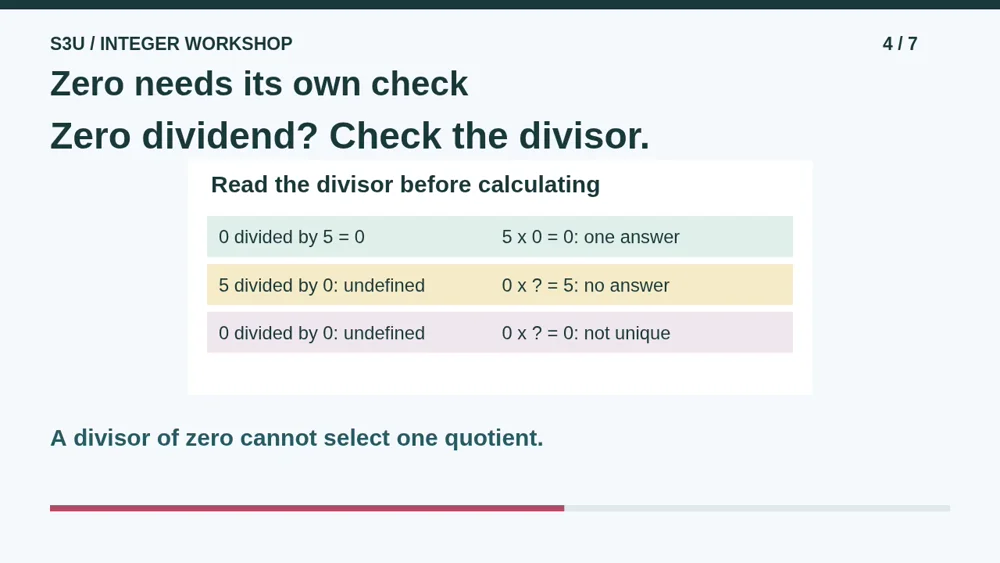
Zero divided by five is zero, because five times zero is zero. Reversing the order changes the question completely. Five divided by zero would need a number that makes zero times that number equal five. No number can do that. What about zero divided by zero? Now every number passes the multiplication check, so there is no single quotient to choose. It is undefined too, not a special way to get zero or one. In ordinary number arithmetic we do not divide by zero. Read the divisor first, and keep this case separate from the sign rule for nonzero numbers.
5. Pause: solve, label, and explain
Video: 3:06
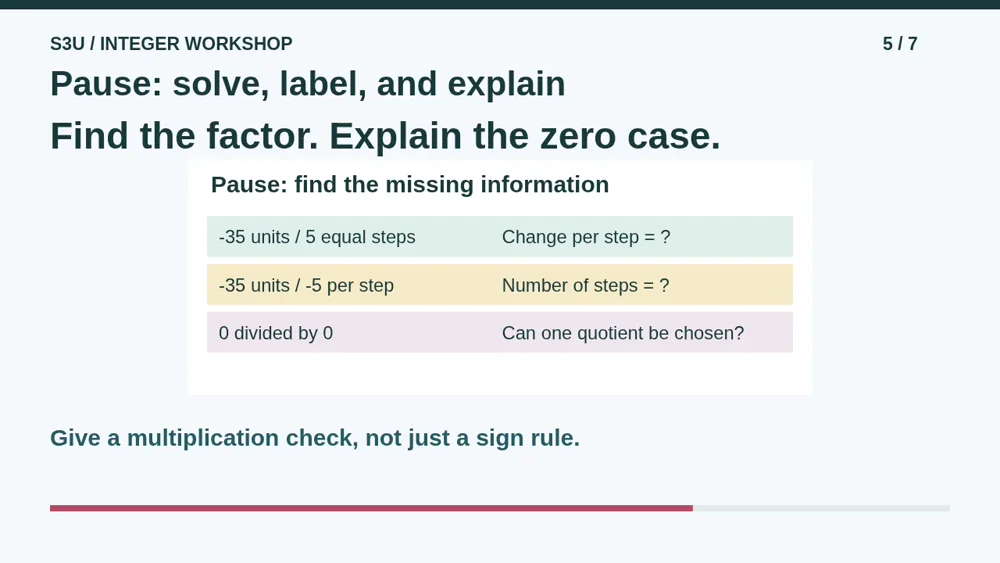
Pause and try three fresh questions. A model position changes by negative thirty-five units over five equal steps. Find the signed change per step and check your result by multiplication. Next, that same total is made in equal changes of negative five units. Find the number of steps, remembering to label what you counted. Finally, decide whether zero divided by zero has a defined quotient, and explain why the multiplication check does not select just one result. Write your reasoning before continuing. You can return to a worked example if you need support, then try these new numbers in your own words.
6. Check the meaning as well as the sign
Video: 3:53
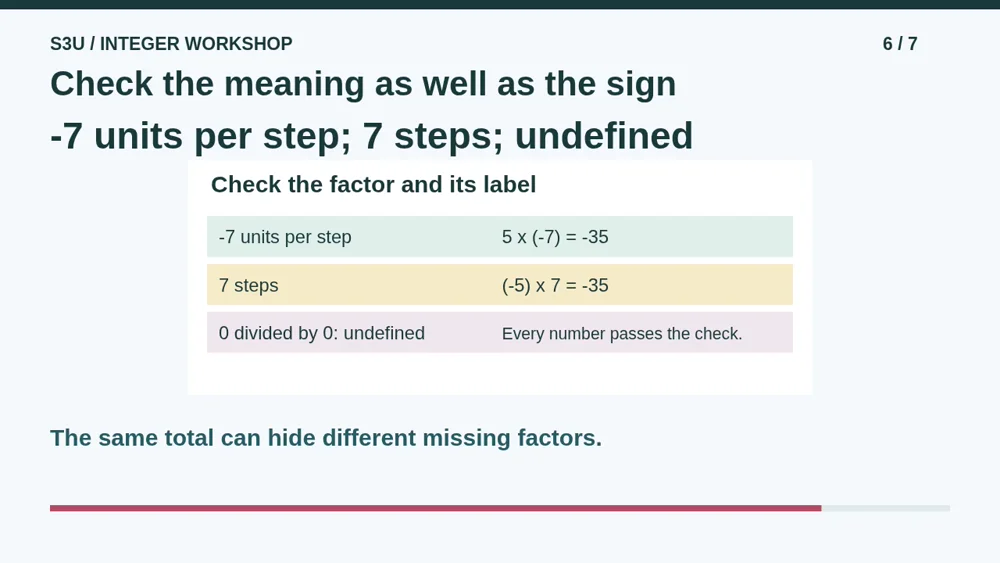
Negative thirty-five divided by five is negative seven units per step. Check that five times negative seven is negative thirty-five. Negative thirty-five divided by negative five is seven steps, since negative five times seven gives negative thirty-five. One answer is a signed change and the other is a count: their labels matter as much as their signs. Zero divided by zero is undefined because every number multiplied by zero gives zero. That does not single out one quotient. If you chose a different answer, inspect your multiplication check and the divisor before trying another problem. A corrected explanation is useful learning, not wasted work.
7. A tiny divisor fact and fresh practice
Video: 4:44
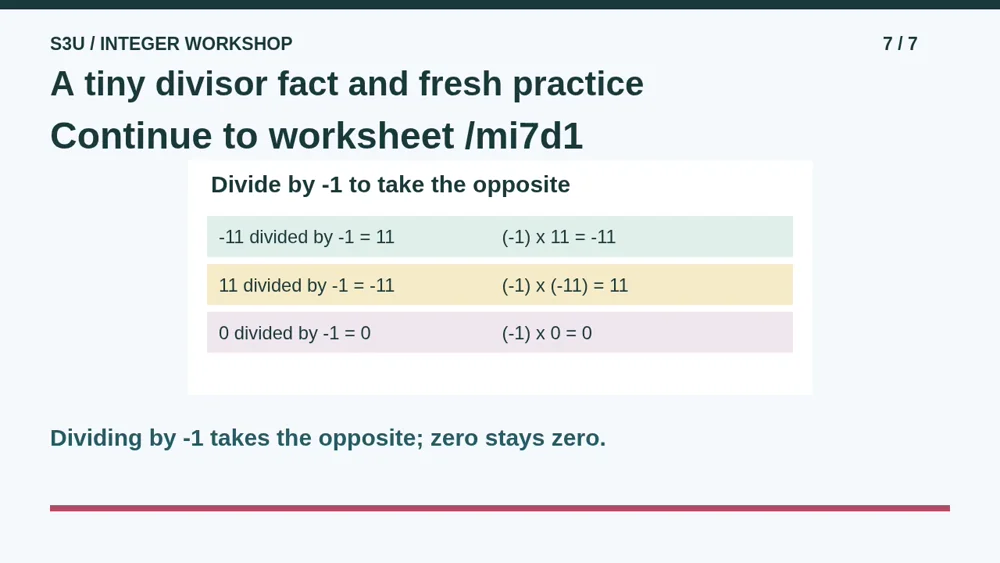
Fun fact: dividing any number by negative one gives its opposite, just as multiplying by negative one does. Negative eleven divided by negative one is eleven: negative one times eleven returns negative eleven. Eleven divided by negative one is negative eleven. Zero divided by negative one is zero, because the divisor is not zero. Continue to the first worksheet, then try the second form for new questions. Explain a missing factor, label the units in a model, and check a zero case. These examples have integer quotients; other integer divisions can give fractions. Watching is preparation. The fresh practice is your chance to explain the method independently.
Show your understanding
You can point, explain aloud, draw or write.
- Find and explain a signed quotient using a missing multiplication factor, with a label for its meaning.
- Distinguish zero divided by a nonzero number from division by zero, including why 0 divided by 0 is undefined.
Try it yourself
Pause: find the change per step for a total of -35 in five steps, then the number of steps for a total of -35 in changes of -5. Explain why 0 divided by 0 is undefined.
Continue to both practice forms. Label each quotient and check it with multiplication. Read the divisor before deciding a zero case.
Next: your worksheet
Signed Division: Find the Missing Factorhttps://s3u.com/mi7d1
Lesson: https://s3u.com/lessons/signed-division