Math / Grade 5
Share to find the mean
Learning goal: Model equal sharing, include zero and repeated values, and explain why different lists can have the same mean.
Before you start: Add whole-number counts, recognize zero and divide a total into equal groups. Use the supplied tray models; no equipment is needed.
Read or print this lesson What to practiceThe video could not load. The transcript is still available below.
Next: your worksheet
Find the Mean of Four Counts - Practice 1
Checking sign-in...
Read the transcript
Saved reading place
Video transcript and practice. Reading or printing does not count as playback time or an assessed grade.
1. Four trays, different amounts
Video: 0:00
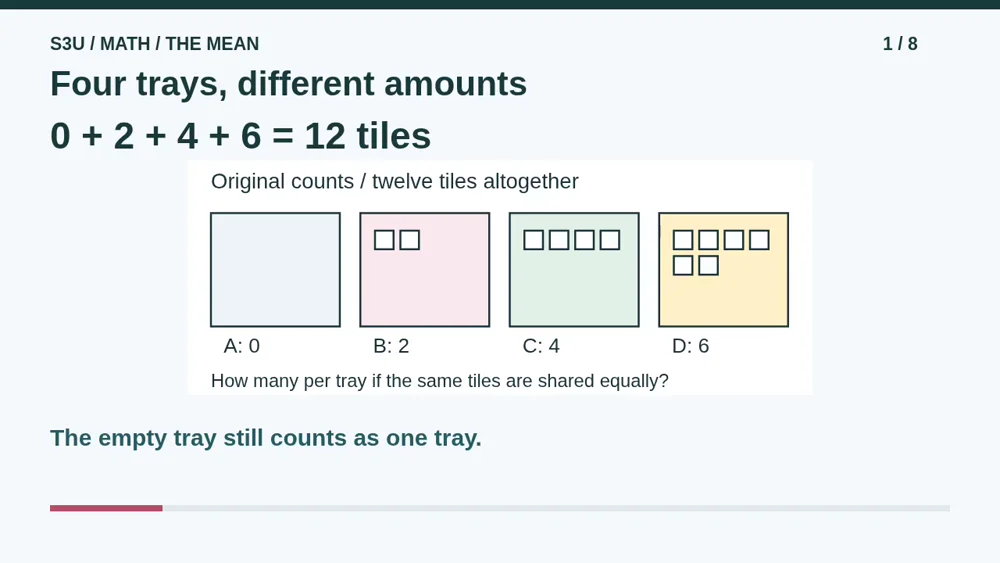
Four trays hold square tiles. Tray A has zero, tray B has two, tray C has four, and tray D has six. That makes twelve tiles altogether. Imagine sharing those same tiles equally among all four trays. How many would each tray get? This equal-share number is called the mean. The empty tray counts too. It has not become invisible just because it forgot to bring tiles.
2. Share without changing the total
Video: 0:31
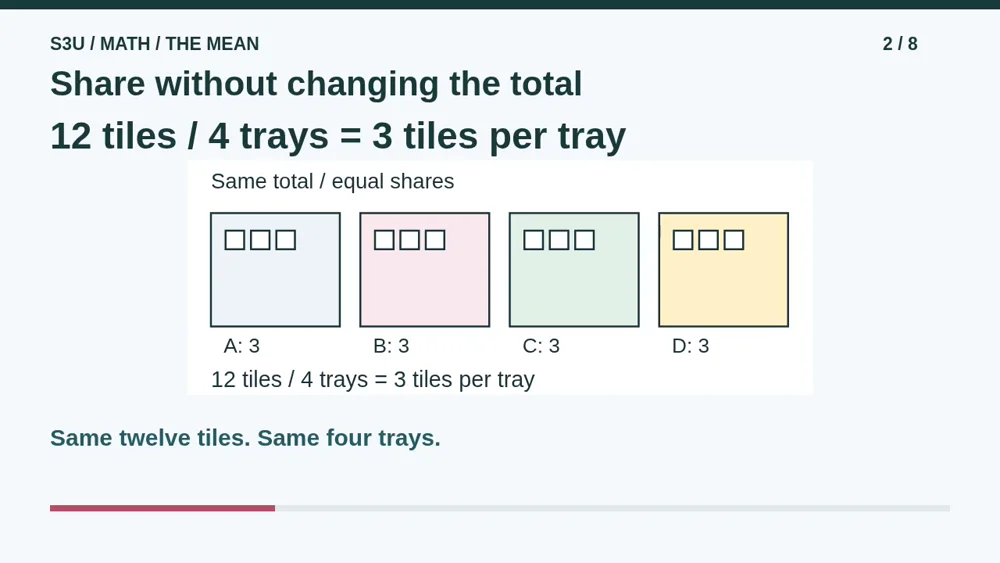
Move three tiles from tray D to tray A. Then move one from tray C to tray B. Now each tray holds three tiles. We did not add tiles or lose any under the table. Twelve shared equally among four is three. The mean is three tiles per tray. The picture has changed, but the total and the number of trays have stayed the same.
3. Use the equal-share calculation
Video: 0:57
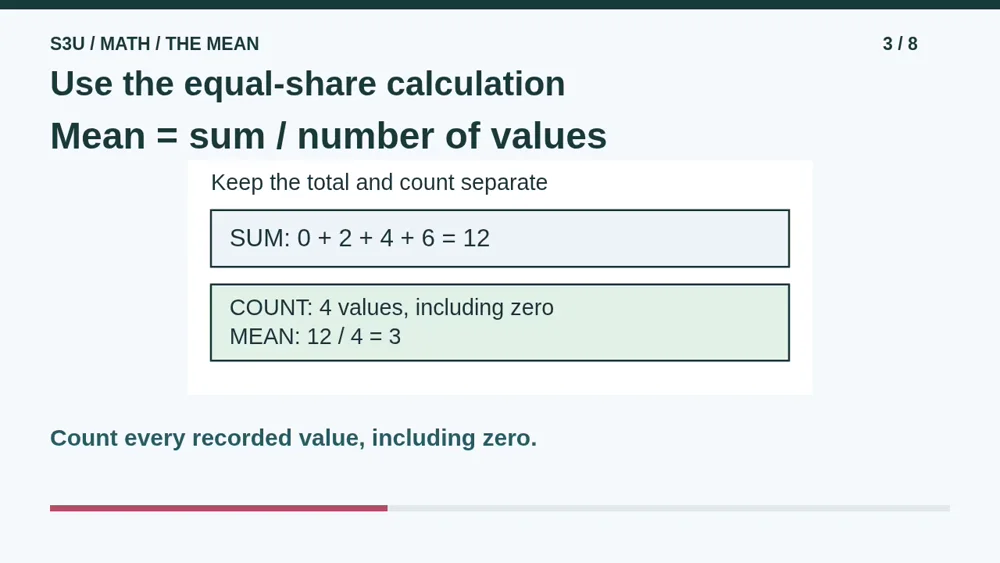
We can find the mean without moving real tiles. First add every value: zero plus two plus four plus six equals twelve. Next count the values. There are four, including zero. Divide twelve by four to get three. Dividing by three instead would leave out the empty tray. Our original counts were zero, two, four, and six. None was three. A mean does not have to appear in the original list.
4. Repeated values still count
Video: 1:30
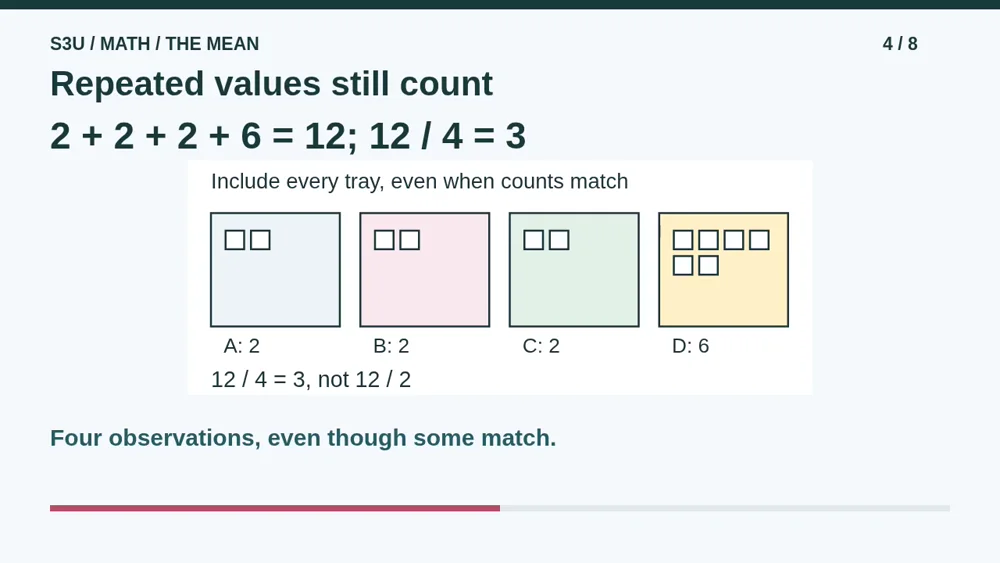
Here is a different set of four tray counts: two, two, two, and six. All three twos belong in the sum. Each describes a different tray. The total is twelve, and there are still four values, so the mean is three. Do not divide by two just because only two different numbers appear. We count observations, not how many different numbers we can collect.
5. Pause: a new set of trays
Video: 1:57
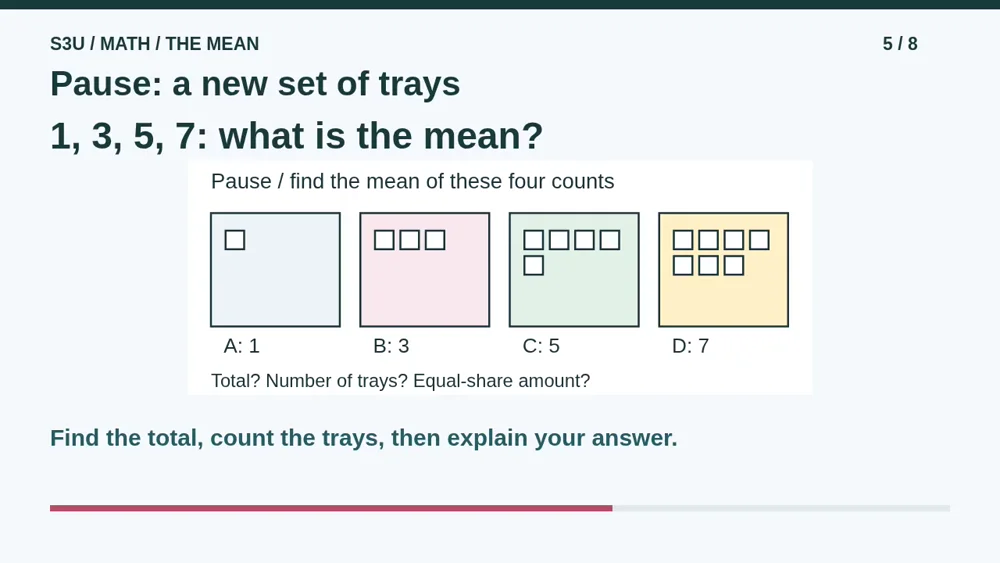
Try a new set. Four trays hold one, three, five, and seven tiles. Pause the video. Find their total and the number of trays, then calculate the mean. Explain how you could rearrange the tiles to give every tray that amount. You can speak, draw, or write your explanation. Keep all the original tiles and all four trays. No secret fifth tray may sneak into the calculation.
6. Check by sharing and multiplying
Video: 2:29
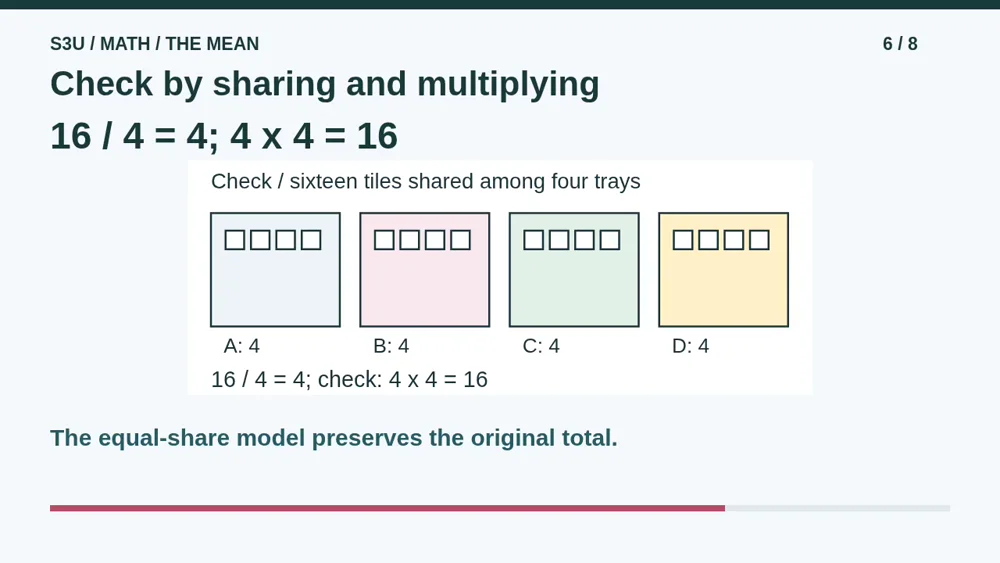
One plus three plus five plus seven equals sixteen. Divide by four trays to get a mean of four tiles per tray. Move three from the seven-tile tray to the one-tile tray, and one from the five-tile tray to the three-tile tray. All four now hold four. Check by multiplying four trays by four tiles: sixteen tiles. That agrees with the original total.
7. The same mean can hide differences
Video: 2:57
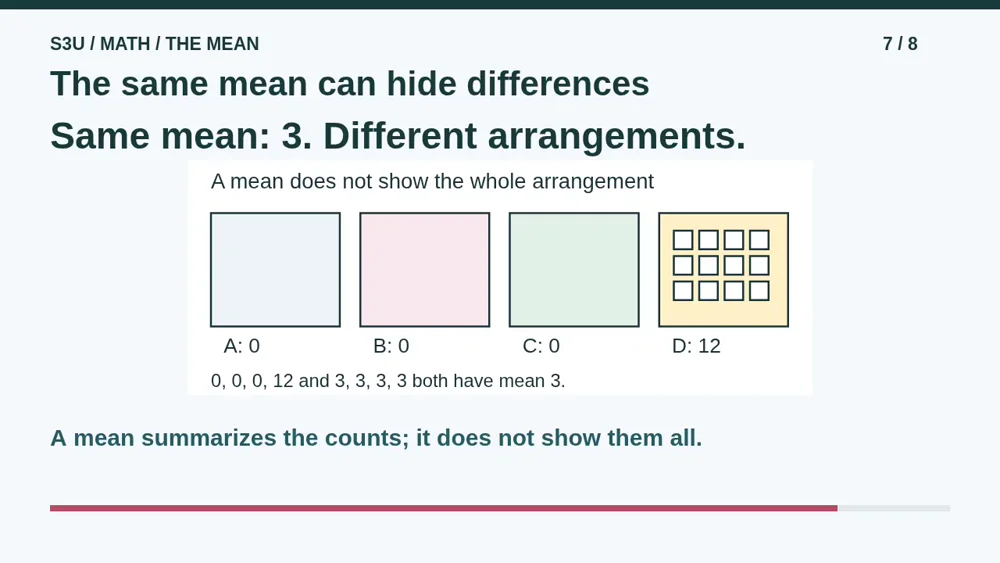
Fun fact: very different lists can have the same mean. Four trays with three tiles each have a mean of three. Trays with zero, zero, zero, and twelve tiles also have a mean of three. Both lists total twelve across four trays, but their starting arrangements are quite different. A mean summarizes the list. It does not tell us that every original tray had the same amount.
8. Continue to the worksheet
Video: 3:26
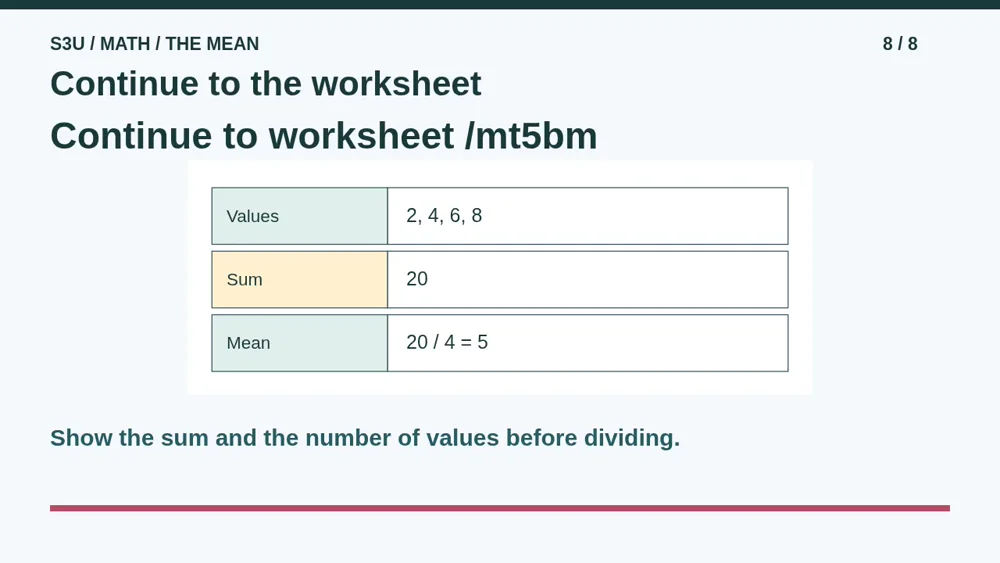
Continue to the worksheet below. Each question gives four new counts. Add them, divide by four, and explain the answer as an equal-share value. The worksheet model uses two, four, six, and eight, not our first tray counts. Practice Two has more examples. You can work on screen or print the pages. Check that your mean times the number of values gives the original total.
Show your understanding
You can point, explain aloud, draw or write.
- Calculate the mean using every observation, including zero and repeated values, and check that equal sharing preserves the total.
- Explain why the mean need not be an observed value and why lists with the same mean can have different arrangements.
Try it yourself
Pause at counts 1, 3, 5 and 7. Find the mean and explain a rearrangement that keeps all sixteen tiles and all four trays.
Continue to the worksheet and Practice Two. Show the total and number of values, then check your mean by multiplication.
Next: your worksheet
Find the Mean of Four Counts - Practice 1https://s3u.com/mt5bm
Lesson: https://s3u.com/lessons/share-to-find-the-mean