Math / Grade 5
Take a fraction of a load
Learning goal: Use an equal-area model to take a fraction of a starting amount, keep the original whole fixed, and compare smaller, unchanged and larger loads.
Before you start: Name equivalent fractions, multiply whole numbers and recognize equal rows and columns in a rectangle.
Read or print this lesson What to practiceThe video could not load. The transcript is still available below.
Next: your worksheet
Scale Fraction Loads - Practice 1
Checking sign-in...
Read the transcript
Saved reading place
Video transcript and practice. Reading or printing does not count as playback time or an assessed grade.
1. A part of a ribbon load
Video: 0:00
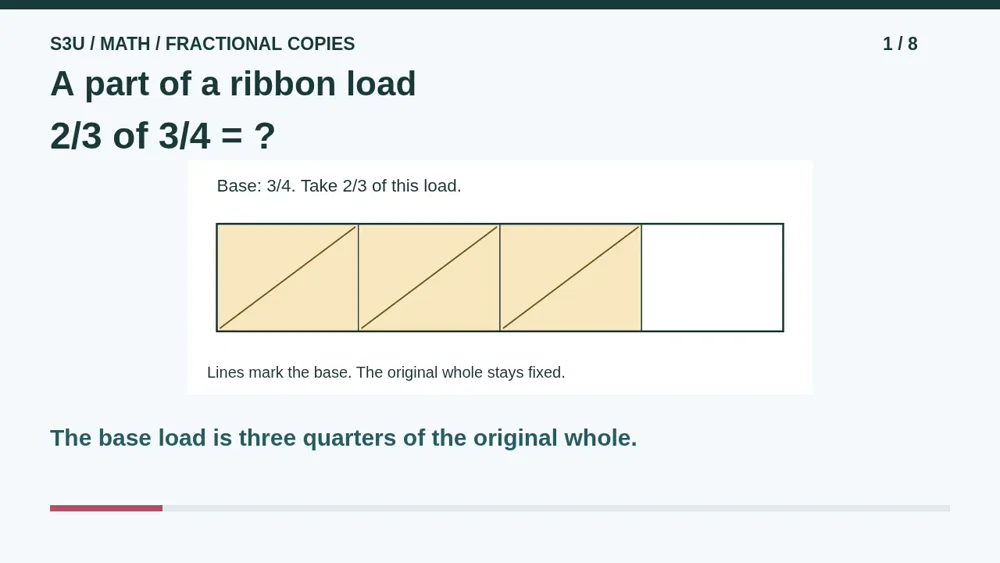
Start with a ribbon load that fills three quarters of one whole strip. Now take two thirds of that load. The word of means multiplication here. We are not adding two thirds to three quarters. We want part of the three-quarter load. Our original whole stays fixed, even though the amount we select will be smaller.
2. Split the load into equal shares
Video: 0:24
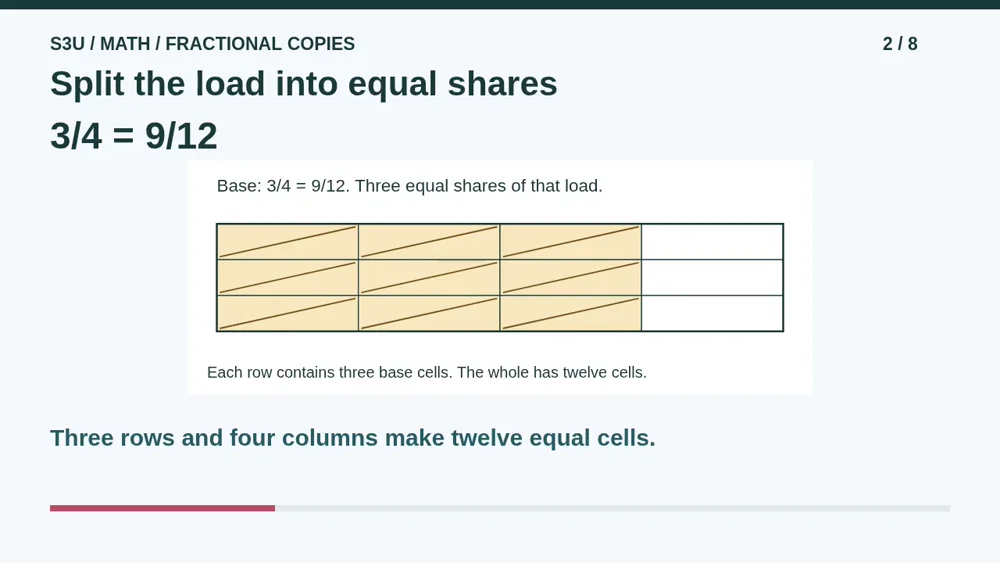
Keep three of four columns as the base load. Split every column into three equal rows. One whole now contains twelve equal cells, and the base load contains nine of them. Each row holds three base cells. We have made three equal shares of the load. Dividing the picture did not create more ribbon, which would be a very strange shop policy.
3. Select two of the three shares
Video: 0:51
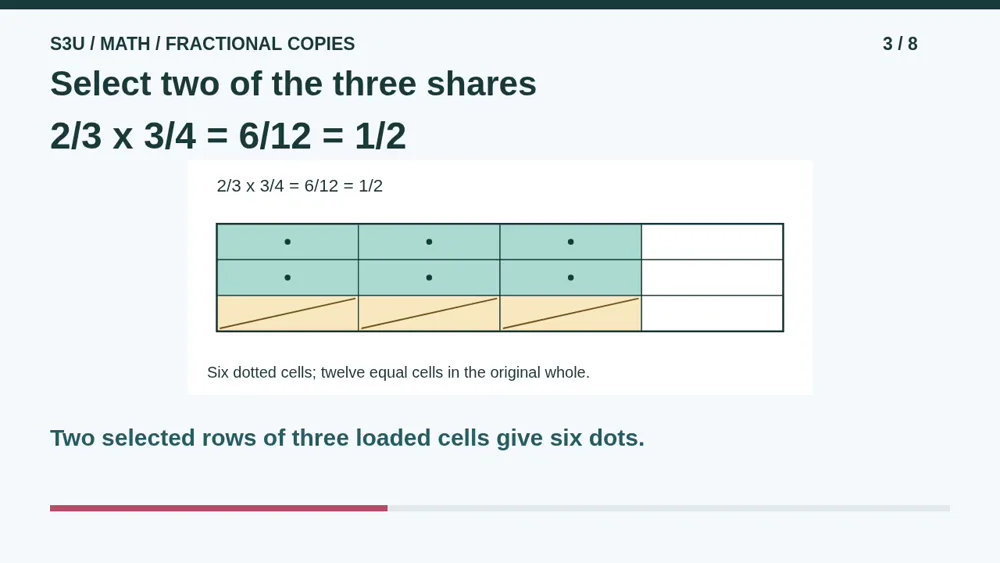
Select two rows from the base load. Two rows of three cells give six dotted cells. The whole has three rows times four columns, or twelve cells. Our result is six twelfths, which is one half. The numerator counts selected cells; the denominator counts cells in one original whole. This rows-and-columns count explains why we multiply the numerators and multiply the denominators.
4. More than one copy
Video: 1:21
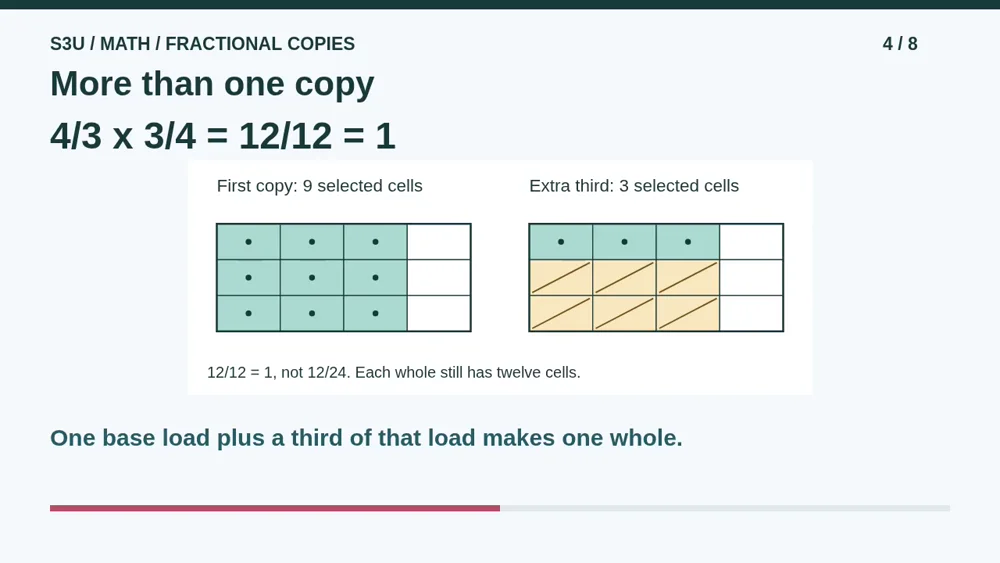
Now take four thirds of the same three-quarter load. That means one full copy and another third of a copy. Select all three rows in the first frame and one row in a second matching frame. Twelve cells are dotted altogether. Each whole still has twelve cells, so the result is one whole. It is larger than three quarters. Multiplication does not always make an amount smaller.
5. Pause: a new part of a load
Video: 1:51
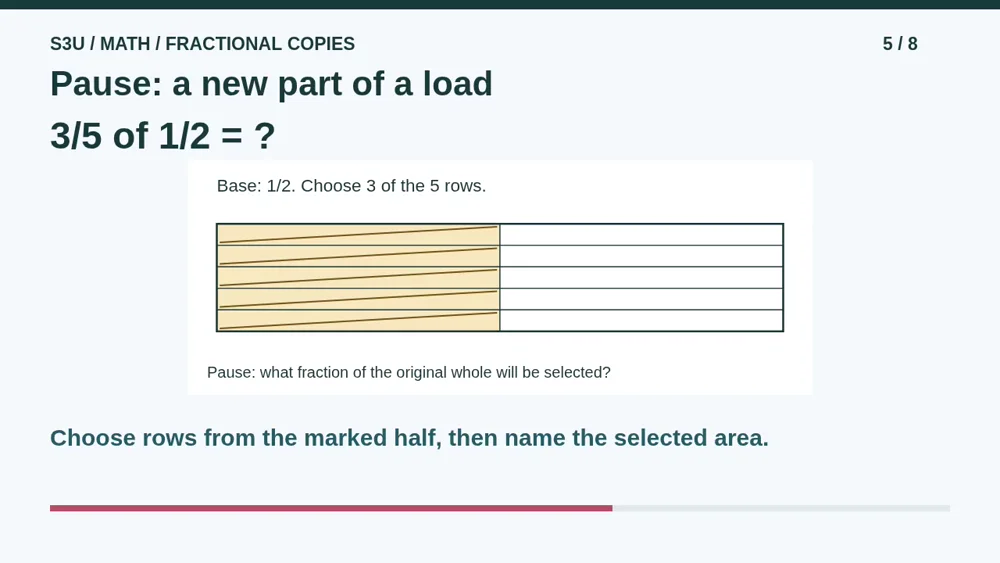
Here is a fresh order: three fifths of one half. The picture marks the half and splits the whole into five rows and two columns. Pause the video. How many rows of that half should you select? What fraction of the original whole will be dotted? Explain whether the result is smaller than the starting half. You may draw or describe the selection aloud.
6. Check the three dotted cells
Video: 2:18
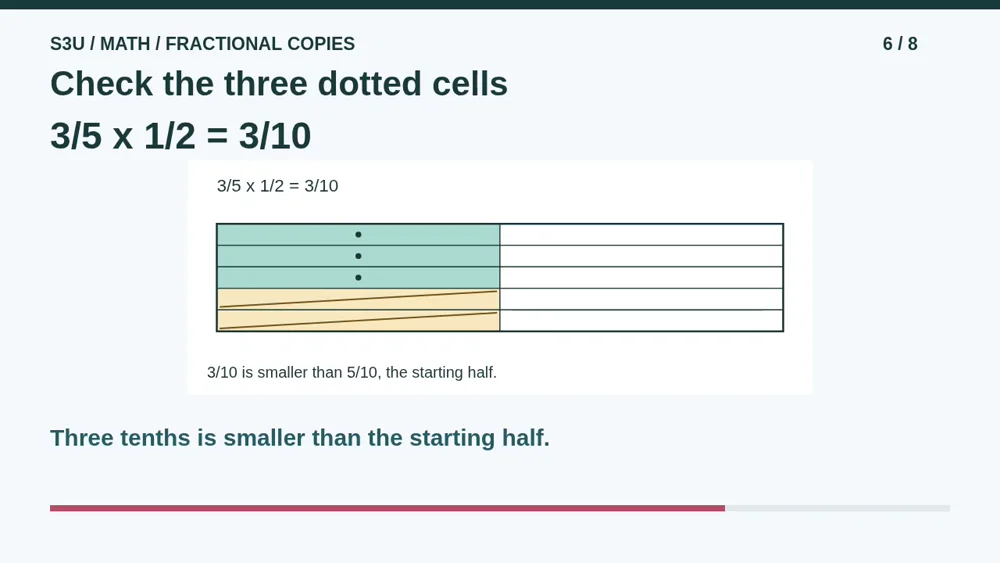
Select three of the five rows in the loaded half-column. That gives three dotted cells. Each whole contains five times two, or ten equal cells, so the result is three tenths. The starting half was five tenths, and three tenths is smaller. We took less than one full copy of a positive load. The denominator ten describes the original whole, not only the marked half.
7. Let the number of copies decide
Video: 2:47
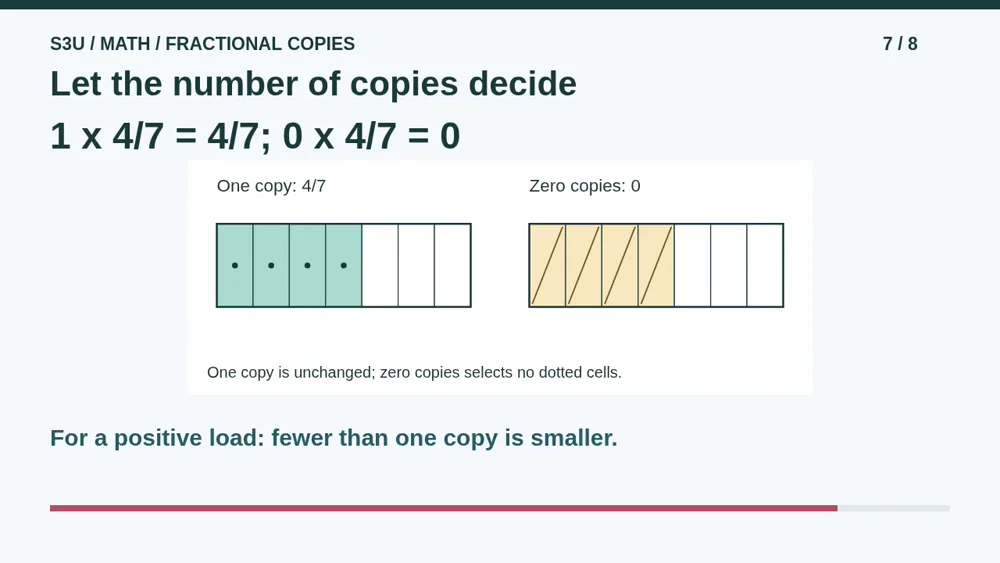
Fun fact: the multiplication sign alone does not tell you whether a positive amount grows. A multiplier between zero and one selects less than a full copy, so the result is smaller. One copy keeps the amount unchanged, as with four sevenths here. Zero copies selects nothing. A multiplier above one takes extra copies and makes a positive amount larger.
8. Continue to the worksheet
Video: 3:16
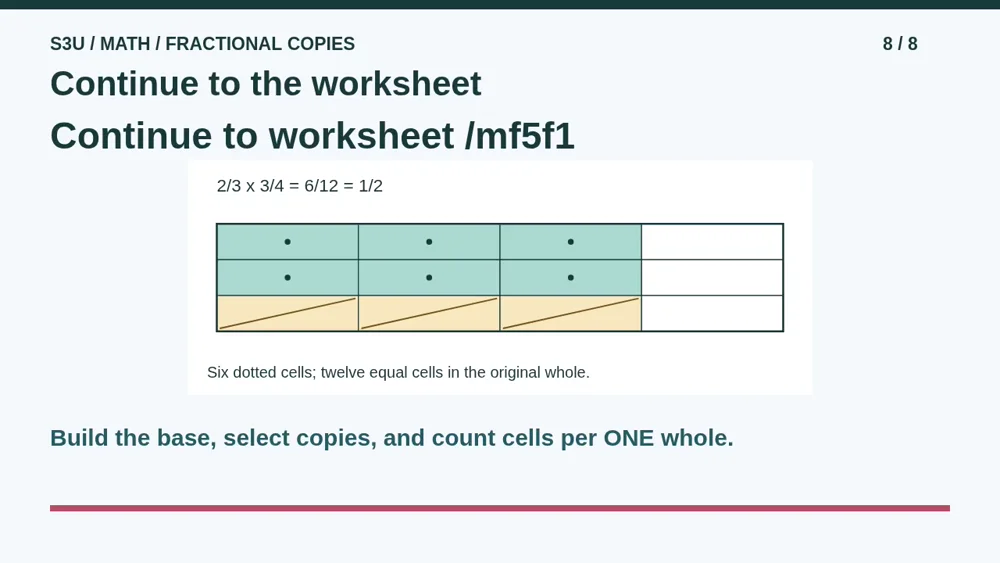
Continue to the worksheet below. Its fresh amounts include fractional copies, zero, one, and more than one. Build the base amount, select the requested copies, and keep the same whole when naming the product. Use the working space to explain your model. Practice Two and Fraction Dock Scaling offer more examples. Watching a video and explaining your own solution are different steps.
Show your understanding
You can point, explain aloud, draw or write.
- Use equal-area cells to find a fraction of a starting load relative to its original whole.
- Explain why a positive load becomes smaller, unchanged, zero or larger depending on the number of copies.
Try it yourself
Pause at three fifths of one half. Select the appropriate rows and name the result using the original whole.
Continue to the worksheet with fresh amounts, then try Practice 2 or choose Scaling at Fraction Dock.
Next: your worksheet
Scale Fraction Loads - Practice 1https://s3u.com/mf5f1
Try Fraction Dock: choose Scaling
Lesson: https://s3u.com/lessons/scale-fraction-loads