Math / Grade 6
Scale both quantities
Learning goal: Build equivalent ratios, distinguish scaling from adding, and use a total or a unit rate with clearly named quantities.
Before you start: Multiply and divide whole numbers, add two part counts and recognize a fraction. All tiles, packs and rates are invented paper examples.
Read or print this lesson What to practiceThe video could not load. The transcript is still available below.
Next: your worksheet
Build Equivalent Ratios and Unit Rates
Checking sign-in...
Read the transcript
Saved reading place
Video transcript and practice. Reading or printing does not count as playback time or an assessed grade.
1. Keep the pair together
Video: 0:00
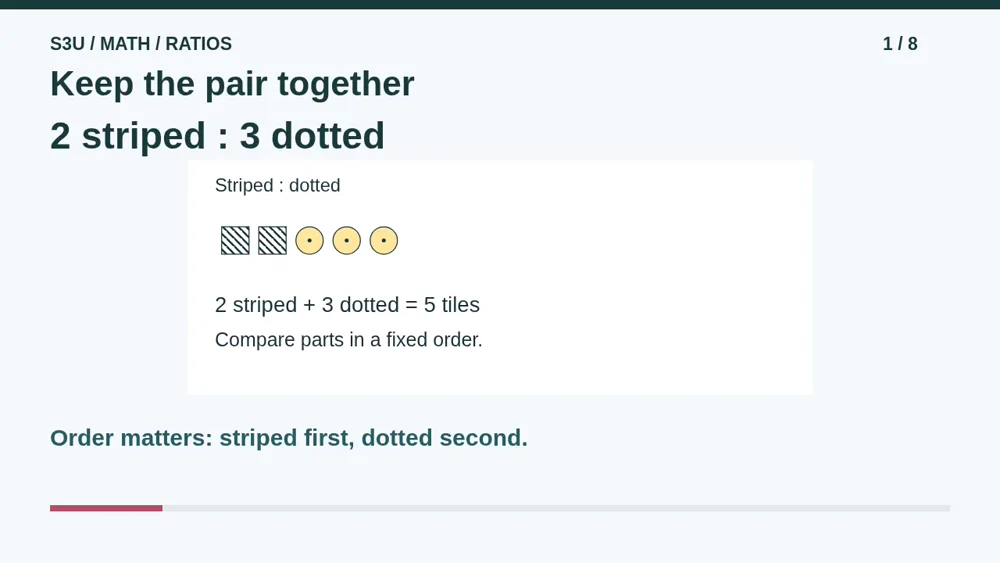
A pattern kit uses two striped tiles for every three dotted tiles. The ratio compares those two quantities in that order. It does not say there are only two tiles altogether. One complete group has five tiles. We will build larger groups with the same pattern, then find an amount for one pack. The stripes and dots are labels, so the pattern still works without color.
2. Scale both quantities
Video: 0:28
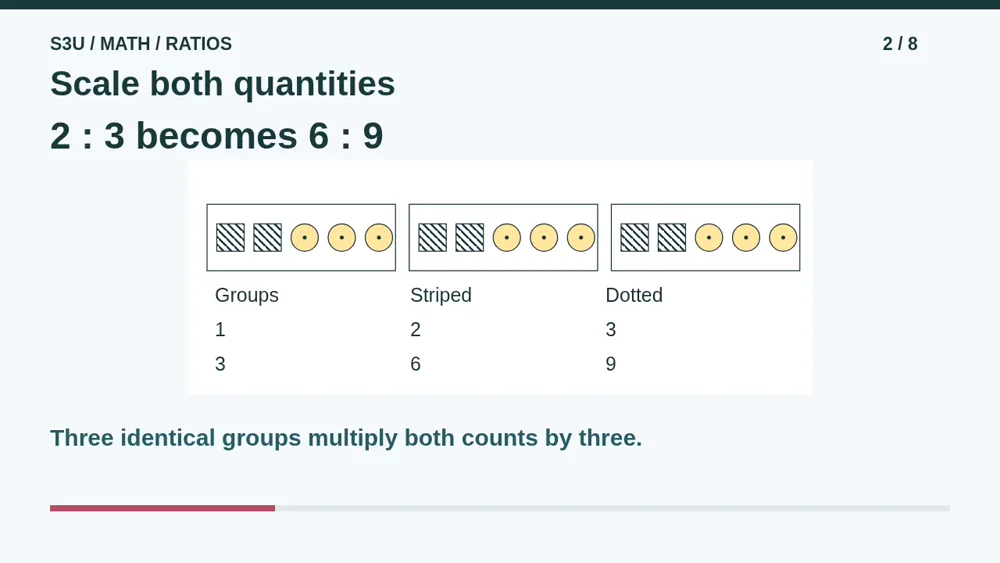
Make three copies of the whole group. Each copy contributes two striped tiles and three dotted tiles. Three times two is six, and three times three is nine. Six striped to nine dotted keeps the original ratio. In the table, every row multiplies both starting counts by the same positive number. Scaling only one count would change the pattern, even if the other tiles politely stayed in line.
3. Adding the same amount is different
Video: 0:59
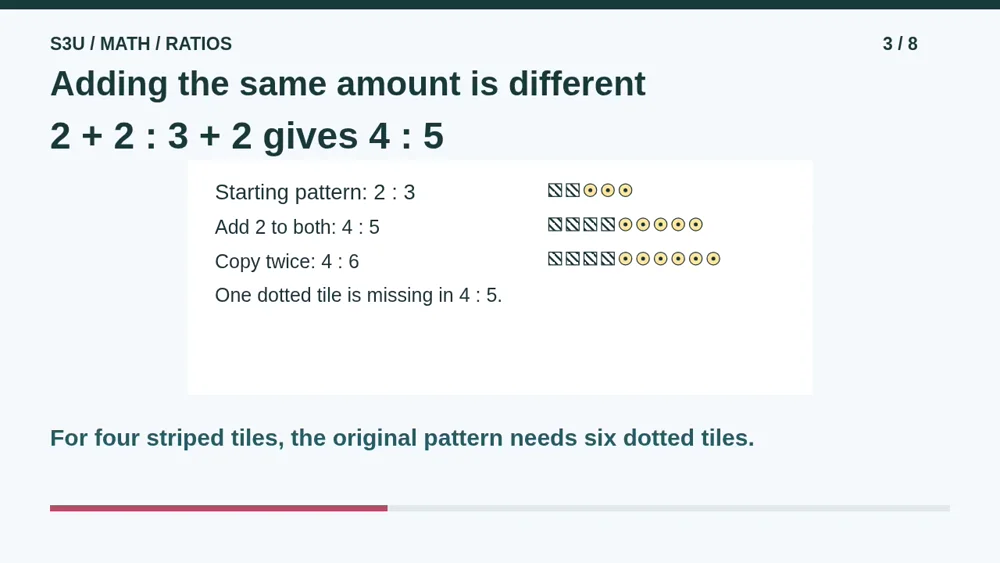
Suppose we add two to each count instead. Two plus two gives four striped tiles, but three plus two gives five dotted tiles. Four to five is not the same ratio as two to three. Four striped tiles require two complete groups, so they need six dotted tiles. Adding the same number to both parts does not generally preserve a ratio. Compare copies of the whole group, not just the size of an addition.
4. A rate for one pack
Video: 1:30
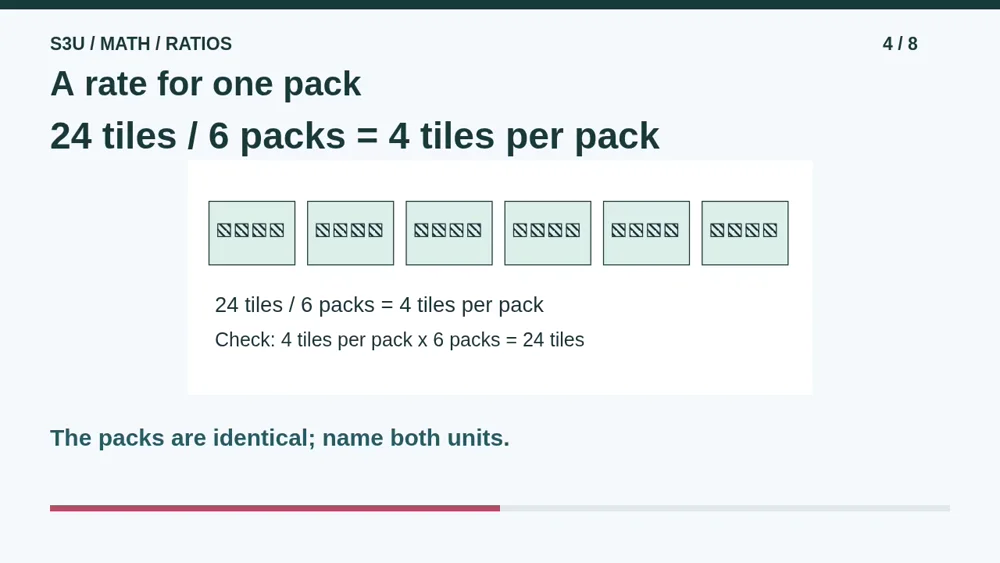
Now six identical packs hold twenty four tiles altogether. Divide twenty four tiles by six packs to get four tiles per pack. This is a unit rate because it describes one pack. Multiplying four tiles per pack by six packs checks the total of twenty four tiles. Keep the units: four packs per tile would answer a different question. The word per is small, but it has a very important job.
5. Pause: use the total
Video: 2:00
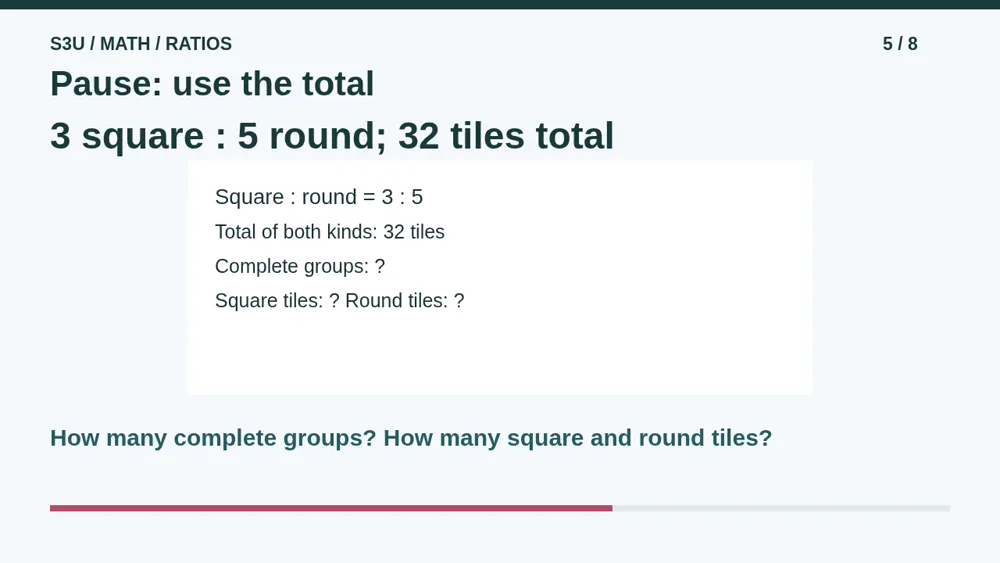
Pause for a new pattern. This time there are three square tiles for every five round tiles, and the whole collection has thirty two tiles. How many complete ratio groups fit that total? How many tiles are square, and how many are round? Explain what you divide by before multiplying. Thirty two is the total of both kinds, not the count of either kind alone. You can speak your reasoning or write it.
6. Count groups before parts
Video: 2:31
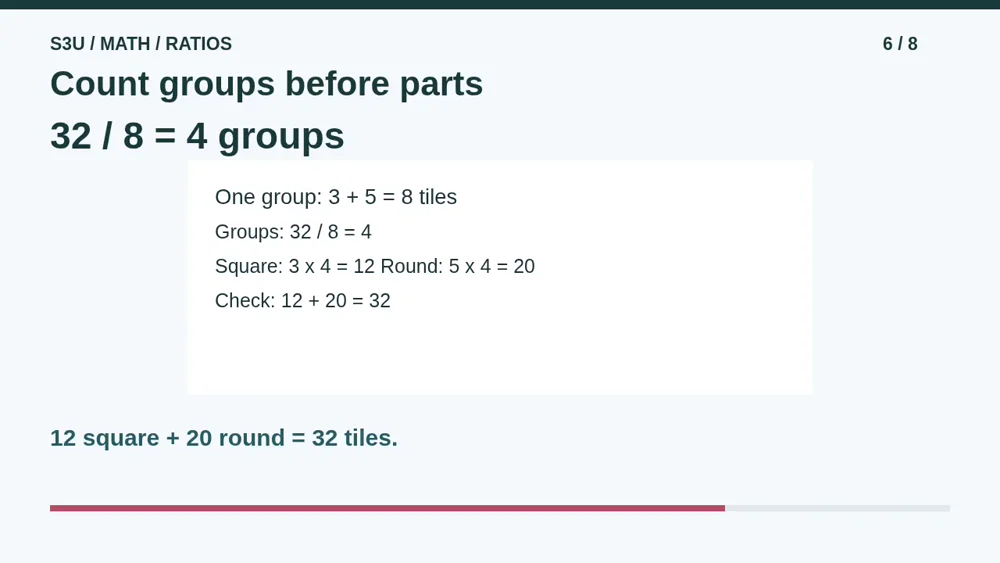
Each complete group contains three plus five, or eight tiles. Thirty two divided by eight gives four groups. Four times three gives twelve square tiles, and four times five gives twenty round tiles. Check that twelve plus twenty is thirty two, then check that both original counts were multiplied by four. Dividing thirty two by three would treat the total as if it counted only square tiles, which it does not.
7. Turn the rate around carefully
Video: 3:02
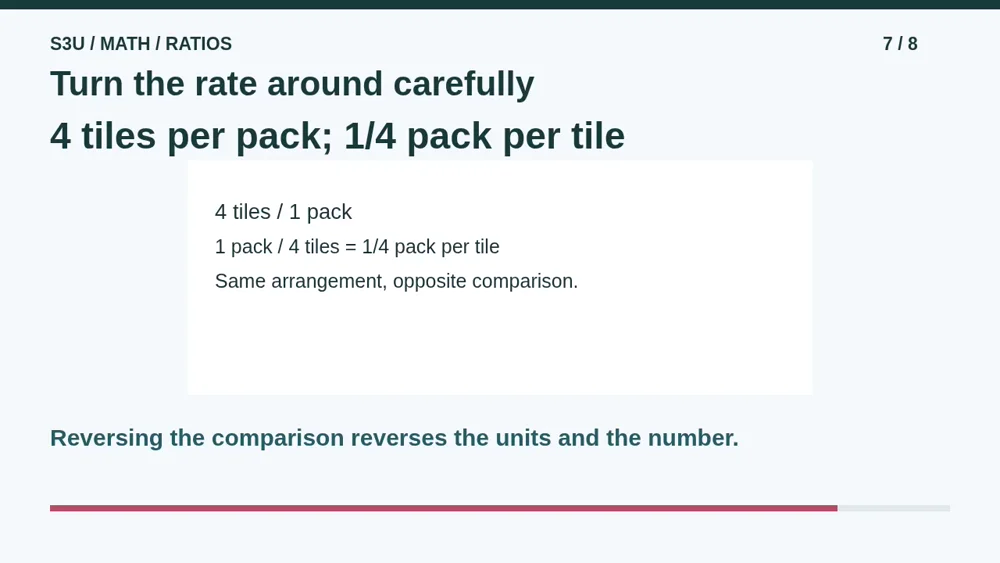
Fun fact: turning a comparison around can give a fractional unit rate. Our four tiles per pack can also be described as one fourth of a pack per tile. A tile accounts for a quarter of that pack, not four packs. Both statements describe the same packing arrangement with opposite units. No one needs to cut open a real pack. Fractions help us describe the comparison on paper.
8. Continue with new ratios
Video: 3:31
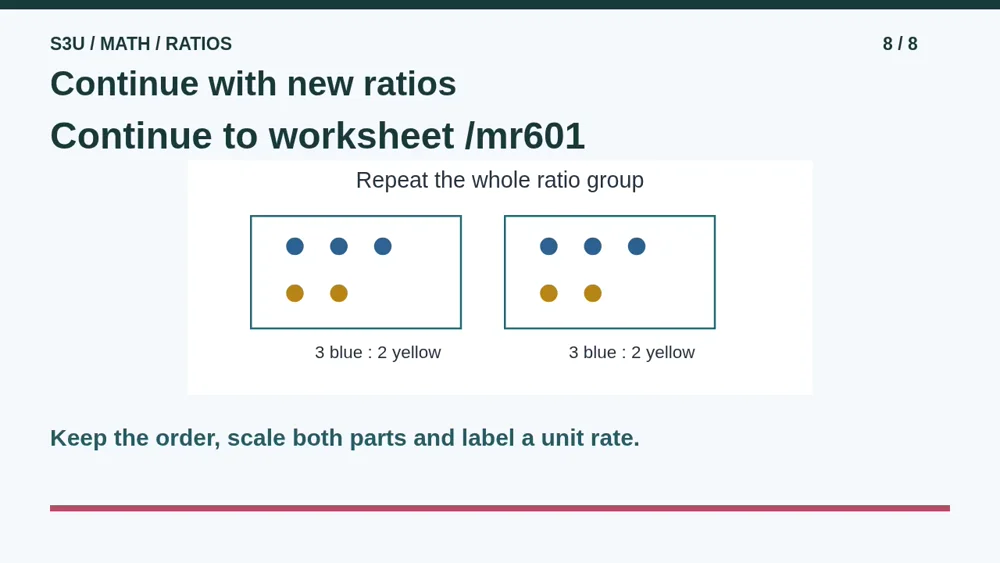
Continue to the worksheet below. It has a different tile ratio, a cost per notebook, a constant travel rate, an ingredient comparison and a bead total. Use each question's own numbers and units. For a total, count one whole ratio group first. For a unit rate, ask what amount goes with one unit. Explain one answer aloud or on paper; watching this lesson is separate from completing the worksheet.
Show your understanding
You can point, explain aloud, draw or write.
- Keep the comparison order fixed and multiply both ratio parts by the same positive factor, distinguishing this from equal addition.
- Find both parts from a total and calculate a unit rate with units, checking against the original relationship.
Try it yourself
Pause at the 3:5 pattern with 32 tiles total. Find the group count, then both part counts, and check the total.
Continue to the worksheet with its own numbers. Name the order and units before calculating.
Next: your worksheet
Build Equivalent Ratios and Unit Rateshttps://s3u.com/mr601
Lesson: https://s3u.com/lessons/scale-both-quantities