Math / Grade 7
Return a tile or leave it out
Learning goal: Track remaining tiles after a stated draw, compare replacement rules, and distinguish an impossible result from an empty bag.
Before you start: Count equally likely tiles and read a matching-count fraction. Use Count tiles, compare chances first when needed.
Read or print this lesson What to practiceThe video could not load. The transcript is still available below.
Next: your worksheet
Return a Tile or Keep It Out
Checking sign-in...
Read the transcript
Saved reading place
Video transcript and practice. Reading or printing does not count as playback time or an assessed grade.
1. Read the rule before the fraction
Video: 0:00
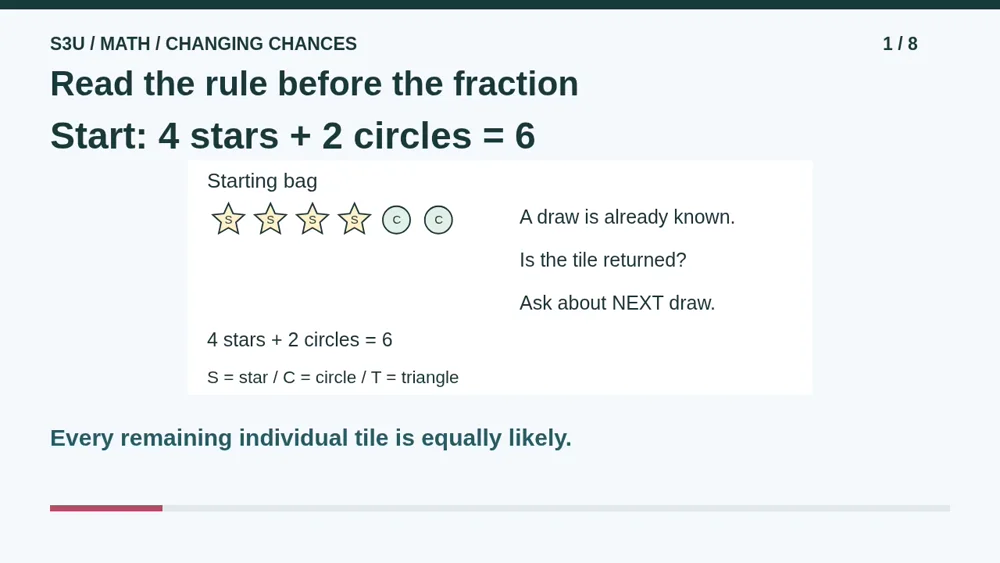
Start with a pretend bag containing four stars and two circles. Every individual tile has an equal chance of being picked. We will be told which tile has already come out. Our question is about the next draw, not the chance of the whole sequence. Does the tile go back, or stay out? That little rule changes the arithmetic.
2. Put the star back
Video: 0:26
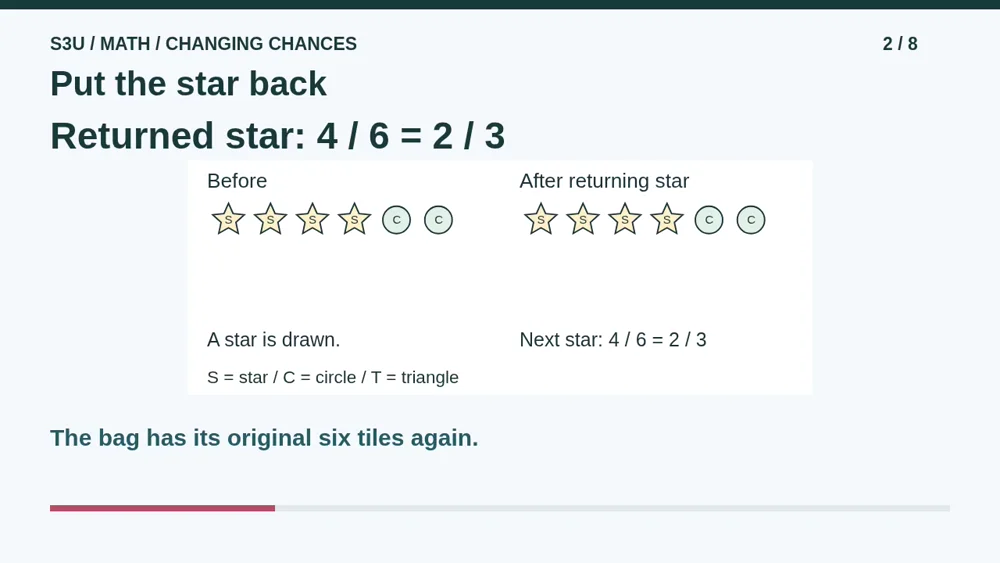
A star was picked. Put it back and mix the bag. Four stars and two circles are available again. The next star chance is four sixths, or two thirds. The previous star does not remove a future star when we return it. The bag does not keep a fairness diary and decide that circles are now owed a turn.
3. Leave the star out
Video: 0:51
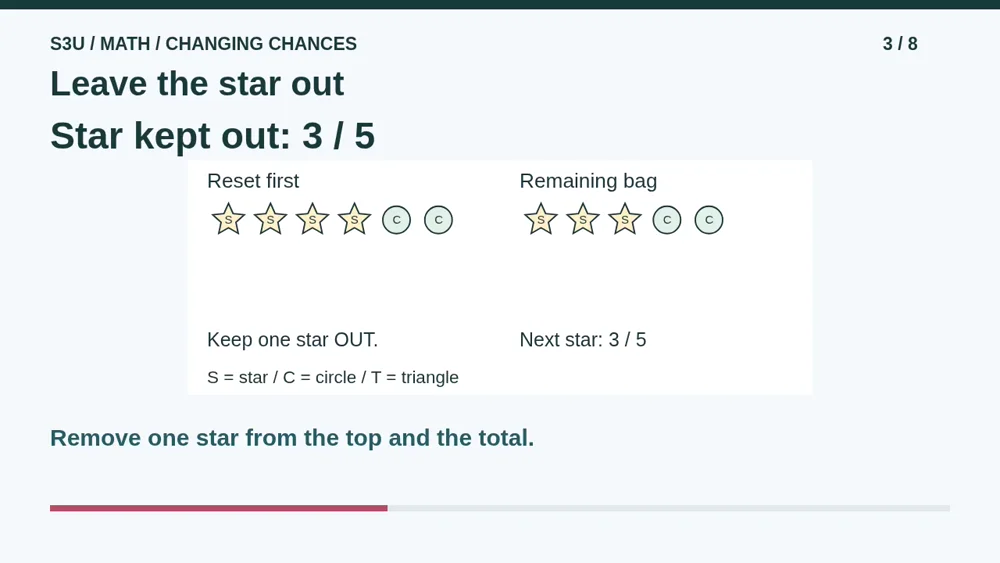
Reset to the original four stars and two circles. This time a star was picked and stays outside the bag. There are now three stars and two circles, five tiles altogether. The next star chance is three fifths. Do not keep six as the denominator: that would count a tile we cannot pick. We changed both the matching count and the total.
4. A different removal
Video: 1:17
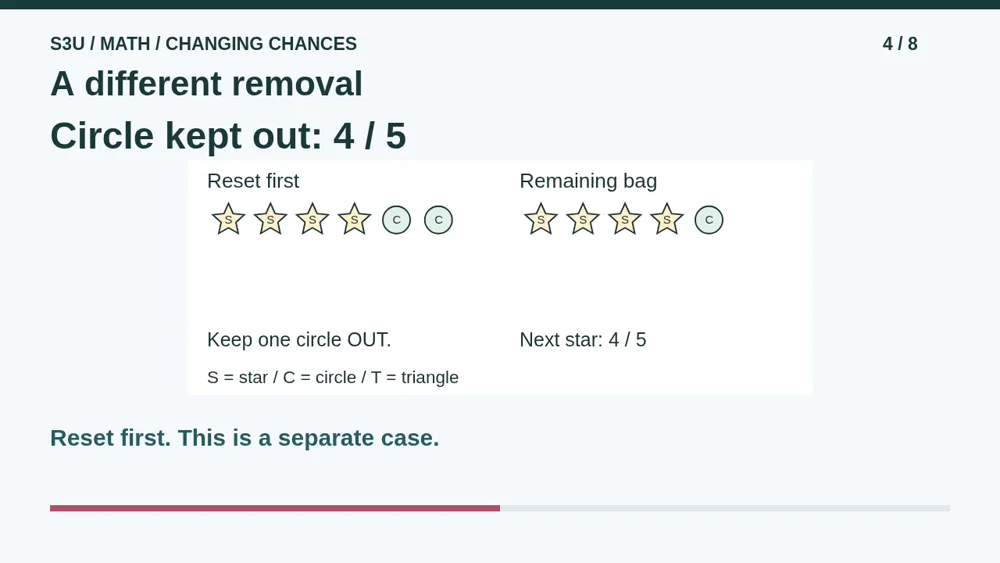
Reset again to four stars and two circles. A circle is picked and stays out. Four stars and one circle remain, so the next star chance is four fifths. Compare this with leaving a star out. Both cases leave five tiles, but different numbers of stars. Say what was removed, not just that something was removed. The remaining bag is our evidence.
5. Pause: follow two removals
Video: 1:45
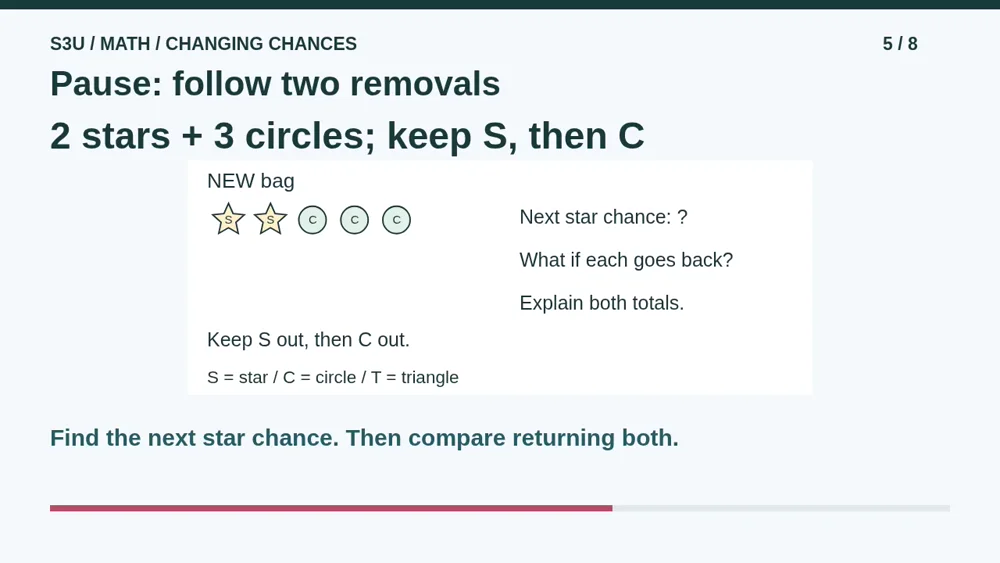
Pause with a fresh bag: two stars and three circles. We are told that a star, then a circle, have been picked and kept out. What is the chance of a star next? Draw the remaining tiles. Then compare a different rule: each picked tile is returned before the next draw. What would the next star chance be with that rule? Explain both denominators.
6. Check the remaining bag
Video: 2:12
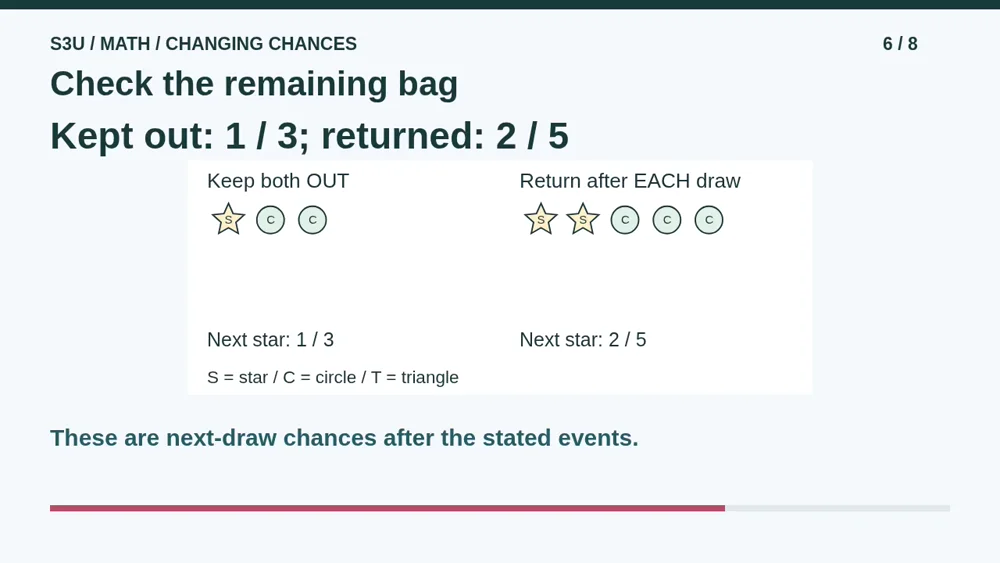
Keeping the star out leaves one star and three circles. Keeping a circle out next leaves one star and two circles. One of the three remaining tiles is a star, so the next star chance is one third. Returning each tile instead restores two stars and three circles before every draw. That next star chance is two fifths. We were given the earlier results; we did not calculate their joint probability.
7. Zero chance or no draw?
Video: 2:42
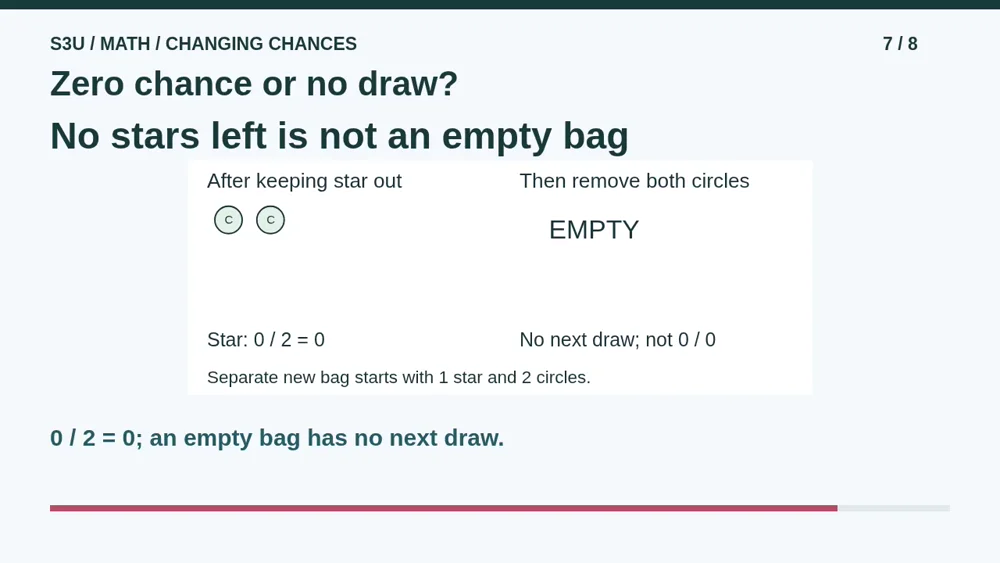
Fun fact: impossible and unavailable are different here. A new bag starts with one star and two circles. Keep its star out and two circles remain. A next draw exists, but a star has chance zero out of two. Remove both circles as well and nothing can be drawn. Do not write zero over zero. There is no next draw from that empty bag.
8. Continue with a new bag
Video: 3:09
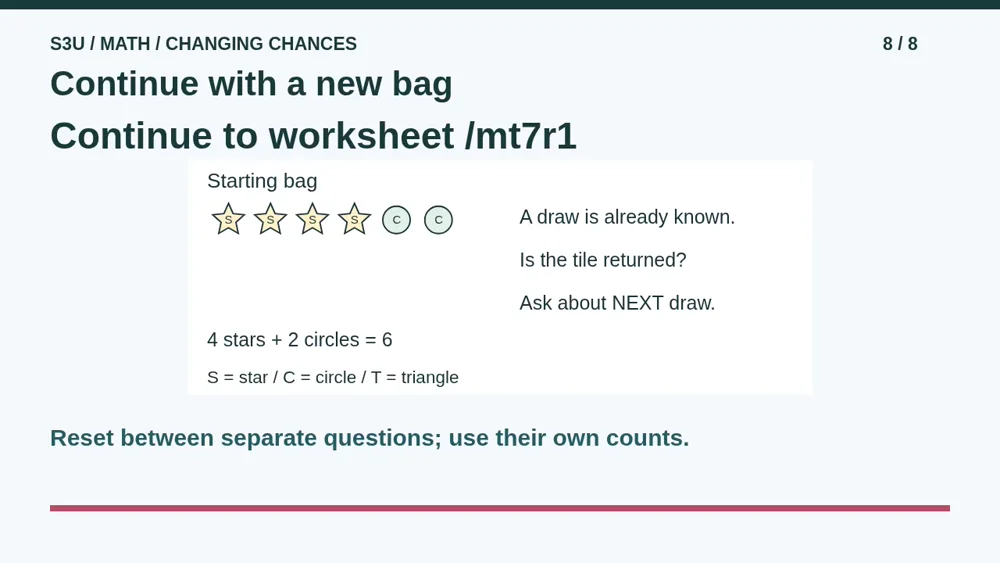
Continue to the worksheet below. For each question, start from its stated bag and read whether a tile is returned or kept out. Count the remaining matching tiles and all remaining tiles. If the bag is empty, say that no next draw is available. Explain the change before choosing an answer. Chance Lab lets you compare both rules without turning a lucky result into a grade.
Show your understanding
You can point, explain aloud, draw or write.
- Recount the remaining numerator and denominator after a stated returned or removed tile, distinguishing next-draw chances from a whole-sequence probability.
- Compare zero chance in a nonempty bag with no next draw from an empty bag, and explain why returned draws do not owe a balancing outcome.
Try it yourself
Pause with two stars and three circles. Follow the stated star and circle removals, then compare returning each tile.
Continue to both worksheets using their own bag counts. Recount the available tiles and say no next draw when none remain.
Next: your worksheet
Return a Tile or Keep It Outhttps://s3u.com/mt7r1
Lesson: https://s3u.com/lessons/return-or-remove