Reading / Grade 5
Summaries: the book repair mission
Learning goal: Choose a main idea, keep essential supporting details and avoid adding outcomes the passage never states.
Before you start: Read or listen to a short passage and distinguish a main event from a small detail.
Read or print this lesson What to practiceThe video could not load. The transcript is still available below.
Next: your worksheet
Summarize a Repair Project
Checking sign-in...
Read the transcript
Saved reading place
Video transcript and practice. Reading or printing does not count as playback time or an assessed grade.
1. A repair project needs a summary
Video: 0:00
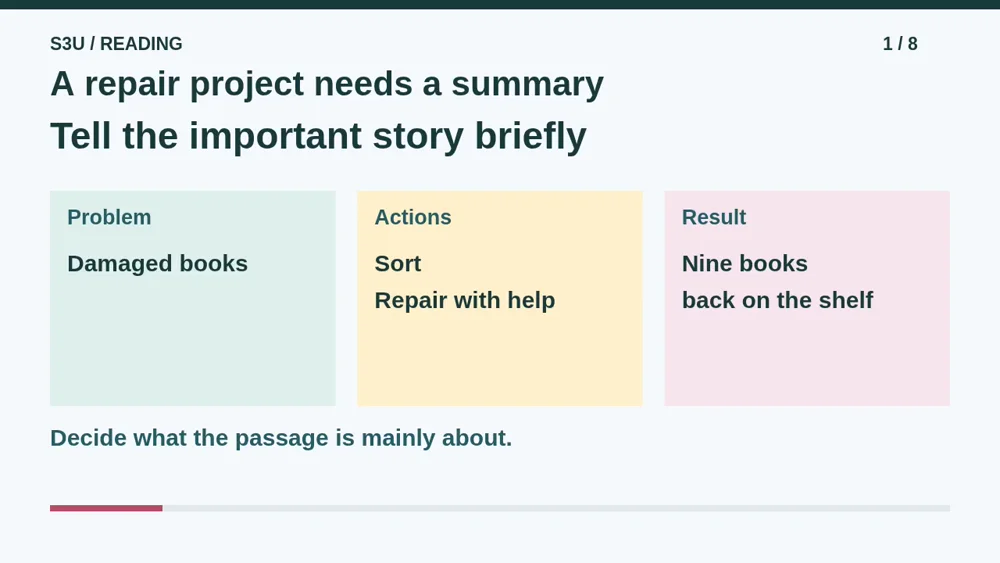
Here is an original practice passage. A class sorts damaged library books. With their teacher, students repair simple tears. A librarian handles books with difficult bindings. Nine repaired books return to the shelf. The temporary repair box is green. What should a short summary keep?
2. Find the thread through the details
Video: 0:24
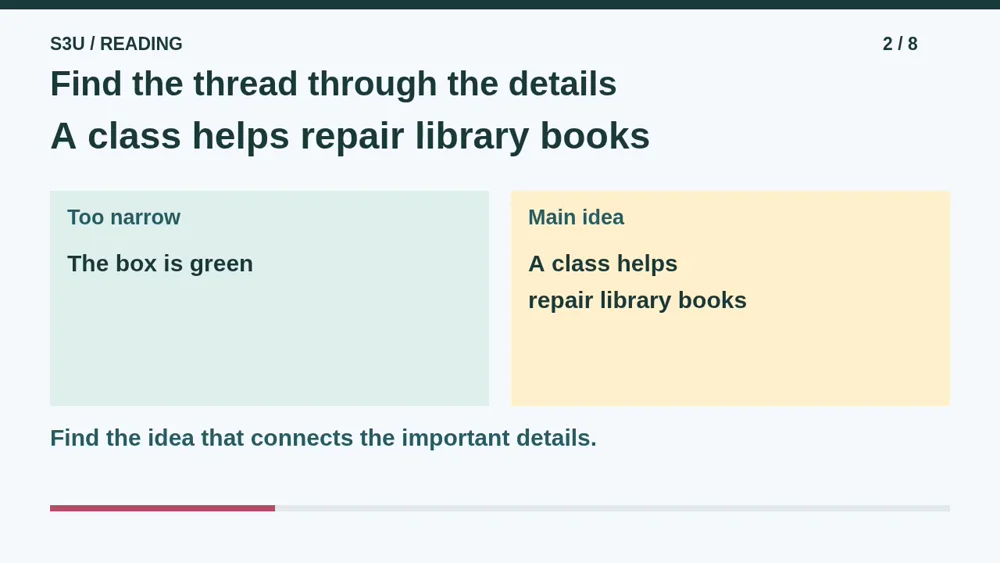
The main idea connects the problem, actions, and result. This passage is about a class helping repair library books. It is not mainly about the color green or the shape of a shelf. A good main idea is broad enough to connect important details, but specific enough to fit this passage.
3. Keep the important limits
Video: 0:46
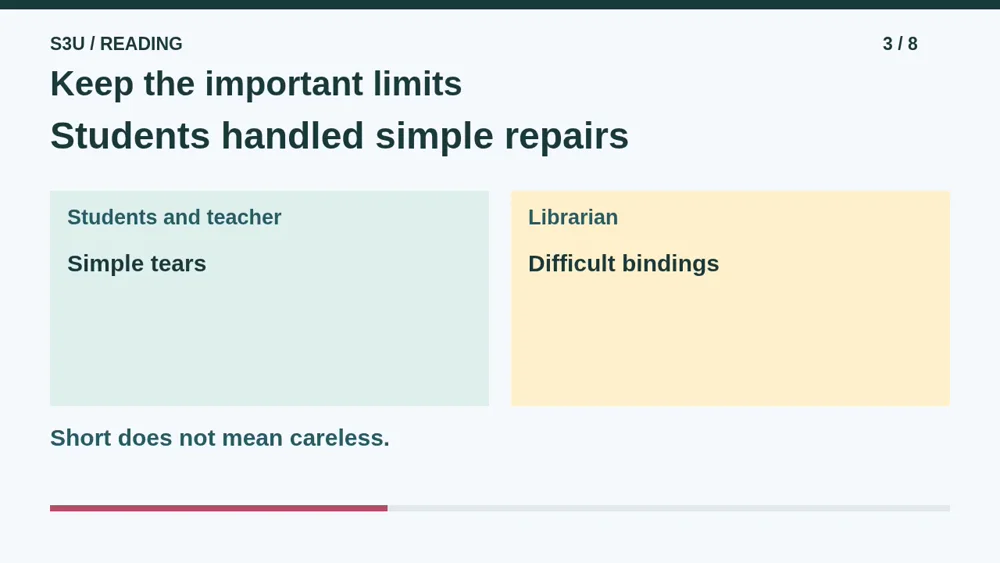
The teacher helps with simple tears, while the librarian handles difficult bindings. That division of work matters. It explains how the project happens and prevents us from claiming that students repair every kind of damage alone. A summary can be short without losing an important limit.
4. Remove a detail, test the meaning
Video: 1:08
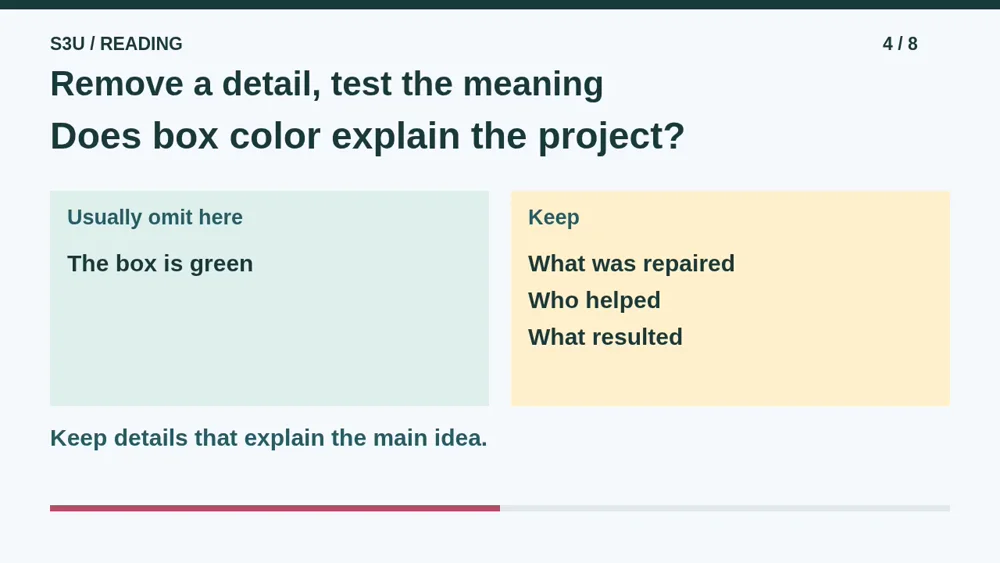
If we leave out the green color of the temporary box, we still understand the repair project. If we leave out all the repairing, we lose the main action. Try removing a detail and ask what becomes unclear. The box may be proud of its color, but the summary has limited space.
5. Pause: choose the accurate summary
Video: 1:29
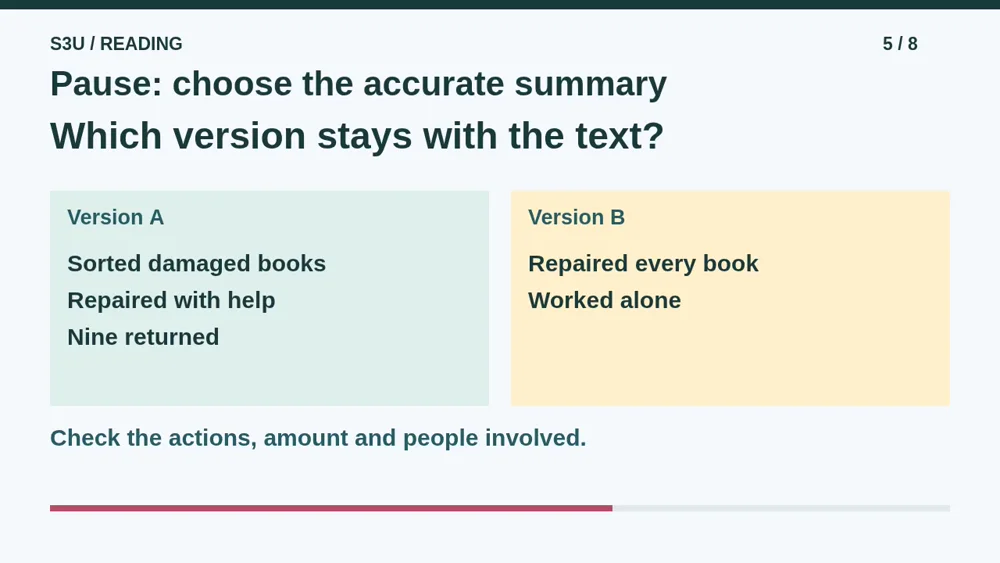
Pause and compare two summaries. One says the class sorted damaged books, repaired simple tears with help, and returned nine books to the shelf. The other says students repaired every library book by themselves. Which summary is supported, and which adds claims the passage never makes?
6. Choose the supported version
Video: 1:51
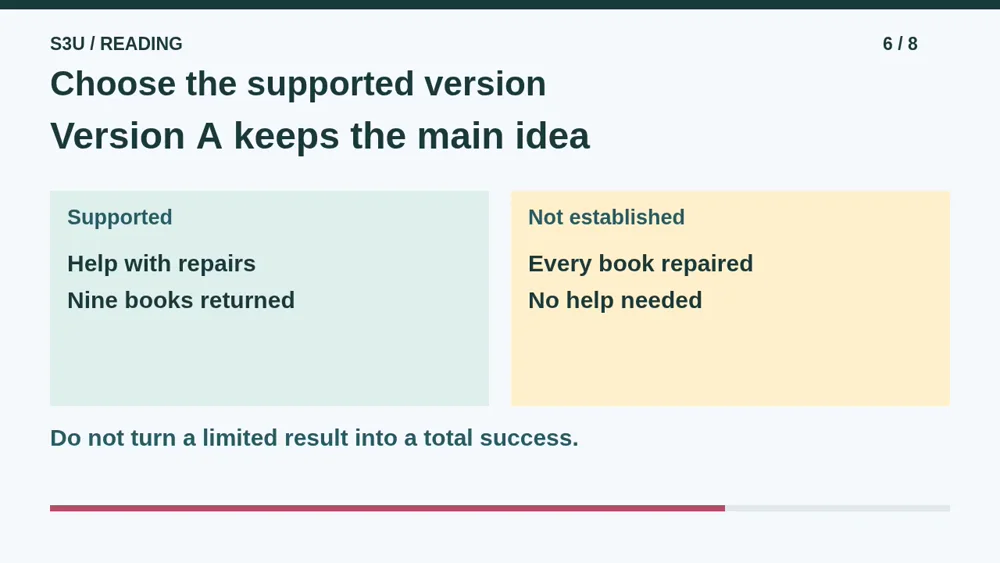
Version A matches the passage. Version B changes damaged books into every book and removes the help. Those are new claims, not a shorter version of the same information. Nine repaired books returned to the shelf does not mean every damaged book was repaired.
7. Shorter is not always more accurate
Video: 2:12
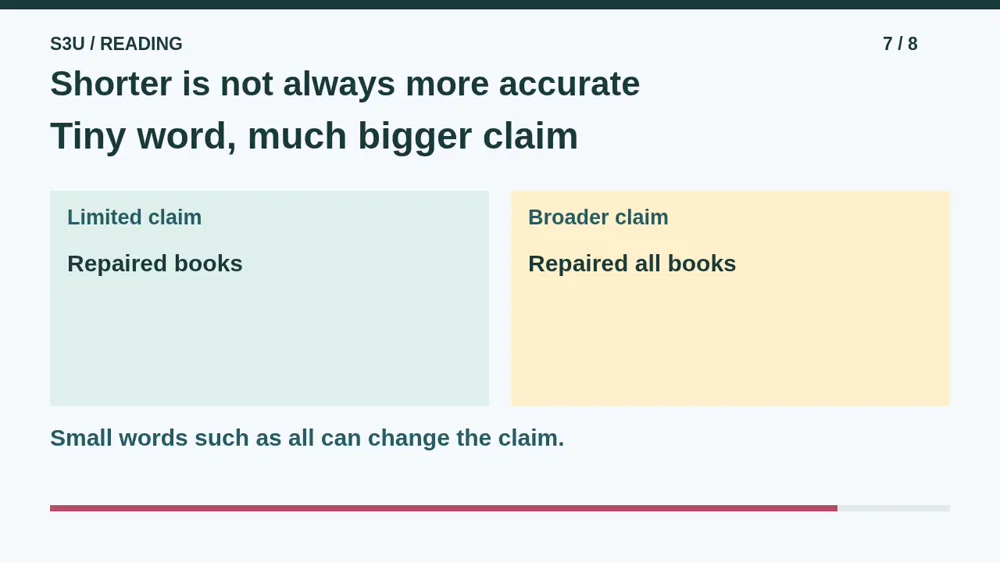
Fun fact: adding the small word all can make a sentence much harder to support. The class repaired books and the class repaired all books are different claims. A short sentence can still exaggerate. Good summarizing checks meaning, not just the number of words.
8. Read, choose, check
Video: 2:32
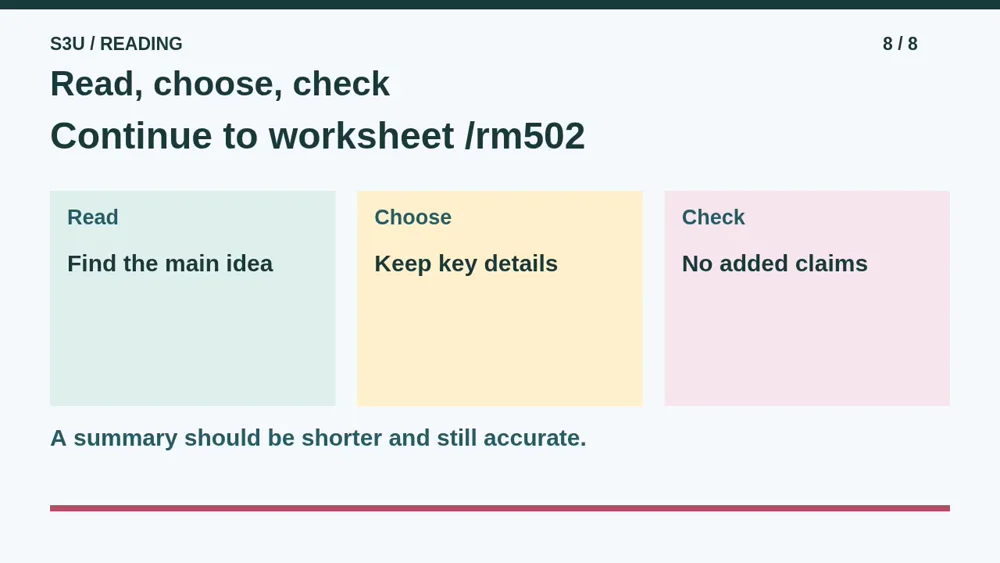
Continue to the repair-project worksheet. Read the passage, state its main idea in your own words, and keep the details that explain that idea. Before checking your answers, compare your summary with the original. Did you add a result, remove a limit, or change who did the work?
Show your understanding
You can point, explain aloud, draw or write.
- State the main idea and retain the details needed to understand it.
- Avoid adding a cause, outcome or opinion that the passage does not support.
Try it yourself
Pause and compare two summaries. One says the class sorted damaged books, repaired simple tears with help, and returned nine books to the shelf. The other says students repaired every library book by themselves. Which summary is supported, and which adds claims the passage never makes?
Continue to the matching worksheet. Explain your reasoning before checking your answers.
Next: your worksheet
Summarize a Repair Projecthttps://s3u.com/rm502
Lesson: https://s3u.com/lessons/repair-summary