Math / Grade 8
Reconcile cash records
Learning goal: Compare same-date bank and book balances, explain timing differences, and record missing interest and fees without counting an item twice.
Before you start: Add and subtract whole numbers. Distinguish a bank statement from book Cash, and review cash, income and expense entries when needed. Use only the fictional records.
Read or print this lesson What to practiceThe video could not load. The transcript is still available below.
Next: your worksheet
Reconcile Cash Timing Differences - Practice 1
Checking sign-in...
Read the transcript
Saved reading place
Video transcript and practice. Reading or printing does not count as playback time or an assessed grade.
1. Two records, one closing date
Video: 0:00
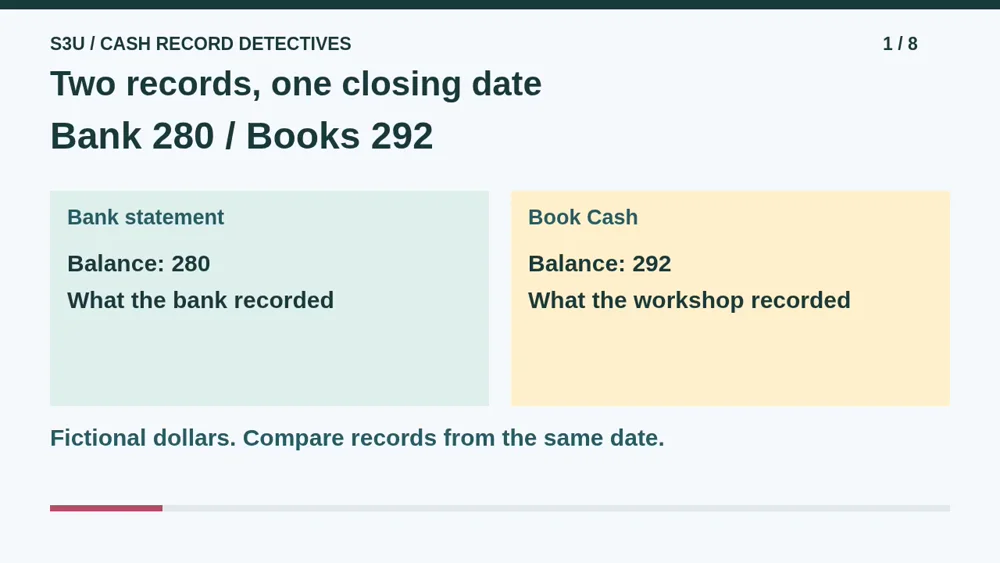
Our pretend workshop has two cash records for the same closing date. The bank statement says two hundred eighty dollars. The workshop books say two hundred ninety-two. Different totals do not automatically mean money vanished. We need evidence about what each record includes. Reconciling means explaining those differences and finding the adjusted balances. We will use fictional dollars and only the items stated here. No real bank account is needed.
2. A deposit still in transit
Video: 0:35
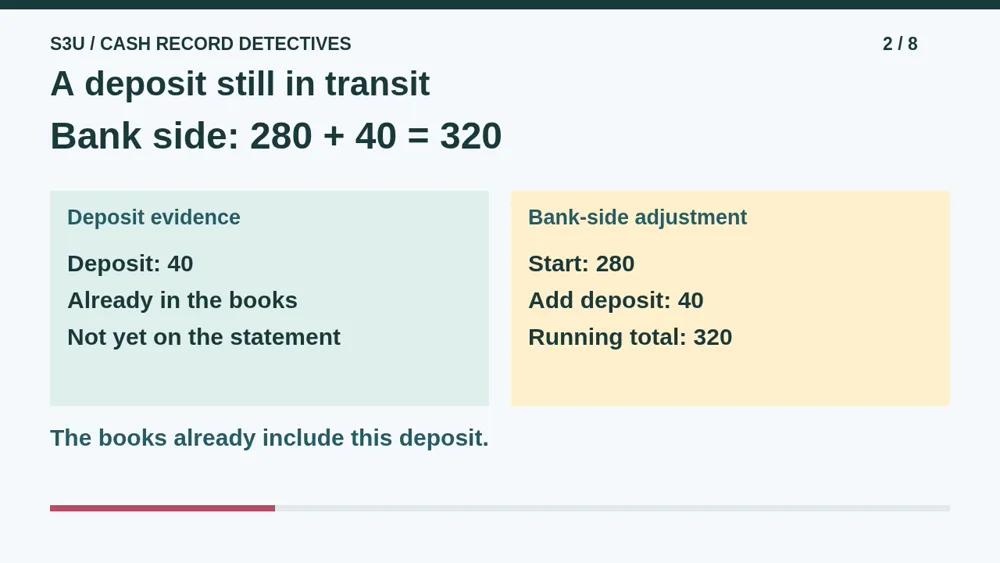
The workshop deposited forty before the closing date and already recorded it in its books. The bank statement does not include it yet. This is a deposit in transit. Add forty on the bank side of the reconciliation: two hundred eighty plus forty is three hundred twenty. Do not add forty to the books again. The deposit needs a place in our comparison, not a second invitation to the same party. This running total is not our final answer yet.
3. Checks waiting to clear
Video: 1:09
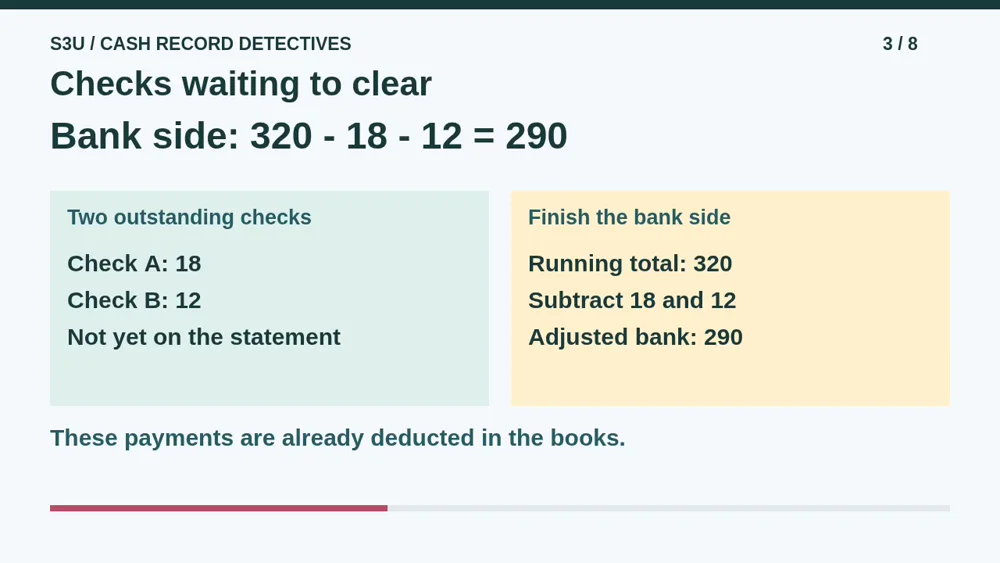
Two checks, for eighteen and twelve, have not cleared the bank by the closing date. They are outstanding checks. The workshop already deducted both payments in its books, but the bank has not deducted them on this statement. Subtract eighteen and twelve on the bank side. Three hundred twenty minus eighteen minus twelve equals two hundred ninety. Do not record either payment in the books a second time. Timing is the difference, not another purchase.
4. Now update the book side
Video: 1:42
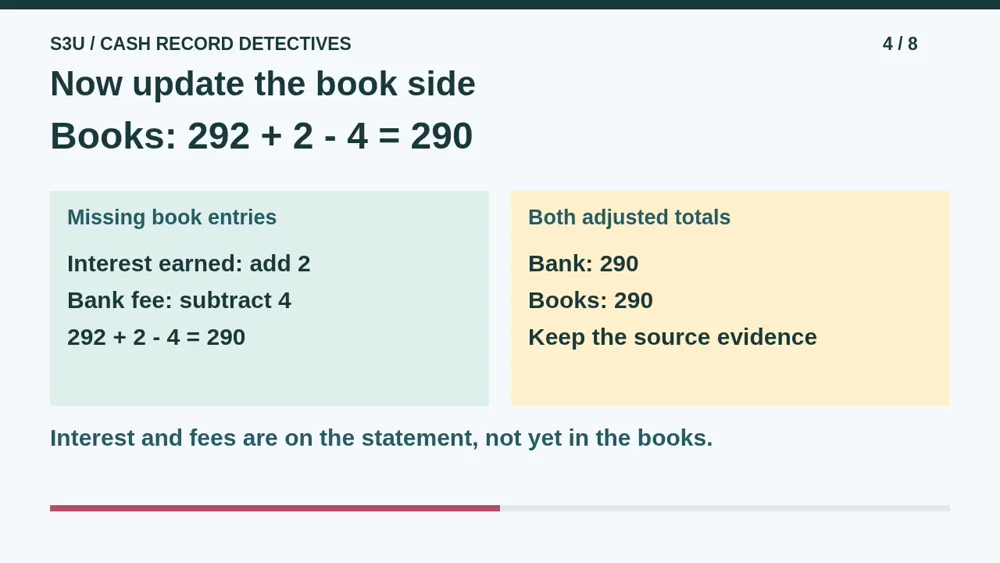
The statement also includes two dollars of interest earned and a four-dollar bank fee. Neither is in the workshop books yet. Add two and subtract four from book Cash: two hundred ninety-two plus two minus four equals two hundred ninety. Record the interest by debiting Cash two and crediting Interest Income two. Record the fee by debiting Bank Fee Expense four and crediting Cash four. Now both adjusted balances are two hundred ninety. We have explained each change, not just made the numbers match.
5. Pause: try a fresh case
Video: 2:20
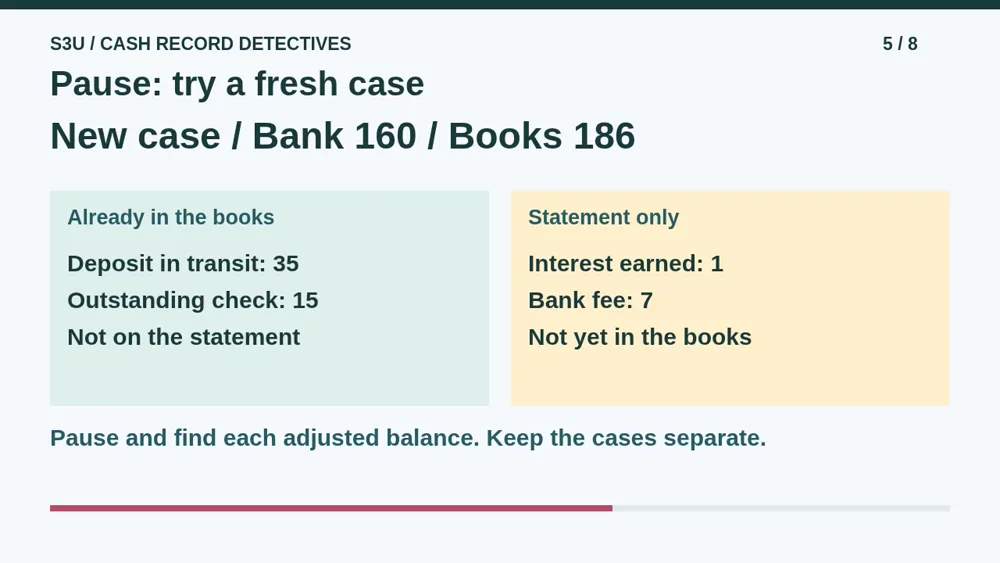
Pause for a different fictional workshop, with records from one closing date. Its bank statement balance is one hundred sixty, and its book Cash is one hundred eighty-six. A deposit of thirty-five and an outstanding check of fifteen are already in the books but not on the statement. Interest of one and a fee of seven appear on the statement but are not yet booked. There are no other differences. Find both adjusted balances and explain which items need new book entries. Do not carry over numbers from our first workshop.
6. Check both sides independently
Video: 2:58
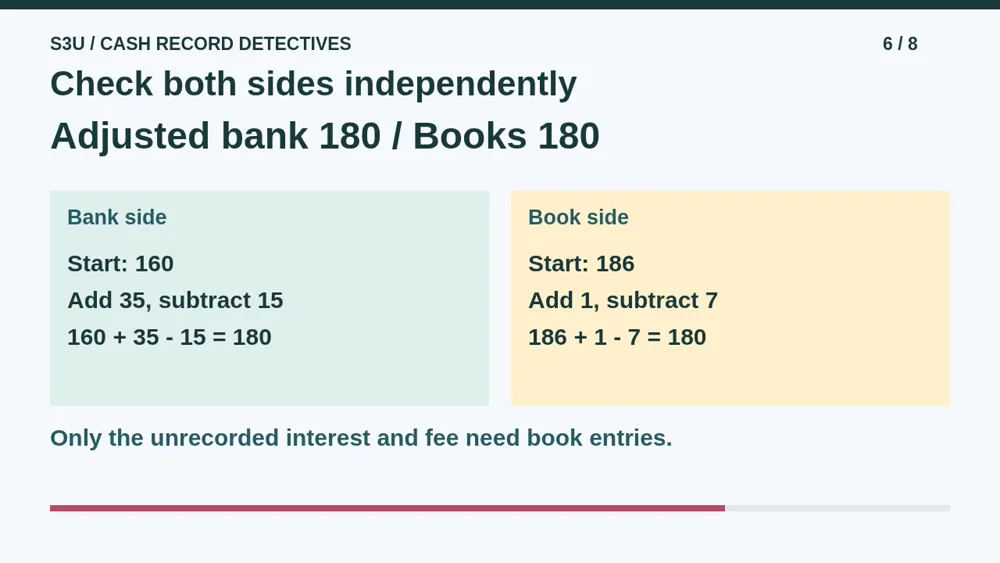
On the bank side, one hundred sixty plus thirty-five minus fifteen equals one hundred eighty. On the book side, one hundred eighty-six plus one minus seven also equals one hundred eighty. The book entries record the interest and the fee. The deposit and check are already there, so do not copy them again. If you got different answers, check each item against its evidence before changing a sign. A minus sign is not decoration; it says the adjustment reduces that side.
7. Matching is a check, not proof
Video: 3:33
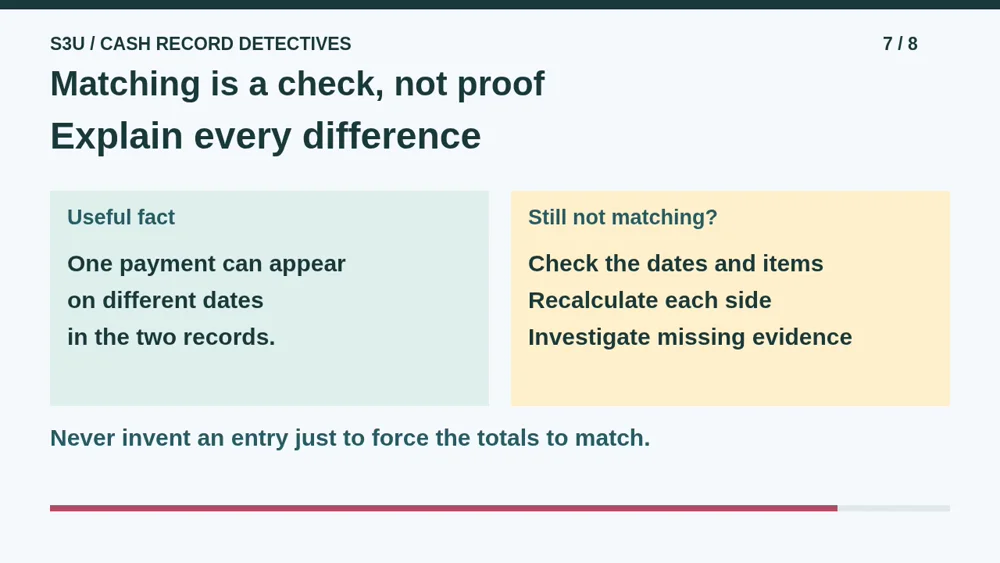
Fun fact: one payment can appear on different dates in the workshop books and the bank records. That is why a timing difference does not automatically mean an error. Matching adjusted totals is useful, but it does not prove every original entry is correct. If the sides still differ, check the dates, source amounts and arithmetic, then investigate missing evidence. Do not invent a fee or change a number just to make the totals agree. Our lesson assumes only the stated timing items, interest and fees. Confirmed recording errors need their own evidence and corrections.
8. Continue with your own case
Video: 4:16
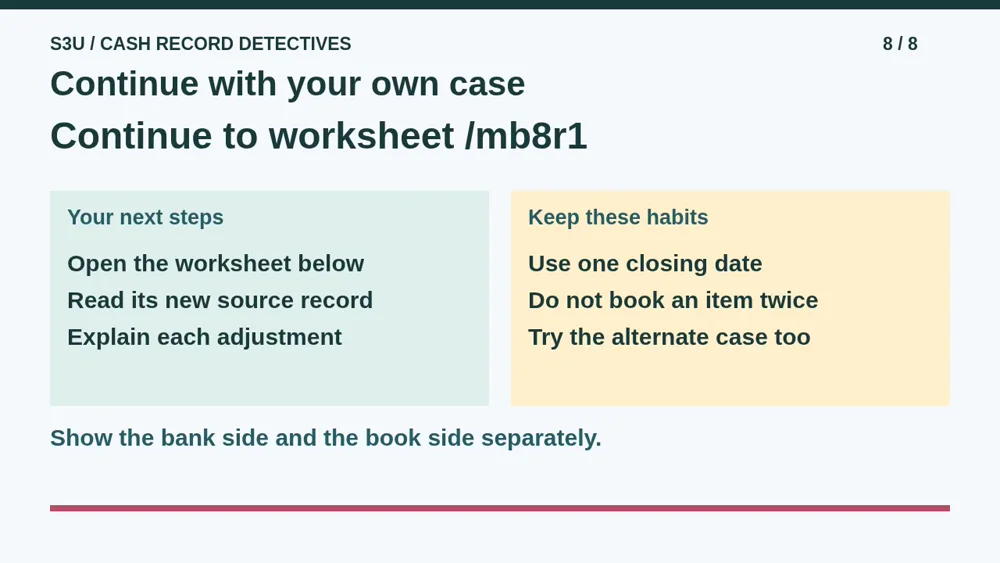
Continue to the worksheet below for a new set of fictional records. Read its worked example, then show the bank side and book side separately. For each item, say which record already includes it and why the other side needs an adjustment. Then try the alternate worksheet with different amounts. Watching this video is preparation, not proof that you can reconcile a fresh case. Keep your reasoning with the numbers. Our detective work ends with evidence, not with a mysterious extra dollar.
Show your understanding
You can point, explain aloud, draw or write.
- Explain why a deposit in transit is added and outstanding checks are subtracted on the bank side without recording them twice in the books.
- Reconcile a fresh same-date case, record missing interest and fees on the book side, and investigate rather than invent a balancing entry.
Try it yourself
Pause at bank 160 and books 186. Use deposit 35, outstanding check 15, interest 1 and fee 7 to explain both adjusted balances.
Continue to the worksheet with its own records, then its alternate case. Identify which side already includes every item.
Next: your worksheet
Reconcile Cash Timing Differences - Practice 1https://s3u.com/mb8r1
Lesson: https://s3u.com/lessons/reconcile-cash-records