Science / Grade 8
Read the rock record
Learning goal: Build relative event order from upright layers, intrusions and an erosion surface, while leaving unsupported numeric ages unknown.
Before you start: Read before-and-after relationships and distinguish sedimentary deposition from molten material entering existing rock. Use the stated upright, undisturbed model.
Read or print this lesson What to practiceThe video could not load. The transcript is still available below.
Next: your worksheet
Order Rock Layers and Cutting Events
Checking sign-in...
Read the transcript
Saved reading place
Video transcript and practice. Reading or printing does not count as playback time or an assessed grade.
1. Order is not a birthday
Video: 0:00
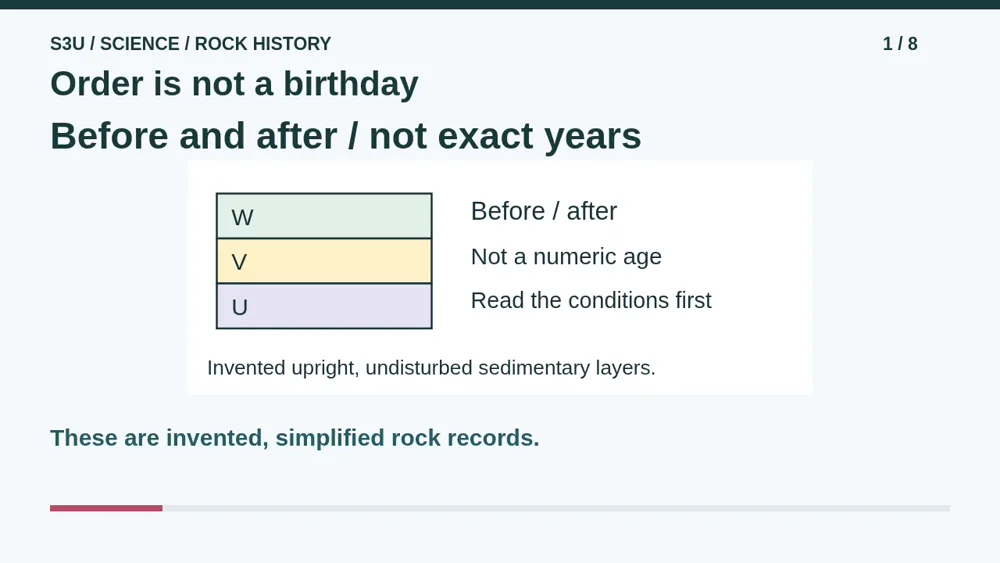
Rock layers can preserve relationships between events without providing their birthdays. Today we will explain which event came first and which came later. That is relative order, not an exact age in years. Our invented model starts with upright, undisturbed sedimentary layers. We must read that condition before using the lower before upper rule. Real rocks may have been folded, overturned or faulted. A drawing needs evidence, not just a confident arrow and a very serious looking pencil.
2. Start with deposition order
Video: 0:38
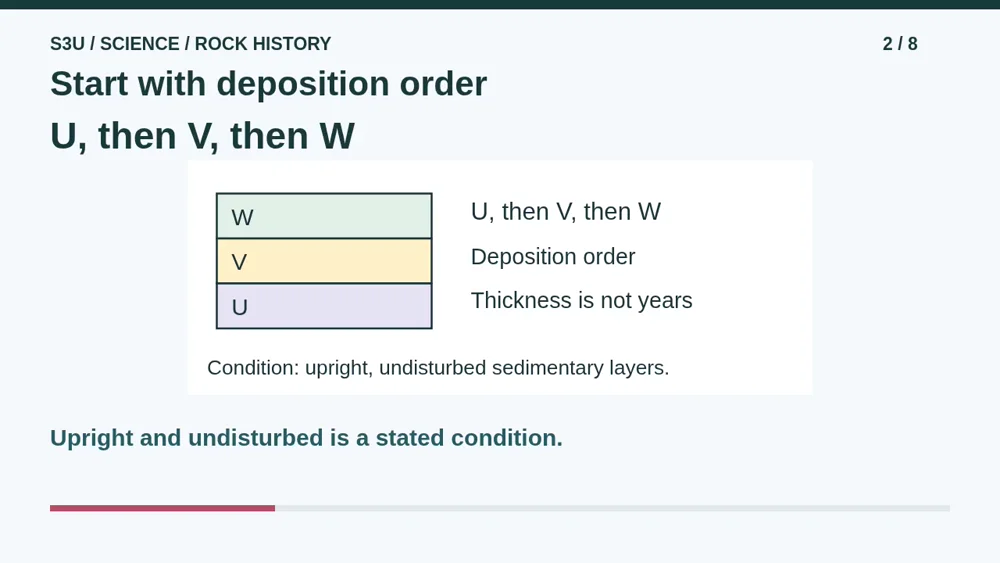
The bottom layer is U, the middle layer is V, and the top layer is W. In this stated upright, undisturbed sedimentary sequence, U was deposited before V, and V before W. This relationship is called superposition. It does not say that all three layers formed at the same rate or took the same amount of time. A thick layer need not represent more years than a thin one. Position supports our order here; thickness is a different measurement.
3. Then a feature cuts the layers
Video: 1:12
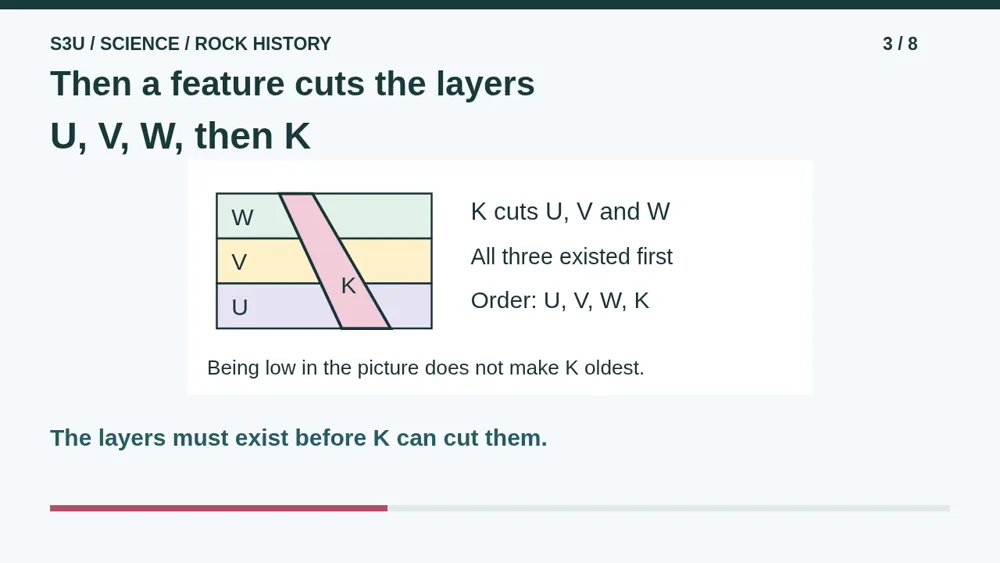
Now the record adds intrusion K. Molten material entered the older rock and solidified, and K cuts through U, V and W. The rocks it cuts must already have existed. Therefore K is younger than all three layers it cuts. Most of K might appear low in a drawing, but that does not make it the oldest rock. Use the cutting relationship for the intrusion. Do not apply the sedimentary layer shortcut to every shape on the page.
4. Add an erosion surface
Video: 1:46
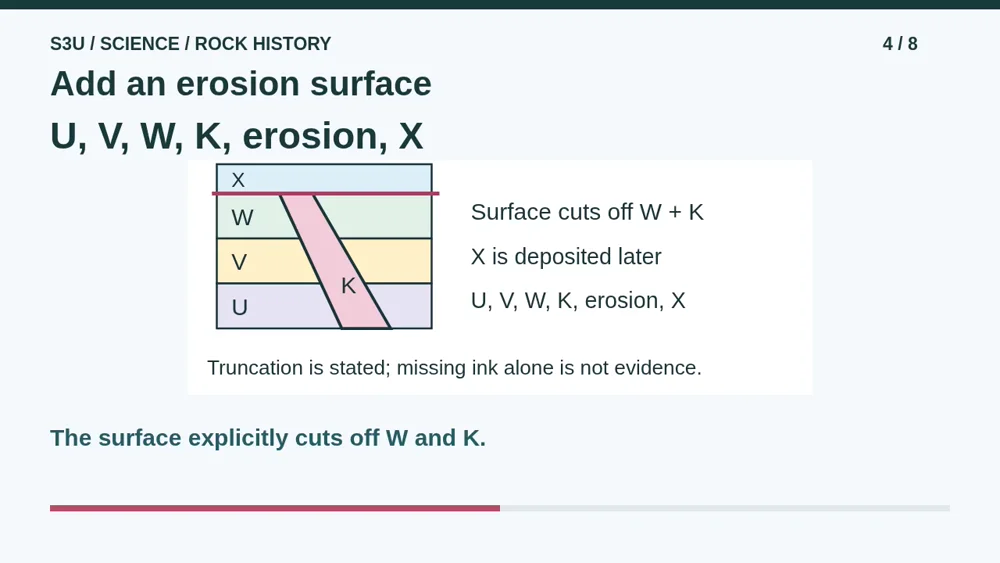
Next, erosion cuts off the top of W and the top of intrusion K. Later, sediment X is deposited on that erosion surface. The stated truncation, meaning cut off, puts erosion after K. The later X deposit comes after the surface it rests on. Our sequence is U, V, W, K, erosion, then X. Simply leaving K out of the drawing of X would not prove this history. The explicit cutting relationship supplies the missing evidence. The duration of erosion is still unknown.
5. Pause: build a fresh history
Video: 2:25
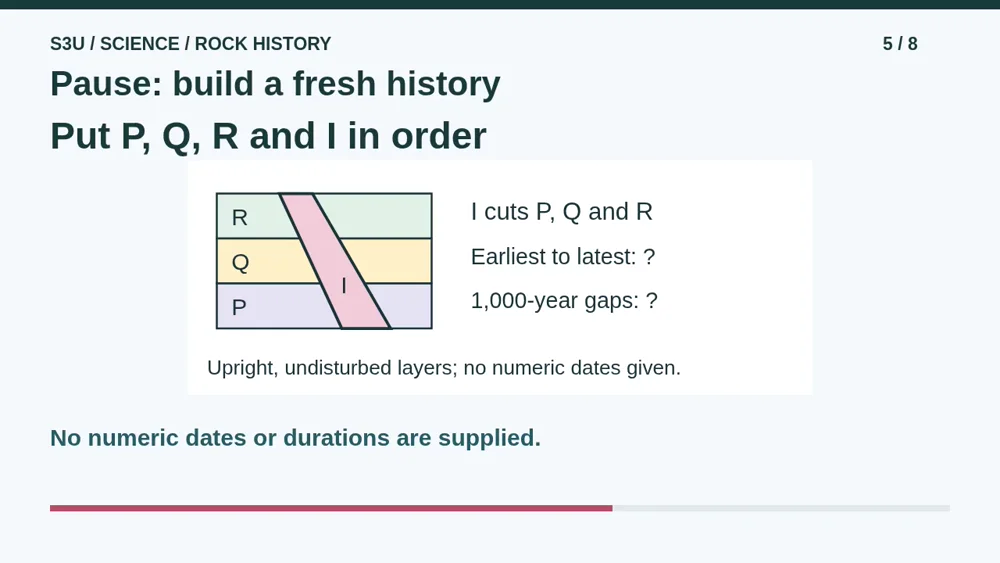
Pause for a new model. Three sedimentary layers stayed upright and undisturbed: P is at the bottom, Q is in the middle, and R is at the top. Intrusion I cuts all three. Give the four events from earliest to latest, and explain why I belongs where you put it. Does the model tell us that each event was exactly one thousand years after the previous event? Say which relationships are supported and which time information is missing.
6. Check the relationships
Video: 2:58
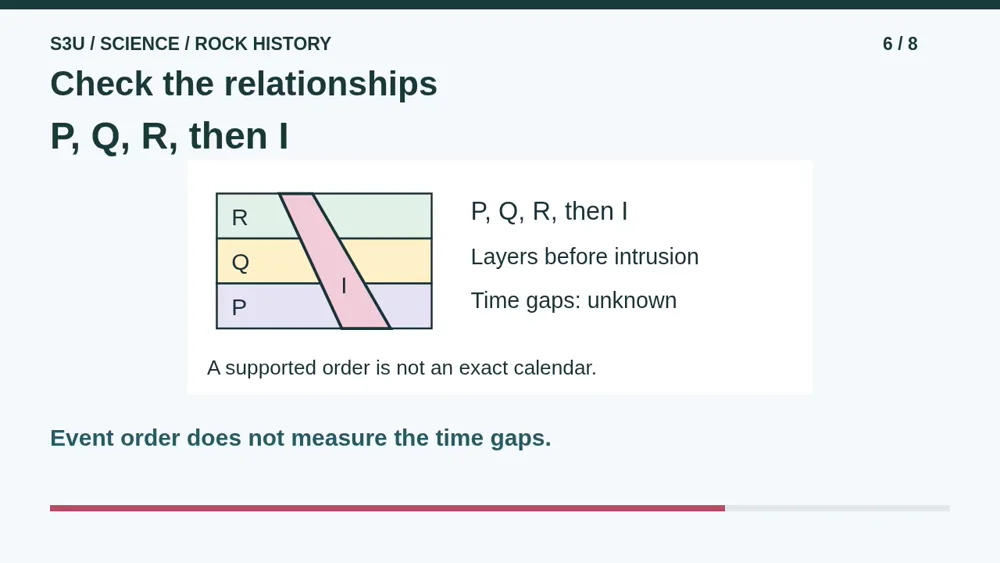
The deposition order is P, Q, R. Intrusion I follows because it cuts all three existing layers. That gives P, Q, R, then I. Nothing supplies a thousand year spacing, equal durations, or an exact calendar date. If you placed I first because it reaches the bottom, compare its shape with the layers it cuts. A supported event order is useful even without numeric dates. Knowing one kind of information does not give us every other kind for free.
7. Low can still be younger
Video: 3:34
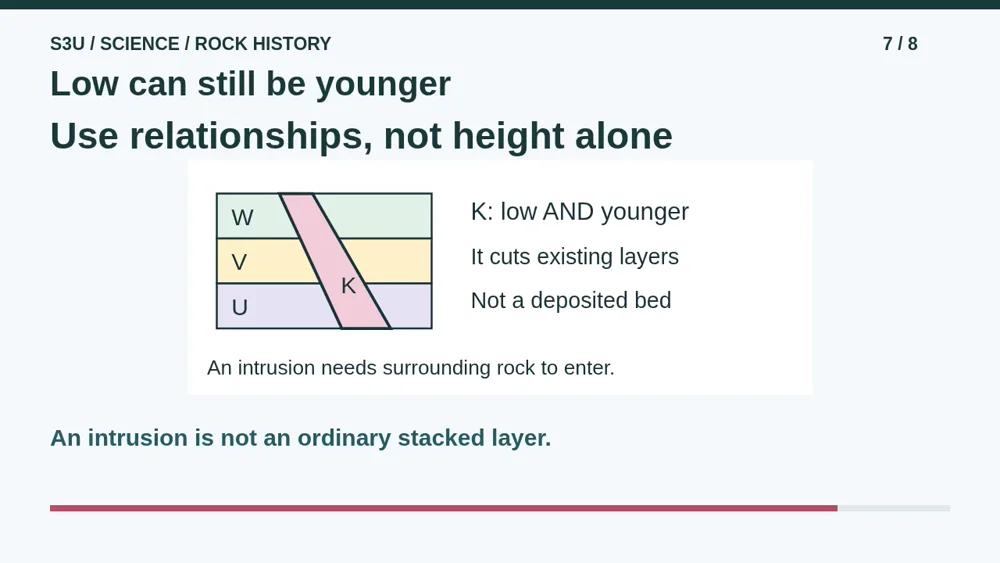
Fun fact: an intrusion can be younger than rocks above it as well as beside it. Molten material can enter older surrounding rock, then solidify. Its position low in a picture does not overrule the evidence that it cuts or intrudes that rock. Geologists combine relationships rather than giving every rock a place in one simple stack. In our paper model, explain one relationship at a time. We are not measuring a real cliff or visiting a quarry.
8. Continue to the rock record
Video: 4:09
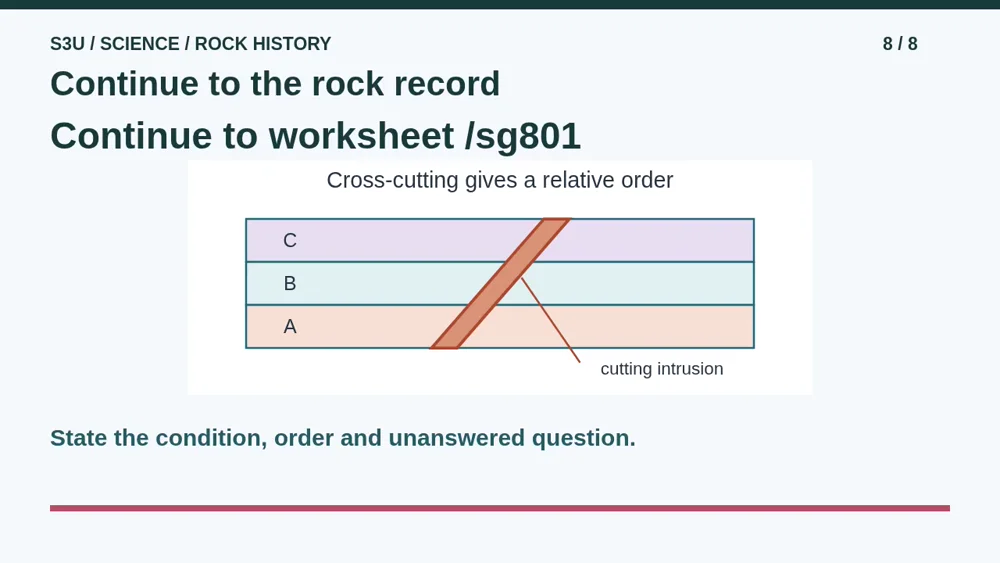
Continue to the worksheet below. It has different labels, so read its evidence rather than copying the letters from this lesson. State the upright, undisturbed condition, order the sedimentary layers, then place the intrusion using what it cuts. Finish by naming one question the supplied evidence cannot answer. You can also revisit the final sessions of Rock Evidence Lab for a longer explanation and revision. Use paper or a private spoken account; collecting and uploading are not required.
Show your understanding
You can point, explain aloud, draw or write.
- Combine superposition, intrusion and explicit truncation evidence into a justified event sequence.
- Explain why relative order, height in a picture and layer thickness do not supply equal time gaps or numeric ages.
Try it yourself
Pause at upright layers P, Q and R cut by I. Give the event order and explain why neither height nor thickness supplies an exact age.
Continue to the worksheet with its own labels. For a longer paper explanation and revision, revisit Rock Evidence Lab; no field visit or upload is required.
Next: your worksheet
Order Rock Layers and Cutting Eventshttps://s3u.com/sg801
Lesson: https://s3u.com/lessons/read-the-rock-record