History / Grade 9
Read the gaps in an archive
Learning goal: Identify a collection's people, dates and record types; preserve missing perspectives as unknown and suggest relevant further evidence.
Before you start: Identify who wrote a short source and when. All collections are fictional; no private records or outside research are needed.
Read or print this lesson What to practiceThe video could not load. The transcript is still available below.
Next: your worksheet
Notice What an Archive Does Not Cover - Practice 1
Checking sign-in...
Read the transcript
Saved reading place
Video transcript and practice. Reading or printing does not count as playback time or an assessed grade.
1. A box is not the whole past
Video: 0:00
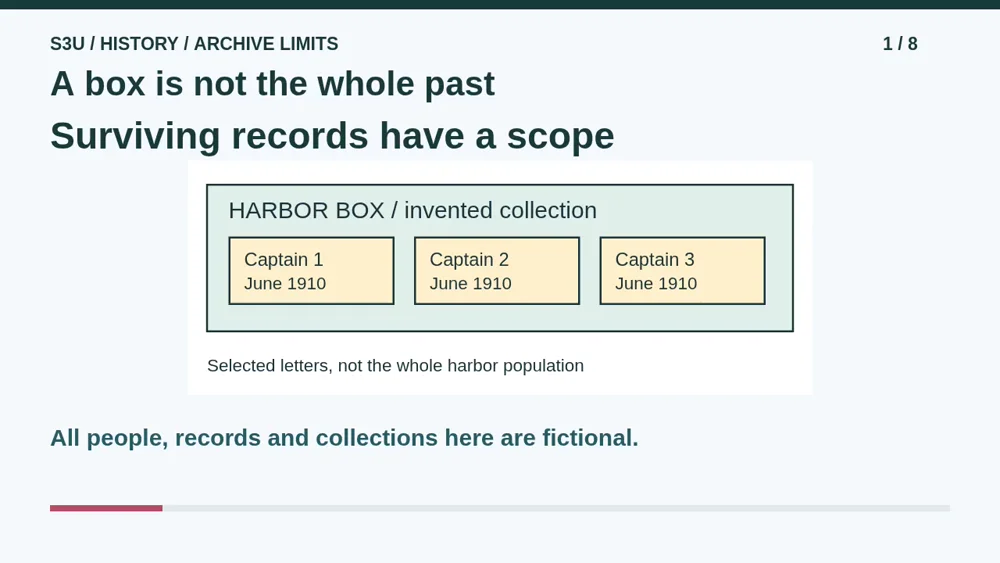
Imagine opening a pretend harbor archive. Its box contains letters from three captains, all written in one month. Those letters may help answer questions about those captains. They are not automatically the voices of every passenger, dock worker, or resident. All the records in this lesson are invented. Our task is to identify what a collection covers, what it leaves open, and what evidence could help next.
2. Start with the collection description
Video: 0:32
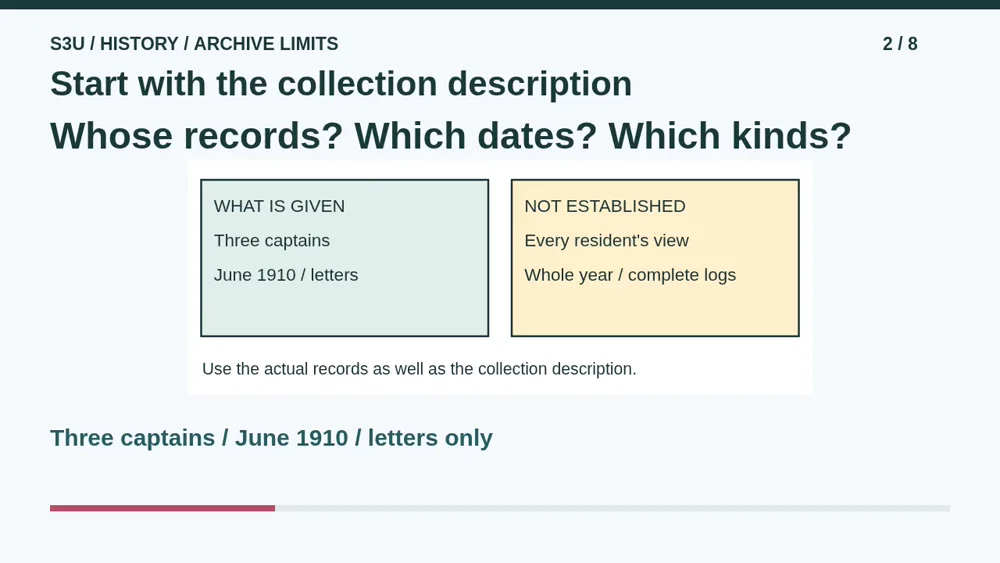
The description says three captains, June nineteen ten, letters only. Keep all three limits in view. We cannot quietly turn three captains into all residents, June into a whole year, or letters into complete shipping logs. A box marked letters is not a tiny time machine containing everything. The description gives us a starting boundary; reading the actual records lets us investigate what they say within it.
3. Missing can have different explanations
Video: 1:03
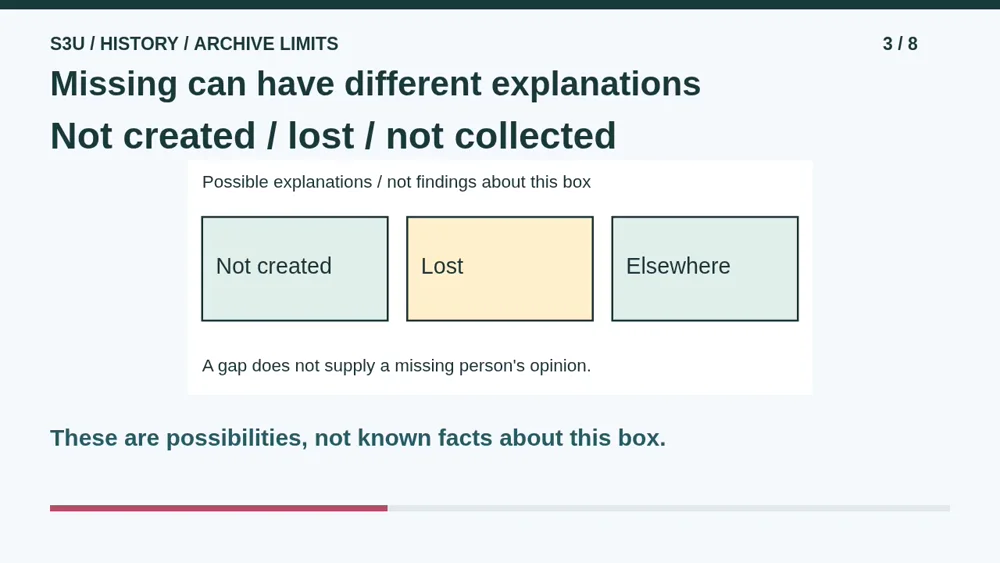
A record might never have been created. It might have been lost, kept elsewhere, or not selected for this collection. These are possible explanations, not facts we have established about our pretend box. We must not invent a missing person's opinion, or decide that an event never happened just because no record appears here. The right response to a gap is a careful question, not a confident extra sentence.
4. Ask what another record could add
Video: 1:34
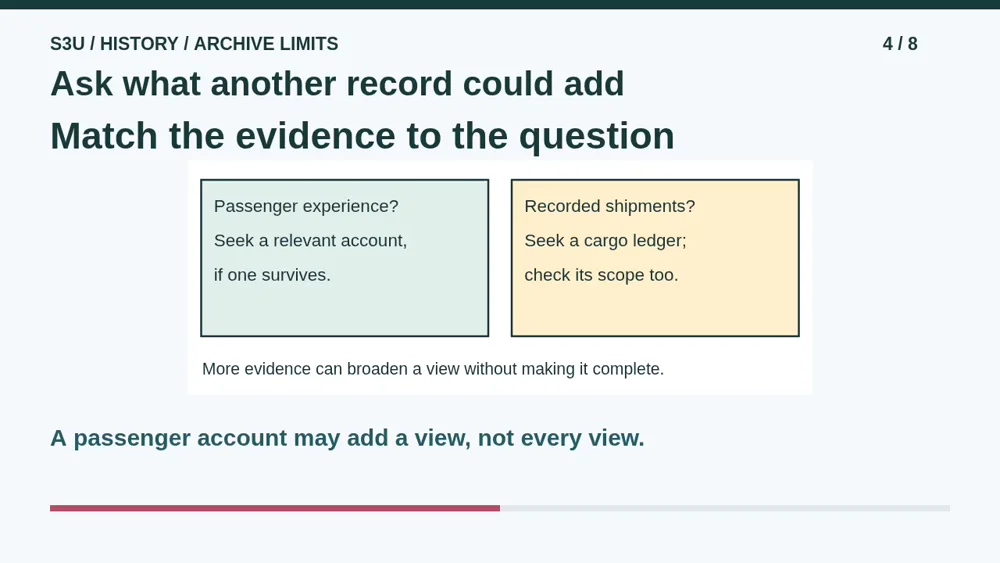
To investigate a passenger's experience, we could look for a passenger's account from a comparable time and journey, if one survives. A cargo ledger could help with recorded shipments, but would not automatically tell us what every passenger thought. Another account can broaden the evidence without making it complete. Explain why the proposed source fits the question, and keep checking its creator, date, purpose and limits.
5. Pause: a different archive
Video: 2:04
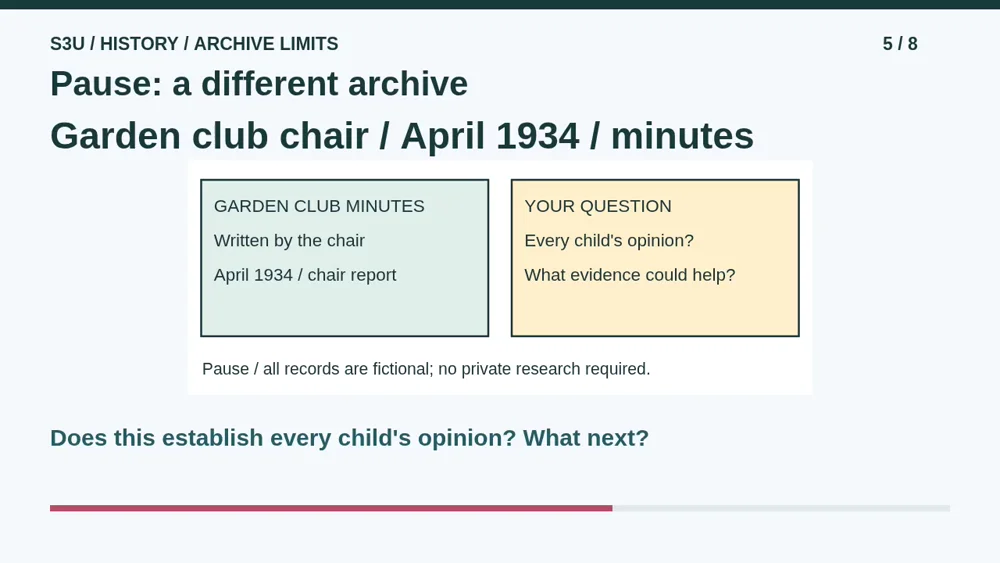
Pause at a new fictional collection. It contains meeting minutes written by a garden club chair in April nineteen thirty-four. The minutes describe the chair's report on a new public garden. Does this collection establish what every child in town thought of the garden? State the limit, then suggest one kind of additional evidence that could help investigate children's experiences without assuming such evidence survives.
6. Keep unknown views unknown
Video: 2:35
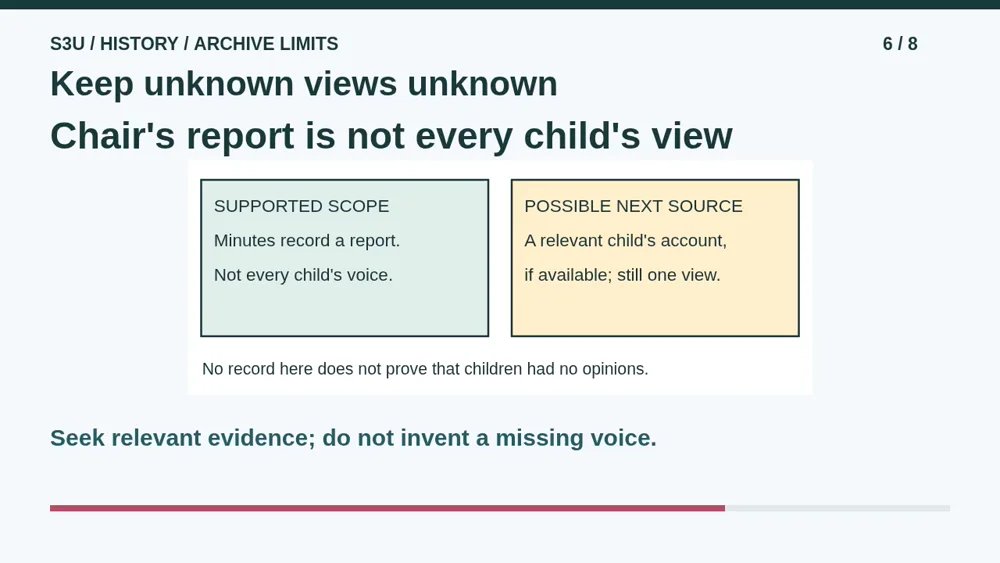
No. These minutes record the chair's report, not every child's opinion. They do not prove that children had no opinions, either. A relevant child's account from that time could add one perspective, if available. It would still not represent every child. A strong answer identifies both the collection's limit and a useful next question, without filling the gap with an imagined historical quotation.
7. Online is not the whole archive
Video: 3:07
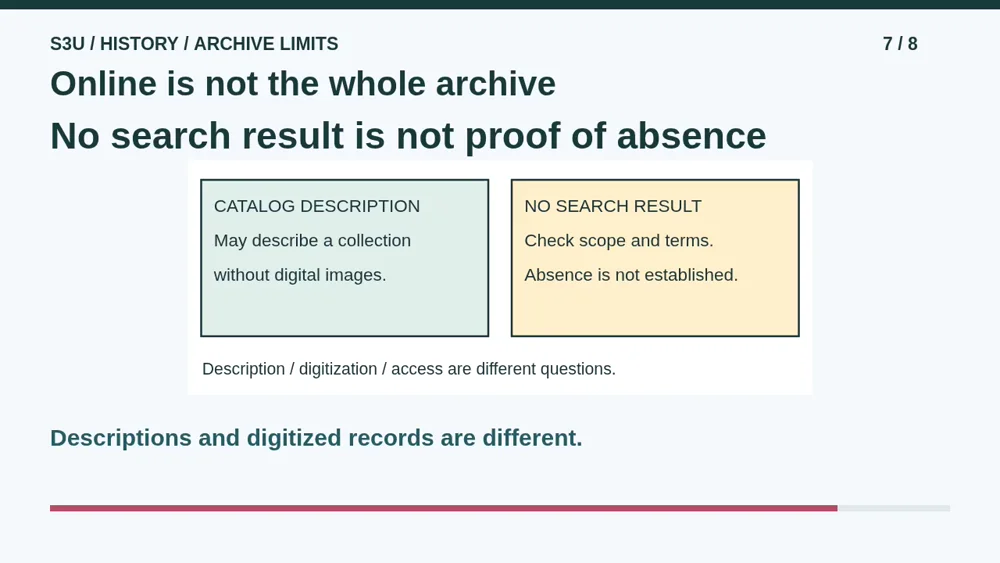
Fun fact: an online archive description can point to records that have not been digitized. The National Archives explains that some research requires records beyond what is available online. So an empty search result is not proof that the evidence never existed. Search terms, descriptions, access, and digitization all matter. For this lesson, stay with our supplied examples; you do not need to contact anyone or search for private records.
8. Continue with collection limits
Video: 3:41
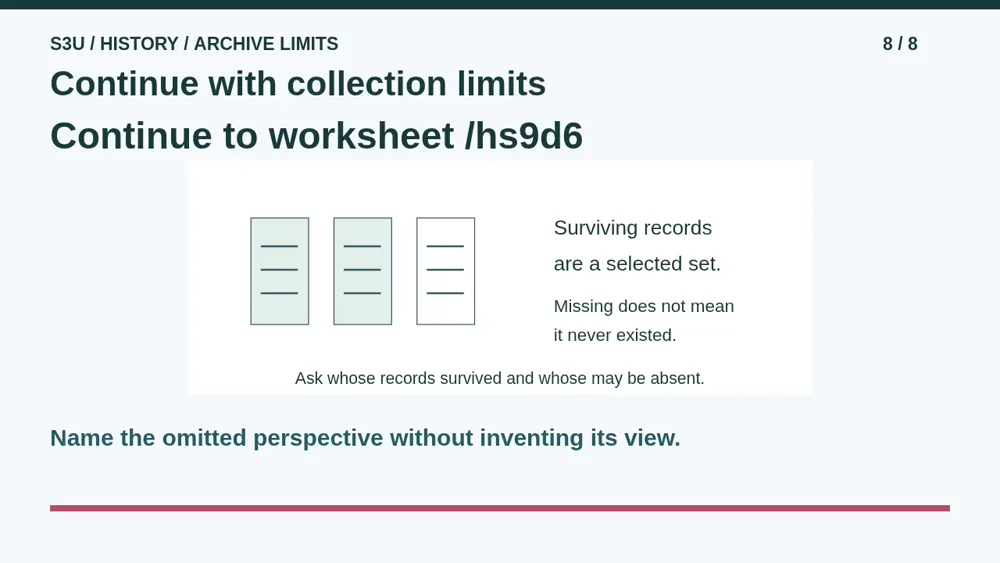
Continue to the worksheet below. Each fictional collection is limited to a stated group of writers. Identify whose perspectives that set may omit. Do not decide what those missing people believed. Practice Two gives different groups. You can explain your reasoning aloud or on paper. A careful historical answer can say what the evidence supports, what remains unknown, and what further evidence might help.
Show your understanding
You can point, explain aloud, draw or write.
- Identify a collection's stated writers, dates and record types without treating it as the whole population or past.
- Explain a missing-perspective limit, suggest relevant additional evidence without assuming it survives, and distinguish online search results from all archival holdings.
Try it yourself
Pause at the garden club minutes. Explain what the chair's report cannot establish about children's views and suggest relevant further evidence.
Continue to both worksheets. Identify potentially omitted perspectives without inventing their opinions.
Next: your worksheet
Notice What an Archive Does Not Cover - Practice 1https://s3u.com/hs9d6
Lesson: https://s3u.com/lessons/read-the-gaps-in-an-archive