History / Grade 3
Read a timeline without guessing
Learning goal: Order fictional dated records, read the year labels and separate event order from cause.
Before you start: Compare positive four-digit numbers and use earlier and later. An adult can read the dates aloud.
Read or print this lesson What to practiceThe video could not load. The transcript is still available below.
Next: your worksheet
Order Records by Their Dates - Practice 1
Checking sign-in...
Read the transcript
Saved reading place
Video transcript and practice. Reading or printing does not count as playback time or an assessed grade.
1. Put the dates to work
Video: 0:00
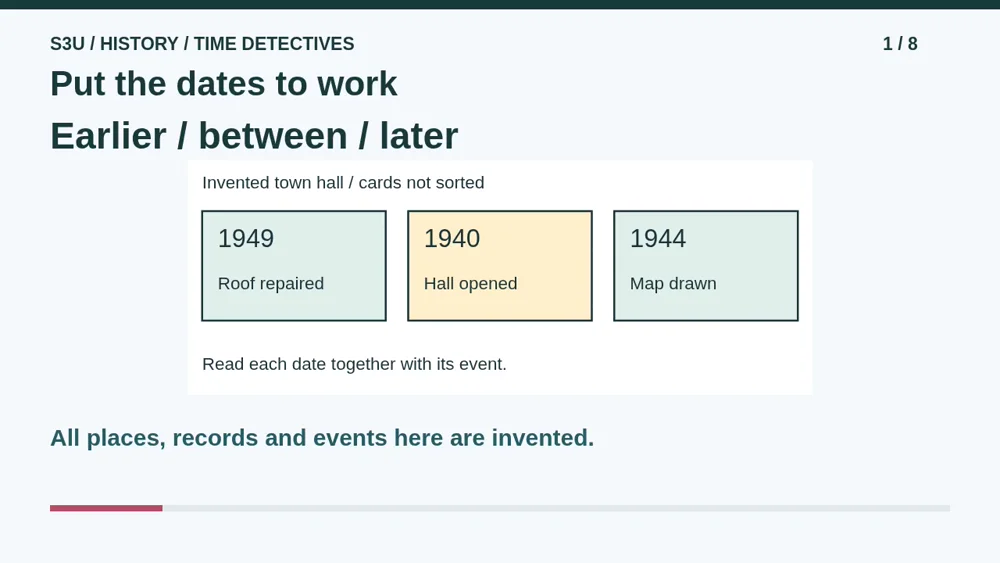
The records for a pretend town hall have slipped out of order. The roof was repaired in nineteen forty-nine. The hall opened in nineteen forty. A map was drawn in nineteen forty-four. Our job is to put the dates in order. These are invented records, not facts about a real town. No time machine is needed, just careful reading.
2. Start with the smallest year
Video: 0:27
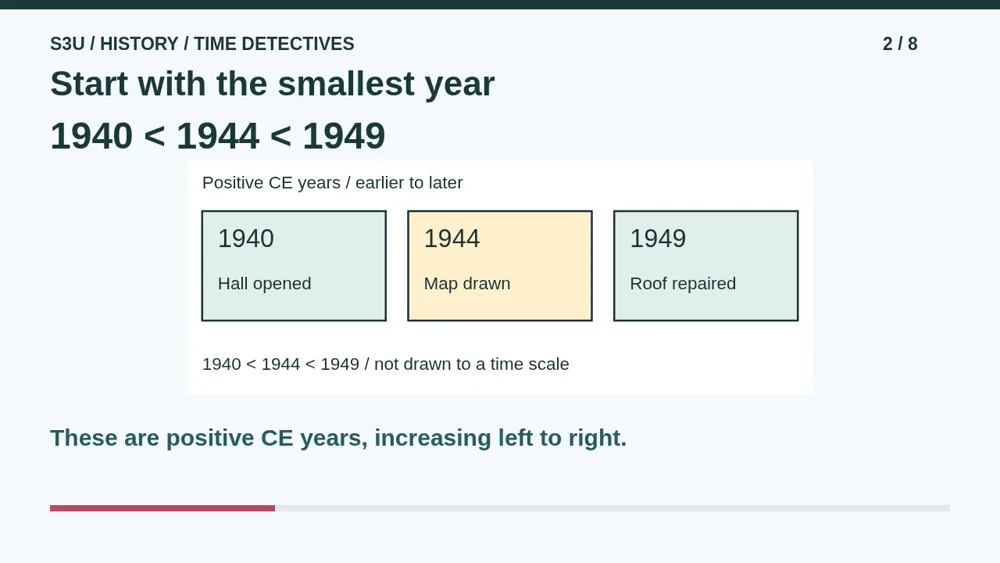
These dates are positive C E years, the kind we usually use today. The smaller year comes earlier. Nineteen forty is first, nineteen forty-four is between the others, and nineteen forty-nine is last. Keep each event with its date. Opening comes first, drawing the map comes next, and repairing the roof comes last. Sorting the numbers must not swap their labels.
3. Read the gaps, not just the dots
Video: 0:56
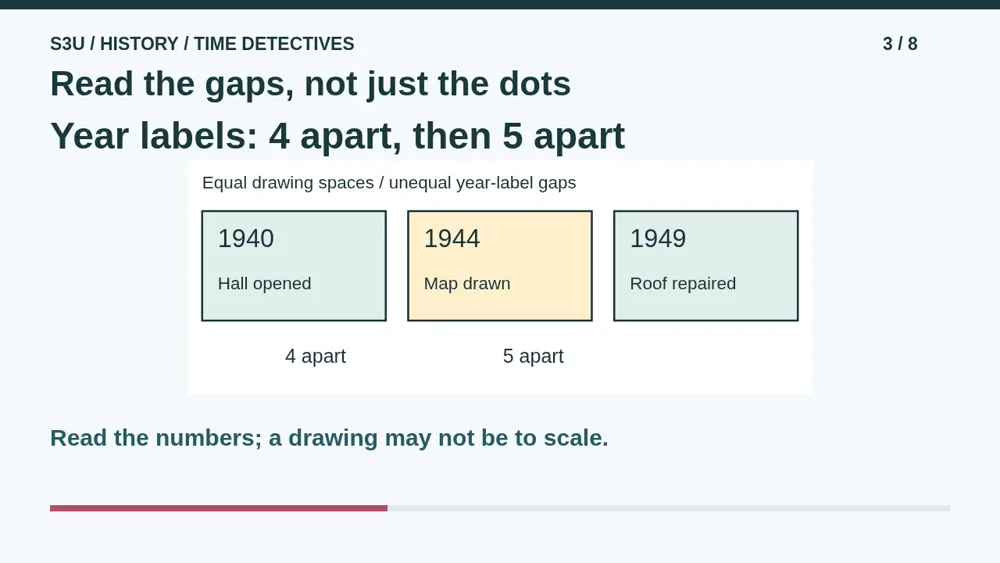
The year labels nineteen forty and nineteen forty-four are four apart. The next labels are five apart. But this drawing puts all three cards at equal distances so their words fit. Equal gaps on this page do not mean equal time. A timeline needs a clear scale before we can measure time from the spaces. Our cards are an ordered list, not a ruler.
4. A date does not tell the whole story
Video: 1:24
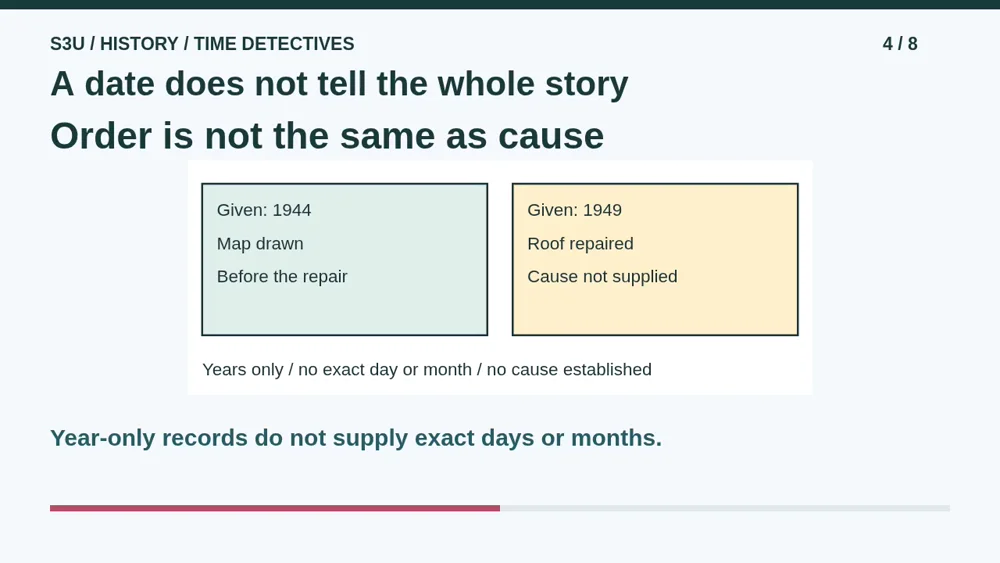
We know the map was drawn before the roof repair. Does that prove the map caused the repair? No. We would need more evidence about why the roof needed work. These records give years, but no months or days. We can compare their year labels without pretending we know the exact time between the events. A timeline shows an order; it cannot answer every question.
5. Pause: sort three new records
Video: 1:53
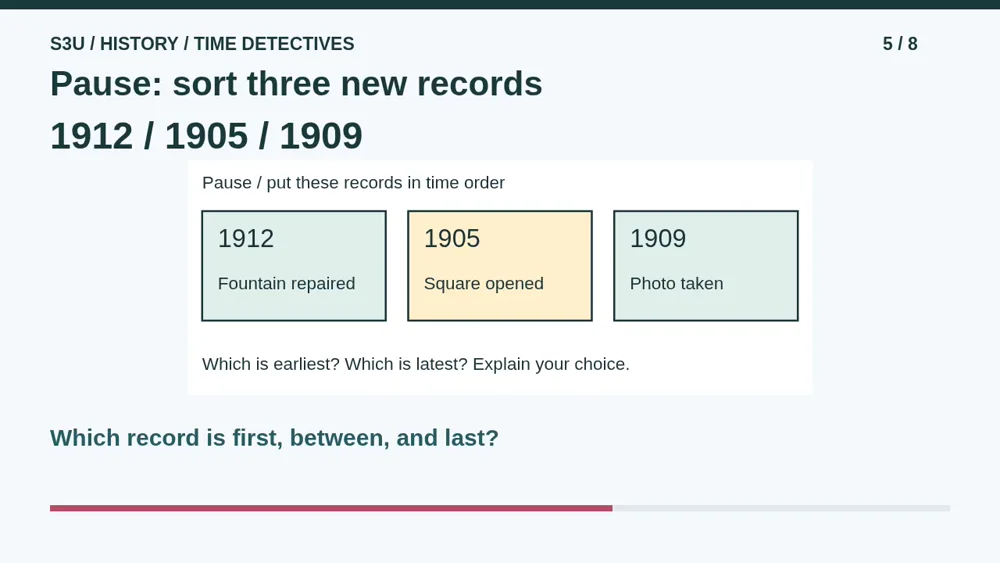
Try a new pretend archive. Its fountain was repaired in nineteen twelve. A square opened in nineteen oh five. A photograph was taken in nineteen oh nine. Pause and put the three records in order from earliest to latest. Say each event with its year, or point to the cards. Does the photograph prove why the fountain was repaired? Think before continuing.
6. Check the labels and the limit
Video: 2:22
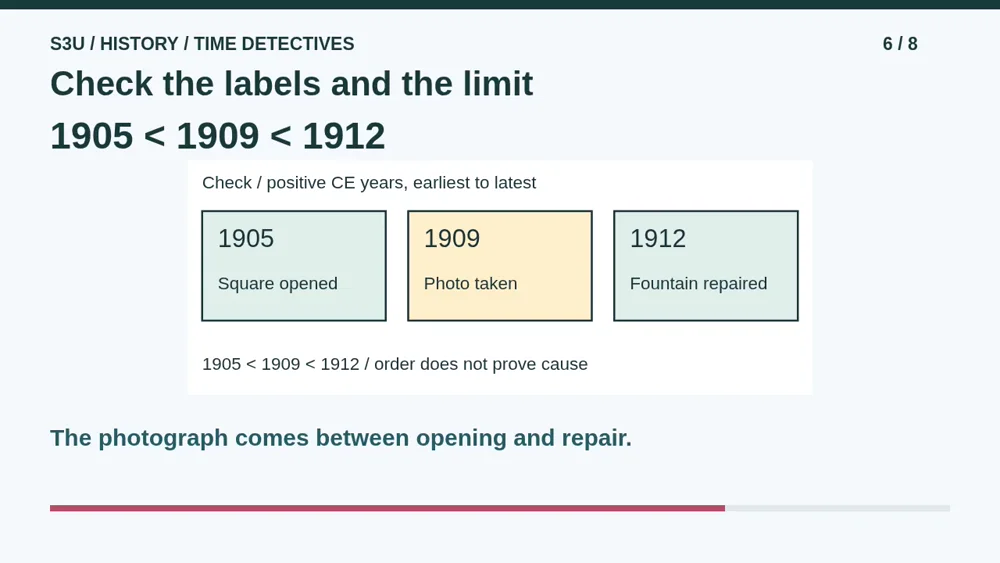
The square opened first, in nineteen oh five. The photograph came next, in nineteen oh nine. The fountain repair was last, in nineteen twelve. We kept the event and year together. The photograph came before the repair, but that order alone does not explain why a repair was needed. We would look for more clues rather than inventing a reason.
7. A crowded timeline can still be right
Video: 2:49
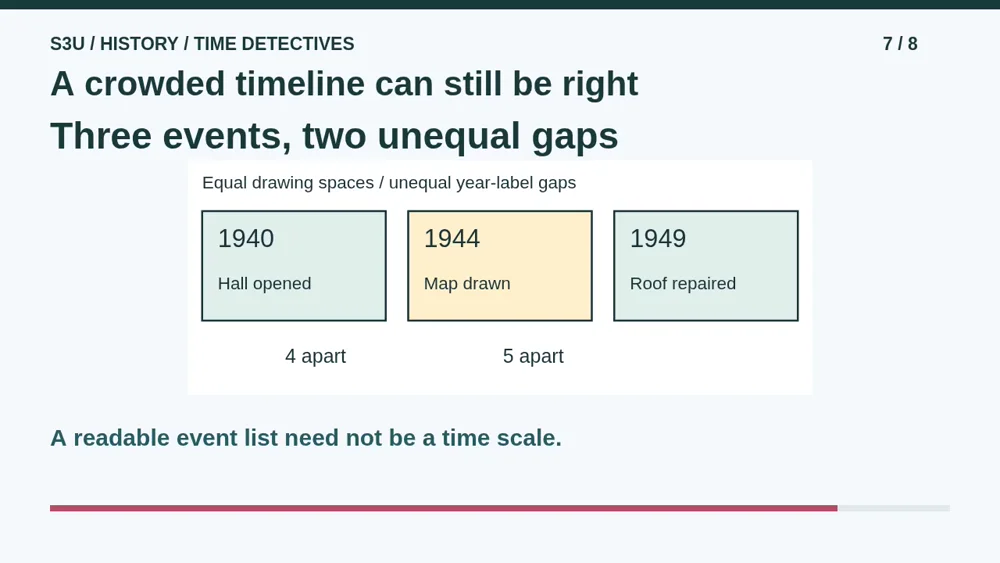
Fun fact: two neat, equal spaces in an event list can stand for different lengths of time. Our first list has gaps of four and five in its year labels, even though the cards are evenly spaced. Always check what a diagram means. A tidy drawing can help you read, but it cannot add dates the records never gave us.
8. Continue with different dates
Video: 3:12
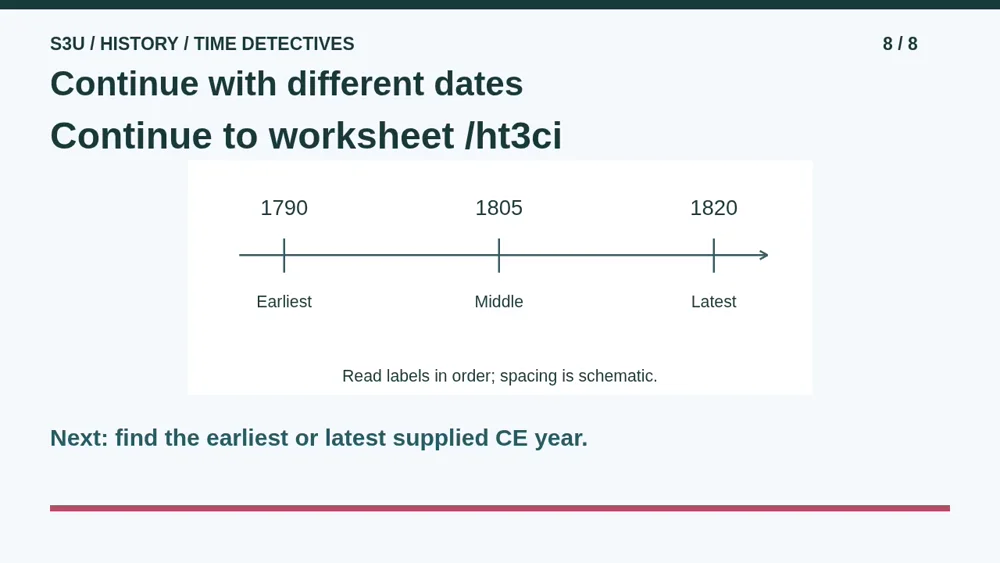
Continue to the worksheet below. Its pretend records use different dates, so read each set carefully. Find the smallest year when asked for earliest, and the largest when asked for latest. Say your reasoning, or write it down. Then try Practice Two for another set. Keep the date labels together and remember that order alone does not explain a cause.
Show your understanding
You can point, explain aloud, draw or write.
- Put supplied positive CE year labels in order while keeping each event with its date.
- Explain why an evenly spaced event list does not prove equal time gaps or the cause of a later event.
Try it yourself
Pause at the new 1912, 1905 and 1909 records. Put each event and its year in order and explain what the order cannot tell you.
Continue to the worksheet for different CE years, then Practice Two. Say or write the reasoning; no real personal records are needed.
Next: your worksheet
Order Records by Their Dates - Practice 1https://s3u.com/ht3ci
Lesson: https://s3u.com/lessons/read-a-timeline