Math / Grade 12
Rates near a point
Learning goal: Compare an interval average with a derivative using a secant, a nearby input and a two-sided limit for x squared.
Before you start: Evaluate x squared, expand a squared sum and calculate slope using signed coordinate differences. Read an interval and a nearby input change h.
Read or print this lesson What to practiceThe video could not load. The transcript is still available below.
Next: your worksheet
Separate Average and Instantaneous Rate - Practice 1
Checking sign-in...
Read the transcript
Saved reading place
Video transcript and practice. Reading or printing does not count as playback time or an assessed grade.
1. One interval, or one point?
Video: 0:00
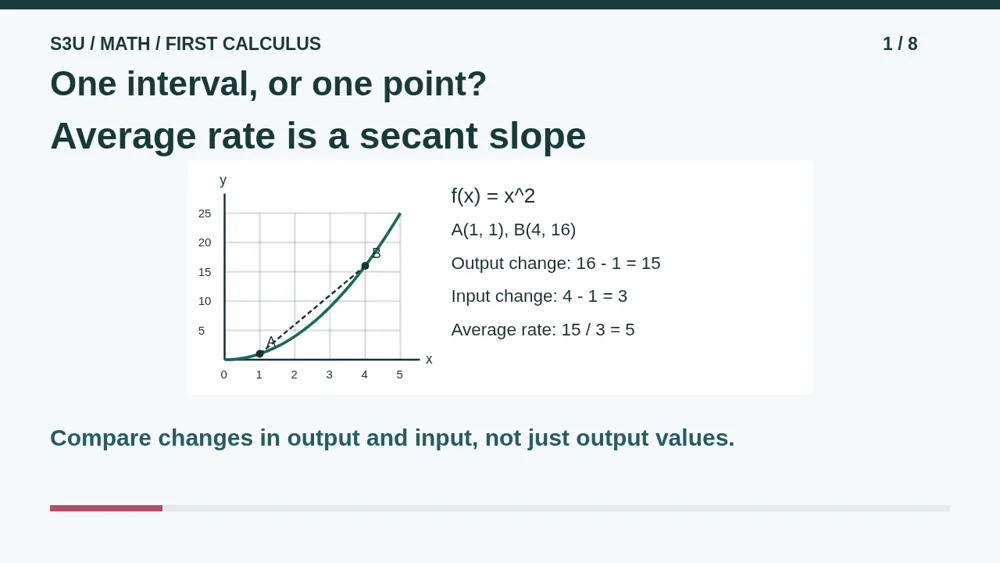
For a straight line, one slope describes the whole line. A curve can change its slope. Let f of x equal x squared. Between x equals one and x equals four, the outputs change from one to sixteen. Divide the output change, fifteen, by the input change, three. The average rate is five. It describes this interval, not every point along the curve.
2. Bring the second point closer
Video: 0:29
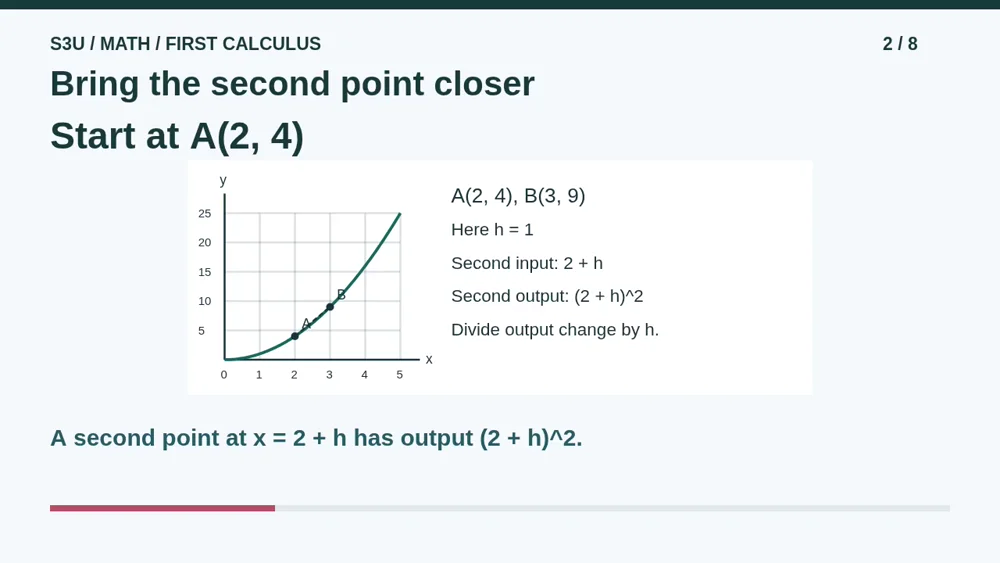
Now ask about the rate right at x equals two. The point is two, four. Choose a nearby second input, two plus h. The letter h measures the input change, so h cannot be zero while we divide by it. A line through these two different points is a secant. Bringing its second point closer helps us investigate a tangent slope at the first point.
3. Simplify before taking the limit
Video: 0:57
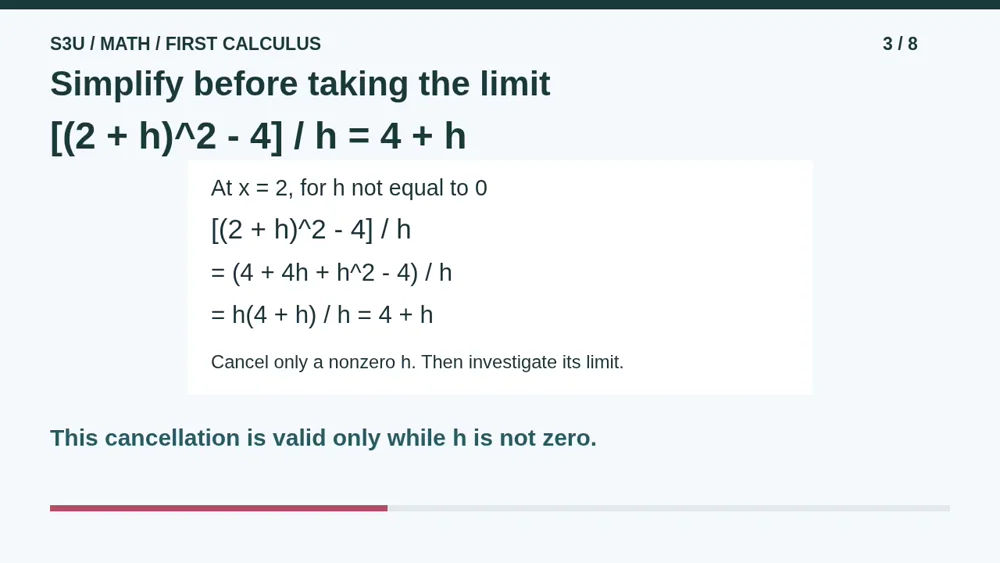
Expand the square: two plus h, all squared, is four plus four h plus h squared. Subtract the starting output, four. The numerator becomes four h plus h squared. Factor out h, then cancel it with the nonzero denominator. The secant slope is four plus h. We have not divided by zero. Zero is still not on the guest list for that original denominator.
4. Approach from both sides
Video: 1:27
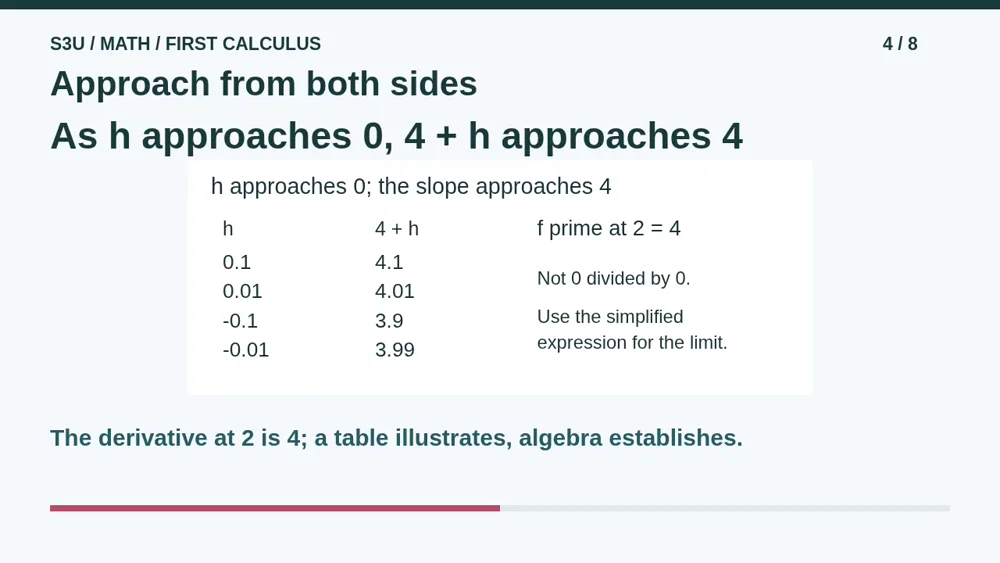
When h is one tenth, the secant slope is four point one. When h is negative one tenth, it is three point nine. Smaller positive and negative changes bring the slopes closer to four. The simplified expression shows the limit is four. That limit is the derivative at two, written f prime of two. It gives an instantaneous rate, rather than the average over a nonzero interval.
5. Pause: two different questions
Video: 1:57
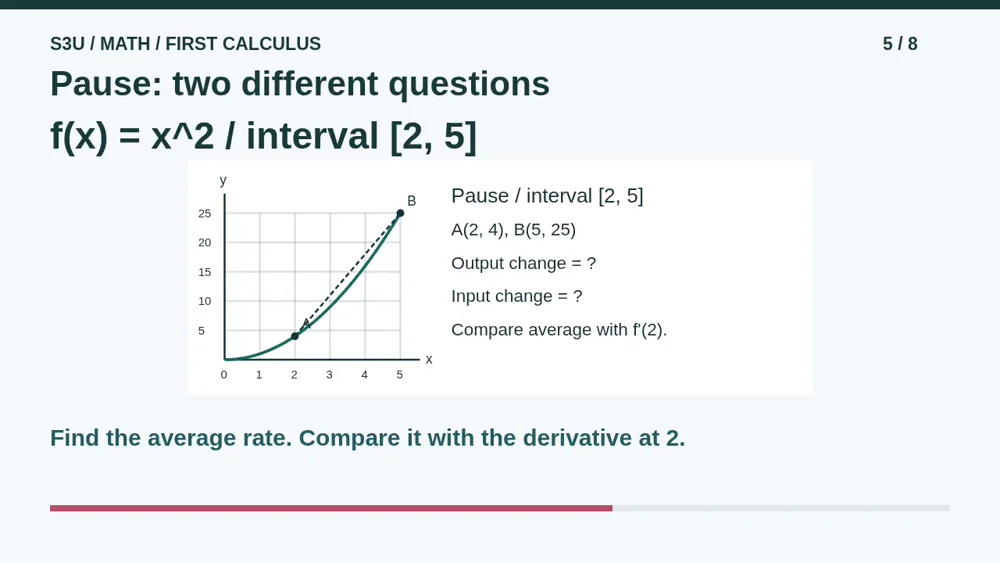
Pause and work a fresh interval from two to five. Find the output change, then divide by the input change. Compare your answer with the derivative at two that we just established. Are they equal? Explain which answer describes an interval and which describes a point. You can write or say the calculation. Do not treat a derivative as a new name for every average rate.
6. The interval average is seven
Video: 2:27
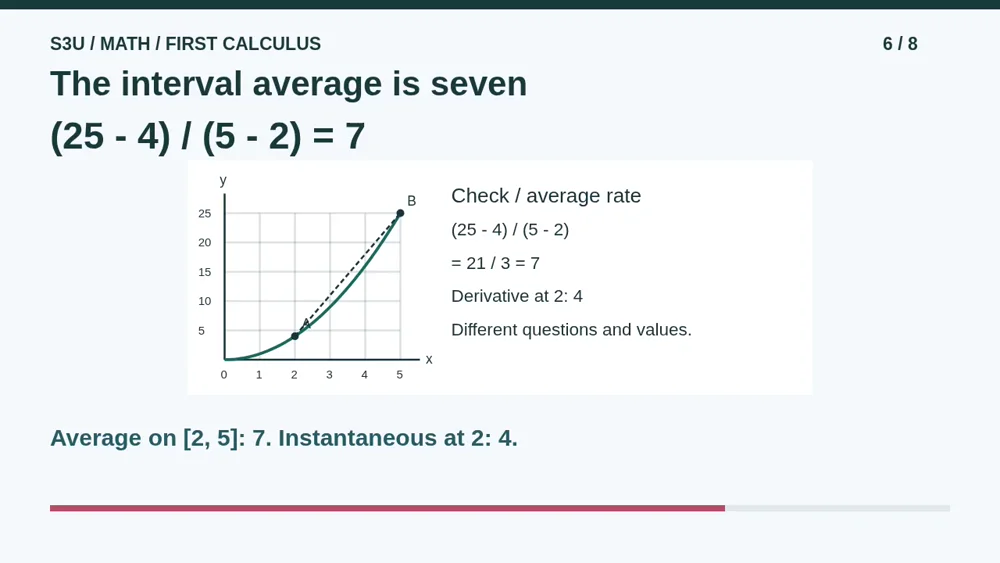
The output increases from four to twenty five, a change of twenty one. The input increases by three. Twenty one divided by three is seven. That is the average rate on this interval. The derivative at two is four, so these answers differ. For x squared, the same expansion at any input a gives a derivative of two a. A different function needs its own justified calculation.
7. Matching numbers, different meanings
Video: 2:58
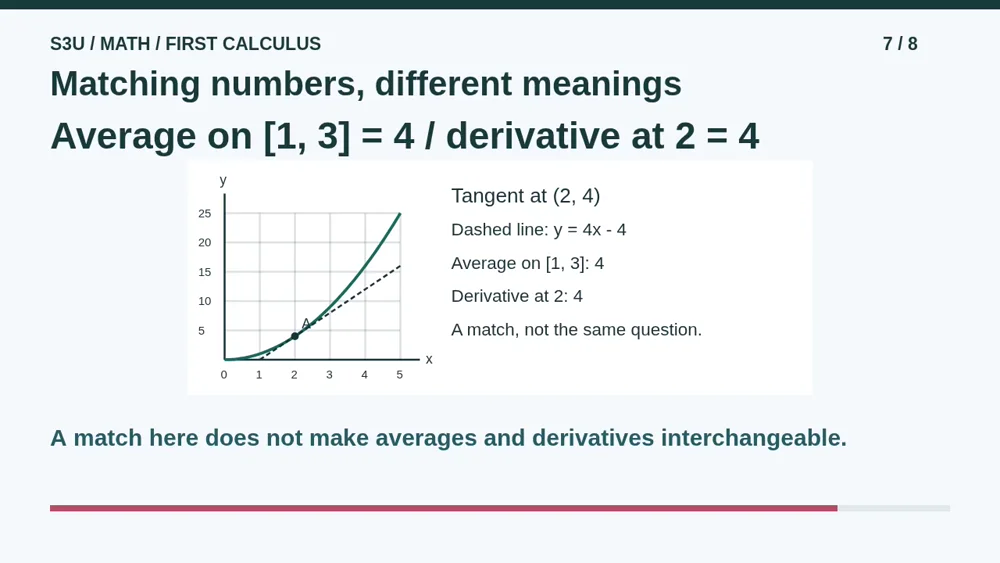
Fun fact: an average rate and a derivative can happen to have the same value. For x squared between one and three, the average is nine minus one, divided by three minus one: four. The derivative at two is also four. But the two questions still refer to different things. This example is not a rule that an interval average always equals a chosen point rate.
8. Continue to the rate worksheet
Video: 3:26
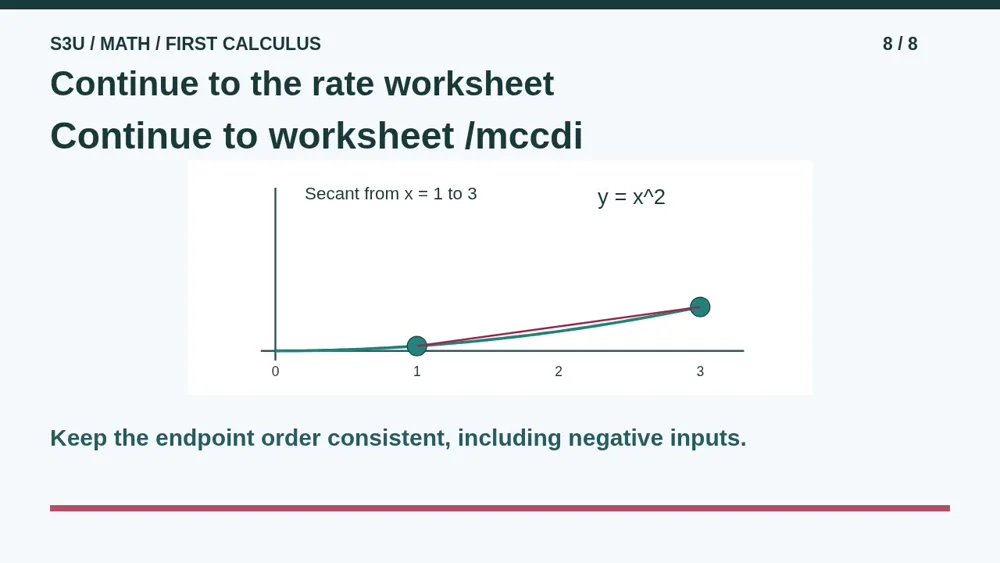
Continue to the worksheet below, then try Practice Two. Its questions ask for interval averages, including intervals with negative inputs. Evaluate the two outputs, subtract in a consistent order, and divide by the corresponding input change. Label the result as an average. A derivative uses a limit when that limit exists. We have established that idea for x squared, not a complete set of differentiation rules.
Show your understanding
You can point, explain aloud, draw or write.
- Find an interval average for x squared and distinguish it from the derivative at a point.
- Explain the nonzero-h simplification and two-sided limit giving derivative 4 at x = 2 without dividing by zero.
Try it yourself
Pause at the interval [2, 5] for x squared. Calculate its average rate and compare it with the derivative at 2.
Continue to the rate worksheet and Practice Two. Distinguish an interval average from a limit at a point, including negative inputs.
Next: your worksheet
Separate Average and Instantaneous Rate - Practice 1https://s3u.com/mccdi
Lesson: https://s3u.com/lessons/rates-near-a-point