Science / Grade 7
Push without sliding
Learning goal: Distinguish actual static friction from its limit, then compare sliding, steady motion and stopping using labeled force models.
Before you start: Add and subtract whole-number forces, distinguish left from right, and recall that balanced forces leave velocity unchanged. Use only the supplied level-floor models; no physical experiment is needed.
Read or print this lesson What to practiceThe video could not load. The transcript is still available below.
Next: your worksheet
Static Friction: A Limit, Not a Fixed Force
Checking sign-in...
Read the transcript
Saved reading place
Video transcript and practice. Reading or printing does not count as playback time or an assessed grade.
1. A push without a slide
Video: 0:00
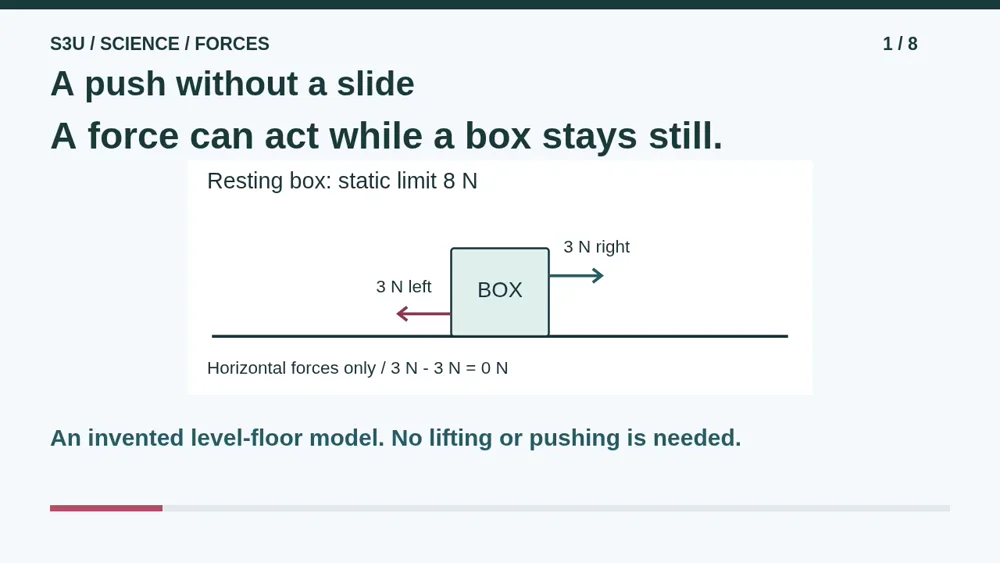
Meet a model delivery box. It has no wheels, no motor, and no appointment to rush to. We apply a horizontal push, but the box stays still on a level floor. Does that mean no forces act? No. We need to compare forces, including friction from the floor. Work with the drawings and numbers; there is no need to push furniture or lift anything.
2. Match the small push
Video: 0:29
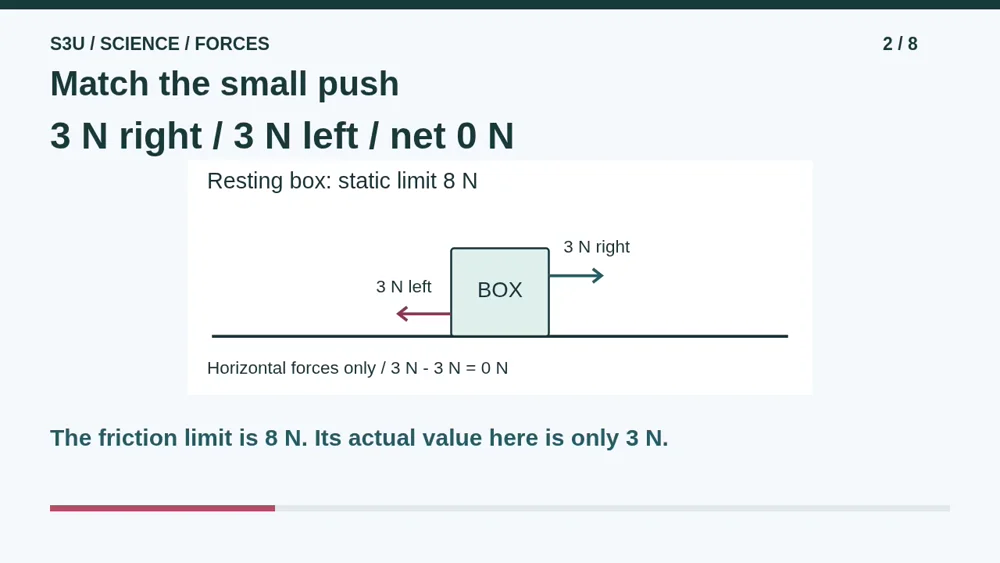
Our box begins at rest. The only horizontal forces are our push and friction. In this model the largest possible static friction is eight newtons. Static means the touching surfaces are not sliding past each other. A three newton push to the right is balanced by three newtons of friction to the left. The net horizontal force is zero. The limit is eight, but the actual friction is three. A maximum is not a command to use the whole amount.
3. A limit is not every reading
Video: 1:04
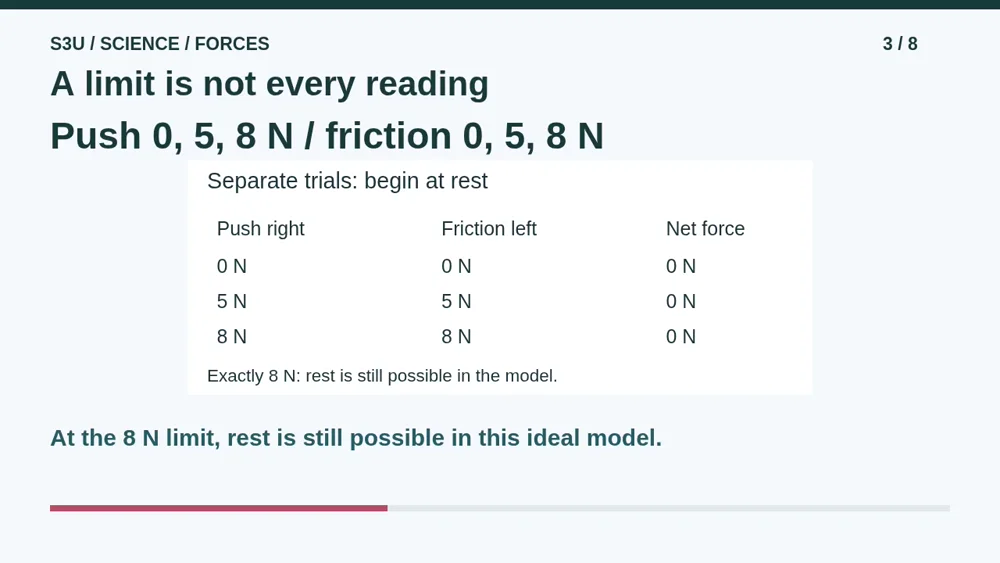
Consider separate trials, each starting with the same box at rest. With no horizontal push or other horizontal force, no horizontal friction is needed. With a five newton push, static friction is five newtons in the opposite direction. At exactly eight newtons, the model can still balance the push, right at the limit. We cannot say that eight must make the box slide. A push above eight cannot be balanced by this static friction. Real measurements and surfaces are less exact than our model.
4. Now the box is sliding
Video: 1:41
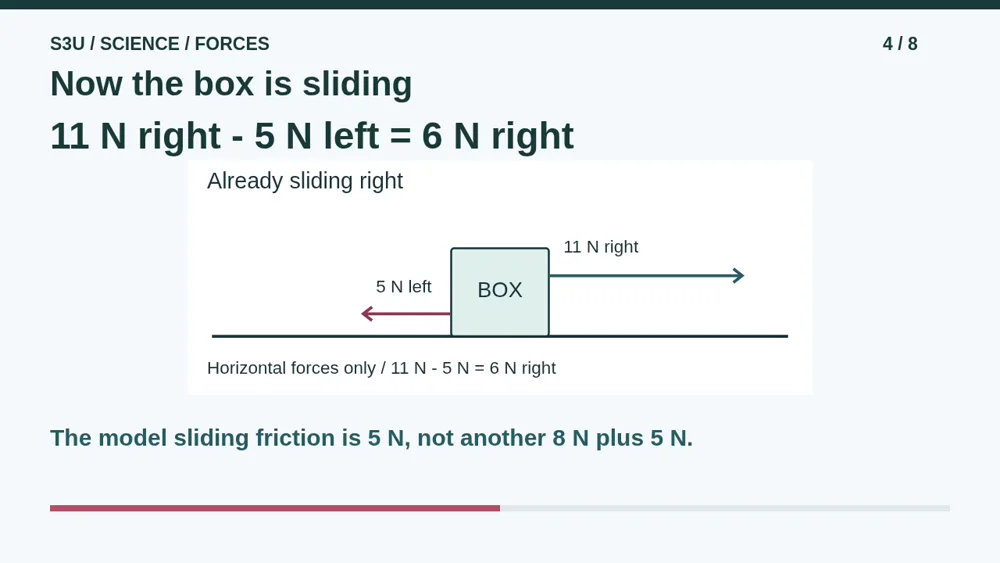
Now the push is eleven newtons to the right, above the eight newton static limit. Once the box slides right, our model gives five newtons of sliding, or kinetic, friction to the left. Subtract five from eleven: the net horizontal force is six newtons right. The box speeds up toward the right. Do not add static and sliding friction together. They describe different contact states, not two floor helpers working at once.
5. Moving does not mean speeding up
Video: 2:13
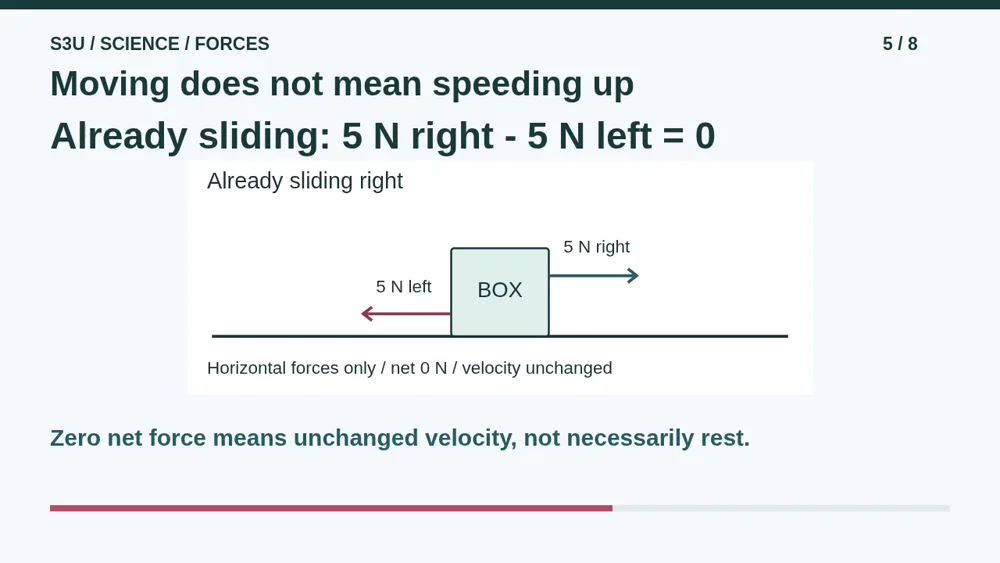
Keep the box already sliding right, but reduce the push to five newtons. Sliding friction is still five newtons left in this simple model. The horizontal forces balance, so the box keeps its current velocity instead of stopping immediately. If the push becomes zero while it still slides right, friction points left and slows it. Once it stops with no horizontal push, do not keep applying the sliding rule and send it backward. Check the contact state again.
6. Pause: a different box
Video: 2:47
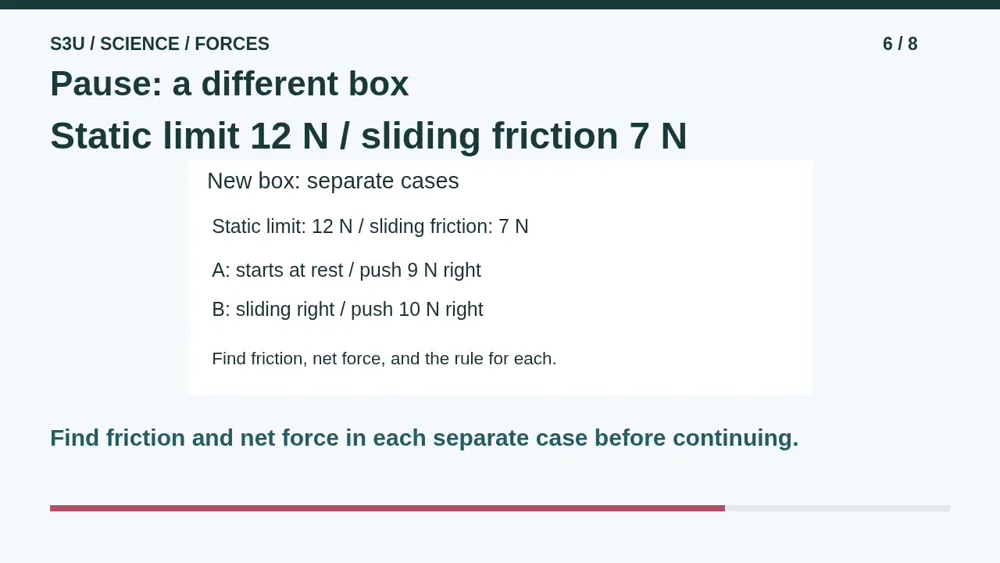
Pause for a new box with a twelve newton static limit and seven newtons of sliding friction. Case A starts at rest with a nine newton push right. Case B is already sliding right with a ten newton push right. Find the friction and net horizontal force in each case. Then explain whether a twelve newton push must start the resting box sliding. These are separate cases, not one continuous journey. Say which rule you used before continuing.
7. Check the state first
Video: 3:21
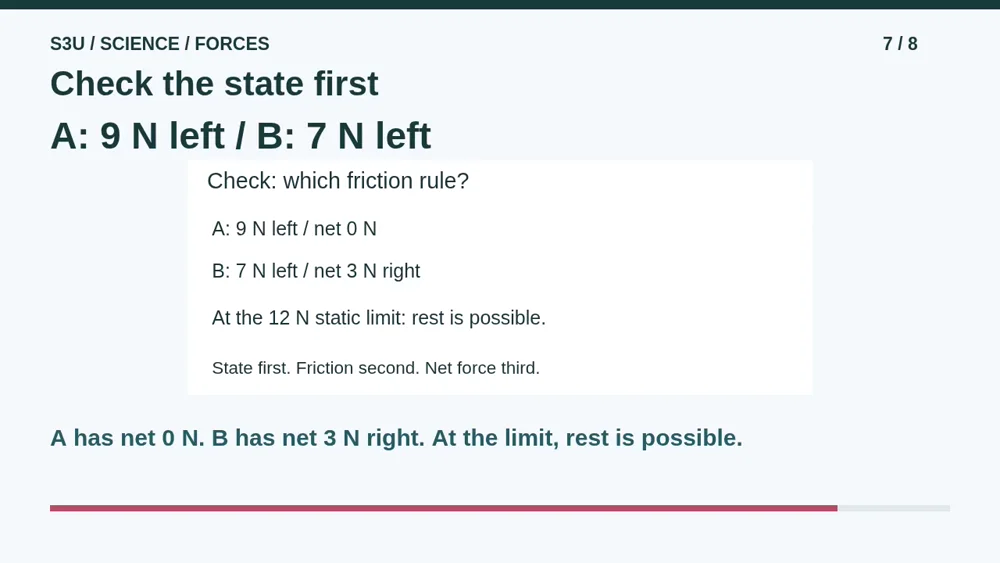
In case A, nine is below the twelve newton limit. Static friction is nine newtons left, giving zero net force. In case B, use the seven newton sliding value, not the twelve newton static limit. Ten minus seven gives three newtons right, so the rightward slide speeds up. At exactly twelve newtons, rest is still possible in our ideal model. Knowing the limit alone is not enough: first ask whether the surfaces are sliding.
8. A useful surprise
Video: 3:54
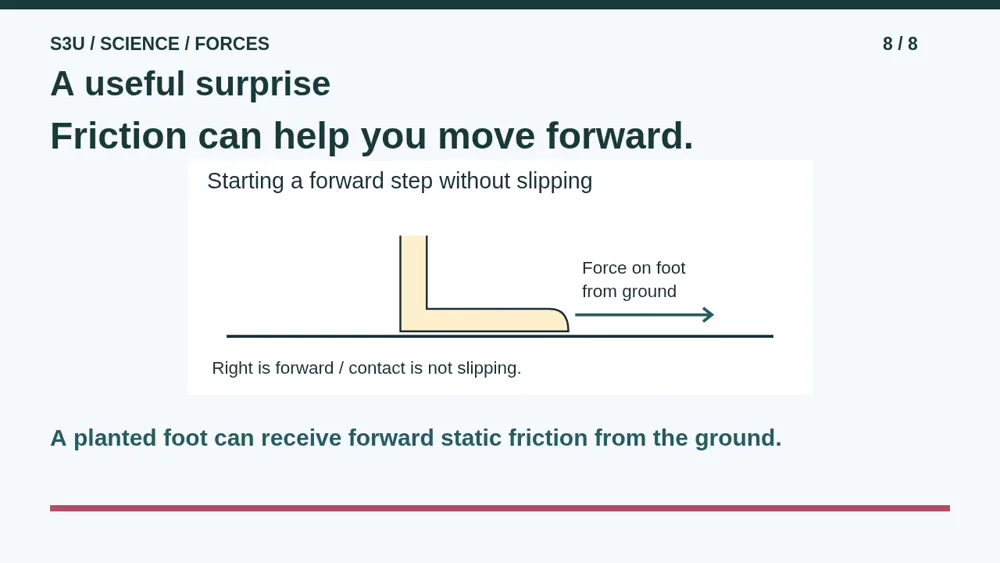
Fun fact: friction is not always a force that slows your whole body. When you start walking forward without your planted foot slipping, that foot pushes backward on the ground. The ground can exert forward static friction on the foot. The contact is not sliding even though your body moves. Our box rule concerns sliding relative to the floor, not a universal backward direction for friction. Continue to the two worksheets below. Use each new model and explain the state before calculating.
Show your understanding
You can point, explain aloud, draw or write.
- Choose actual static friction below or at its stated limit without treating the maximum as a constant reading.
- Use the contact state to find net force during sliding, steady motion and stopping, then explain a fresh case.
Try it yourself
Pause at the new box: static limit 12 N, sliding friction 7 N. Explain each separate case using its contact state.
Continue to the static-friction worksheet, then sliding practice. These are paper models, not instructions to move furniture.
Next: your worksheet
Static Friction: A Limit, Not a Fixed Forcehttps://s3u.com/sf7f1
Lesson: https://s3u.com/lessons/push-without-sliding