Math / Grade 8
Profit for a period, position at a date
Learning goal: Build a simple income statement, follow owner equity, and check a balance sheet without confusing profit with cash.
Before you start: Add and subtract signed whole numbers. Distinguish assets, liabilities and owner equity; review Cash is not the whole workshop if needed. Use only the fictional adjusted records.
Read or print this lesson What to practiceThe video could not load. The transcript is still available below.
Next: your worksheet
Profit and Position: A Workshop Month
Checking sign-in...
Read the transcript
Saved reading place
Video transcript and practice. Reading or printing does not count as playback time or an assessed grade.
1. Two questions, two time labels
Video: 0:00
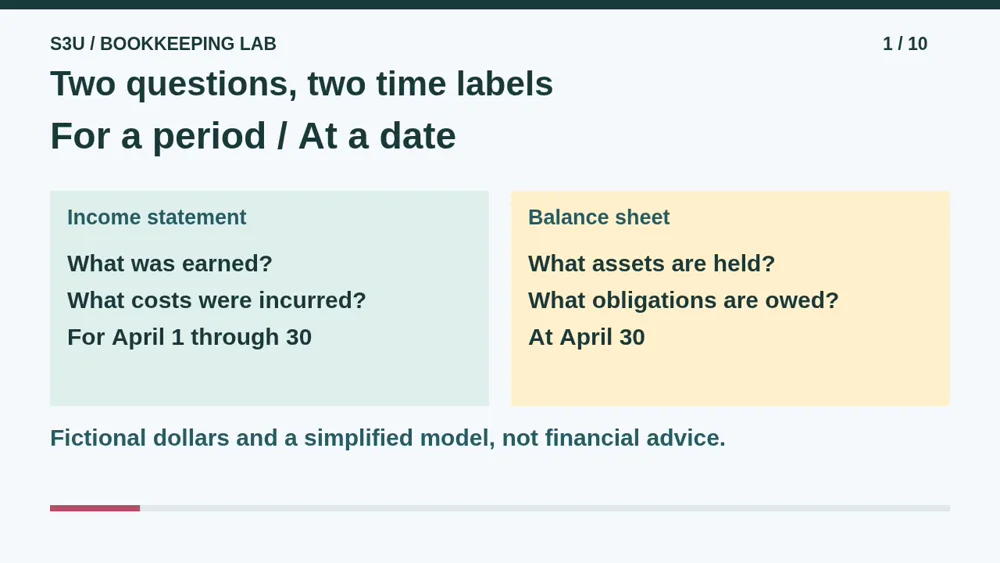
A workshop can have cash and still report a loss. That sounds like the cash box is telling a joke, but the reports answer different questions. An income statement covers a period: what revenue was earned, and what expenses were incurred? A balance sheet describes assets, liabilities and equity at one date. We will use fictional dollars and supplied final adjusted amounts. No other accounts, interest, taxes or depreciation apply in this simplified model. This is bookkeeping practice, not financial advice.
2. Start with the period result
Video: 0:39
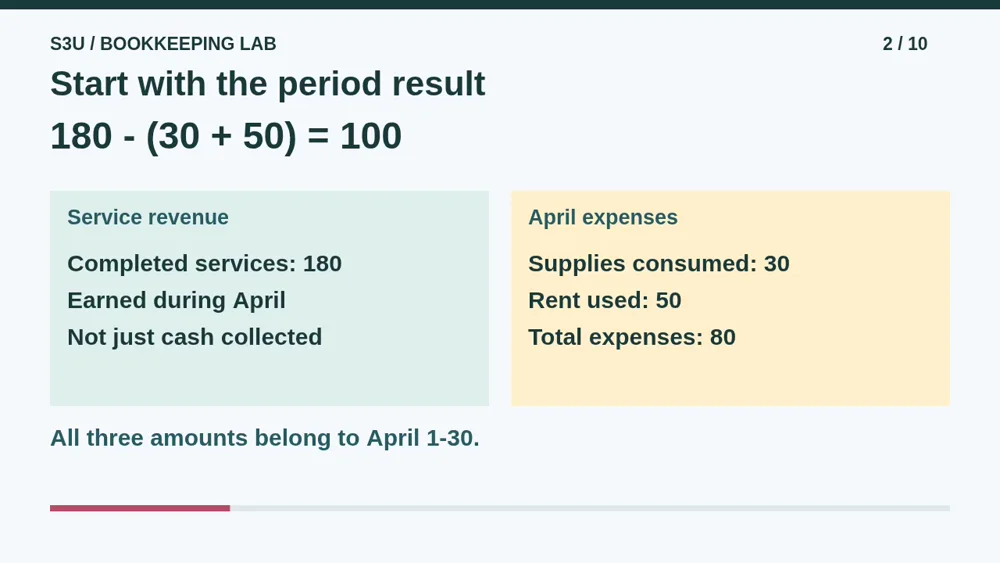
Our model repair workshop completed services worth one hundred eighty dollars in April. It consumed thirty dollars of supplies and used fifty dollars of rent. These are the only expenses for the period. Add the expenses: thirty plus fifty is eighty. Subtract eighty from revenue of one hundred eighty. Net income is one hundred dollars. Always attach the period to the result. This is income for April, not a count of money in the cash box at the end of April.
3. Not every receipt is revenue
Video: 1:15
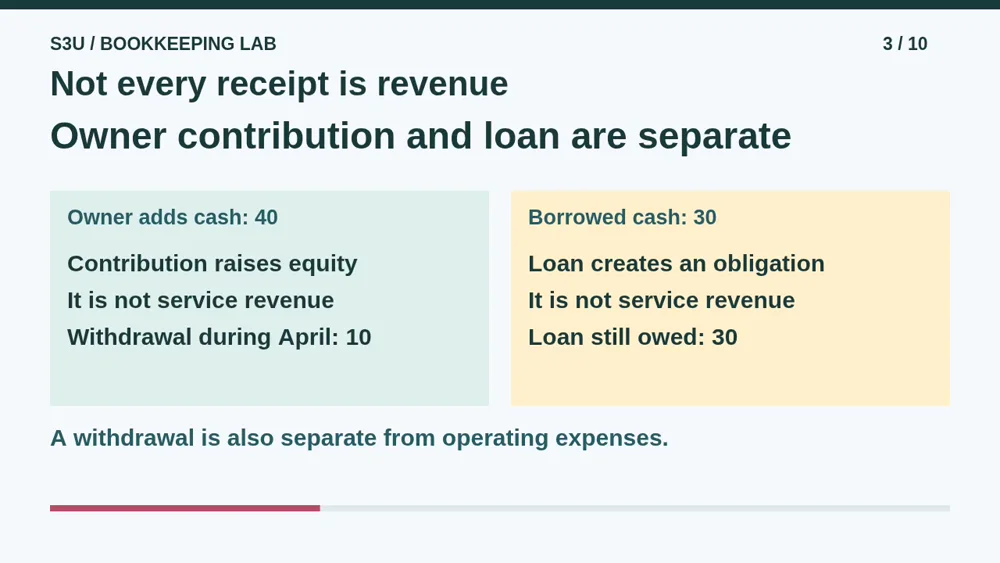
During April the owner also contributed forty dollars, and the workshop borrowed thirty. Both brought in cash, but neither was earned from a customer. Keep both out of service revenue. The contribution raises the owner's equity directly. The loan creates a liability, an obligation to repay. The owner also withdrew ten dollars. That reduces equity directly; it is not an expense of performing repair services. Sorting these events first prevents a busy cash box from pretending that every arrival is profit.
4. Earned is not the same as collected
Video: 1:55
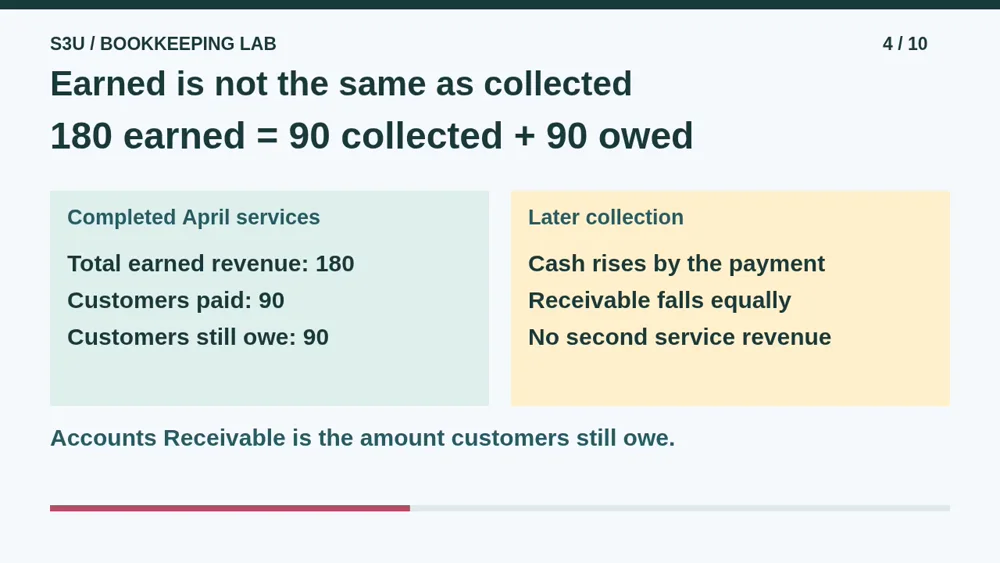
Of the one hundred eighty earned, customers paid ninety by April thirtieth and still owe ninety. The unpaid amount is Accounts Receivable, an asset in this model. Revenue is one hundred eighty, not just the ninety collected. When a customer later pays that recorded receivable, cash increases and the receivable decreases equally. Do not record the same service revenue twice. We are using an accrual model with completed services and supplied adjusted records, not claiming every cash receipt belongs to the period in which it arrives.
5. Follow the owner equity bridge
Video: 2:35
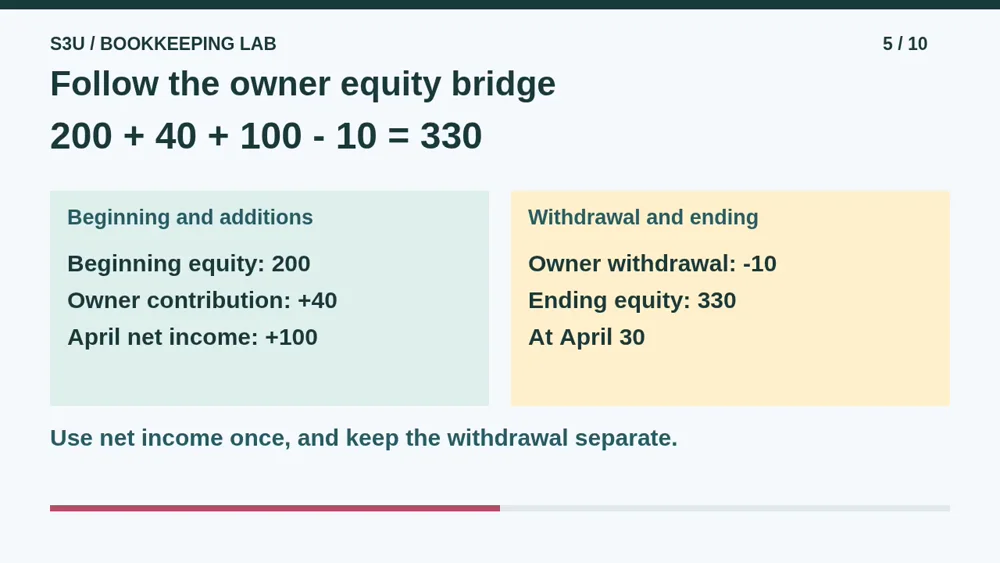
The workshop began April with owner equity of two hundred dollars. Add the forty-dollar contribution and the one hundred dollars of net income. Then subtract the ten-dollar withdrawal. Ending equity is three hundred thirty dollars. This bridge explains how the owner's claim changed over the period. The income statement result flows into the equity calculation. Once it is included, do not add it again when making the balance sheet. That would give the same hundred dollars two seats at the table.
6. Check the end-date snapshot
Video: 3:13
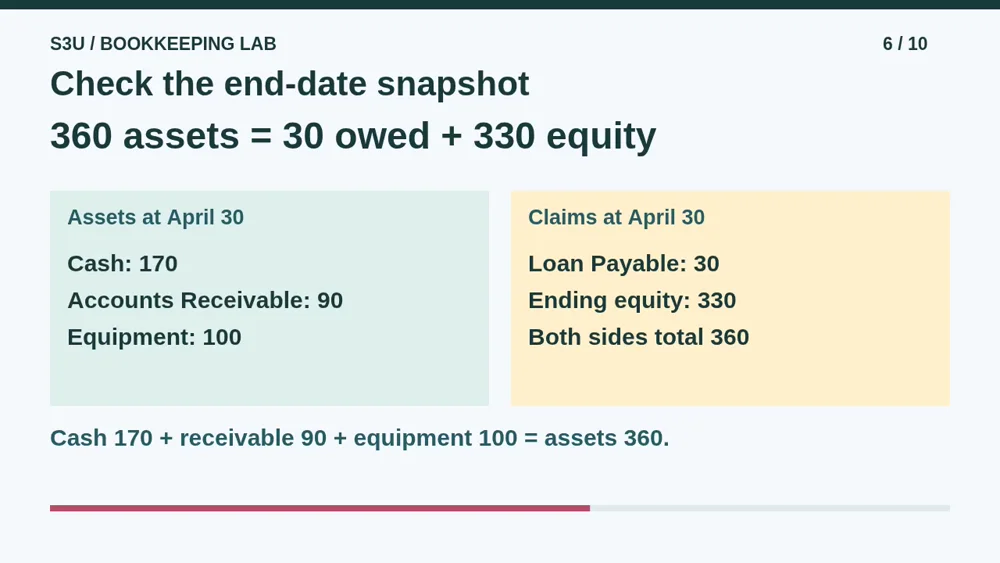
Now read the balances at April thirtieth. Cash is one hundred seventy, Accounts Receivable is ninety, and equipment is recorded at one hundred. Total assets are three hundred sixty. On the other side, the thirty-dollar loan plus ending equity of three hundred thirty also totals three hundred sixty. Cash, profit and total assets are three different numbers. The equation checks the relationship between the supplied balances, but equality alone does not prove that every transaction was recorded correctly. Source records still matter.
7. Pause: build three connected reports
Video: 3:54
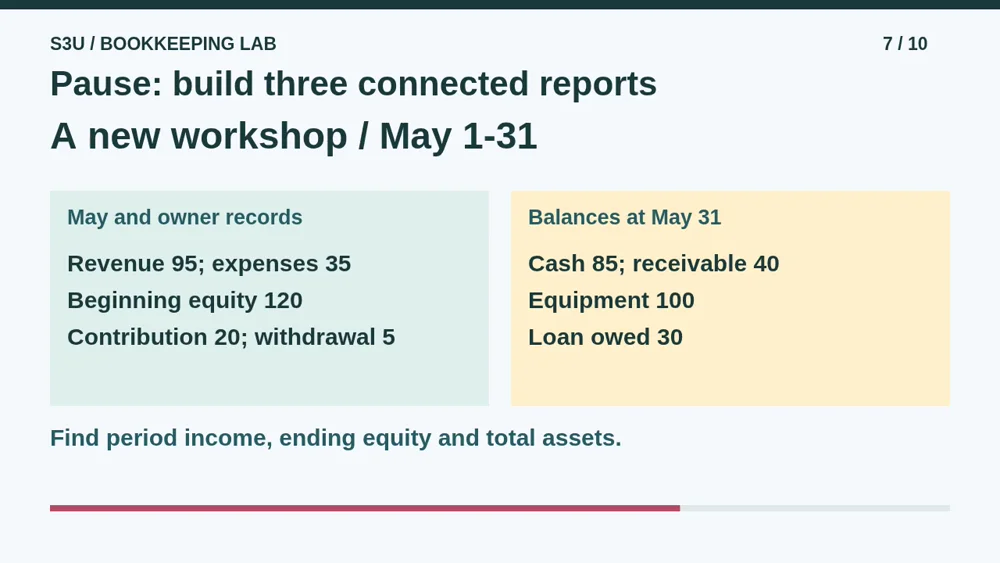
Pause for a new workshop. Its only May revenue is ninety-five dollars and its only May expenses are thirty-five. Beginning equity is one hundred twenty. The owner contributes twenty and withdraws five. At May thirty-first, cash is eighty-five, customers owe forty, equipment is one hundred and a loan of thirty remains owed. These are final adjusted amounts in the same simplified model. Find net income for May, ending equity, and total assets. Then check both sides of the balance sheet. Name the period or date with each answer.
8. Check the fresh workshop
Video: 4:36
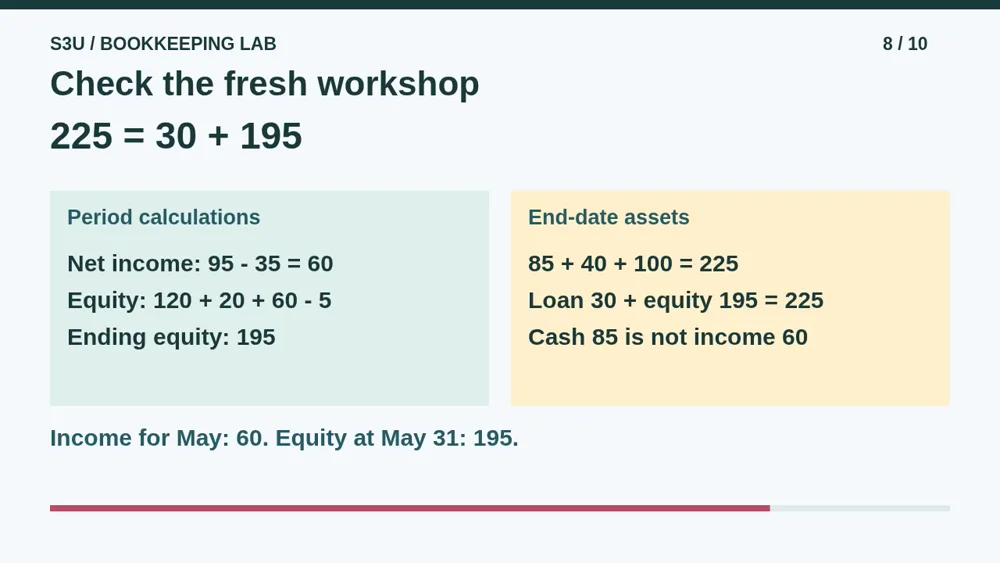
Net income for May is ninety-five minus thirty-five, or sixty. Ending equity is one hundred twenty plus twenty plus sixty minus five, which is one hundred ninety-five. Total assets are eighty-five plus forty plus one hundred, giving two hundred twenty-five. The thirty owed plus equity of one hundred ninety-five matches. Notice what we did not do: we did not count the owner contribution as revenue, count the withdrawal as an expense, or add the same income twice. The date labels keep the three connected reports distinct.
9. A loss can still fit a balanced report
Video: 5:16
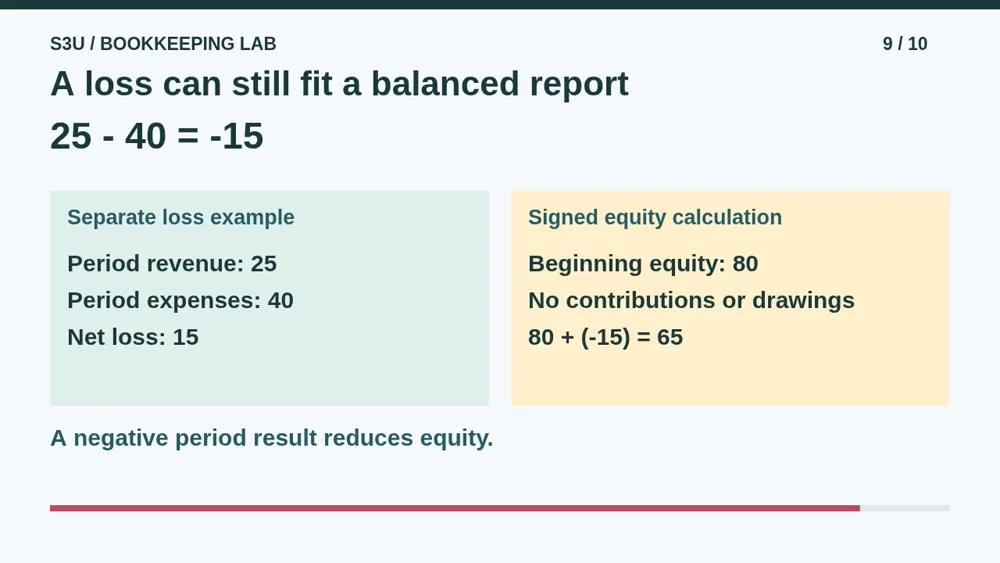
In a separate example, a workshop earns twenty-five and incurs forty of expenses. Revenue minus expenses is negative fifteen, a net loss of fifteen. If beginning equity is eighty and there are no owner contributions or withdrawals, ending equity is sixty-five. A loss reduces equity; it does not mean the balance sheet should stop balancing or that cash must be negative. Read each measure for what it says. A positive cash balance alone cannot prove that this period made a profit.
10. Continue with new workshop records
Video: 5:54
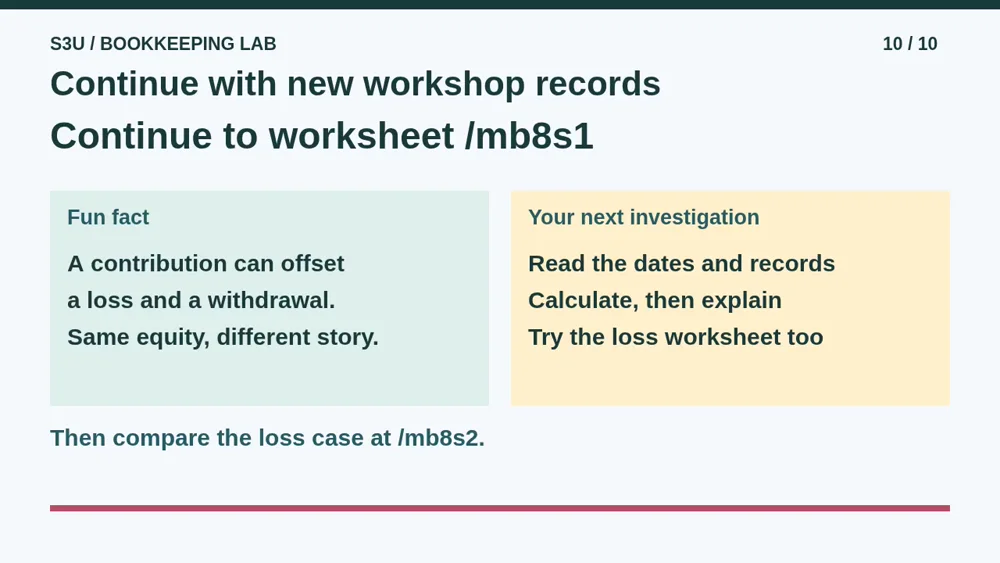
Fun fact: ending equity can equal beginning equity even when the workshop had a loss. A contribution might exactly offset the loss and a withdrawal. The unchanged total would hide the story unless you read the bridge. Continue to the worksheet below for a new profitable workshop, then try the linked loss case. Each has its own records, so do not copy our lesson totals. Explain which amounts belong to a period and which belong to an end-date snapshot. No real account, purchase or personal financial record is needed.
Show your understanding
You can point, explain aloud, draw or write.
- Calculate period income or loss and ending owner equity without treating contributions, loans or withdrawals as operating revenue or expense.
- Check an end-date balance sheet and explain why cash, net income and total assets are different measures.
Try it yourself
Pause at the new May workshop. Calculate income, ending equity and assets from its own records, then check the balance sheet.
Continue to both worksheets. Explain why contributions, borrowing, withdrawals and collecting an existing receivable are not new service revenue or operating expenses.
Next: your worksheet
Profit and Position: A Workshop Monthhttps://s3u.com/mb8s1
Lesson: https://s3u.com/lessons/profit-and-position