Science / Grade 7
How plants build sugars and use energy
Learning goal: Compare photosynthesis and aerobic respiration through their inputs, outputs and energy transfers.
Before you start: Recognize sugar, water, oxygen and carbon dioxide, and follow an input-to-output arrow. Meet the cell team introduces the organelles.
Read or print this lesson What to practiceThe video could not load. The transcript is still available below.
Next: your worksheet
Compare Photosynthesis and Cellular Respiration - Practice 1
Checking sign-in...
Read the transcript
Saved reading place
Video transcript and practice. Reading or printing does not count as playback time or an assessed grade.
1. A plant does more than make sugar
Video: 0:00
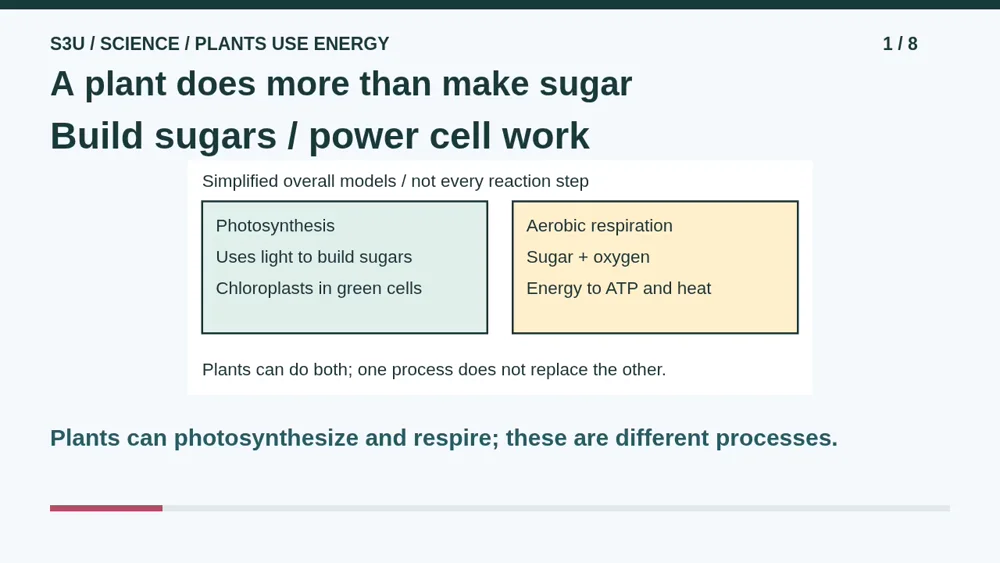
A green plant needs material to grow and energy for cell work. Making sugar and using energy from sugar are connected, but they are not the same process. We will compare photosynthesis with aerobic cellular respiration. These are simplified overall models, not every chemical step. A leaf does not pick one process for its entire life like choosing a favorite sandwich. Living plant cells need continuing energy transfers.
2. Follow the photosynthesis model
Video: 0:34
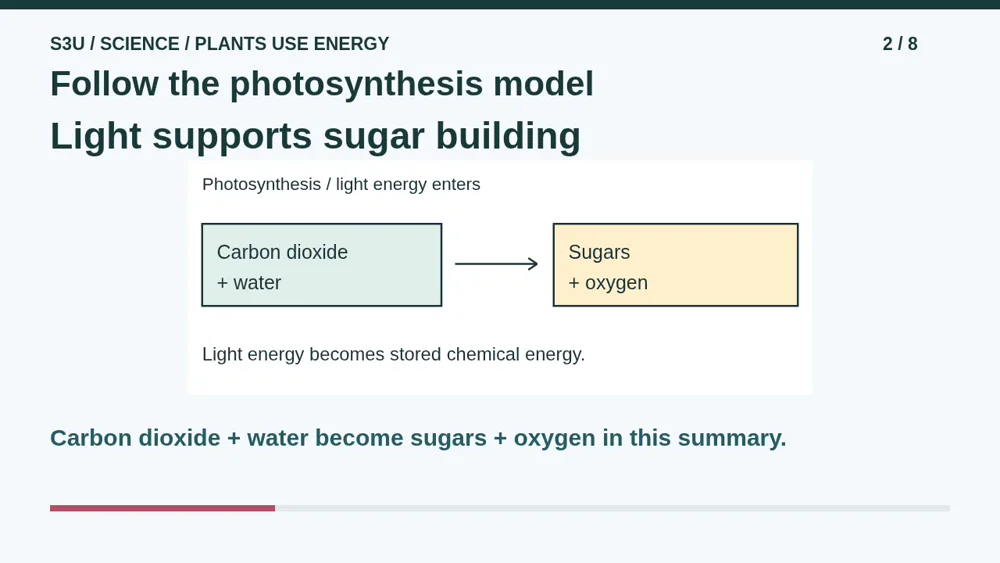
Start with the inputs, carbon dioxide and water. In a green leaf, chloroplasts use light energy in photosynthesis. The overall model produces sugars and oxygen. Energy from light becomes stored chemical energy. The plant is not getting ready-made sugar out of sunlight, and light is not a bag of carbon atoms. Carbon dioxide supplies the carbon used to build sugar. Keep matter and energy separate in your explanation.
3. Follow aerobic respiration
Video: 1:08
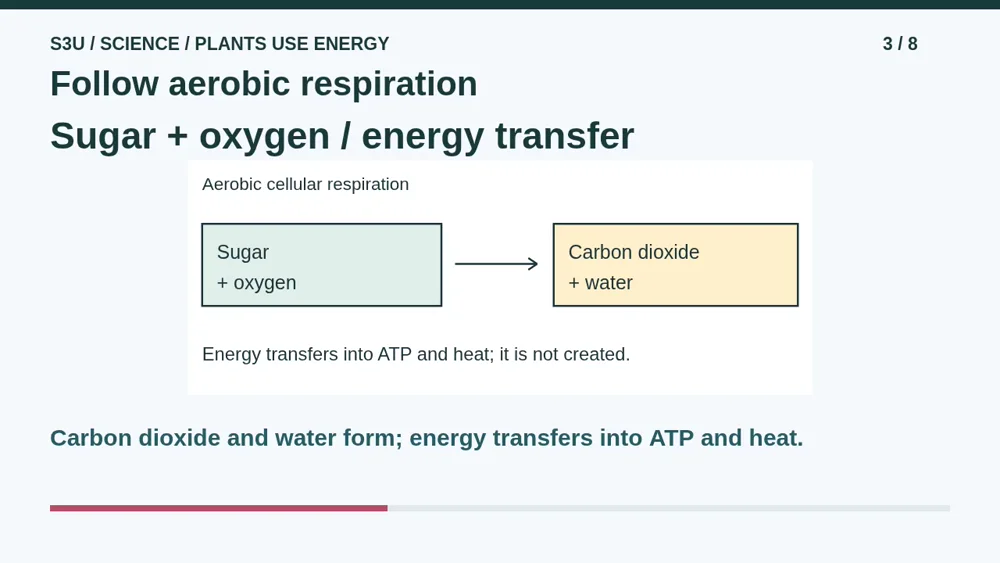
Now follow a different path. Aerobic cellular respiration uses sugar and oxygen, forming carbon dioxide and water. Some transferred energy supports making A T P, which helps power cell work; some becomes heat. Sugar breakdown starts in the cytoplasm, and mitochondria carry out major later steps in these plant cells. Respiration here means cellular chemistry, not simply breathing air in and out. Energy changes form rather than appearing from nowhere.
4. A shared word does not make a match
Video: 1:44
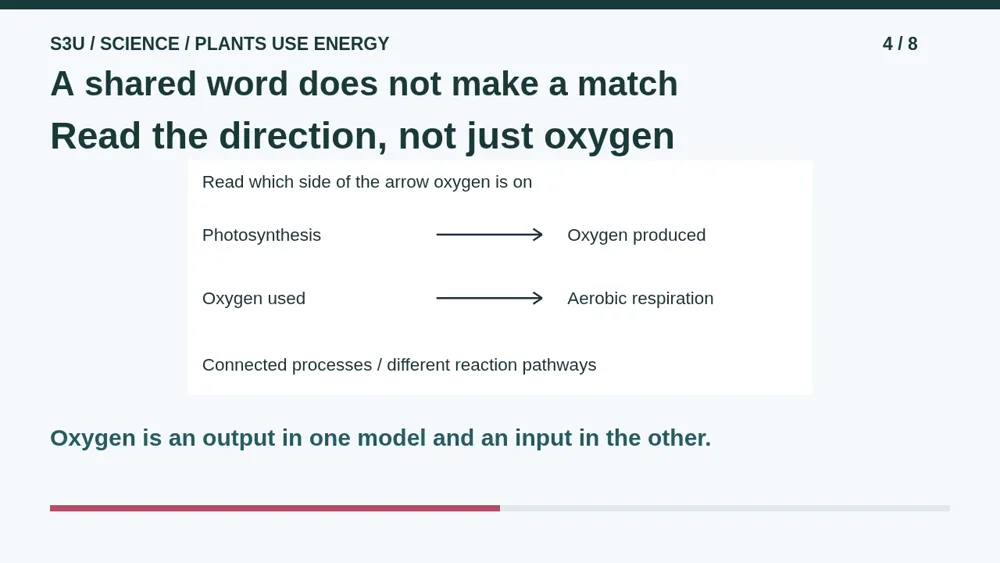
Both diagrams mention oxygen, so the word oxygen alone is not enough to identify the process. Ask which side it is on. In our photosynthesis summary it is produced. In our aerobic respiration summary it is used. The processes connect, but one is not simply the other running backward through identical steps. Like reading a route, you need its direction as well as the names along the way.
5. Pause: a leaf after sunset
Video: 2:15
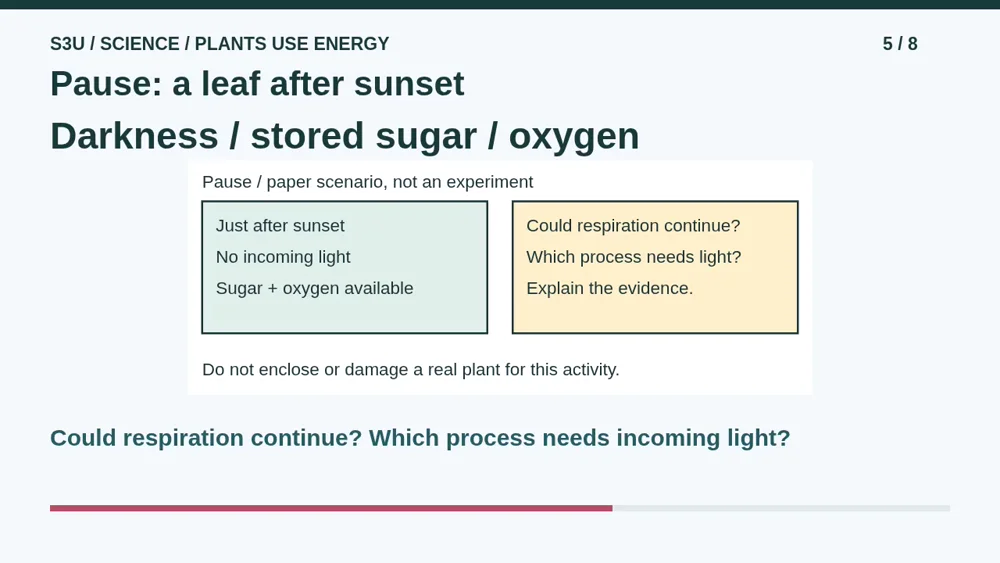
Imagine a healthy leaf just after sunset with stored sugar and available oxygen. No light is reaching it in this example. Pause and explain whether aerobic cellular respiration could continue. Which process cannot keep using incoming light when that light is absent? Say what evidence supports your answer. This is a paper thought experiment; do not shut a plant in a container or damage one to test the idea.
6. Darkness is not a stop-all switch
Video: 2:46
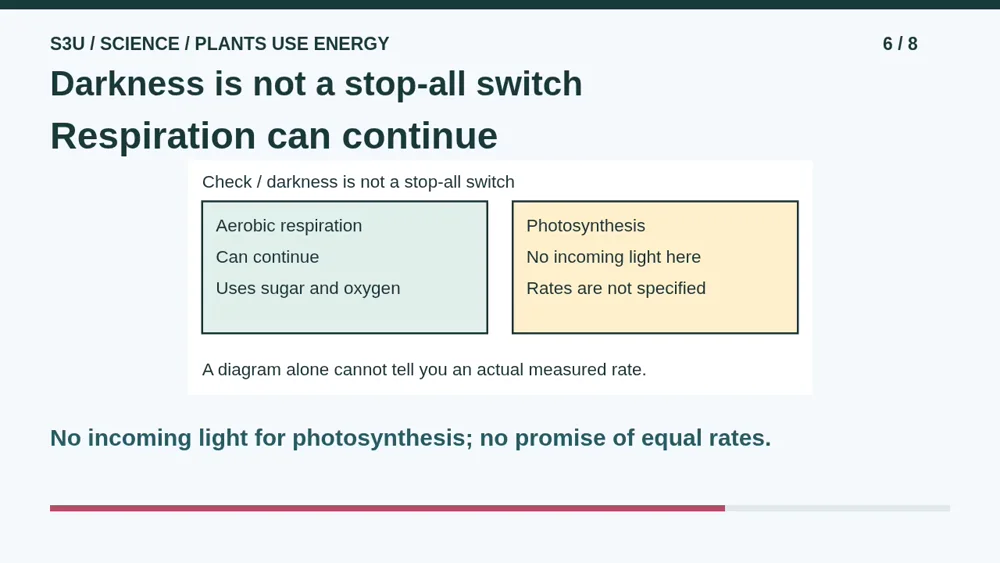
Aerobic respiration can continue using stored sugar and oxygen in this example. With no incoming light, the leaf cannot keep carrying out light-powered photosynthesis. That does not mean all cellular chemistry stops. Nor does our diagram say the two processes have equal rates during the day. To compare actual rates, we would need measurements and conditions, not just matching words on two arrows.
7. Green cells also have mitochondria
Video: 3:17
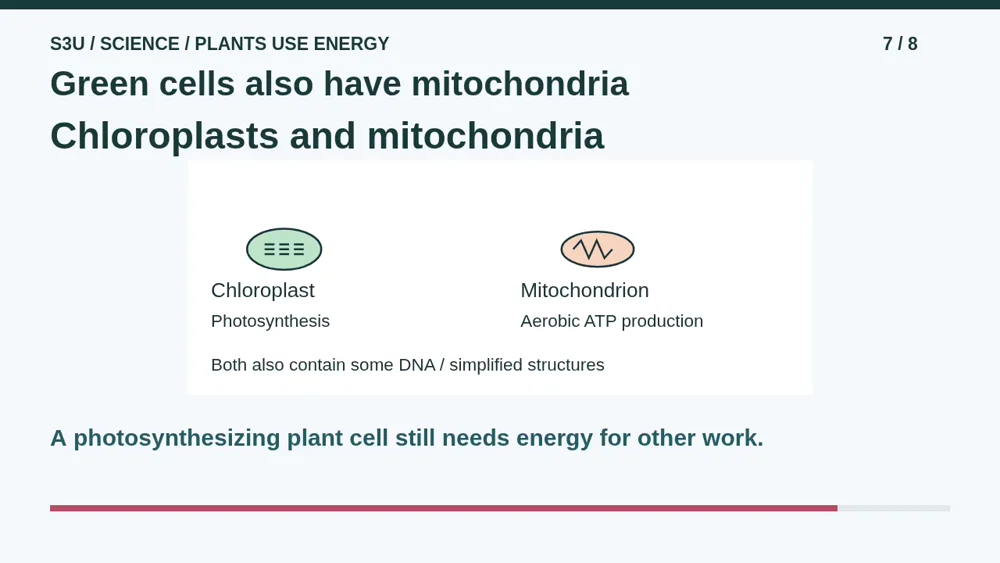
Fun fact: a photosynthesizing plant cell can contain both chloroplasts and mitochondria. Making sugars does not remove the need to transfer energy for cell work. The green parts are not an excuse to retire the mitochondria. Remember the limit too: not every plant cell photosynthesizes. Our labeled green leaf example helps us compare jobs without claiming that every cell looks or works exactly alike.
8. Continue to the process worksheet
Video: 3:49
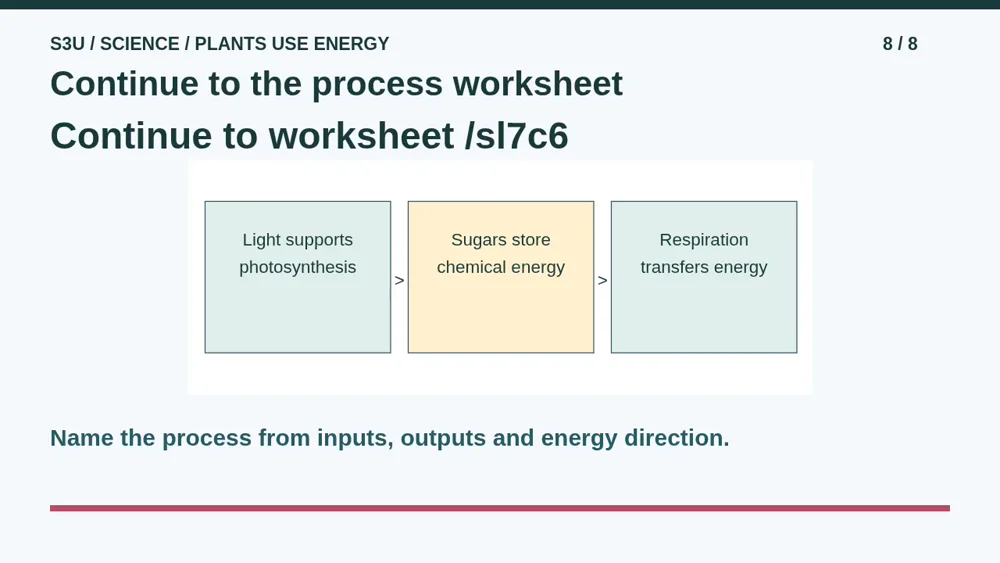
Continue to the worksheet below. Read each description, identify the process, and explain the input or output that helped you decide. Practice Two includes a darkness question and a different diagram description. You can draw two labeled arrows or give a spoken explanation. Use these models, not private health information or a real experiment. Keep the two processes distinct while explaining how they connect in a living plant.
Show your understanding
You can point, explain aloud, draw or write.
- Distinguish photosynthesis from aerobic respiration using their stated inputs, outputs and energy transfers.
- Explain why a leaf with stored sugar and available oxygen can continue respiration after sunset without claiming equal process rates.
Try it yourself
Pause at the leaf just after sunset. Explain which process can continue using stored sugar and oxygen, and which needs incoming light.
Continue to the worksheet and Practice Two. Follow the inputs and outputs instead of guessing from one shared word. This is a paper model, not an experiment.
Next: your worksheet
Compare Photosynthesis and Cellular Respiration - Practice 1https://s3u.com/sl7c6
Lesson: https://s3u.com/lessons/plants-use-energy