Math / Grade 7
Keep both sides equal
Learning goal: Solve two-step equations with reversible operations on both sides, then check by substitution.
Before you start: Multiply and divide signed numbers, read 3x as three times x and substitute a number into a short expression.
Read or print this lesson What to practiceThe video could not load. The transcript is still available below.
Next: your worksheet
Undo a Two-Step Equation - Practice 1
Checking sign-in...
Read the transcript
Saved reading place
Video transcript and practice. Reading or printing does not count as playback time or an assessed grade.
1. An equation makes a promise
Video: 0:00
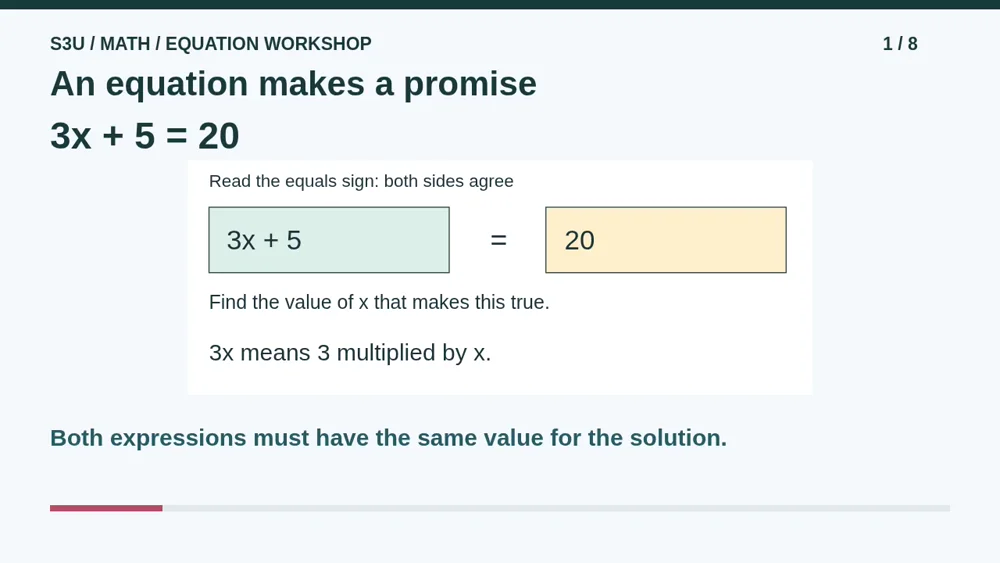
An equation says that two expressions have the same value. Here, three times an unknown number, plus five, equals twenty. We want the number that makes this true. The equals sign is not an instruction to write the next random thing. It is a promise: these two sides agree. Our boxes represent expressions, not a physical weighing experiment.
2. Undo the added five on both sides
Video: 0:27
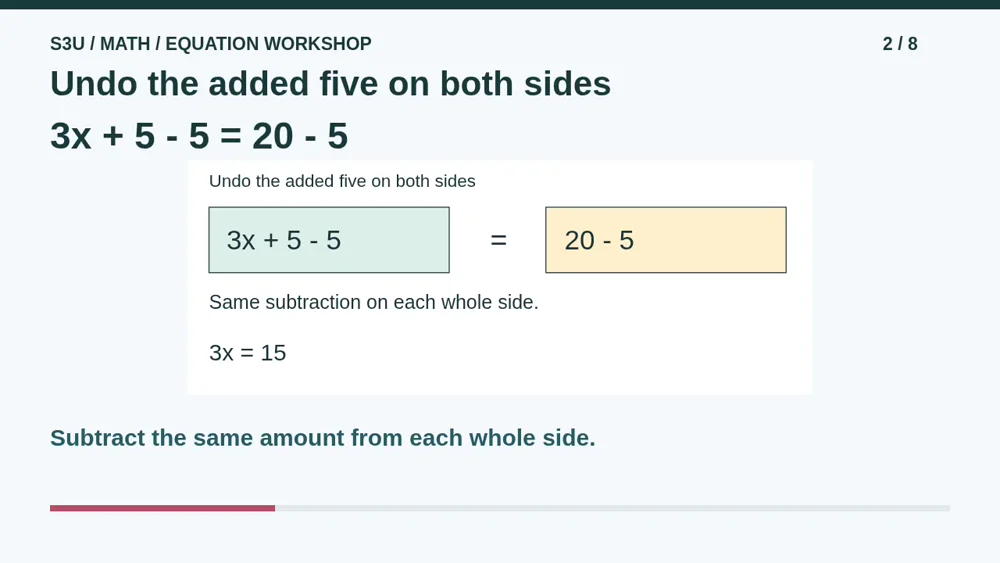
The left side first multiplies the unknown by three, then adds five. A convenient way back is to undo the added five. Subtract five from each whole side. On the left, plus five and minus five cancel, leaving three times x. On the right, twenty minus five is fifteen. Subtracting only on the left would break our equality promise.
3. Share both sides into three equal parts
Video: 0:54
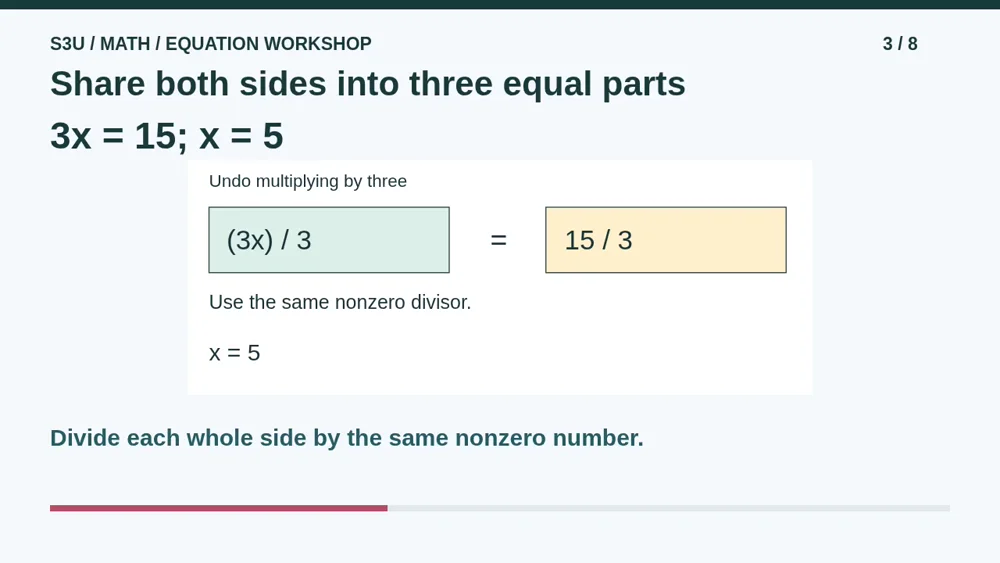
Now three times x equals fifteen. Divide each whole side by three, which is not zero. Three equal copies of x become one copy. Fifteen divided by three is five, so x equals five. We did not divide just one term and forget the others. Other valid routes can work too; the important rule is preserving equality, not memorizing a magic crossing-the-sign trick.
4. Put the answer back to check
Video: 1:24
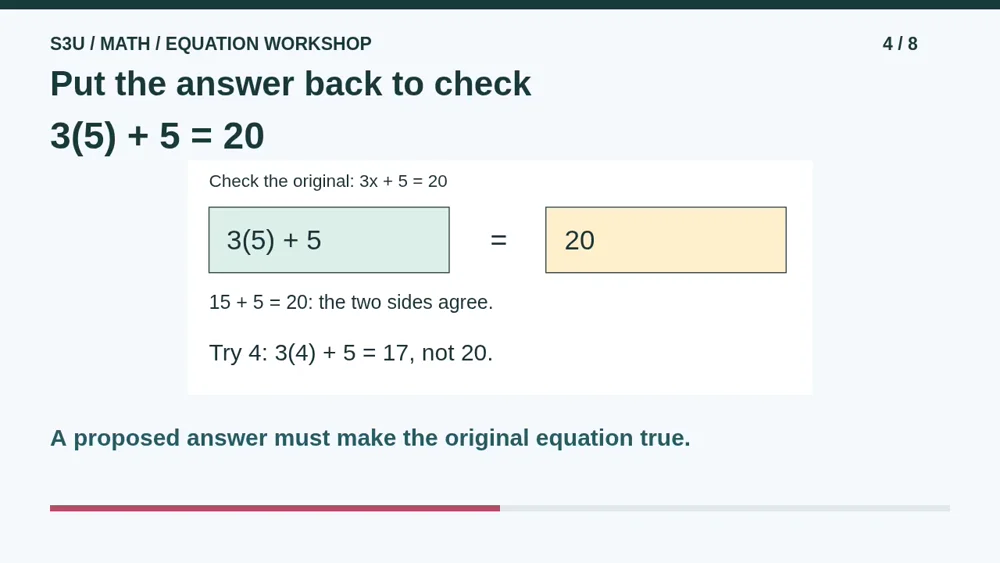
Check the original equation, not only the final line. Replace x with five. Three times five is fifteen, and fifteen plus five is twenty. The right side was twenty too. It works. If someone suggests four, three times four plus five gives seventeen, not twenty. Four does not work here. The equation is a very patient answer checker; it never gets bored of substitution.
5. Pause: keep the negative signs
Video: 1:56
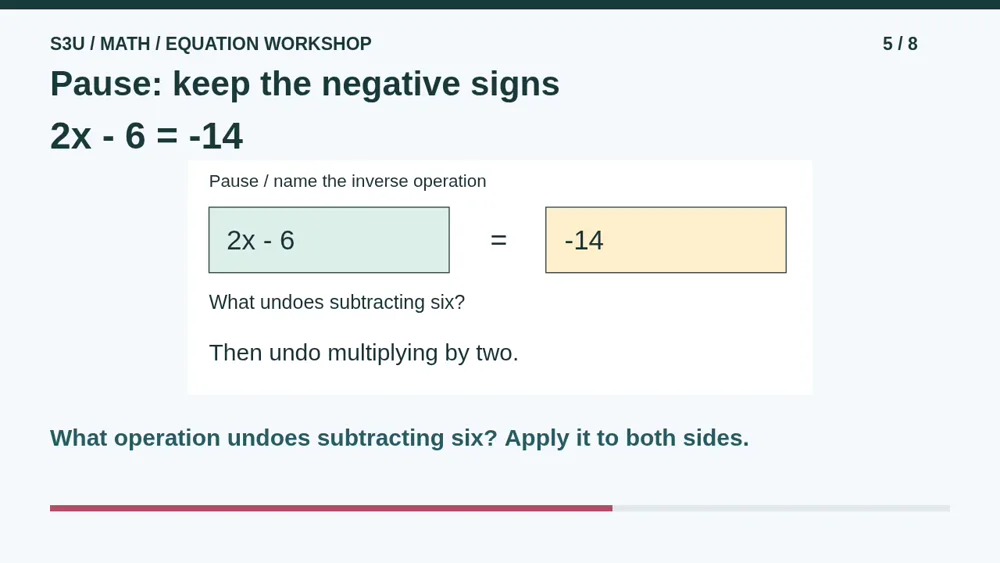
Try a new equation: two times x minus six equals negative fourteen. Pause before seeing the next chapter. What operation undoes subtracting six? Apply that operation to both sides, then undo multiplying by two. Write each new equation and check your proposed value in the original. Negative numbers are allowed. Do not turn negative fourteen into positive fourteen just because a positive number feels friendlier.
6. Check the negative solution
Video: 2:30
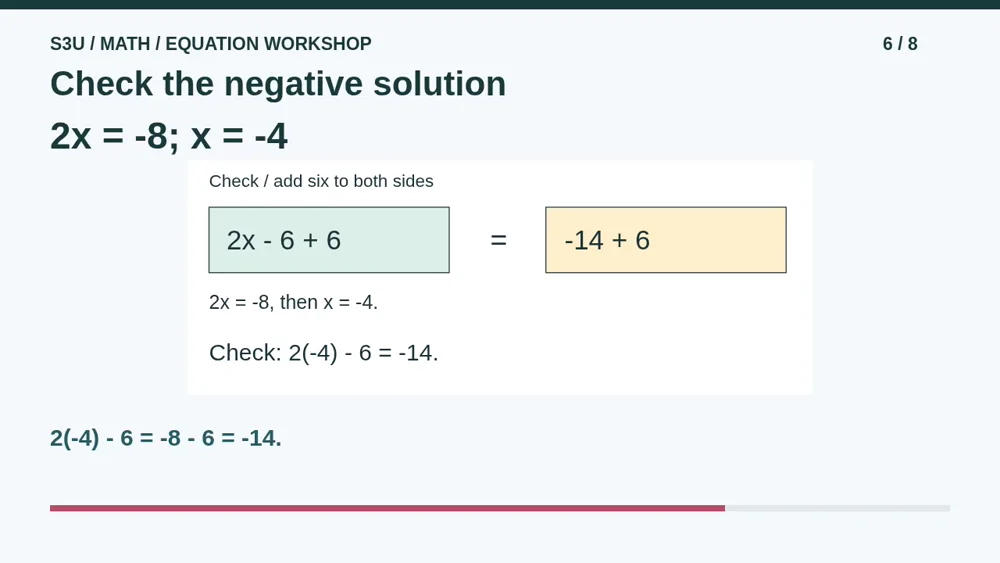
Add six to both sides. Negative fourteen plus six is negative eight, so two times x equals negative eight. Divide both sides by two and x equals negative four. Check: two times negative four is negative eight, then subtracting six gives negative fourteen. That matches. Subtracting another six would not undo the original subtraction. Name the inverse operation before moving any numbers.
7. Different-looking equations can agree
Video: 3:03
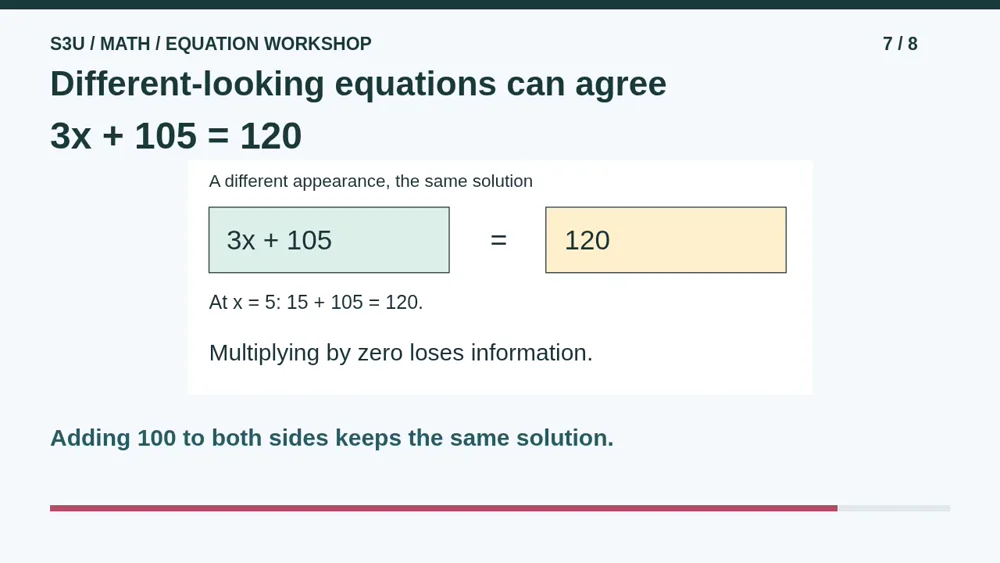
Fun fact: adding one hundred to both sides of our first equation produces three times x plus one hundred five equals one hundred twenty. It looks bigger, but the solution is still five. Reversible operations preserve the solution. Multiplying both sides by zero instead gives zero equals zero and loses the information about x. Never divide by zero. Same-looking steps do not always preserve everything you need.
8. Continue to the equation worksheet
Video: 3:37
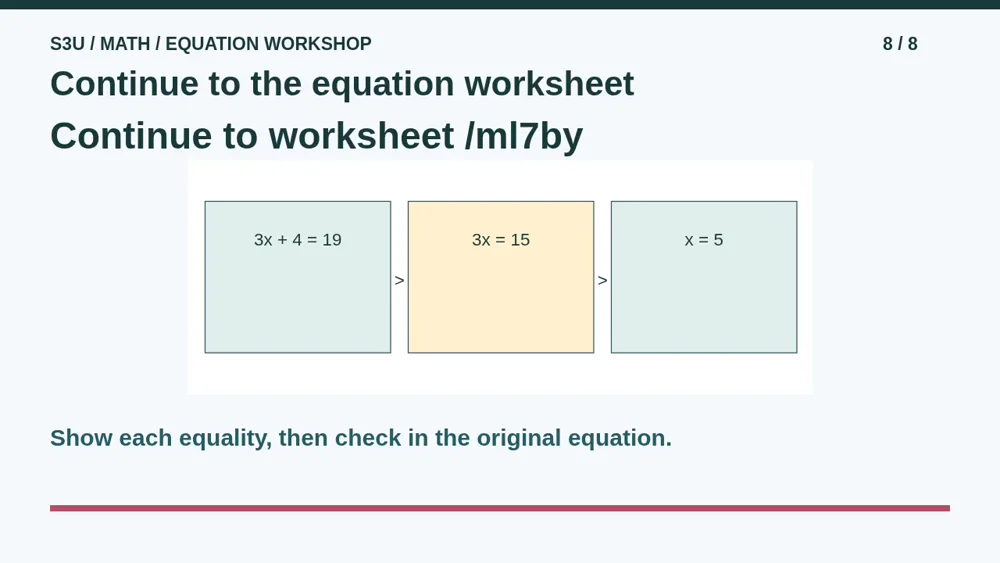
Continue to the worksheet below. Its numbers are different, but the reasoning is the same: choose an operation, apply it to both whole sides, and check your answer in the original equation. Practice Two gives another set, including positive solutions. You can write, say, or point through your explanation. These examples begin a larger algebra sequence; they do not cover every possible kind of equation.
Show your understanding
You can point, explain aloud, draw or write.
- Solve a two-step equation by applying a reversible operation to both whole sides.
- Check a positive or negative proposed solution in the original equation and explain why division by zero is not allowed.
Try it yourself
Pause at 2x - 6 = -14. Name the inverse operations and apply each to both whole sides before checking the original.
Continue to the equation worksheet and Practice Two. Show or say each equality; negative solutions are allowed.
Next: your worksheet
Undo a Two-Step Equation - Practice 1https://s3u.com/ml7by
Lesson: https://s3u.com/lessons/keep-equations-equal