Math / Grades 2-3
Inside and around: area and perimeter
Learning goal: Count unit squares inside a rectangle, trace its outside edges, and compare equal-area and equal-perimeter designs.
Before you start: Count equal rows and add small whole numbers. Use Equal groups first when needed. All squares use the same unit size; a helper can read the directions.
Read or print this lesson What to practiceThe video could not load. The transcript is still available below.
Next: your worksheet
Cover a Rectangle with Unit Squares - Practice 1
Checking sign-in...
Read the transcript
Saved reading place
Video transcript and practice. Reading or printing does not count as playback time or an assessed grade.
1. Inside or around?
Video: 0:00
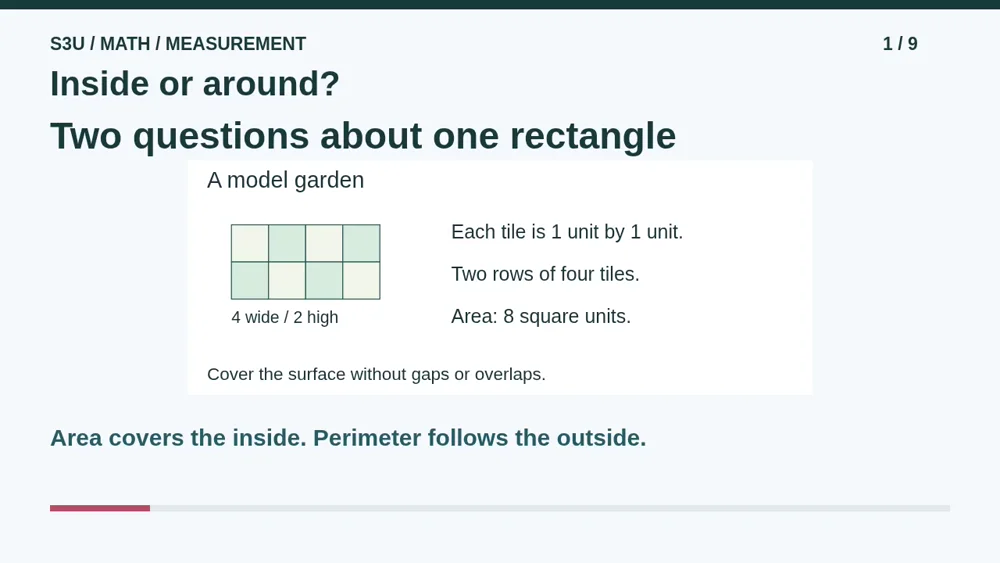
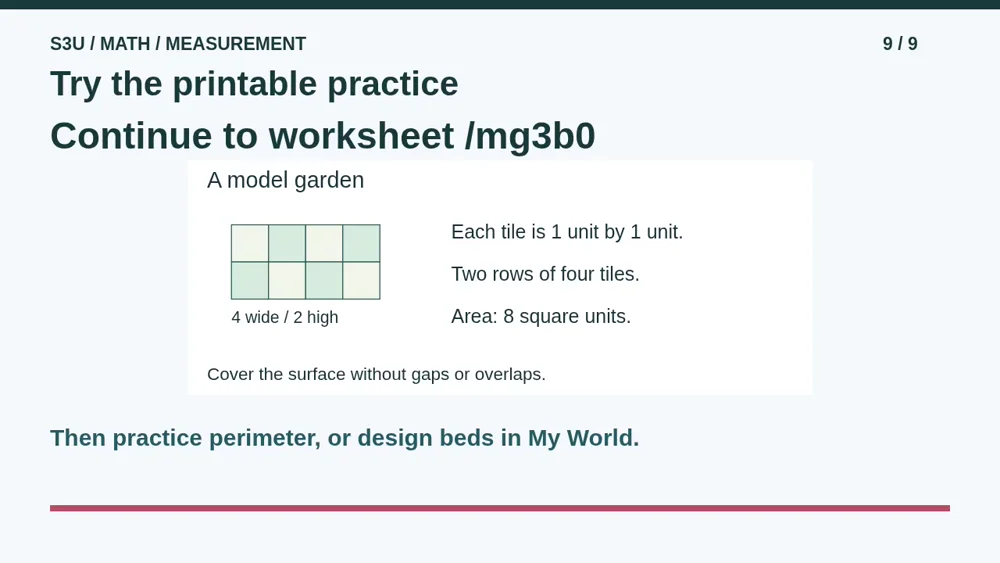
Imagine a tiny model garden. We want tiles to cover its inside and a fence to go around its outside. Those are two different jobs. The tile crew cannot build the fence by counting planting spaces. Let us help them sort it out. Our rectangle is four units wide and two units high. Each small square has sides one unit long.
2. Cover the inside with squares
Video: 0:27
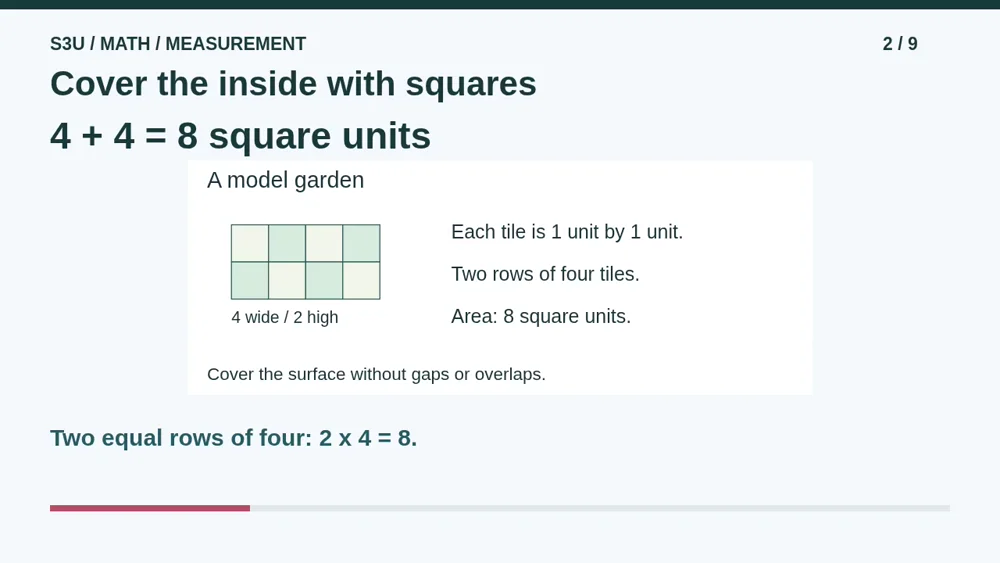
Count the inside squares. There are four in the top row and four in the bottom row. Four plus four is eight. Two rows of four also means two times four. The area is eight square units. We use square units because we are covering a surface with squares, with no gaps or overlaps. We are not counting the length of a fence.
3. Follow only the outside edge
Video: 0:53
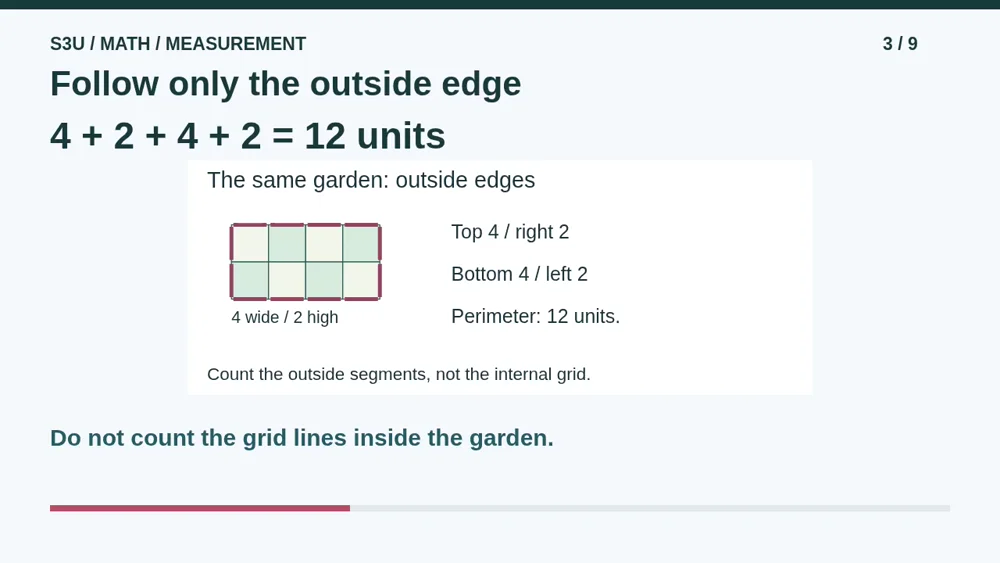
Now trace the outside. The top is four units long. The right side is two. The bottom is four, and the left side is two. Four plus two plus four plus two is twelve. The perimeter is twelve units. Each short fence segment is one unit long. Do not count the lines between inside squares. They are not on the outside boundary.
4. Same fence, different space
Video: 1:21
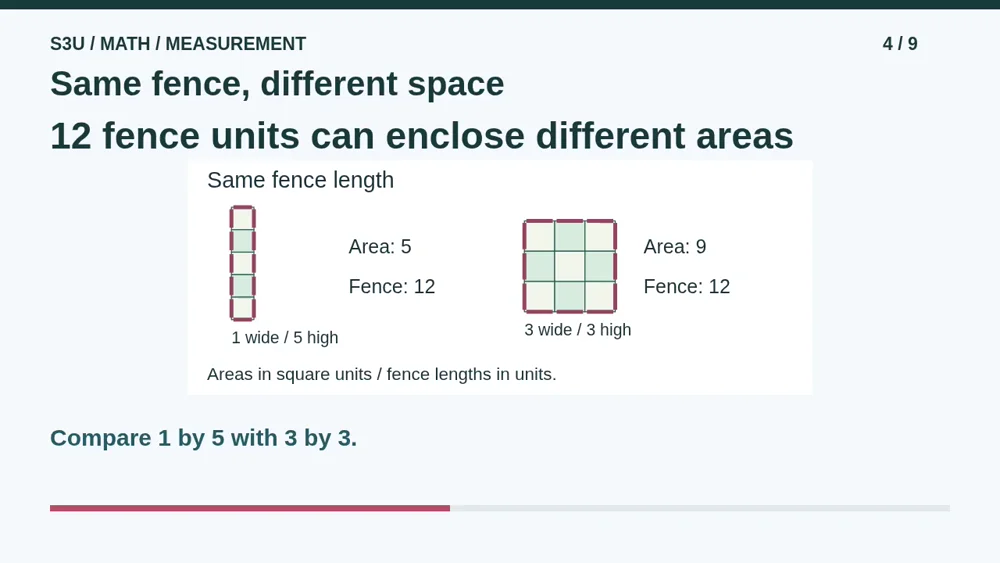
Look at two new designs. A rectangle one unit wide and five high has perimeter twelve and area five. A three by three square also has perimeter twelve, but its area is nine. Yes, a square is a rectangle too: it has four right angles. The same fence length does not always cover the same amount of space. The fence crew may need to talk to the tile crew!
5. Pause: a new garden
Video: 1:49
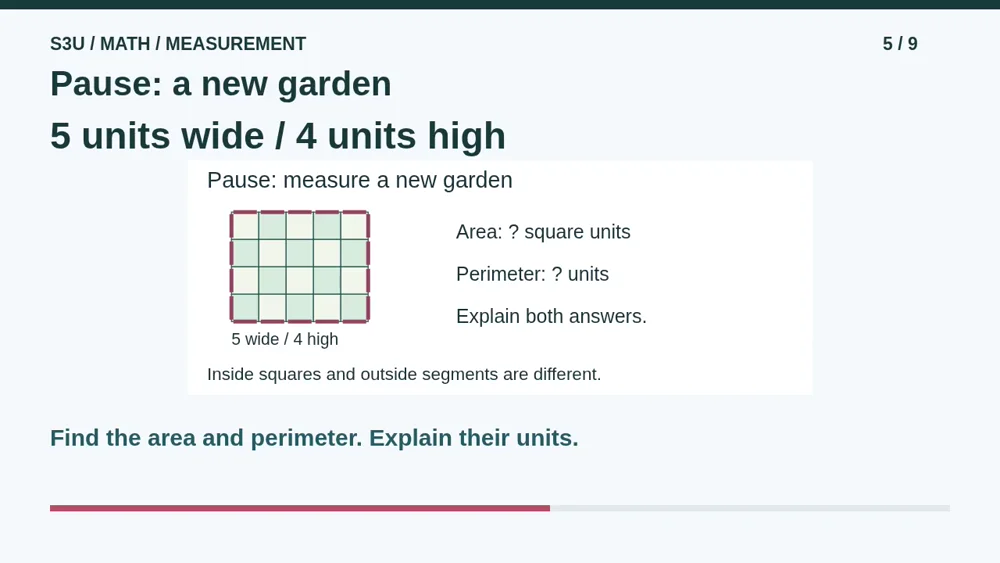
Pause for a new garden. It is five units wide and four units high. How many square tiles cover the inside? How many unit fence segments go around the outside? Count rows for one answer and all four outside edges for the other. Say which answer is the area and which is the perimeter. Write the units as well as the numbers before continuing.
6. Check both measurements
Video: 2:17
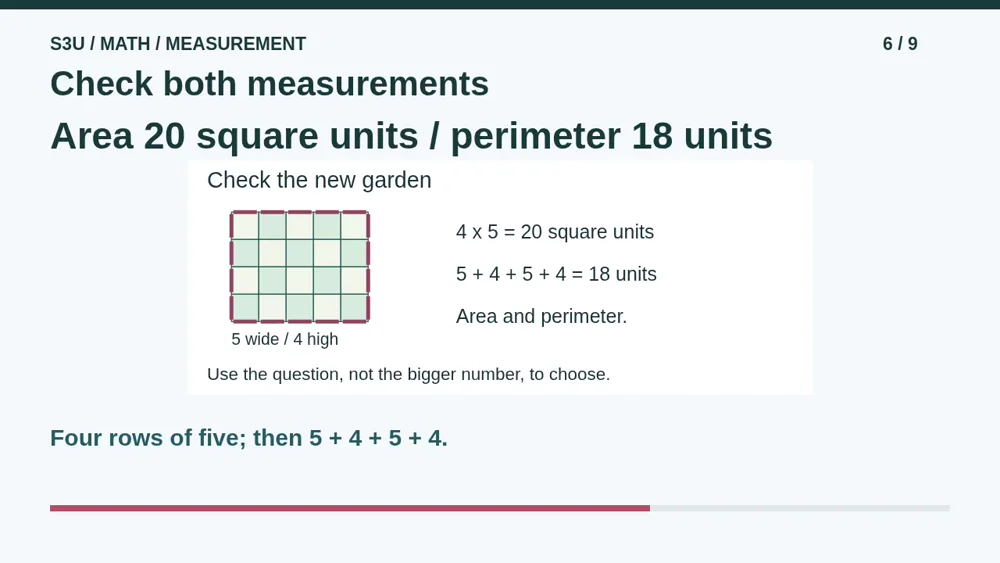
Four rows of five tiles cover twenty square units. That is the area. The outside edges measure five, four, five, and four units. Their sum is eighteen units. That is the perimeter. Twenty and eighteen answer different questions. The larger number is not the way to decide which measurement you need. Ask whether you are covering the inside or measuring the outside boundary.
7. Same space, different fence
Video: 2:48
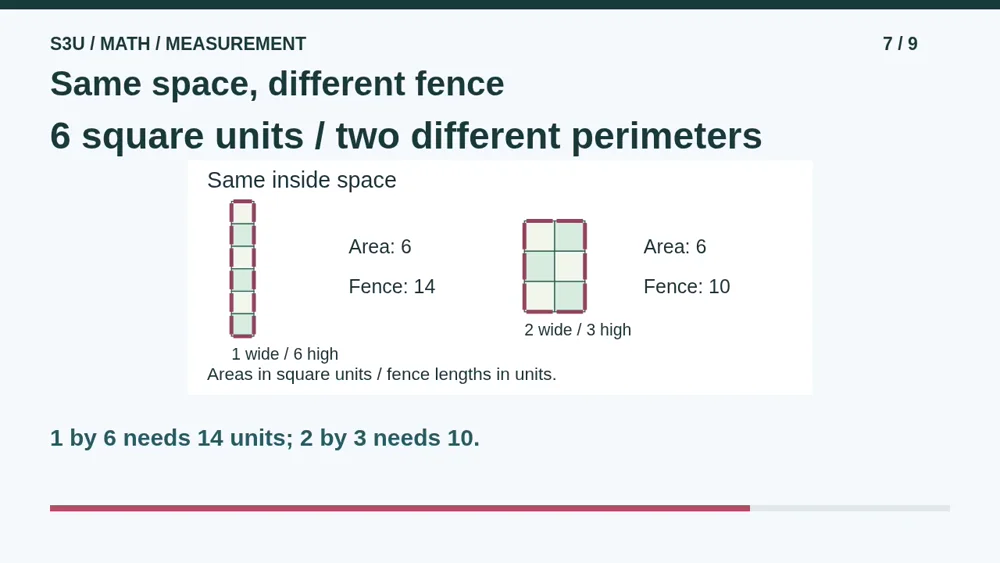
We can also keep the area the same and change the perimeter. A one by six rectangle covers six square units. Its perimeter is fourteen units. A two by three rectangle also covers six square units, but its perimeter is ten. Both have room for six tiles. One needs a longer fence. Equal area does not promise equal perimeter. These are flat models, not instructions for building a real fence.
8. Fun fact: give it a turn
Video: 3:21
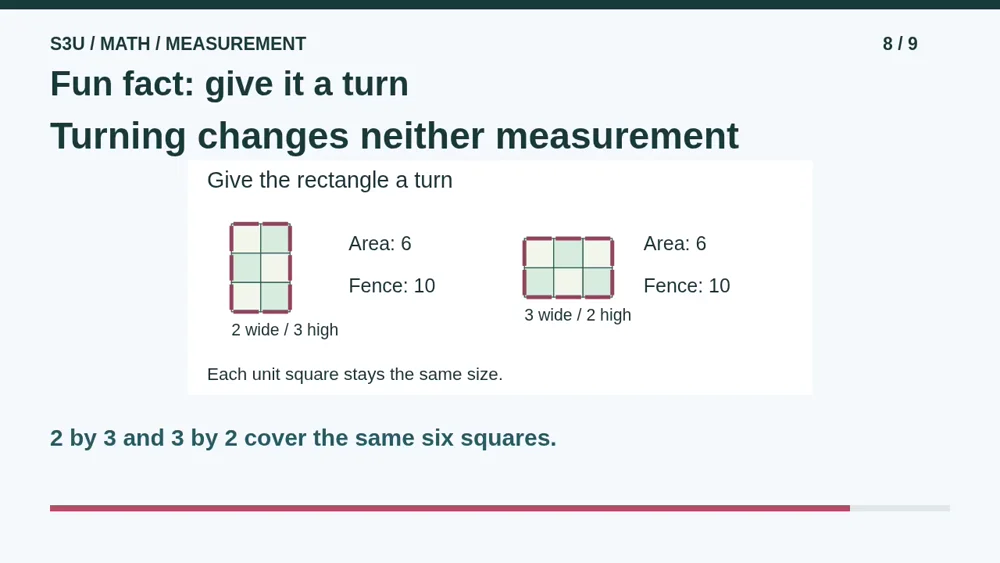
Fun fact: turning a rectangle does not add tiles or stretch its outside edge. Turn our two by three rectangle on its side. It becomes three wide and two high. Both arrangements cover six square units and have perimeter ten units. The rows and columns traded jobs, but nothing was added or removed. Keep the same unit size when making your comparison.
9. Try the printable practice
Video: 3:49
Continue to the area worksheet below. Read its own side lengths and count equal rows. There is another area form for later practice, and two perimeter worksheets for tracing the outside. Explain which units belong with each answer. Then try Design the garden beds in My World. You can change the model shapes and compare their measurements. Hints and worked examples are there to help you learn.
Show your understanding
You can point, explain aloud, draw or write.
- Count unit squares for rectangle area and all four outside edges for perimeter, keeping square units separate from length units.
- Use fresh labeled rectangles to explain why equal perimeter need not give equal area, equal area need not give equal perimeter, and turning preserves both.
Try it yourself
Pause at the five-by-four garden. Find its area and perimeter, and explain why the units differ.
Continue to the area and perimeter worksheets, then try Design the garden beds in My World. Count inside squares separately from outside segments.
Next: your worksheet
Cover a Rectangle with Unit Squares - Practice 1https://s3u.com/mg3b0
Area: Practice 2 · Perimeter: Practice 1 · Perimeter: Practice 2
Design garden beds in My World · Explore Measuring Studio
Lesson: https://s3u.com/lessons/inside-and-around