Science / Grade 7
Follow the heat-transfer path
Learning goal: Distinguish conduction, convection and radiation using the stated mechanism, then repair three mixed-up museum labels.
Before you start: Distinguish a solid, liquid and gas and follow a labeled direction arrow. Vacuum means a gap without material.
Read or print this lesson What to practiceThe video could not load. The transcript is still available below.
Next: your worksheet
Identify the Described Heat-Transfer Mechanism - Practice 1
Checking sign-in...
Read the transcript
Saved reading place
Video transcript and practice. Reading or printing does not count as playback time or an assessed grade.
1. Follow the energy path
Video: 0:00
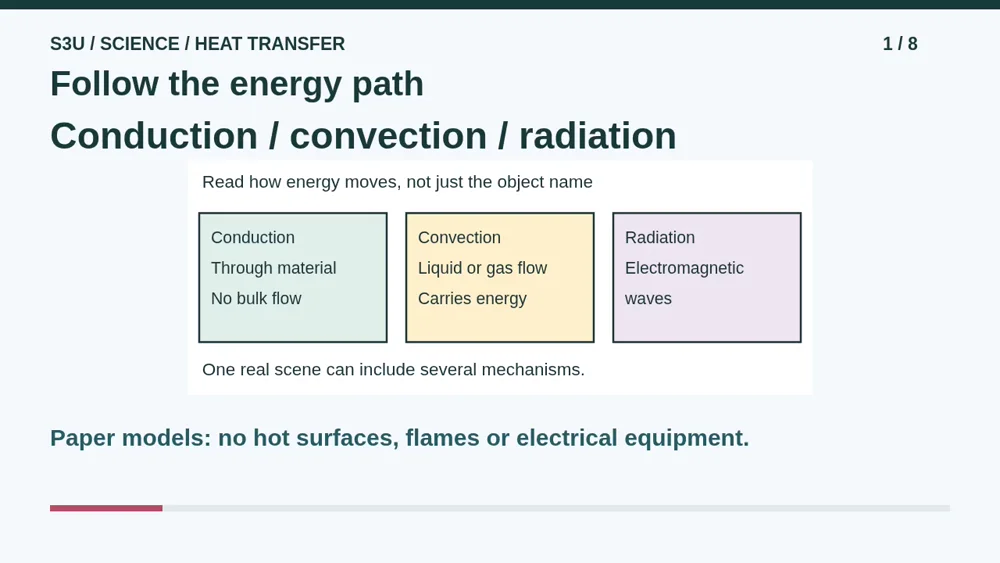
A museum has three heat-transfer diagrams, but its labels have gone on a very unhelpful holiday. We can put them back by following how energy moves. The three names are conduction, convection, and radiation. They describe mechanisms, not three different substances called heat. We will use paper models only. Do not heat a rod, touch a hot object, or set up a flame to copy these pictures.
2. Through material without bulk flow
Video: 0:31
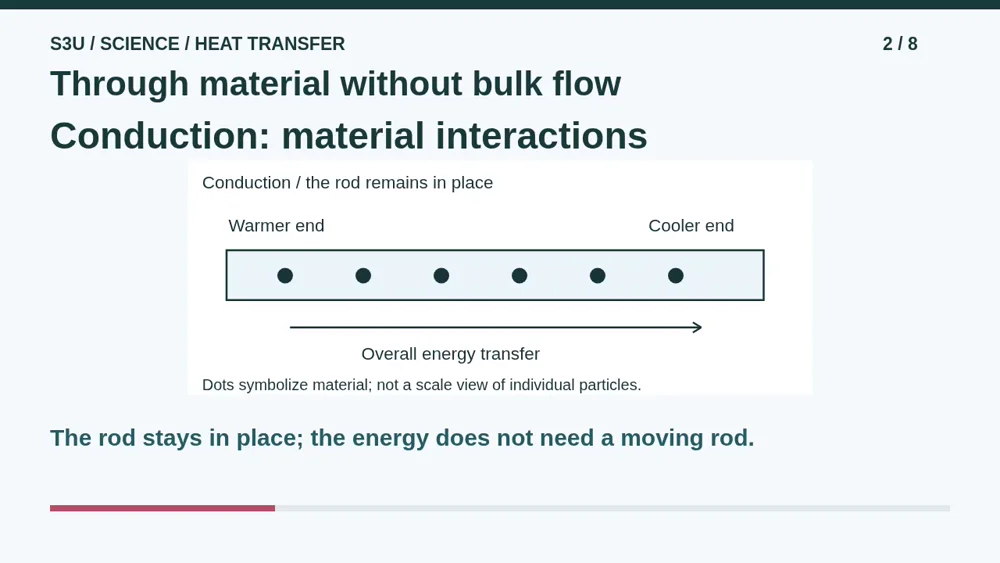
In the first picture, one end of a stationary rod is warmer than the other. Energy transfers through the material by microscopic interactions. The whole rod does not travel across the table. That described path is conduction. Do not decide from the word metal alone: read what the question says is happening. Our arrow shows the overall transfer from warmer to cooler, not a trail of colored liquid inside the rod.
3. Moving fluid carries energy
Video: 1:03
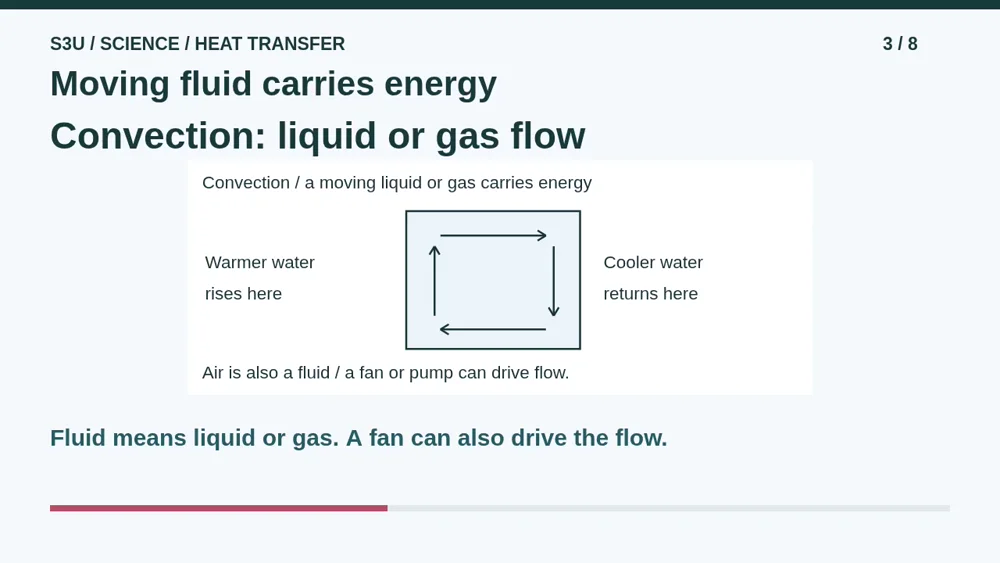
In the second picture, warmer water moves upward and cooler water returns downward in a loop. The moving fluid carries energy. That is convection. In physics, a fluid can be a liquid or a gas, so circulating air can also carry energy this way. The loop here illustrates natural circulation. A fan or pump can drive flow too. Heat does not always go upward; the mechanism depends on the path being described.
4. Waves can cross an empty gap
Video: 1:36
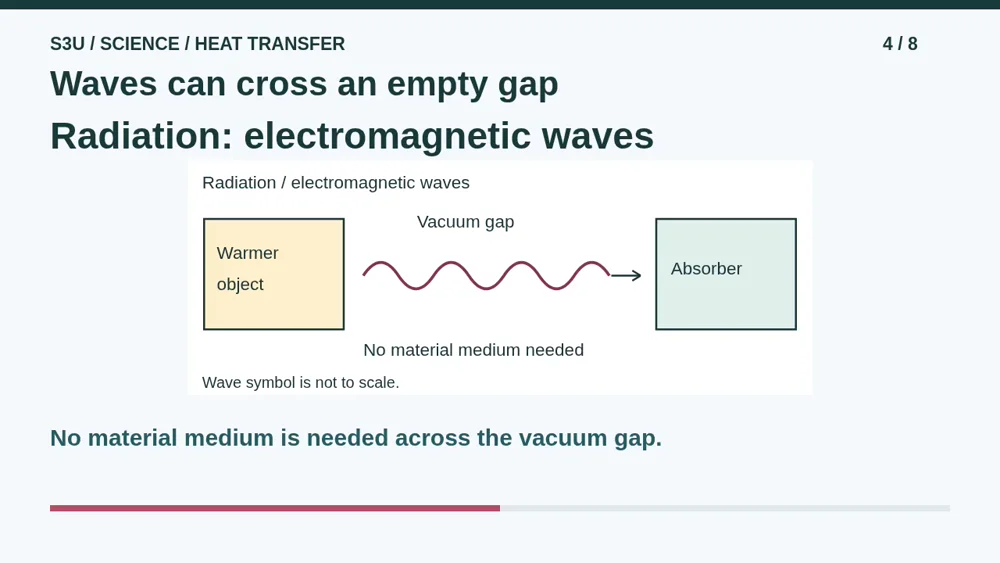
The third picture shows electromagnetic waves crossing a vacuum gap, with no material filling that gap. That path is radiation. A wave does not need a stream of warm air to carry it across space. Sunlight reaches Earth this way, not by conduction through an air bridge all the way from the Sun. The drawing is a model of the path. Its curved lines are symbols, not waves drawn to scale.
5. Pause: return the three labels
Video: 2:06
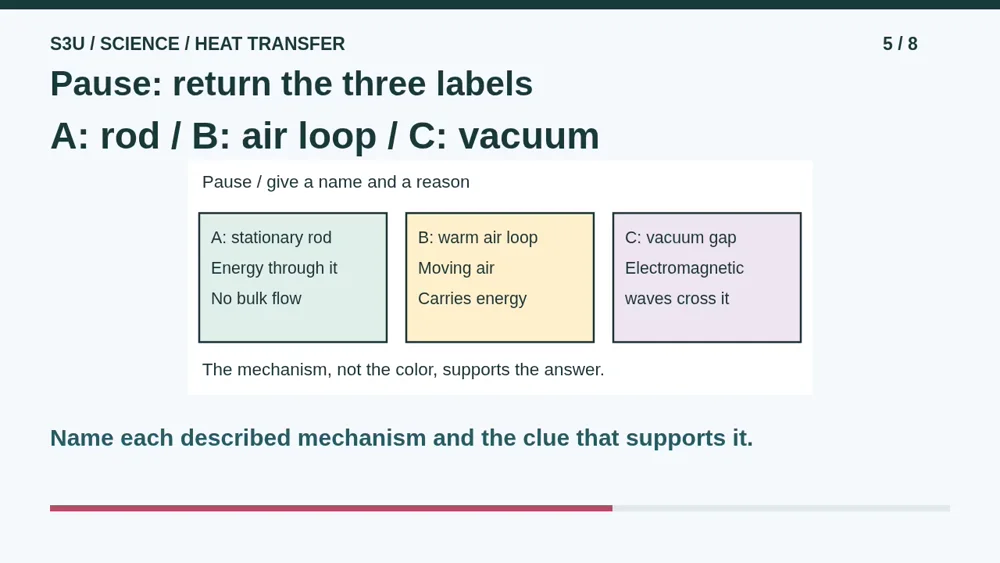
Pause and return the museum labels. A says energy passes along a stationary solid without bulk flow. B says circulating warm air carries energy around a room. C says electromagnetic waves carry energy across an evacuated gap. Name each mechanism and explain the decisive clue. Do not use position or color as your reason. The museum will rearrange its signs tomorrow, and your explanation should still work.
6. Check the clues, not a single word
Video: 2:40
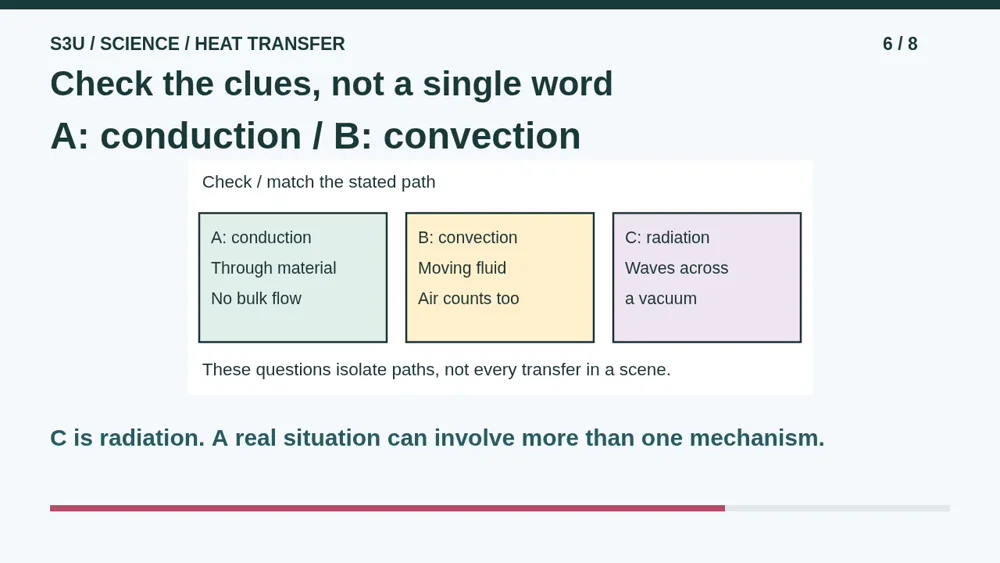
A is conduction: energy passes through material without its bulk flow. B is convection: moving air carries energy, and air is a fluid. C is radiation: electromagnetic waves cross the vacuum gap. A real warm object can transfer energy in several ways at once. Our questions isolate one described path. Seeing a solid nearby does not prove every transfer in the whole scene must be conduction.
7. No visible glow is required
Video: 3:13
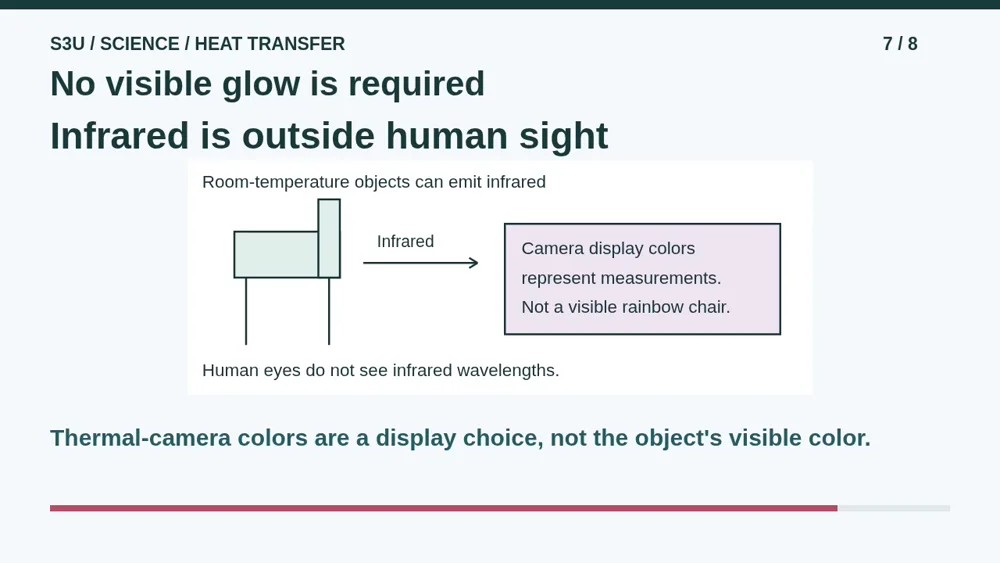
Fun fact: ordinary room-temperature objects emit infrared radiation even when they do not visibly glow. Human eyes cannot see those infrared wavelengths. An infrared camera can turn measurements into a visible display, often using added colors. That does not mean the object actually changed to rainbow colors. Radiation is not reserved for dramatic glowing objects; a quiet, unglamorous chair can join in without asking for a spotlight.
8. Continue to the transfer worksheet
Video: 3:48
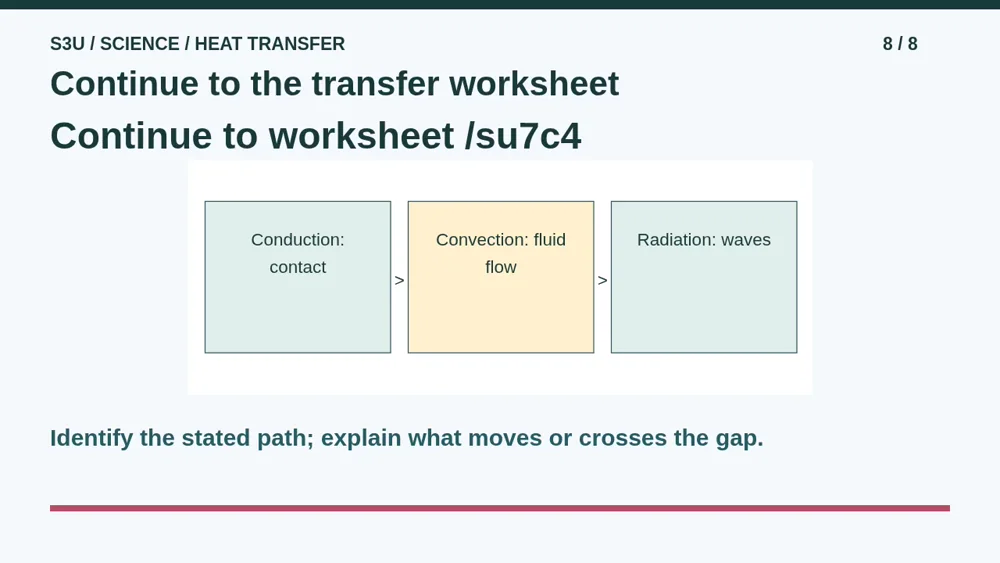
Continue to the worksheet below and read each described path. Ask whether energy passes through material without bulk flow, travels with a moving fluid, or crosses as electromagnetic waves. Then explain the clue rather than memorizing one object for each word. Practice Two changes the examples. You can speak your explanation or use the printable page. No equipment, personal measurements, or upload is needed for this investigation.
Show your understanding
You can point, explain aloud, draw or write.
- Identify conduction, convection or radiation from the stated energy-transfer mechanism and explain the clue.
- Explain why moving air is a fluid example, radiation can cross a vacuum, and a real scene can contain more than one mechanism.
Try it yourself
Pause at the rod, air loop and vacuum gap. Name each described mechanism and explain the decisive clue.
Continue to the worksheet and Practice Two. One real scene can include several mechanisms; these paper questions isolate a stated path. No heating experiments are required.
Next: your worksheet
Identify the Described Heat-Transfer Mechanism - Practice 1https://s3u.com/su7c4
Lesson: https://s3u.com/lessons/heat-transfer-paths